Key takeaways
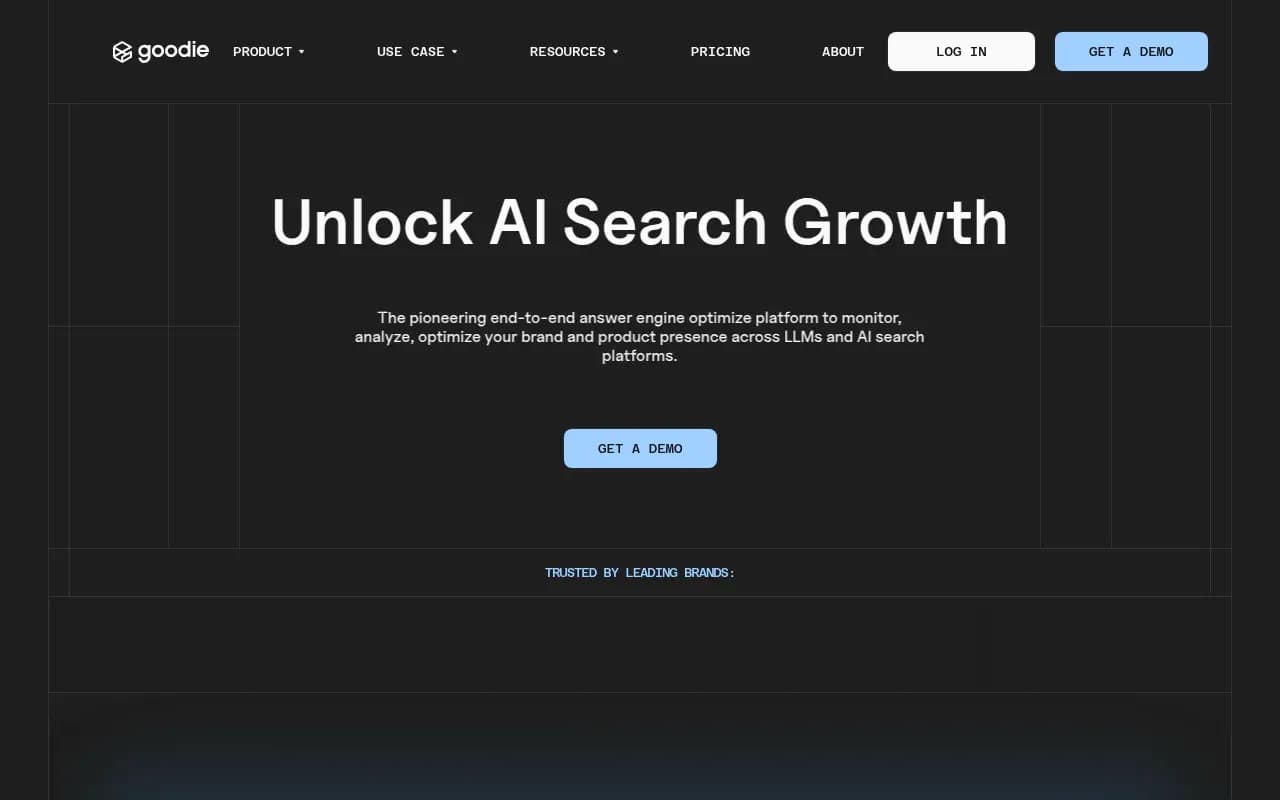
- Goodie AI tracks 11 AI platforms (including Amazon Rufus) but has no free trial, no public pricing, and requires a sales call before you see anything — a real barrier for lean B2B SaaS teams
- Most alternatives fall into two camps: monitoring-only dashboards that show you data, and full-cycle platforms that help you act on it
- The best choice depends on whether you need content generation, revenue attribution, crawler insights, or just a fast way to see where you stand
- Pricing across alternatives ranges from $29/month to $295/month, with several offering free trials or self-serve sign-up
- If you need to move fast and actually fix your AI visibility gaps (not just measure them), tools with built-in content generation are worth the premium
Goodie AI is a genuinely capable platform. It tracks 11 AI engines, including Amazon Rufus — something no other tool in this space currently does. Its AEO Content Writer produces citation-optimized content. On paper, it checks a lot of boxes.
But three things keep coming up when B2B SaaS teams evaluate it:
First, there's no free trial and no self-serve access. You have to book a demo before you see the product. For a category where most buyers want to poke around before committing, that's a significant ask.
Second, pricing is opaque. There's no public pricing page. Third-party estimates put entry somewhere between $199 and $495/month depending on scope — but you won't know until you've already sat through a sales conversation.
Third, setup isn't trivial. One reviewer described needing to "evangelize internally" just to explain why AI visibility mattered before they could justify the onboarding investment. That's a lot of friction before you've seen a single data point.
If your team is moving fast and needs to show results quickly, that process is a problem. Here are five alternatives worth looking at seriously.
What to look for before you switch
Before jumping to alternatives, it's worth being clear about what you actually need. The AI visibility tool market in 2026 has two very different types of products:
Monitoring-only tools show you where your brand appears (or doesn't) in AI-generated answers. They're useful for reporting and competitive benchmarking. Most tools in this space are here.
Full-cycle platforms go further: they identify content gaps, help you create content engineered to get cited, track whether that content is working, and connect visibility to actual traffic and revenue.
For B2B SaaS companies with lean marketing teams, the second type usually delivers more value — because you're not just trying to understand the problem, you're trying to fix it.
With that framing in mind, here's how the main alternatives stack up.
1. Promptwatch — best for teams that want to act, not just monitor
Promptwatch is the option I'd point most B2B SaaS teams toward first, especially if you're tired of dashboards that show you a problem and then leave you alone with it.
The core difference is what happens after you see your visibility data. Most tools stop at "here's where you're not showing up." Promptwatch has an Answer Gap Analysis that shows you exactly which prompts your competitors are getting cited for that you're not — and then a built-in AI writing agent that generates content specifically designed to close those gaps. The content isn't generic SEO filler; it's grounded in 880M+ citations analyzed across real AI responses.
On the monitoring side, it covers 10 AI models: ChatGPT, Perplexity, Claude, Gemini, Google AI Overviews, Google AI Mode, Meta/Llama, DeepSeek, Grok, Mistral, and Copilot. It also has AI crawler logs — real-time visibility into which AI crawlers are hitting your pages, how often, and what errors they're running into. Most competitors don't have this at all.
For B2B SaaS specifically, the prompt intelligence features are useful: volume estimates and difficulty scores for each prompt, plus query fan-outs that show how one search question branches into sub-queries. That helps you prioritize instead of guessing.
Pricing starts at $99/month (Essential: 1 site, 50 prompts, 5 articles), $249/month (Professional: 2 sites, 150 prompts, 15 articles, crawler logs), and $579/month (Business: 5 sites, 350 prompts, 30 articles). Free trial available, no sales call required.

2. Profound — best for enterprise teams that need depth and compliance
Profound has built a strong reputation for rigorous AI visibility tracking. Its standout feature is empirical answer snapshots — it captures exactly what AI engines say in response to specific prompts, with enough detail for compliance-sensitive teams to audit and report on.
It tracks 10+ AI engines and has solid prompt volume research built in. The competitive modeling is detailed. If you're a larger organization that needs to present AI visibility data to a CMO or board, Profound's reporting layer is polished.
The limitation is that it's primarily an analytics platform. There's no content generation, no built-in writing tools, no crawler logs. You'll get excellent data on where you stand, but you'll need to take that data elsewhere to act on it.
Pricing: $99/month (Starter), $399/month (Growth), custom at Enterprise. There's a self-serve option at the lower tiers, which is a meaningful improvement over Goodie's demo-first approach.
Profound

3. Otterly.AI — best for budget-conscious teams that just need to start somewhere
Otterly.AI is the easiest entry point in this category. It's clean, visually intuitive, and you can be up and running in minutes. No sales call, no complex onboarding.
It tracks four AI engines (ChatGPT, Perplexity, Claude, and Google AI Overviews), which covers the engines that matter most for most B2B SaaS buyers. The interface is straightforward enough that a non-technical marketer can navigate it without help.
What it doesn't have: content generation, crawler logs, revenue attribution, or Reddit/YouTube tracking. It's a monitoring tool, full stop. If you need to show leadership a visibility score and track it over time, Otterly works well. If you need to actually improve that score, you'll hit a ceiling quickly.
Starting at $29/month, it's the most accessible option in this list. Several reviewers cite it as the best starting point for teams that are new to AI visibility tracking and want to validate the concept before committing to a more expensive platform.
Otterly.AI

4. Writesonic GEO — best for teams that want AI visibility and content in one place
Writesonic has been a content generation tool for a while, and its GEO layer adds AI visibility tracking on top of an already capable writing platform. The appeal for B2B SaaS teams is consolidation: instead of paying for a monitoring tool and a separate content tool, you get both in one.
The visibility tracking covers major AI engines with prompt and crawler insights. The content workflows let you edit pages, create new content, and fix gaps without switching platforms. For fast-moving teams that are already using Writesonic for content, adding the GEO layer is a natural extension.
The trade-off is depth. The visibility analytics aren't as granular as Profound or Promptwatch, and the content generation, while solid, isn't specifically engineered around citation data the way Promptwatch's is. But for teams that prioritize speed and simplicity over maximum data depth, it's a reasonable choice.
GEO Professional starts around $199/month.

5. Gracker AI — best for lean B2B SaaS teams on a tight budget
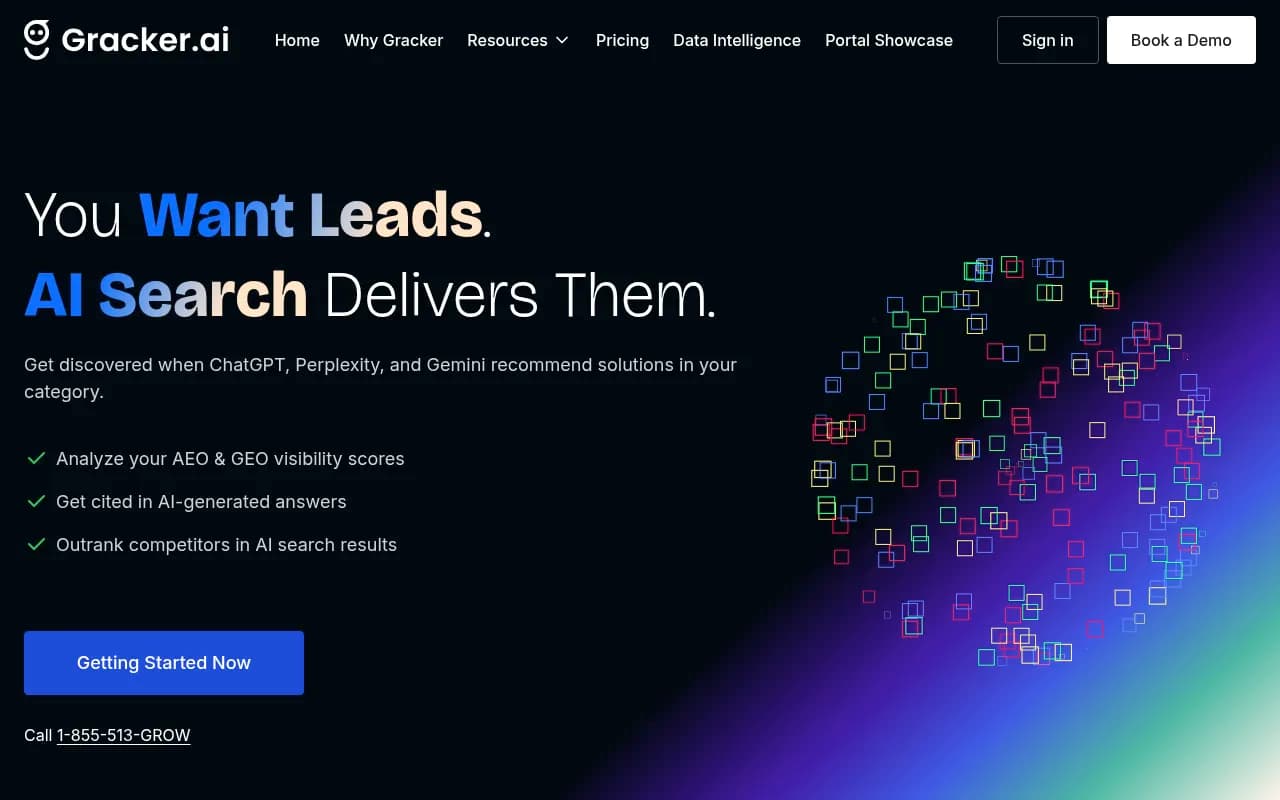
Gracker AI is built specifically for B2B SaaS, which makes it worth mentioning even though it's a smaller player. It tracks five AI engines on the Starter plan (nine on Pro) and has a built-in content engine, which puts it ahead of pure monitoring tools at a lower price point.
The positioning is explicitly for lean teams — smaller marketing orgs that need to move quickly without a lot of setup overhead. The $39/month Starter price is genuinely low for a tool that includes content generation.
The limitations are real: fewer engines tracked than the top-tier platforms, less sophisticated analytics, and a smaller dataset to draw on. But for an early-stage SaaS company that wants to start building AI visibility without a large budget, it's a practical starting point.
Side-by-side comparison
| Tool | Starting price | AI engines tracked | Content generation | Free trial / self-serve | Best for |
|---|---|---|---|---|---|
| Goodie AI | ~$199/mo (estimated) | 11 (incl. Amazon Rufus) | Yes (AEO writer) | No — demo required | Enterprise teams with patience for onboarding |
| Promptwatch | $99/mo | 10 | Yes (AI writing agent) | Yes | Teams that want to find gaps AND fix them |
| Profound | $99/mo | 10+ | No | Yes (lower tiers) | Enterprise analytics and compliance |
| Otterly.AI | $29/mo | 4 | No | Yes | Budget-first teams starting out |
| Writesonic GEO | ~$199/mo | Major engines | Yes | Yes | Teams already using Writesonic for content |
| Gracker AI | $39/mo | 5–9 | Yes | Yes | Lean B2B SaaS teams on tight budgets |
How to choose
The honest answer is that the right tool depends on where you are in your AI visibility journey.
If you're just starting out and want to understand the landscape before committing real budget, Otterly.AI at $29/month is a low-risk way to see what AI visibility tracking actually looks like in practice.
If you're past the "what is this" phase and need to actually improve your visibility — not just measure it — Promptwatch is the most complete option. The combination of gap analysis, content generation grounded in real citation data, and crawler logs gives you a full loop: find the problem, fix it, track the result.
If you're at a larger organization with compliance requirements and a dedicated analytics team, Profound's depth is worth the trade-off of not having content tools built in.
And if you're a lean B2B SaaS team with a small budget, Gracker AI gives you more than most monitoring-only tools at a fraction of the price.
What none of these alternatives match on Goodie's side is Amazon Rufus tracking — if your SaaS product has any e-commerce angle and you specifically need to monitor how you appear in Amazon's AI shopping assistant, Goodie remains the only option in the market for that. For everything else, the alternatives above are faster to get into, more transparent on pricing, and in several cases more capable on the action side of the equation.
The category is moving fast. Whatever tool you pick, the ones that will matter in 12 months are the ones that help you do something with the data — not just look at it.