Key takeaways
- Adobe LLM Optimizer is now sold as Adobe Brand Visibility (formerly Adobe LLM Optimizer). The product page carries that name, and sources disagree on exact dates, so confirm the current packaging with Adobe.
- Adobe fits teams already on Adobe Experience Manager and Adobe Analytics. Its pricing is unpublished, with third-party listings reporting roughly $115K a year. Treat that as unverified.
- Brandlight is an enterprise monitoring platform for large, regulated brands. Pricing is quote-only, and third-party reviewers say you need internal bandwidth to act on its insights.
- Promptwatch is a specialist platform that monitors, writes, publishes, and measures. It has published pricing from $95/month and IP-verified AI crawler logs.
- I found no independent head-to-head benchmark of these three tools. Most comparisons are vendor-written, so weigh them accordingly.
The real question: suite or specialist?
Adobe sells AI visibility as one product inside Experience Cloud. Brandlight and Promptwatch each exist for one job. That framing sounds neat, but it is more useful than it first looks, because it predicts almost everything else: who the buyer is, how long procurement takes, how the data is collected, and whether the tool stops at a dashboard or goes on to fix things.
This guide compares all three on the dimensions that tend to decide the purchase. A caveat first. Much of the public material on Adobe and Brandlight comes from competitors or third-party review sites, and some of it conflicts. I flag those spots rather than smooth them over.
What each tool is
Adobe Brand Visibility (formerly LLM Optimizer)
Adobe's product page now reads "Adobe Brand Visibility (Formerly Adobe LLM Optimizer)." Adobe's June 2026 announcement describes it as LLM Optimizer combined with Semrush's AI Optimization, following Adobe's acquisition of Semrush, which closed April 28, 2026.
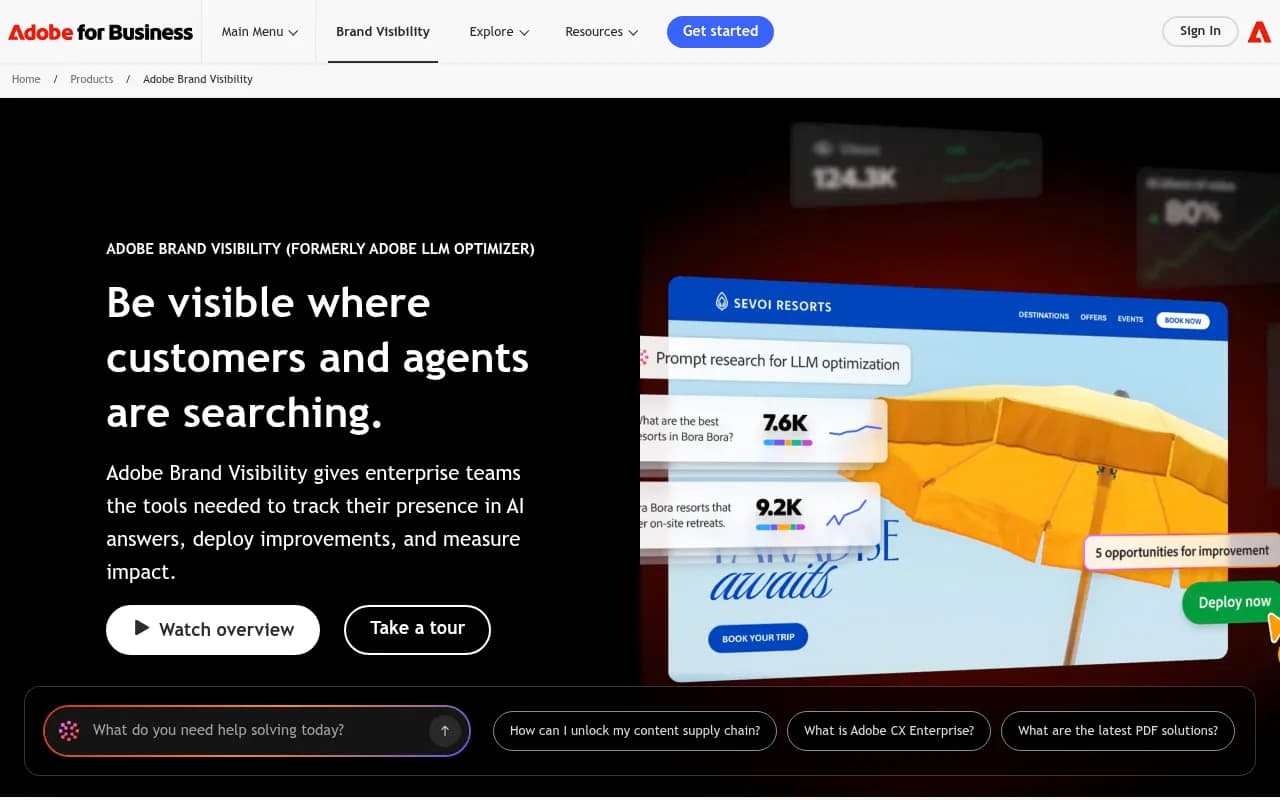
The page describes four jobs: measure brand presence in AI answers, find opportunities, deploy changes at the CDN edge or through AEM Sites, and measure business impact through Adobe Analytics and Customer Journey Analytics.
The dates are messy. One source says Brand Visibility was only previewed on June 17, 2026. Another says the rename took effect August 4, 2026. A third says it replaced LLM Optimizer for new sales from July 31, 2026. The product page now lists it as live, so the older "coming soon" framing is likely stale. Check Adobe's transition page before you sign anything.
Brandlight
Brandlight positions itself as an AI visibility platform for enterprise brands, aimed at Fortune 500 companies. It says it runs thousands of buyer questions natively in every engine, country, and market.
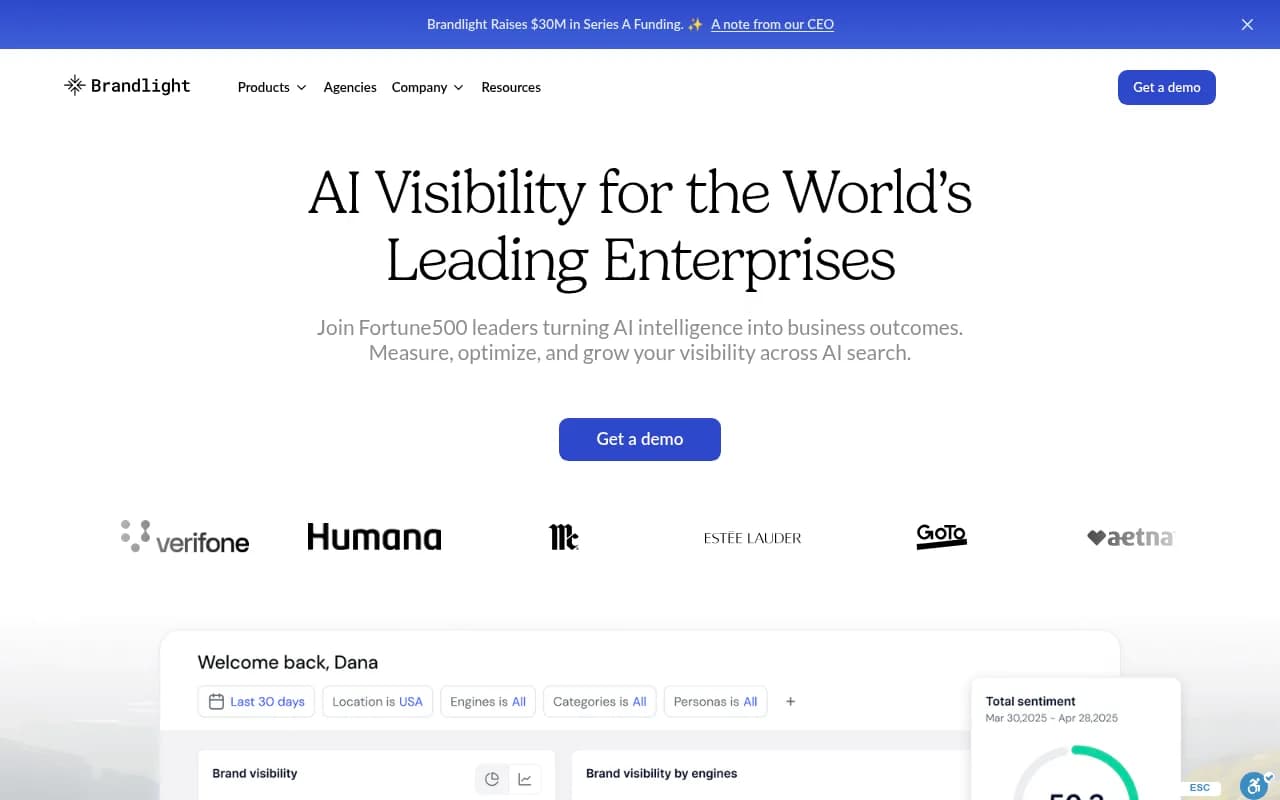
Third-party reviews mention SOC 2 Type II, SSO, role-based access, and multi-brand, multi-market management. Named customers on one review site include Humana, Aetna, The Hartford, and Prudential. Reviewers describe it as monitoring-focused, with recommendations around third-party reviews, structured data, and freshness, but no autonomous content generation. That last point comes from a third-party reviewer, so verify it in a demo.
Promptwatch
Promptwatch is an AI search visibility and GEO platform that covers the whole loop: monitor what ChatGPT, Gemini, Perplexity, Google AI Overviews, Claude, Copilot and others say about you, trace where the answers come from, act on the gaps, and measure the result on your own site.

The action side is what separates it from most trackers. The Content Agent writes and publishes pages to WordPress, Webflow, or Framer, and the Action Board prioritizes what to do next. IP-verified crawler logs and visitor analytics then show whether AI bots read the page and whether it sent traffic.
Head-to-head comparison
| Dimension | Adobe Brand Visibility | Brandlight | Promptwatch |
|---|---|---|---|
| Category | Module in an enterprise experience suite | Enterprise monitoring platform | End-to-end AI visibility and GEO platform |
| Pricing | Unpublished; third-party listings report ~$115K/yr (unverified) | Quote only; no public pricing page | $95 / $245 / $579 per month, plus agency plans and custom Enterprise |
| Pricing model | Metered by prompts per year, per reported listings | Custom | Tiered by prompts, responses, and projects |
| Engines tracked | ChatGPT, Google AI Mode, Copilot, Perplexity; Gemini planned per one source; Adobe's page claims 10 LLM families | Reported 5, including Copilot and Grok | ChatGPT, Gemini, Perplexity, Claude, AI Overviews, AI Mode, Copilot, Meta AI, Alexa and more |
| Data method | Semrush prompt database built on clickstream and panel data (per Profound, a competitor) | Native queries in each engine and market | Real interfaces of the AI platforms, per country and language |
| Crawler visibility | URL Inspector flags pages blocked from AI crawlers; edge deployment | Technical health monitoring incl. server logs, per reviewer | IP-verified crawler logs with crawl-to-citation path |
| Content execution | Recommendations; one-click fixes on AEM; edge deployment | Recommendations only, per reviewer | Content Agent, CMS publishing, Content Refresh |
| Attribution | Native Adobe Analytics and CJA | In development, per one reviewer | Built-in visitor analytics and crawler-to-citation tracking |
| Best for | Adobe-standardized enterprises | Large regulated brands and holding companies | Marketing, SEO, content teams, and agencies that want to act, not just report |
Data: modeled versus captured
This is the most contested point. Profound, a competitor of Adobe, argues that Adobe's prompt layer is built from clickstream and search-panel data rather than captured AI conversations. It also quotes Adobe's own documentation as describing the method as a statistical approximation of answers to selected prompts. Take that with a grain of salt since Profound sells against Adobe, but the source is Adobe's own docs, which is worth a look yourself.
What does it mean in practice? Semrush's database is large (Digital Applied cites 289 million prompts, vendor-stated) and organized by topic cluster. That is good for spotting broad demand patterns across many brands. It is a worse fit when you need to know what a specific buyer persona typed into a specific engine in a specific country.
Promptwatch collects from the real user interfaces rather than relying on APIs, because user-facing answers and citations can differ from API output. That matters more than it sounds: Promptwatch Data found that 47.6% of ChatGPT responses with citations cite 10 or more domains (Sep 28 to Oct 4, 2026), but only 21.3% of brand-specific prompts do. Answers differ a lot by prompt type, so a tool that models averages will miss the shape of your own prompts.
Brandlight says it queries natively, though I could not find methodology detail beyond its own site.
Crawler access: a quiet differentiator
If AI bots cannot reach your pages, nothing else matters. Adobe's URL Inspector flags pages blocked from AI crawlers, and Brandlight reportedly monitors blocked domains and server logs. Promptwatch goes further with real-time, IP-verified logs of crawlers such as GPTBot, ClaudeBot, and PerplexityBot, which filters out spoofed user agents.
The provider mix shifts quickly. Promptwatch's AI crawler traffic report found OpenAI made up 79.8% of verified AI crawler requests in Aug 31 to Sep 6, 2026, down from 94.8% in Jun 8 to 14. If a provider is large in that chart but near zero in your own logs, it probably cannot reach you. That kind of check needs actual logs, not just a flag.
From insight to published content
Here the suite-versus-specialist split shows up clearly.
Adobe's Analyze, Plan, Act, Adapt cycle ends in deployment, and that is real. Edge deployment detects AI agent requests at the CDN layer and serves optimized content, with rollback, and it targets AI agents only, not human visitors. The catch is that the smoothest path, one-click onboarding and auto-optimize, is documented for AEM Cloud Service with managed Fastly. Other stacks need their own CDN routing and allowlisting work. Adobe's own FAQ says Brand Visibility is not only for AEM customers, so you can buy it without AEM, just with more setup.
Brandlight, by third-party accounts, tells you what to change and leaves the work to you. One reviewer's pitfall is blunt: acting on the insights takes internal bandwidth. If you have a content team with spare capacity, fine. If you do not, you will own a dashboard that tells you things.
Promptwatch puts the writing in the product. The Content Agent plans, writes, and publishes against visibility gaps, with a review inbox or fully hands-off mode, and Content Refresh gives diff-style updates for existing pages. Each published document is tracked through crawls, citations, and AI traffic, so underperformers come back as actions. The Content Agent and Agentic AI Search Optimization start on the Business plan.
Pricing and procurement
None of the three is simple to price, but they fail in different ways.
| Adobe | Brandlight | Promptwatch | |
|---|---|---|---|
| Public price | None | None (pricing URL returned 404) | Yes, at promptwatch.com/pricing |
| Reported cost | ~$115K+/yr (third-party, unverified); one source lists a $295/mo self-serve entry | Estimates of $4K to $25K+/mo are unverified | $95 to $579/mo self-serve; agency $199 to $799/mo; Enterprise custom |
| Trial | 200-prompt trial for AEM Cloud customers, per Scrunch | Demo-led | 7-day free trial on monthly plans, plus a free AI visibility report |
| Onboarding | Sales-led, annual contract per one source | 2 to 4 weeks, 6 to 8 for enterprise (third-party) | Self-serve setup in minutes for crawler logs via CDN or plugin |
Two cautions. First, the Adobe figures conflict across sources, so ask for a written quote naming prompts, engines, runs per prompt, regions, and seats. Second, the Promptwatch numbers above are the ones on its own pricing page, and some third parties list slightly different figures, so confirm at the source.
Promptwatch Business at $579/month buys 350 prompts, 42,000 responses, the Content Agent, Fact Check, and local GEO targeting. Set that next to a reported six-figure Adobe contract and the gap is the main story for mid-market teams. For a company already paying Adobe for AEM and Analytics, though, the incremental cost and the native attribution can look different.
Who should buy what
Choose Adobe Brand Visibility if
- Your content already lives in AEM and you report through Adobe Analytics.
- You want fixes served at the CDN edge, with governance through Adobe's Admin Console.
- Procurement prefers one vendor, and a six-figure line item is normal.
Choose Brandlight if
- You are a global brand or holding company in a regulated category such as insurance or healthcare.
- SOC 2 Type II, SSO, and multi-market management are entry requirements.
- You have a team that will act on recommendations, since reviewers say the tool does not do the work.
Choose Promptwatch if
- You want one product that monitors, writes, publishes, and measures.
- You need crawler logs and AI-referred visitor analytics next to visibility data.
- You are an agency managing several clients, or a team that needs transparent pricing. Promptwatch is also ISO/IEC 27001 certified and GDPR compliant, which helps with security reviews.
See Promptwatch's own comparison of GEO platforms for a broader side-by-side, and keep in mind that it is vendor-authored.
How to run a fair evaluation
Because there is no independent benchmark, run your own. A few steps that keep vendors honest:
- Build one prompt set of 50 to 100 prompts from real buyer questions, including brand-specific and competitor-comparison prompts.
- Give every vendor the same set, markets, and languages, and ask how each result was collected: real interface, API, or modeled.
- Pick five pages you know are weak and ask each vendor to show the path from gap to published fix.
- Check crawler visibility by comparing the vendor's view with your own server logs.
- Ask who writes the content and who publishes it. If the answer is "your team," budget for that time.
- Get quotes in writing, including renewal terms and what happens when you add prompts.
If you want to widen the shortlist, the GEO software directory at bestgeosoftware.com lists other platforms in this category, including [tool:profound] and [tool:scrunch-ai], which both turn up in enterprise comparisons.
Where this leaves you
Adobe is a reasonable answer if you are already an Adobe shop and the budget is there. Brandlight suits regulated enterprises that want a monitoring layer and have people to act on it. Promptwatch is the pick when the goal is revenue from AI search rather than a report, and when a published price matters. The decision usually comes down to a plain question: does your team want a dashboard it has to act on, or a system that does the acting and checks the result? Start with the free AI visibility report or the 7-day trial to test your own prompts before talking to any enterprise sales team.