
Key takeaways
- An AEO MCP server connects Claude, ChatGPT, Cursor or another MCP client to live data on how AI engines mention and cite your brand, so you ask questions in plain language instead of opening a dashboard.
- Almost every AI visibility vendor now claims an MCP server. The protocol is the easy part. The monitoring data behind it decides whether the answers are any good.
- Check six things: data coverage, freshness, actionable output, write access, authentication and plan limits.
- Test any server with five of your own prompts and verify the numbers by hand before you rely on it.
- Vendor details below come from third-party roundups and vendor docs, so confirm plan gating and pricing on each vendor's site.
What an AEO MCP server is
MCP (Model Context Protocol) is the open standard that lets assistants like Claude, ChatGPT and Cursor call tools in other systems. AEO is answer engine optimization, also called GEO: getting your brand mentioned and cited in AI answers. An AEO MCP server is the connector between the two. It exposes mentions, cited pages, sentiment and competitors, split by AI engine and country, to your assistant.
So instead of logging in and clicking through reports, you type something like "which prompts lost visibility on Perplexity this month?" or "which pages do AI engines cite when they recommend our competitors?" and the assistant calls the platform's tools to answer from live data.
It is worth separating this from an SEO MCP server. An SEO server reads Google data: rankings, backlinks, traffic. An AEO server reads what ChatGPT, Perplexity, Gemini and Google's AI surfaces actually say. Some servers are read-only. Others can also write, for example by creating a tracking prompt or a tag.
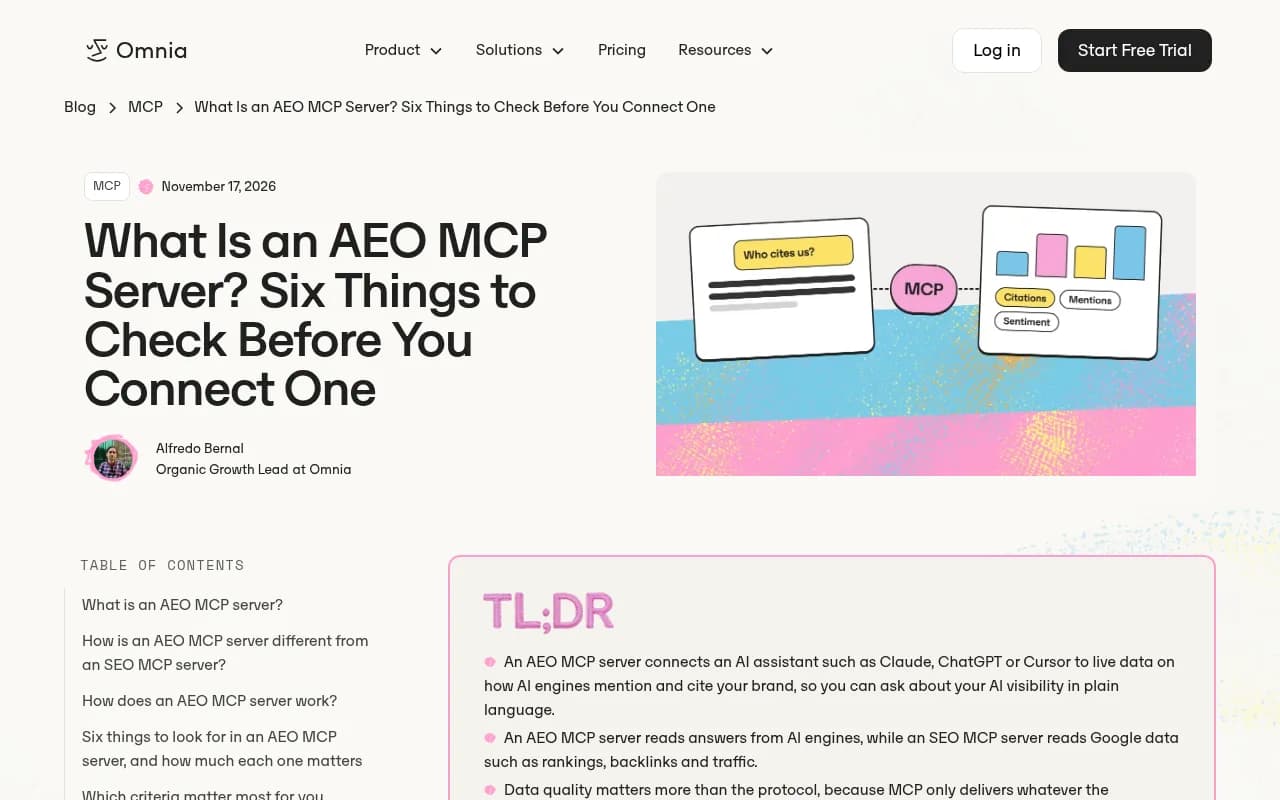
Omnia's own explainer is a good read on the evaluation side, even though it is written by a vendor. Its central point is one I agree with: a thin server still gives confident answers, just from thin data. You find out when a colleague types the same prompt into ChatGPT and gets a different story.
Why the data behind the server matters more than the protocol
Connecting takes minutes. Most servers are hosted, use OAuth or an API key, and appear in the Claude connector directory or ChatGPT's plugin list. Nothing about MCP makes the underlying numbers more accurate.
There is a cautionary anecdote floating around. A Reddit post in r/Rankin_AI describes Claude auditing a client's AI visibility over MCP, with a headline number off by almost 2x on a setup of roughly 40 tracked prompts across ChatGPT, Gemini and Google AI Mode. I only saw the snippet, so treat it as unverified. But it matches what you would expect: an assistant will happily summarize whatever the server returns, including a sample that is too small or a metric that is defined differently than you assumed.
And connecting an MCP server does not improve your AI visibility. It changes how you read and act on the data. Nothing more.
One more thing about prompts. Promptwatch's ChatGPT query fanouts report found that average web searches per response fell from 2.15 in early December 2025 to about 1.84 by early March 2026, and that fanout queries are short, keyword-style strings, around 53 characters once they returned in April. When you ask an assistant to inspect your visibility, ask about the sub-queries the engines actually run, not only the conversational prompts you track.
Six criteria for judging an AEO MCP server
| Criterion | What to ask | Red flag |
|---|---|---|
| Data coverage | Which engines, countries and languages? Real interfaces or APIs only? | Only ChatGPT, or Claude locked behind Enterprise |
| Freshness | How often do prompts run? How old is the latest data point? | Weekly snapshots presented as current |
| Actionable output | Does it return cited URLs, content gaps and recommendations, or just a score? | A single visibility number with no drill-down |
| Write access | Can the assistant create prompts, tags, content or actions? | Read-only when you wanted to automate workflows |
| Authentication | OAuth, API key, or both? Which clients are documented? | API key in a header only, which limits some clients |
| Plan limits | How many MCP requests per hour or month? | A quota that an assistant chaining several calls burns through fast |
Weight them by who you are. A marketer with no AEO specialist should put data coverage and actionable output first. Someone building their own AI workflows should put data coverage and write access first.
Plan limits deserve more attention than they get. One roundup notes Otterly's Standard quota of 2,000 API and 2,000 MCP requests a month can run out quickly, because a single question to an assistant often triggers several tool calls.
AEO platforms with MCP servers in 2026
Here is a practical rundown of the platforms that document an MCP server. Pricing and gating claims for third-party tools come from the roundups I read (Drew Garrett's best AEO tools list, checked in November 2026, and Geoptie's API and MCP comparison), not from my own testing, so verify them.
Promptwatch
Promptwatch is the platform I would start with if you want the assistant to do more than read a report. Its MCP server lets Claude, Claude Code, Cursor, Lovable, OpenAI Codex, ChatGPT and any MCP-compatible client query your data. It is an official connector in the Claude directory and a plugin in the ChatGPT store, both powered by the same server, and the docs list brand visibility across ChatGPT, Claude, Gemini, Perplexity and AI Overviews, citation source analysis, AI-referred traffic, competitor comparison and content gaps.
The part that matters most here is that it covers the whole loop. The same data set includes IP-verified AI crawler logs, visitor analytics and page-level tracking, so you can ask whether a page is being crawled, cited and clicked, not just whether the brand was mentioned. The MCP surface has 110+ read and write tools, so the assistant can also generate AI-optimized content from prompts and personas and work the Action Board. Most competitors stop at monitoring.
Plan gating is worth checking at promptwatch.com/pricing. Every plan, including the free Explore plan, includes MCP and API access, with request limits that rise by tier (100 per hour on Explore up to 10,000 per hour on Business). There is a 7-day free trial on the paid tiers.

A third-party route also exists: Truto can generate a managed MCP server for Promptwatch and connect it to ChatGPT. That is an alternative, not the native path.
Searchable
Searchable tracks prompts across ChatGPT, Google AI Overviews and Perplexity, with Claude, Gemini and AI Mode as add-ons. It also audits pages, drafts content and connects to Claude over MCP. Drew Garrett ranks it the best all-around AEO tool, and reports the MCP server is included from the $125 Pro plan. Worth noting that the same roundup is a Searchable-adjacent recommendation in a list Searchable also publishes itself, so read both with that in mind.
Scrunch
Scrunch ships an MCP server and, per the same roundup, includes it on its $250 Core plan. It documents a ChatGPT connection too.
Otterly.AI
Otterly's MCP server is OAuth-only and listed in Claude's connector directory, with ChatGPT, Cursor and Microsoft Copilot also supported. Access starts at $189 per Geoptie's comparison. Mind the monthly request quota.
Otterly.AI

Peec AI
Peec is listed in ChatGPT's plugin directory and documents Claude, Codex and Cursor. According to the comparison, each plan tracks three models and Claude is Enterprise-only, which is a coverage limit to check against your needs.

Ahrefs Brand Radar and Semrush
Ahrefs has a hosted MCP server with documented setup for Claude, ChatGPT, Copilot Studio and n8n. Claude can be tracked on custom prompts at eight checks per update. Semrush adds MCP access from its $199 Starter plan, per the roundup. Both suit teams already paying for the suite, though both are SEO platforms adding AI tracking, so expect shallower AI-specific data than a purpose-built tool.
Profound
Profound documents a ChatGPT connection and is an enterprise-priced option tracking up to 10 engines.
Profound

Omnia and Conductor
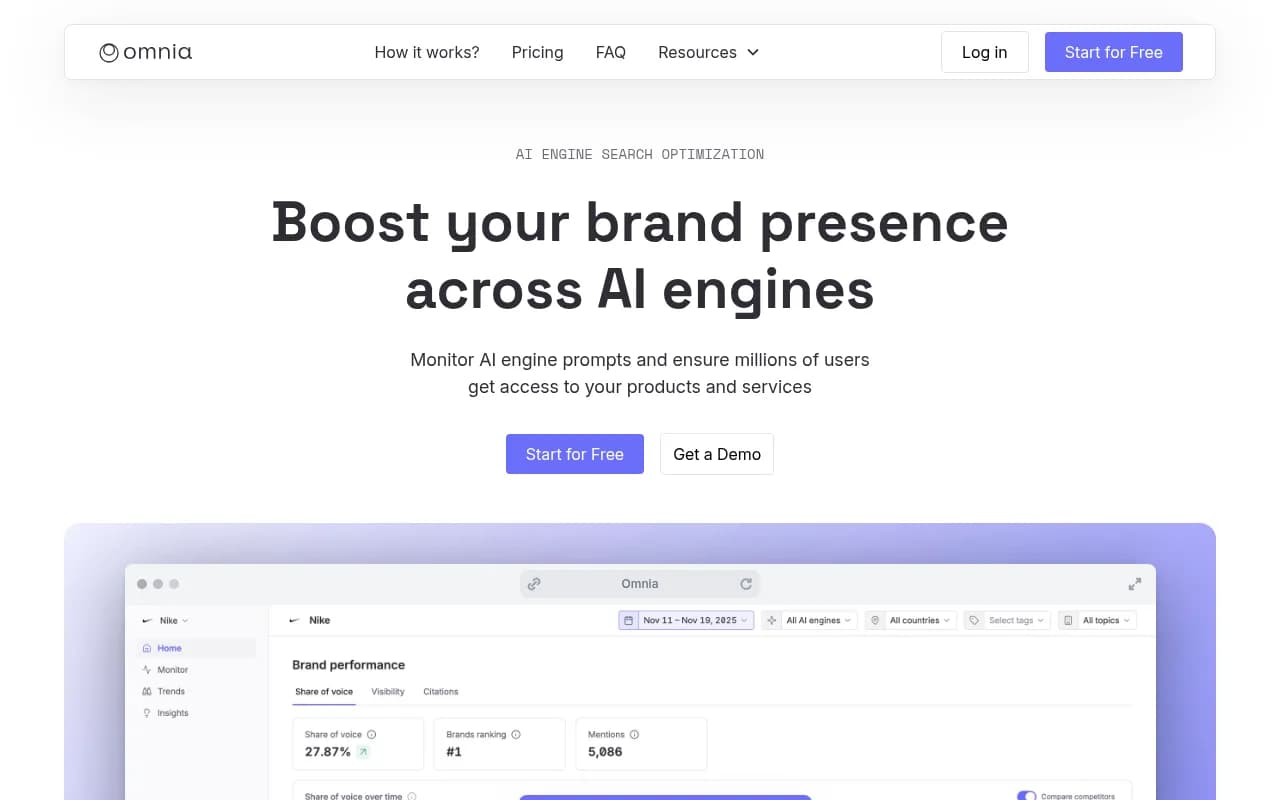
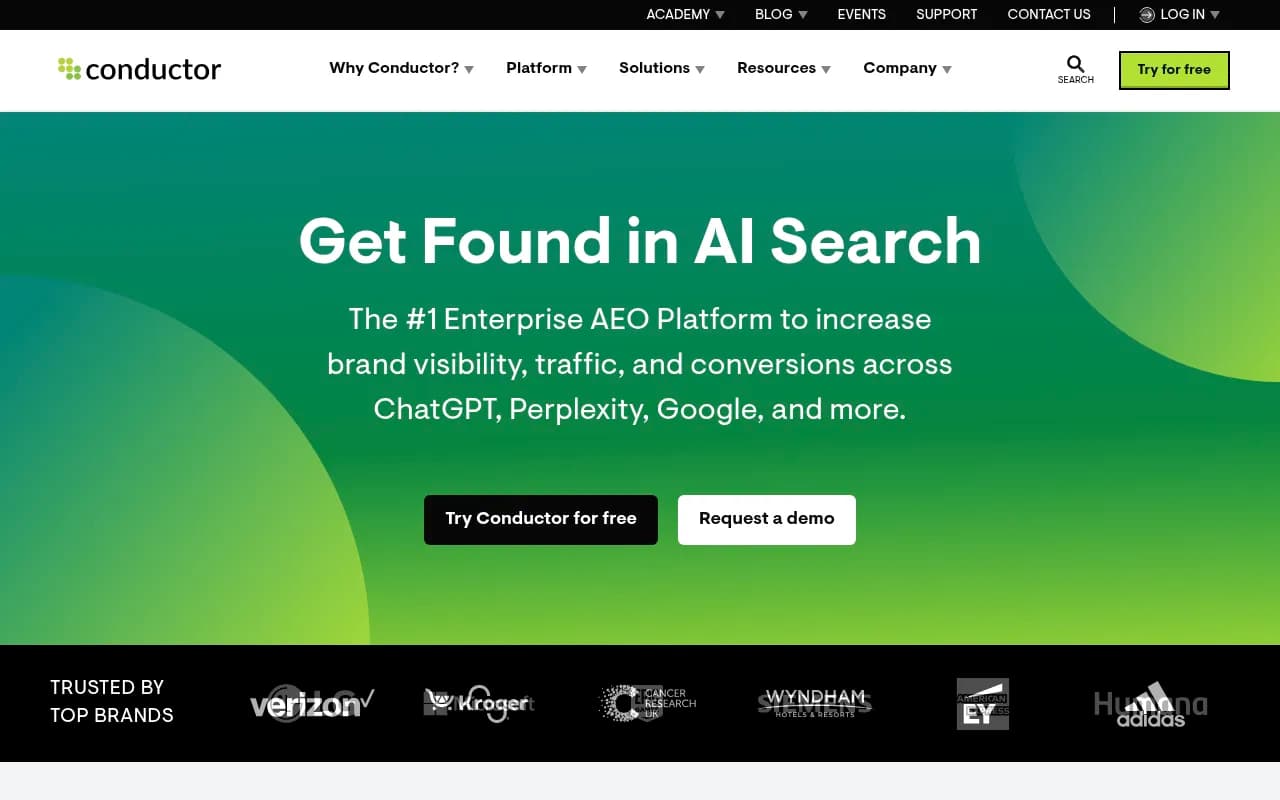
Omnia's MCP server connects Claude, ChatGPT and Cursor, monitors ChatGPT, Perplexity, Google AI Overviews and Google AI Mode by default, and offers a 14-day free trial. Conductor publishes its own guide to AEO MCP servers and runs one for its enterprise SEO and AEO data.
Side-by-side
| Platform | MCP clients documented | Claimed gating or entry price | Watch out for |
|---|---|---|---|
| Promptwatch | Claude, ChatGPT, Claude Code, Cursor, Lovable, Codex, any MCP client | MCP and API on every plan, limits rise by tier | Confirm current pricing on its site |
| Searchable | Claude | From $125/mo (third-party claim) | Claude tracking is an add-on |
| Scrunch | Claude, ChatGPT | $250 Core (third-party claim) | Verify engine coverage |
| Otterly.AI | Claude, ChatGPT, Cursor, Copilot | From $189 (third-party claim) | Monthly MCP request quota |
| Peec AI | ChatGPT, Claude, Codex, Cursor | Varies | Three models per plan |
| Ahrefs Brand Radar | Claude, ChatGPT, Copilot Studio, n8n | Add-on to Ahrefs | Eight Claude checks per update |
| Semrush | MCP from Starter | $199 Starter (third-party claim) | SEO-suite depth, not AI-native |
| Omnia | Claude, ChatGPT, Cursor | 14-day free trial | Claude and Gemini on request |
How to test a server in one afternoon
Pick one candidate with a trial and do this before you commit.
- Load five prompts you actually care about: a category prompt, a comparison prompt, a branded prompt, and two where you expect a competitor to win.
- Open the full AI answers in the real ChatGPT or Perplexity interface and note who is mentioned and what is cited.
- Ask your assistant the same questions through the MCP server. Compare the mentions, the cited URLs and the competitor names.
- Check one number by hand. If the assistant says you appear in 40% of responses, count the stored responses yourself.
- Ask a question the data can't answer, for example about an engine you don't track. A good setup says so. A thin one improvises.
- Try one write action if the server supports it, like adding a prompt, and confirm the change shows up in the dashboard.
If the numbers diverge from what you saw in step 2, stop. The data is the problem, not the assistant.
Prompts worth running once you're connected
These work on most servers, with the caveat that quality depends on coverage.
Which pages on my site were cited by ChatGPT in the last 30 days, and which prompts triggered them?

Show prompts where a competitor is mentioned and we are not. Group by topic.

Which third-party pages get cited for our category that never name us?

Compare our sentiment against the top three competitors by AI engine.

Which of our pages rank in Google but never get cited by AI?
The last one needs search data alongside AI data. That is where servers that combine Search Console, crawler logs and citation data pull ahead of pure prompt trackers.
For context on what you will find, Promptwatch Data's social media citations report (Oct 11 to Nov 9, 2026) showed ChatGPT getting just 0.64% of citations from social platforms versus 13.16% for Google AI Overviews. A question like "where do my citations come from, by engine?" will look very different for each one, and a good server should show that split.
Which one to pick
- You want the assistant to trace visibility to crawling, traffic and content, and to act: Promptwatch.
- You already live inside Ahrefs or Semrush and want a quick AI layer: their built-in options.
- You are small, price-sensitive and want a Claude-first workflow: Searchable or Otterly, checking quotas.
- You are enterprise with an existing Conductor contract: start there.
- You are comparing more broadly: the GEO software directory at bestgeosoftware.com lists more options.
My honest take: the MCP badge is no longer a differentiator. Ask what is behind it. Run the five-prompt test, count one number by hand, and check the request limits before you let anyone on your team build a workflow around it.
FAQ
Does connecting an MCP server improve my AI visibility?
No. It changes how you query and act on the data. Visibility improves when you change content, fix crawler access and earn citations.
Can I use these servers in ChatGPT, not just Claude?
Often yes. ZeroRank AI, SE Ranking, Peec, Otterly, Ahrefs, Profound and Scrunch document ChatGPT connections per Geoptie's comparison, and Promptwatch ships a ChatGPT plugin. Servers that authenticate only with an API key in a header may suit Claude Code or Cursor better.
What is the difference between an AEO and an SEO MCP server?
An AEO server reads data from AI engine answers: mentions, citations, sentiment. An SEO server reads Google data like rankings and backlinks. The most useful setups combine both.
Should I choose read or write access?
Read-only is enough if you only want answers. Write access matters if you want the assistant to add prompts, queue content or manage tasks. Scope your API keys and keep an audit trail if you grant it.
How many MCP requests will I use?
More than you expect. One question can trigger several tool calls, so check hourly or monthly limits before you build scheduled workflows.