Key Takeaways
- Citation-optimized AI writers analyze 880M+ citations, prompt volumes, and competitor gaps to create content engineered for AI search visibility — not just SEO rankings
- Generic AI writers (ChatGPT, Jasper, Copy.ai) produce drafts quickly but lack the data layer needed to understand what AI models actually cite and recommend
- The action loop matters: The best tools don't just write — they show you what's missing, generate content to fill those gaps, then track whether AI models start citing your new pages
- Visibility tracking is table stakes in 2026: If your AI writer doesn't connect to real citation data or help you measure results in ChatGPT/Perplexity/Claude, you're writing blind
- Research-focused tools (NVivo, ATLAS.ti, Citavi) solve a different problem — academic rigor, not AI search performance — and shouldn't be confused with marketing content generators
AI content generation exploded in 2024. By 2026, the market has split into two camps: tools that help you write faster, and tools that help you get cited.
Most AI writers — ChatGPT, Jasper, Copy.ai, Writesonic — were built for speed. They generate blog posts, social captions, and email copy in seconds. But they don't know what AI search engines actually cite. They can't tell you which prompts your competitors rank for but you don't. They don't track whether your new content shows up in ChatGPT responses or Perplexity citations.
That's the gap citation-optimized tools fill. Instead of treating content as the end goal, they treat visibility as the outcome. They analyze real citation data — which pages, domains, and Reddit threads AI models reference — then generate content engineered to earn those citations.
This guide breaks down the difference, compares both categories, and shows you when each type of tool makes sense.
What Makes a Tool "Citation-Optimized"?
Citation-optimized AI writers are built around a data layer that generic tools don't have:
- Citation analysis: They track which pages AI models cite across millions of prompts — not just which pages rank in Google
- Prompt intelligence: Volume estimates, difficulty scores, and query fan-outs show you which prompts are worth targeting
- Content gap analysis: They surface the exact topics, angles, and questions your competitors are visible for but you're not
- AI-native content generation: The writing agent creates articles grounded in citation data, persona targeting, and competitor analysis — not generic SEO filler
- Visibility tracking: After you publish, they show you whether AI models start citing your new content and which pages drive traffic
Generic AI writers skip all of this. They generate text based on a prompt you give them, but they don't know what's missing from your site, which prompts matter, or whether your content performs after you hit publish.
The Action Loop: Find Gaps → Create Content → Track Results
The best citation-optimized platforms close a loop that generic writers can't:
Step 1: Find the Gaps
Answer Gap Analysis shows exactly which prompts competitors are visible for but you're not. You see the specific content your website is missing — the topics, angles, and questions AI models want answers to but can't find on your site.
Example: A SaaS company discovers they're invisible for "best project management tools for remote teams" even though competitors with weaker products dominate that prompt. The gap analysis surfaces the missing content.
Step 2: Create Content That Ranks in AI
The built-in AI writing agent generates articles, listicles, and comparisons grounded in real citation data (880M+ citations analyzed), prompt volumes, persona targeting, and competitor analysis. This isn't generic SEO filler — it's content engineered to get cited by ChatGPT, Claude, Perplexity, and other AI models.
The same SaaS company uses the agent to generate a comprehensive guide targeting that exact prompt, structured around the citation patterns the platform identified.
Step 3: Track the Results
See your visibility scores improve as AI models start citing your new content. Page-level tracking shows exactly which pages are being cited, how often, and by which models. Close the loop with traffic attribution (code snippet, GSC integration, or server log analysis) to connect visibility to actual revenue.
Within weeks, the new guide starts appearing in ChatGPT and Perplexity responses. The platform tracks citation frequency, click-through rates, and revenue attribution.
This cycle — find gaps, generate content, track results — is what makes a platform an optimization tool, not just another writer.
Citation-Optimized Tools: Built for AI Search Visibility
These platforms combine content generation with the data layer needed to actually rank in AI search:
Promptwatch

Promptwatch is the only AI visibility platform that combines monitoring, content gap analysis, and AI-native content generation in one workflow. It tracks 10 AI models (ChatGPT, Perplexity, Claude, Gemini, Google AI Overviews, Meta AI, DeepSeek, Grok, Mistral, Copilot) and has analyzed over 880M citations.
What sets it apart: Answer Gap Analysis shows you exactly which prompts competitors rank for but you don't, then the built-in AI writing agent generates content engineered to fill those gaps. You're not guessing — you're working from real citation data.
Additional capabilities:
- AI Crawler Logs: Real-time logs of AI crawlers hitting your site — which pages they read, errors they encounter, how often they return
- Prompt Intelligence: Volume estimates and difficulty scores for each prompt, plus query fan-outs
- Citation & Source Analysis: See exactly which pages, Reddit threads, YouTube videos, and domains AI models cite
- Reddit & YouTube Insights: Surface discussions that directly influence AI recommendations
- ChatGPT Shopping Tracking: Monitor when your brand appears in product recommendations
- Competitor Heatmaps: Compare your AI visibility vs competitors across LLMs
Pricing: Essential $99/mo (1 site, 50 prompts, 5 articles), Professional $249/mo (2 sites, 150 prompts, 15 articles, crawler logs), Business $579/mo (5 sites, 350 prompts, 30 articles). Free trial available.
Conductor AI Writing Assistant
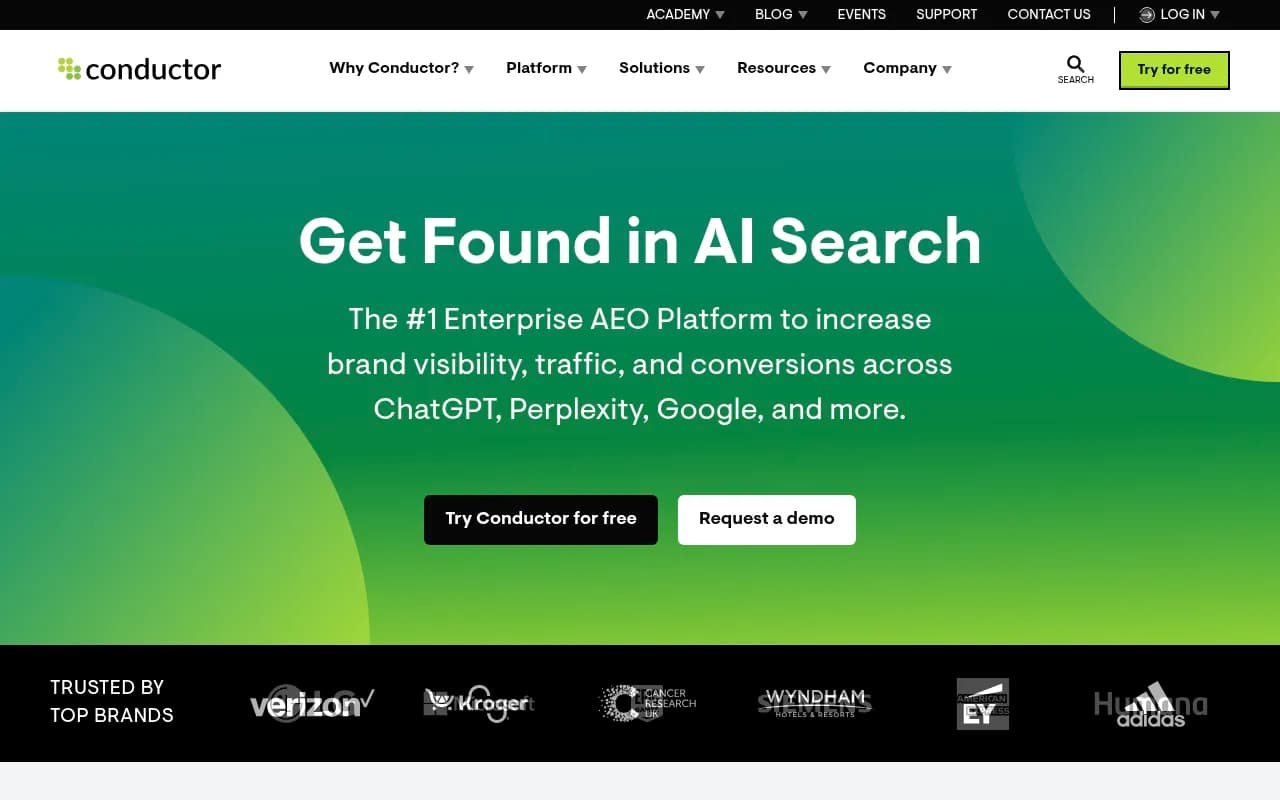
Conductor's AI Writing Assistant is built into their broader SEO and content intelligence platform. It generates content aligned with search intent and optimized for both traditional SEO and AI Overviews.
Strengths: Deep integration with Conductor's keyword research, competitive analysis, and content briefs. The assistant understands context from your existing content strategy.
Limitations: Primarily focused on Google SEO and AI Overviews — doesn't track ChatGPT, Perplexity, Claude, or other standalone AI search engines. No Reddit/YouTube citation tracking.
Frase
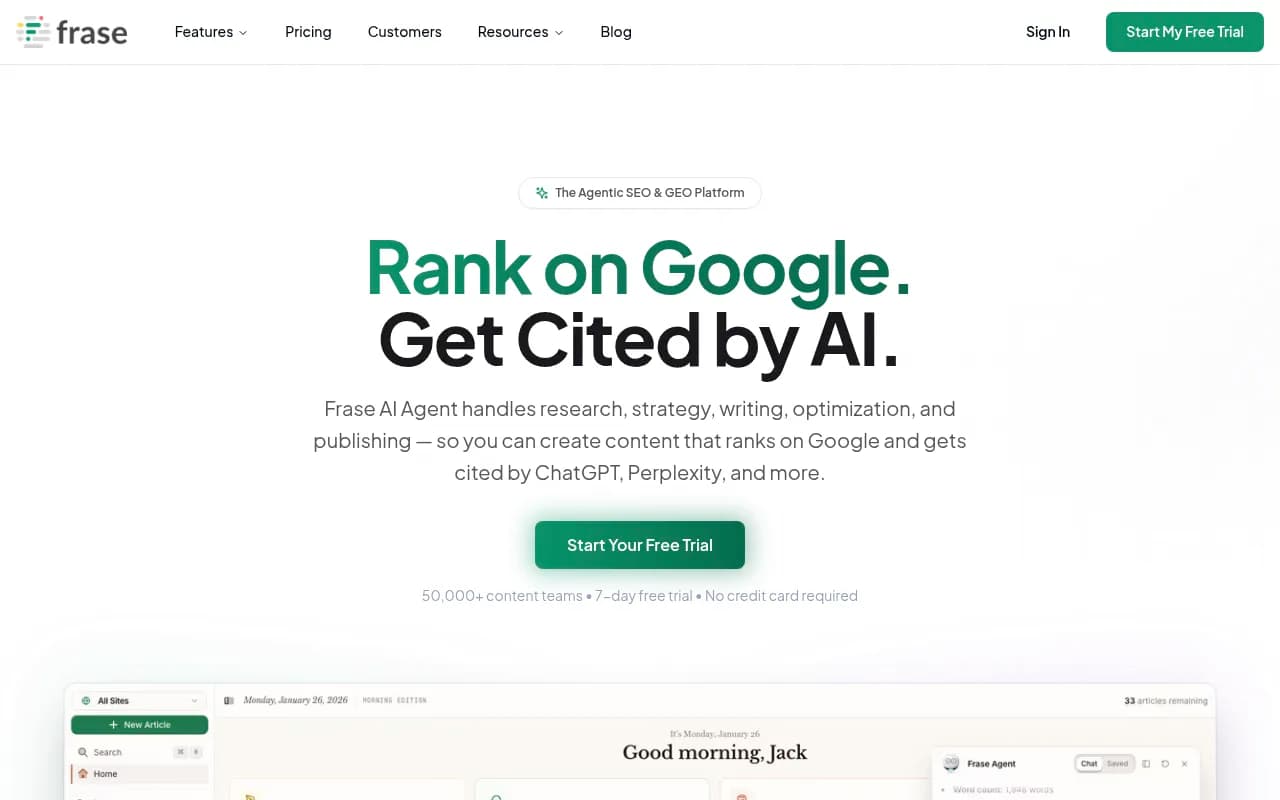
Frase combines content research, AI writing, and optimization in one platform. It analyzes top-ranking content for a given keyword, then generates outlines and drafts based on that analysis.
Strengths: Strong SERP analysis and content brief generation. The AI writer produces drafts that align with what's already ranking.
Limitations: Built for Google SEO, not AI search visibility. Doesn't track citations in ChatGPT, Perplexity, or other LLMs. No prompt intelligence or content gap analysis for AI models.
Surfer AI
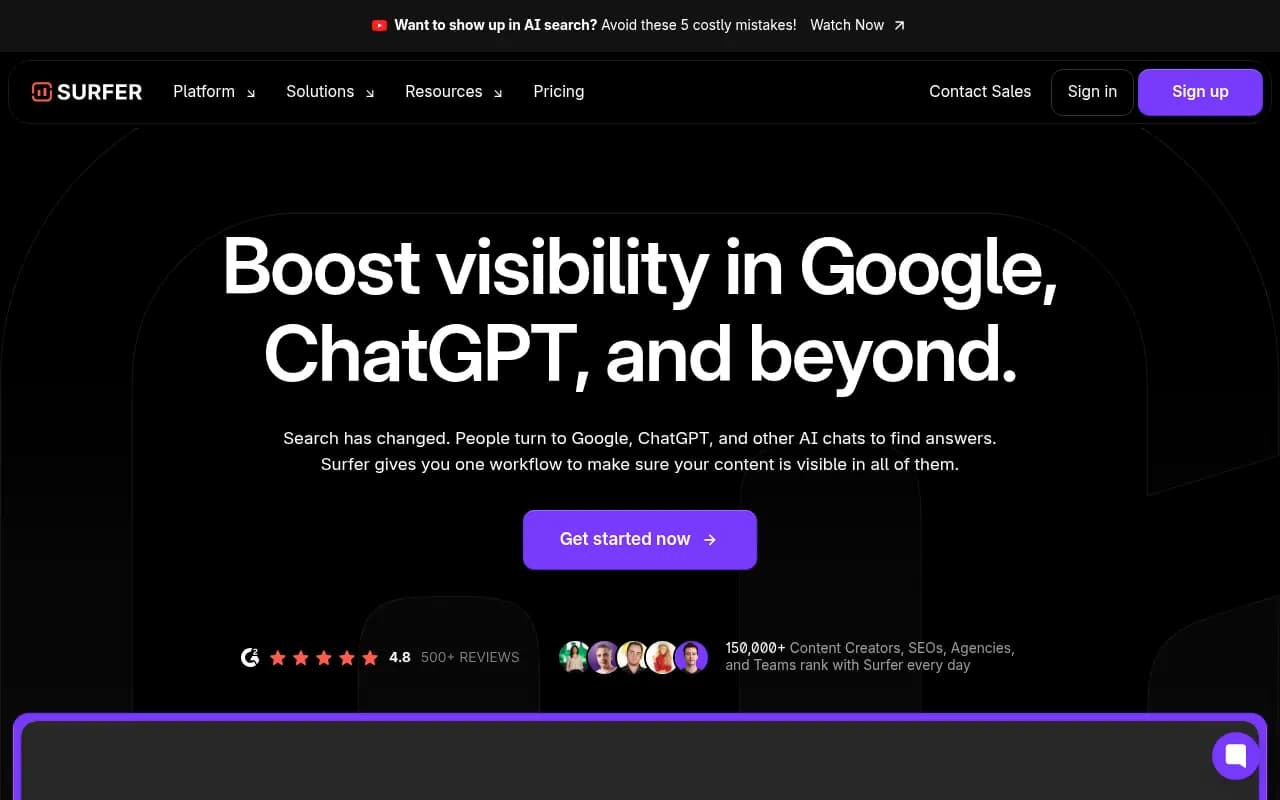
Surfer AI generates full articles optimized for SEO based on keyword research and competitor analysis. It's tightly integrated with Surfer's content editor and optimization tools.
Strengths: Produces SEO-optimized drafts at scale. Strong keyword density and semantic analysis.
Limitations: Focused on traditional SEO rankings, not AI search citations. No visibility tracking for ChatGPT, Perplexity, Claude, or other AI models.
MarketMuse
MarketMuse uses AI to analyze content gaps and generate topic clusters. Its content briefs are grounded in competitive analysis and semantic relevance.
Strengths: Excellent for content strategy and planning. Identifies topical authority gaps.
Limitations: Content generation is secondary to strategy. Doesn't track AI search visibility or citations.
Generic AI Writers: Fast Drafts, No Visibility Data
These tools generate content quickly but lack the data layer needed to optimize for AI search:
ChatGPT
ChatGPT is the most versatile AI assistant available. It can write blog posts, emails, social captions, product descriptions, and more — all from a simple prompt.
Strengths: Free (or $20/mo for Plus), incredibly flexible, constantly improving, supports multi-turn conversations.
Limitations: No citation data, no prompt intelligence, no visibility tracking. You're writing blind — it has no idea what AI models actually cite or which prompts matter for your business.
Jasper
Jasper is a marketing-focused AI platform with templates for ads, blog posts, social media, and more. It supports brand voice customization and team collaboration.
Strengths: Strong brand voice controls, marketing-specific templates, multi-user workflows.
Limitations: Generates content based on templates and prompts, but doesn't analyze what's missing from your site or track whether your content gets cited by AI models.
Copy.ai

Copy.ai specializes in short-form marketing copy — social posts, ad headlines, email subject lines, product descriptions.
Strengths: Fast, affordable, great for high-volume short-form content.
Limitations: Not built for long-form content or SEO. No citation analysis or AI search tracking.
Writesonic

Writesonic offers AI writing for blog posts, landing pages, ads, and more. It includes a built-in SEO checker and plagiarism detector.
Strengths: Affordable, supports multiple content types, includes basic SEO optimization.
Limitations: SEO optimization is surface-level (keyword density, readability). Doesn't track AI search visibility or analyze citation patterns.
Rytr
Rytr is a budget-friendly AI writer with templates for blog posts, emails, social media, and more.
Strengths: Extremely affordable ($9-$29/mo), simple interface, supports 30+ languages.
Limitations: Basic content generation only. No research, no optimization, no visibility tracking.

Research-Focused AI Tools: A Different Use Case
Academic research tools like NVivo, ATLAS.ti, and Citavi are often mentioned alongside AI content generators, but they solve a completely different problem.
These platforms are built for qualitative research, data analysis, and citation management in academic contexts. They help researchers organize literature, code interview transcripts, identify themes, and manage bibliographies.
NVivo, ATLAS.ti, Citavi
Strengths: Rigorous methodology, transparent AI support, structured workflows for academic research.
Limitations: Not designed for marketing content or AI search optimization. They don't track citations in ChatGPT or Perplexity. They don't generate blog posts or landing pages.
If you're writing a dissertation or conducting qualitative research, these tools are essential. If you're trying to rank in AI search engines, they're irrelevant.
When to Use Citation-Optimized Tools vs Generic AI Writers
Use Citation-Optimized Tools When:
- You need to rank in AI search engines (ChatGPT, Perplexity, Claude, Gemini)
- You want to understand which prompts competitors are visible for but you're not
- You need content grounded in real citation data, not generic SEO advice
- You want to track whether your content actually gets cited after you publish
- You're serious about AI search visibility and willing to invest in tools that close the loop
Use Generic AI Writers When:
- You need fast drafts for internal docs, emails, or social posts
- You're experimenting with AI writing and don't need advanced features
- You have a tight budget and visibility tracking isn't a priority yet
- You're comfortable doing your own research and optimization manually
Don't Confuse Research Tools with Marketing Tools
Academic research platforms (NVivo, ATLAS.ti, Citavi) are not marketing content generators. They're built for qualitative analysis and citation management in academic contexts, not AI search optimization.
The Competitive Landscape in 2026
The AI content generation market has matured significantly:
Monitoring-Only Platforms: Tools like Otterly.AI, Peec.ai, AthenaHQ, and Search Party track AI search visibility but don't help you create content or fix gaps. They show you the problem but leave you stuck.
Otterly.AI

Traditional SEO Tools Adding AI Features: Semrush, Ahrefs, and Moz have added AI search tracking, but it's bolted onto platforms built for Google SEO. Semrush uses fixed prompts, Ahrefs Brand Radar has fixed prompts and no traffic attribution.
Citation-Optimized Platforms: Promptwatch, Conductor, and a handful of others combine monitoring, content gap analysis, AI-native content generation, and visibility tracking in one workflow. These are the only tools that close the action loop.
Generic AI Writers: ChatGPT, Jasper, Copy.ai, Writesonic, and dozens of others generate content quickly but lack the data layer needed to optimize for AI search.
How to Choose the Right Tool
Ask yourself these questions:
-
Do I need to rank in AI search engines? If yes, you need citation-optimized tools with visibility tracking. Generic writers won't cut it.
-
Do I need to understand what's missing from my site? If yes, you need content gap analysis grounded in real citation data — not just keyword research.
-
Do I need to track results after I publish? If yes, you need page-level citation tracking across ChatGPT, Perplexity, Claude, and other AI models.
-
What's my budget? Citation-optimized platforms start around $99-$249/mo. Generic AI writers range from free (ChatGPT) to $20-$100/mo. Traditional SEO platforms with AI features start around $120-$200/mo.
-
Am I doing academic research or marketing content? If academic, use NVivo/ATLAS.ti/Citavi. If marketing, use citation-optimized or generic AI writers.
The Future of AI Content Generation
By 2026, the market has split into two clear paths:
Path 1: Speed and Volume
Generic AI writers will get faster, cheaper, and more versatile. They'll support more languages, better brand voice controls, and tighter integrations with CMS platforms. But they'll remain blind to visibility outcomes.
Path 2: Visibility and Optimization
Citation-optimized platforms will deepen their data layers — more citation sources (Reddit, YouTube, TikTok), more AI models (DeepSeek, Grok, regional LLMs), more sophisticated prompt intelligence. The action loop will tighten: find gaps faster, generate content smarter, track results deeper.
The winners will be the teams that understand the difference and choose tools aligned with their actual goals.
Practical Recommendations
For Marketing Teams Serious About AI Search:
Start with a citation-optimized platform like Promptwatch. Run Answer Gap Analysis to identify your biggest visibility gaps. Use the AI writing agent to generate 5-10 articles targeting high-value prompts. Track results for 30-60 days. Measure citation frequency, click-through rates, and revenue attribution.
For Content Teams on a Budget:
Use ChatGPT or Jasper for drafts, but pair it with manual research. Manually search your target prompts in ChatGPT, Perplexity, and Claude. Note which domains get cited. Analyze what they're doing differently. Use that insight to guide your AI-generated drafts. Track results manually using search operators and screenshot comparisons.
For Agencies Managing Multiple Clients:
Invest in a citation-optimized platform with multi-site support and white-label reporting. Promptwatch's Business plan supports 5 sites and 350 prompts. Run gap analysis for each client, generate content at scale, and deliver visibility reports that tie citations to revenue.
For Academic Researchers:
Stick with NVivo, ATLAS.ti, or Citavi. Don't waste time with marketing content generators — they're not built for your use case.
Common Mistakes to Avoid
Mistake 1: Treating AI Writers as Set-It-and-Forget-It Tools
Even citation-optimized platforms require human oversight. Review drafts, add expertise, fact-check claims, and refine tone. AI accelerates the process but doesn't replace judgment.
Mistake 2: Ignoring Visibility Tracking
If you're not tracking whether your content gets cited in AI search, you're writing blind. Visibility tracking is table stakes in 2026.
Mistake 3: Confusing Academic Research Tools with Marketing Tools
NVivo, ATLAS.ti, and Citavi are not marketing content generators. They're built for qualitative research and citation management in academic contexts.
Mistake 4: Assuming Generic AI Writers Understand SEO
ChatGPT, Jasper, and Copy.ai can write content, but they don't know which keywords matter, which prompts competitors rank for, or whether your content will perform. They're drafting tools, not optimization platforms.
Mistake 5: Skipping Content Gap Analysis
Most teams generate content based on gut instinct or keyword volume. Citation-optimized platforms show you exactly what's missing — the prompts competitors are visible for but you're not. Start there.
Final Thoughts
AI content generation has moved beyond speed. In 2026, the question isn't "Can I generate content faster?" — it's "Will my content get cited?"
Generic AI writers (ChatGPT, Jasper, Copy.ai) are excellent for drafts, but they don't know what AI models actually cite. They can't tell you which prompts matter, what's missing from your site, or whether your content performs after you publish.
Citation-optimized tools (Promptwatch, Conductor, Frase) close that loop. They analyze real citation data, surface content gaps, generate AI-native content, and track visibility outcomes. They're not just writers — they're optimization platforms.
If you're serious about AI search visibility, choose tools built for that outcome. If you just need fast drafts, generic writers are fine. But don't confuse the two.
The market has split. The winners will be the teams that understand the difference.