Key takeaways
- Brand hallucinations are not random. Each type traces back to a specific cause: thin training data, stale pages, weak retrieval, or a bad source that got cited.
- ChatGPT cites about 5 sources per web-search answer, so one wrong or outdated page can dominate what it says about you (Promptwatch Data).
- Pages that describe what you sell are 39% of ChatGPT citations, and landing pages and docs stay cited for months. Stale pricing lingers.
- You cannot eliminate hallucinations. You can find them early, trace them to a source, and fix the source.
What a brand hallucination actually is
IBM defines AI hallucinations as outputs that sound plausible but are factually wrong, irrelevant or fabricated. For a brand, that means ChatGPT says you offer a feature you never built, Gemini quotes a price from 2023, or Perplexity credits a competitor's award to you.
The root cause is the same everywhere. A language model predicts what fits the pattern, not what is true. IBM puts it bluntly: a generative AI does not "know" what is true or false, it only "knows" what fits the pattern. Researchers at OpenAI and elsewhere (Kalai et al., 2025) add a second cause: most evaluations give a point for a right answer and zero for both a wrong answer and "I don't know," so guessing is rewarded. Models learn to bluff.
Brands get hit harder than most topics because brand facts are narrow. A famous company has plenty of consistent text behind it. A mid-size B2B brand has a few hundred pages of mixed quality, and the model fills the gaps.
It also helps to separate two situations. In one, the model answers from training data alone. In the other, it searches the web and cites pages. The second is where you have the most control, because you can see the sources and change them.
The 8 types at a glance
| # | Error type | Typical example | Main cause |
|---|---|---|---|
| 1 | Fabricated features | Claims a product has an integration it lacks | Pattern completion from competitor or category norms |
| 2 | Outdated facts | Old pricing, old plans, old leadership | Stale pages that stay cited |
| 3 | Wrong attribution | Competitor's award or review credited to you | Entity confusion in sparse data |
| 4 | Name collision | Mixes you up with a similarly named company | Ambiguous brand name |
| 5 | Invented citations or URLs | Links to a pricing page that does not exist | Ungrounded generation |
| 6 | Misstated policies | Wrong refund, trial, or SLA terms | Missing or buried policy pages |
| 7 | Distorted sentiment or reputation | Repeats one old complaint as the norm | One dominant source in a small source set |
| 8 | Context inconsistency | Answer contradicts the page it just cited | Retrieval and summarization drift |
The rest of this guide goes through each one.
1. Fabricated features and capabilities
This is the classic one. Ask about your product and the answer includes a Slack integration, SOC 2 report, or mobile app you do not have.
Why it happens: Appen's taxonomy calls this factual fabrication, where the model invents an entity or detail that does not exist. For brands, the trigger is usually category pressure. If nine of your ten competitors offer a feature, the model's pattern says you probably do too.
How to spot it: run prompts like "Does [brand] integrate with X?" and "What are the main features of [brand]?" across several models and read every claim, not only the mention.
Fix: state what you do and do not do, plainly. A features page that lists integrations explicitly, plus an FAQ with "Does [brand] support X?" entries, gives retrieval something exact to quote. Negative statements help more than people expect.
2. Outdated facts
The second most common error is the least exotic. The model is right about what you used to be.
Why it happens: Promptwatch Data tracked every page ChatGPT cited on July 6, 2026 for 90 days (ChatGPT content half-life report). After 30 days, ChatGPT still cited 78% of landing pages and 76% of docs. After 60 days it was still 69% and 67%. Landing pages, docs, comparisons and listicles only crossed the 50% mark in the final week of the window. News is the exception, losing half its pages in 36 days.
That means an old pricing page, a retired plan, or a three-year-old comparison post can keep feeding answers for months. Training data adds a second layer of lag that you cannot touch directly.
Fix: audit landing pages, docs, pricing and comparison pages for stale prices, features and positioning. Redirect or update old versions rather than leaving them live. Check third-party listicles that cite you and ask for corrections.
3. Wrong attribution
The model gives you a competitor's award, funding round, customer, or review score. Or it credits your product launch to someone else.
Why it happens: when two brands appear together in the same listicles and comparison pages, the model blends them. Sparse, similar data about two entities is where entity confusion thrives. Listicles are 13.6% of ChatGPT citations and comparisons another 5.9% (Promptwatch Data, Sep 28 to Oct 4, 2026, content type report), so these multi-brand pages carry real weight.
Fix: make claims unambiguous on your own pages. Name the award, the year and the issuing body. Use structured data and consistent naming across your site, LinkedIn, and review profiles so each fact attaches to one entity.
4. Name collisions
If your brand name is a common word, a person's name, or close to another company's, the model may answer about the wrong thing entirely.
Why it happens: the model has no strong signal about which "Mercury" or "Apollo" you mean. This is a disambiguation failure, and it shows up before the model even gets to facts.
How to spot it: prompt with the brand name alone, then with category context. If the first answer describes someone else, you have a collision.
Fix: always pair the brand with its category on key pages ("Acme, project management software for agencies"). Build a clear About page, consistent profile bios, and a Wikipedia or Wikidata-style entity footprint where legitimate. Monitoring tools with brand alias rules let you separate your mentions from the common-word noise when you measure this.
5. Invented citations and URLs
Google Cloud notes that lack of grounding can extend to fabricating links to web pages that never existed. For a brand, that looks like a link to yoursite.com/pricing/enterprise that returns a 404, or a quote attributed to your CEO that nobody said.
Why it happens: the model knows what URLs on sites like yours look like and generates one that fits. The most famous version of this failure is the 2023 case where a lawyer filed ChatGPT-generated case law that turned out to be fictitious (the Mata v. Avianca sanctions were reported by Reuters).
How to spot it: click every cited URL. Check your server logs and 404 reports for AI-referred visits landing on pages that do not exist.
Fix: you cannot stop the invention, but you can make it harmless. Set sensible redirects for likely URL patterns, keep a clean sitemap, and make sure the real page exists at the obvious path. A 404 that turns into a redirect to the right page converts a hallucination into a visit.
6. Misstated policies
Refund windows, free trial length, cancellation terms, shipping times, SLAs. Policy errors cost the most because customers act on them.
The cautionary tale is Moffatt v. Air Canada (2024). A tribunal held the airline liable after its chatbot told a customer he could claim a bereavement refund after travel, which actual policy did not allow. That was the airline's own chatbot, but the same logic applies to the damage when a public AI engine gets your policy wrong, even if the legal exposure differs.
Why it happens: policies are often buried in PDFs, legal pages with dense language, or help-center articles with conflicting versions. If retrieval can't find a clean statement, the model averages industry norms.
Fix: give each policy one canonical, plain-language page. Put the key terms in a short summary at the top. Remove or redirect superseded versions. Documentation and FAQ pages are 7.5% and 3.3% of ChatGPT citations respectively, so they are worth the effort.
7. Distorted sentiment and reputation
The model describes your product as "expensive and hard to set up" because one dominant source said so, and it repeats that claim in every answer.
Why it happens: ChatGPT cites about 5 sources per web-search answer, while Google AI Overviews and Perplexity cite about 10 (Promptwatch average sources report). With so few sources, a single old review or forum thread carries a large share of the answer. Branded prompts also lean on reviews: they are 5.6% of citations for branded prompts, more than 3 times their share across all prompts, and social posts are almost 4 times their overall share (Promptwatch Data, Sep 28 to Oct 4, 2026).
Fix: this is a source problem, not a wording problem. Find which pages carry the claim, then earn fresher, better coverage on the review sites your category trusts. Respond to old complaints publicly where you can. Fixing the underlying issue and updating the source beats arguing with the model.
8. Context inconsistency
The answer cites your page and then says the opposite of what the page says. Appen calls this context inconsistency: the output contradicts the document or retrieved passage it was given.
Why it happens: summarization drifts. Long pages, tables, and pages where the key fact sits in an image or behind a script are easy to misread. Retrieval can also be unstable. Promptwatch's report shows Microsoft Copilot's average source count swung from under 2 to nearly 17 within a few weeks, so what it says about you can shift without any change on your side.
Fix: put the key fact in plain text near the top of the page, avoid burying it in images or tabs, and check that crawlers can actually read the page. For Copilot, make sure Bing indexes and ranks your key pages well, since it draws on Microsoft's search stack.
How to find hallucinations before customers do
Manual spot checks work for a first pass. Open ChatGPT, Gemini, Perplexity, Claude and Google AI Overviews, ask 15 to 20 questions a buyer would ask, and log every claim. Do it in the countries and languages you sell in, because answers differ.
To make it repeatable, use a taxonomy. Appen recommends writing labeling guidelines with categories and three severity tiers: critical (legal, safety, or financial harm), major (materially wrong), and minor (imprecise but not misleading). The eight types above work as a brand-specific version of that.
A realistic weekly routine:
- Run a fixed set of brand and comparison prompts across models.
- Extract each claim and mark it accurate, inaccurate, or unverifiable.
- For every inaccurate claim, find the cited pages behind it.
- Check crawl logs to see whether AI bots can read the right page.
- Fix the source, then re-run the prompt to confirm.
Tools that help
This is the point where dedicated tooling beats spreadsheets. Promptwatch is an AI visibility platform whose Brand Narrative feature pulls the individual claims AI makes about you out of tracked responses and groups them by theme like Pricing or Features. Fact Check (Business plan and up) lets you mark a claim inaccurate and then finds the pages on your site that state it or its opposite, which is the tracing step most teams do by hand.

Promptwatch also logs AI crawler visits with IP-verified crawler logs, so you can tell whether a wrong answer is an access problem or a content problem. Pricing starts at $95/month for Essential; check promptwatch.com/pricing for current plans. If you only want a quick read first, the free AI visibility report scans how ChatGPT, Gemini and Perplexity describe your brand.
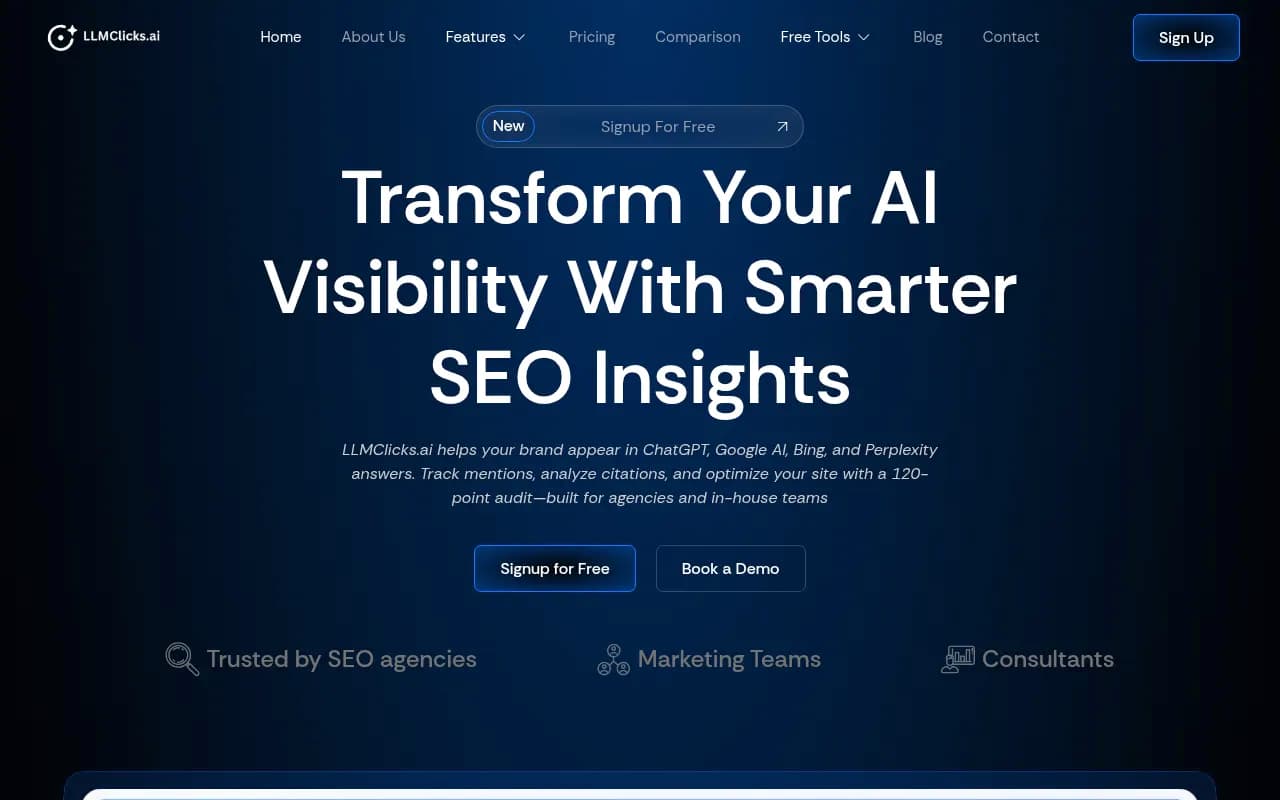
Other monitoring tools cover part of this. LLMClicks advertises hallucination detection:
Otterly.AI and Peec AI are simpler prompt trackers that tell you whether you were mentioned, though not why a claim is wrong:
Otterly.AI


For a wider look at the category, the directory at bestgeosoftware.com lists GEO platforms side by side.
| Need | What to look for | Example options |
|---|---|---|
| Spot wrong claims | Claim-level extraction, not just mention counts | Promptwatch, LLMClicks |
| Trace the source | Citation and page-level tracking | Promptwatch |
| Check bot access | IP-verified AI crawler logs | Promptwatch |
| Basic mention tracking | Prompt runs and share of voice | Otterly.AI, Peec AI |
| Check page changes | Website change detection | Visualping, Page Modified |
Fixing the cause, not the symptom
Most hallucination advice stops at "verify the output". That is right for a lawyer drafting a brief. It is useless for a brand, because you are not the one prompting.
Three fixes cover most of the eight types:
- Make the right answer easy to find. Product pages are 22.4% and landing pages 16.8% of ChatGPT citations, so about 39% of citations go to pages describing what a company sells. Your homepage, product pages and docs should answer the questions people ask about you: pricing, features, who it is for. Promptwatch's own advice from the data is to add a plain-language FAQ and collect reviews on trusted category sites.
- Remove the wrong answer's source. Update, redirect, or request a correction on the page that carries the error. Remember the half-life data: stale pages keep working against you for months.
- Verify the fix. Re-run the same prompts after a few weeks and compare. If the wrong claim persists, the source you fixed wasn't the real one.
This is also where AI search and plain SEO hygiene overlap. If you need help auditing a site for these problems, a specialist team such as 1001 SEO Media does this kind of GEO and technical work, but the checks above are doable in-house.
A note on expectations
IBM says it directly: hallucinations can be reduced but not fully eliminated. Some will be invented from nothing and vanish the next day. Chasing every one is a waste of time.
Prioritize by harm. A wrong policy or price (types 2 and 6) goes first. Fabricated features (type 1) are next because they create support tickets. Name collisions (type 4) go first if they hide you entirely. Sentiment distortion (type 7) is slower work because it means earning new coverage.
One limit on the data in this guide: none of the Promptwatch reports cited here measure hallucination rates directly. They show what AI engines cite and how long pages stay cited, which is the mechanism behind several of the error types. Treat the causes as well-supported reasoning, not a measured error rate.
Start with 20 prompts this week, log every wrong claim against one of the eight types, and fix the highest-harm source first.