Key takeaways
- All four platforms touch the content-to-citation problem, but from very different angles -- AirOps is a content engine, Scrunch is an edge delivery layer, Profound and Promptwatch are both end-to-end AEO platforms
- Only Promptwatch and Profound offer the full loop: gap identification, content creation, and citation tracking in one place
- Promptwatch is the only platform with AI crawler logs, page-level citation tracking, Reddit/YouTube insights, and ChatGPT Shopping data combined
- Profound has strong prompt volume data and an Amazon Rufus module, but enterprise pricing kicks in quickly and model coverage at lower tiers is limited
- Scrunch's CDN-edge delivery approach is genuinely novel but doesn't replace a monitoring and content strategy layer
- AirOps' Quill agent (launched May 2026) closes part of the content loop but lacks native citation tracking and crawler analytics
There's a specific frustration that every marketing team running an AI visibility program eventually hits: you can see that you're not being cited, but you don't know why, and you don't have a clear path to fix it.
That's the gap this comparison is really about. Not "which tool has the prettiest dashboard" but "which platform actually helps you go from invisible to cited."
Four platforms come up most often in this conversation right now: AirOps, Promptwatch, Profound, and Scrunch. They're all doing interesting things. They're also doing very different things, which makes a direct comparison genuinely useful.
Let's get into it.
What the content-to-citation loop actually means
Before comparing tools, it's worth being precise about what "closing the gap" means.
AI search engines -- ChatGPT, Perplexity, Claude, Google AI Overviews -- pull citations from web content when they answer user queries. If your content doesn't exist, isn't structured well, or doesn't match the specific angle of a prompt, you don't get cited. Simple enough.
The loop has three stages:
- Find which prompts you're missing (gap analysis)
- Create content that addresses those gaps (content creation)
- Confirm that AI models are now citing that content (citation tracking + crawler logs)
Most tools handle one or two of these stages. The question is which platform handles all three -- and handles them well enough to be worth paying for.
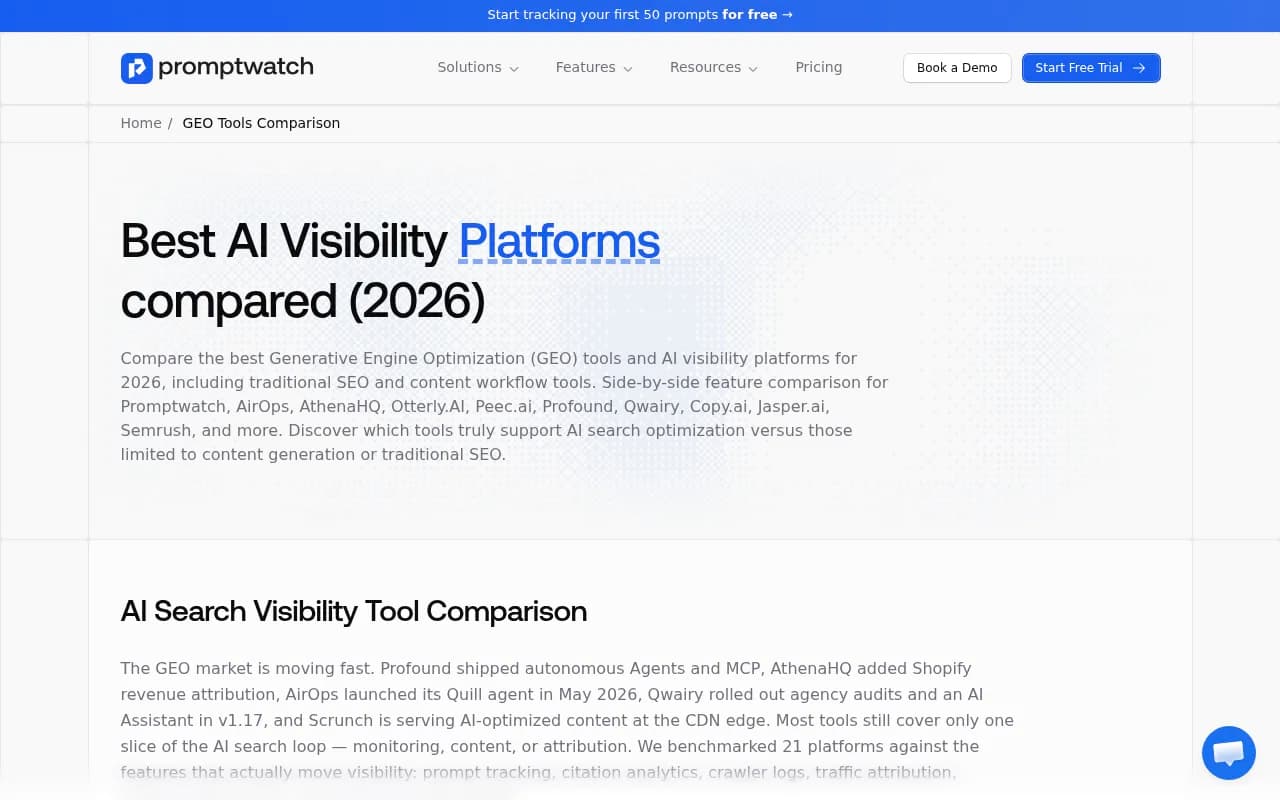
The four platforms at a glance
AirOps
AirOps started as a workflow automation tool for content teams and has evolved into what it calls a "content engineering platform." Its big 2026 move was launching Quill in May -- an AI agent that researches, drafts, and publishes content designed to rank in AI search engines.
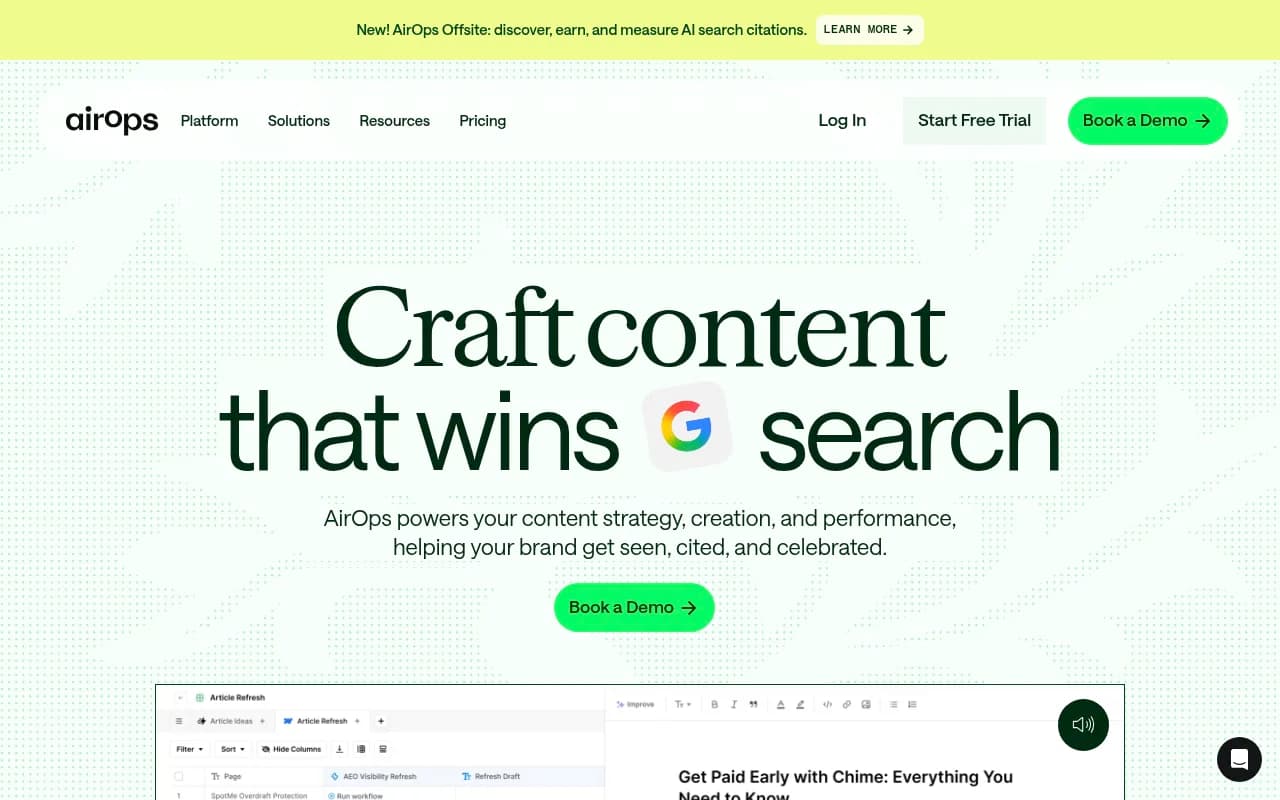
Quill is genuinely interesting. It doesn't just generate text; it analyzes competitor citations, identifies content angles that AI models are pulling from, and produces structured content designed to be cited. For teams that want to scale content production with AI visibility in mind, it's one of the more sophisticated options available.
The gap: AirOps doesn't have native citation tracking. It doesn't show you whether the content Quill produces is actually being cited by ChatGPT or Perplexity. You'd need to pair it with a separate monitoring tool to close that loop. It also lacks crawler logs -- so you can't see whether AI agents are even visiting your new pages.
Best for: Teams that already have a monitoring setup and need to scale content production fast.
Scrunch
Scrunch takes a different approach entirely. Rather than helping you create content and then hoping AI models find it, Scrunch delivers AI-optimized content at the CDN edge -- directly to AI user agents when they crawl your site.
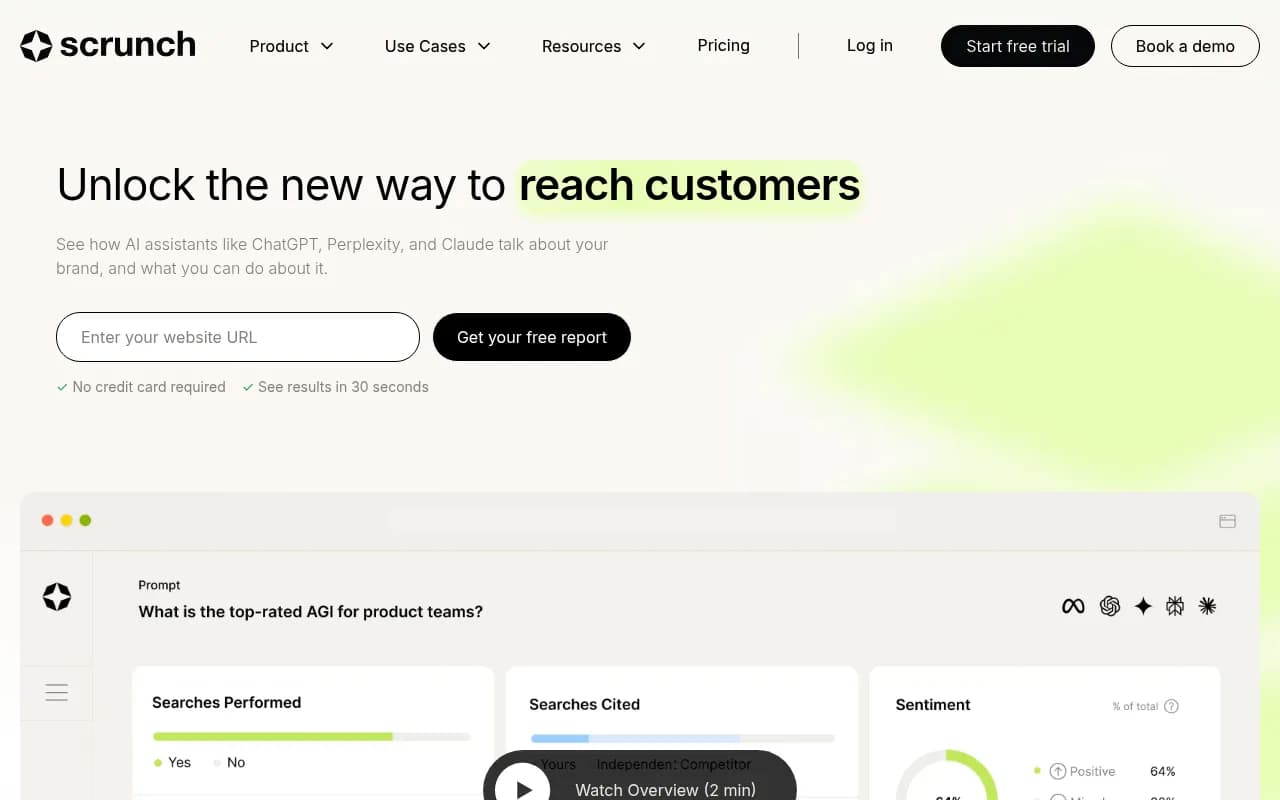
Its Agent Experience Platform (AXP) intercepts crawler requests and serves structured, optimized responses tailored for AI consumption. It also has site auditing features and monitoring capabilities. The CDN-edge delivery angle is genuinely novel -- it's solving a real problem (AI crawlers often struggle with JavaScript-heavy sites) in a technically elegant way.
The gap: Scrunch is strong on delivery but lighter on the strategy side. It doesn't have the depth of prompt intelligence, content gap analysis, or citation analytics that a full AEO platform offers. It's more of an infrastructure layer than a strategy platform.
Best for: Technical teams that want to ensure AI crawlers can read their content properly, or brands with JavaScript-heavy sites that are invisible to AI agents.
Profound
Profound is one of the original purpose-built AEO platforms and still one of the most feature-rich options in the market. It tracks brand mentions across 9+ AI engines, has real prompt volume data (not fabricated queries), front-end response capture (which matters because user-facing answers can differ from API outputs), and an Amazon Rufus shopping module that most competitors don't offer.
Profound
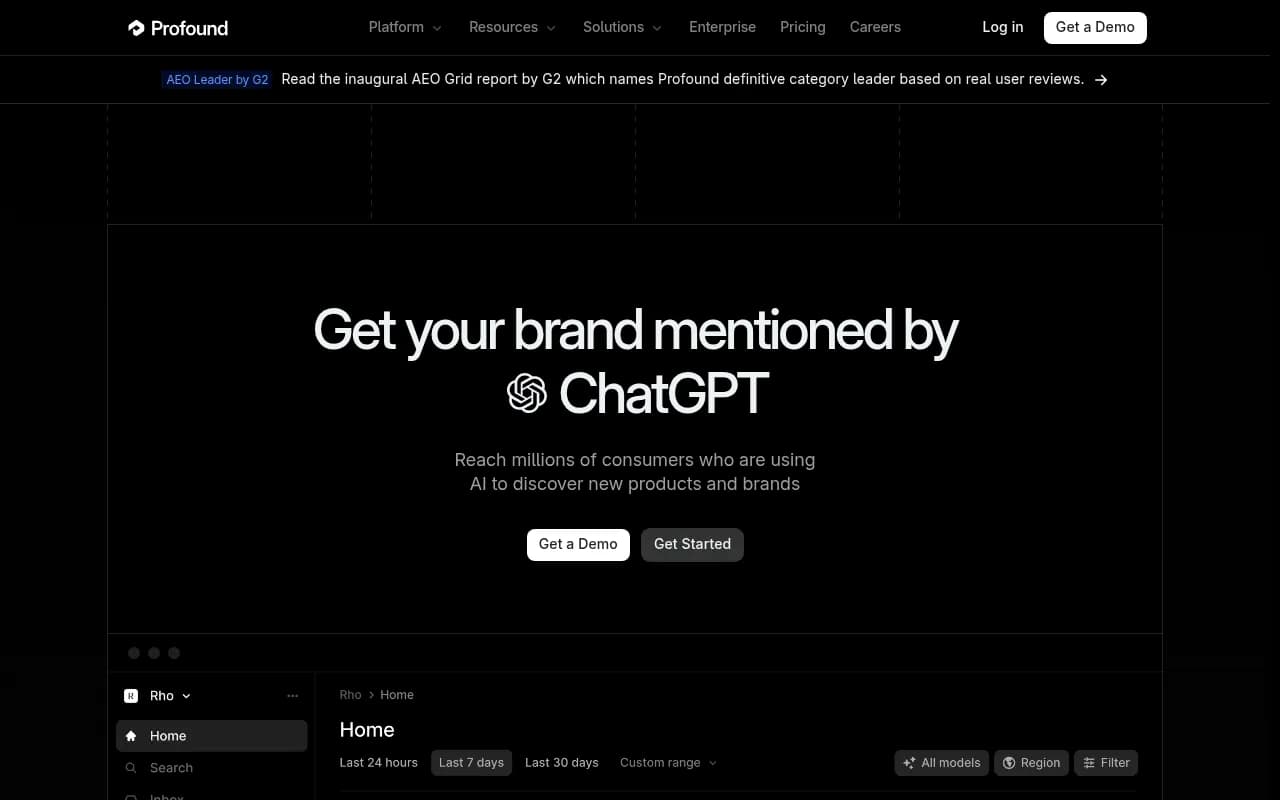
Its Agents feature handles content creation, and its AIM (AI Influence Management) module is designed to help teams act on the data they're seeing. The research and data quality is strong.
The gap: Pricing is a real friction point. The Starter plan at $99/month only covers ChatGPT. Perplexity and Google AIO require the $399/month Growth plan. Claude, Gemini, Grok, and the rest are enterprise-only, with pricing not published. At Growth, you're capped at 100 tracked prompts and 3 user seats. For teams that need broad model coverage without enterprise budgets, that's a problem.
Best for: Enterprise teams with budget flexibility that want deep prompt volume data and Amazon shopping visibility.
Promptwatch
Promptwatch is the platform that most directly attempts to close the full content-to-citation loop in one place. It tracks prompts across 10 AI models (ChatGPT, Perplexity, Google AI Overviews, Google AI Mode, Claude, Gemini, Meta/Llama, DeepSeek, Grok, Mistral, Copilot), generates content through AI Content Agents, and then tracks whether that content gets cited -- including real-time AI crawler logs that show which pages AI agents are visiting, how often, and when a page moves from crawl to citation.

The crawler logs are worth dwelling on. Most platforms show you citation data after the fact. Promptwatch shows you the crawl-to-citation pipeline -- which means you can identify indexing problems before they become visibility problems. If ChatGPT's crawler is hitting your page but not citing it, that's a different problem than if it's not crawling the page at all.
Other features that stand out: Reddit and YouTube insights (surfacing discussions that influence AI recommendations), ChatGPT Shopping tracking, page-level citation tracking, offsite citation analysis, and traffic attribution that connects AI visibility to actual revenue. The Answer Gap Analysis shows exactly which prompts competitors are visible for that you're not -- with specific content recommendations for each gap.
Pricing is more accessible than Profound: Essential at $99/month (1 site, 50 prompts, 5 articles), Professional at $249/month (2 sites, 150 prompts, 15 articles, crawler logs), Business at $579/month (5 sites, 350 prompts, 30 articles).
Best for: Marketing and SEO teams that want a single platform to find gaps, create content, and verify that content is being cited -- without stitching together multiple tools.
Feature comparison
| Feature | AirOps | Scrunch | Profound | Promptwatch |
|---|---|---|---|---|
| Prompt tracking | No | Limited | Yes (9+ models) | Yes (10 models) |
| Content generation | Yes (Quill agent) | No | Yes (Agents) | Yes (Content Agents) |
| Citation tracking | No | Limited | Yes | Yes |
| AI crawler logs | No | Partial (edge) | Yes | Yes |
| Answer gap analysis | No | No | Yes | Yes |
| Reddit/YouTube insights | No | No | No | Yes |
| ChatGPT Shopping | No | No | Yes (Rufus) | Yes |
| Page-level tracking | No | No | No | Yes |
| Traffic attribution | No | No | Limited | Yes |
| Prompt volume data | No | No | Yes (real users) | Yes |
| Offsite citation analysis | No | No | No | Yes |
| Multi-model coverage | No | No | Enterprise only | All plans |
| Entry price | Custom | Custom | $99/mo (ChatGPT only) | $99/mo (all models) |
Where each platform wins
AirOps wins on content production speed
If you have a monitoring setup already and your bottleneck is content creation, Quill is impressive. It's designed specifically for AI search -- not generic SEO content -- and the workflow automation capabilities mean you can scale production without proportionally scaling headcount. The content engineering angle is more sophisticated than most AI writers.
Scrunch wins on technical delivery
For brands with JavaScript-heavy sites, Scrunch's edge delivery approach solves a real problem that monitoring tools can't fix. AI crawlers often can't render JavaScript, which means they see a blank page. Scrunch intercepts those requests and serves structured content directly. That's a legitimate technical advantage.
Profound wins on data depth and shopping
Profound's real-user prompt volume data is genuinely differentiated. Most platforms construct their own queries; Profound's data comes from actual search behavior, which means the prompts it tracks correspond to things real people are asking. The Amazon Rufus module is also unique -- if you're in ecommerce and care about AI shopping recommendations, Profound is one of the few platforms tracking that.
Promptwatch wins on the full loop
The combination of gap analysis, content generation, crawler logs, and citation tracking in one platform is what makes Promptwatch stand out. You can identify a gap on Monday, generate content on Tuesday, see AI crawlers visit the page by Thursday, and track citation growth over the following weeks -- all without leaving the platform or stitching together separate tools.
The Reddit and YouTube insights are also underrated. A significant portion of AI citations come from third-party sources -- Reddit threads, YouTube videos, review sites -- not just your own pages. Knowing which external discussions are influencing AI recommendations gives you a channel most competitors ignore.
The honest trade-offs
No platform is perfect, and it's worth being direct about the limitations.
AirOps is a content tool that has moved toward AI visibility, not an AI visibility platform that added content. That distinction matters when you're trying to build a complete program. You'll need additional tools for monitoring and attribution.
Scrunch is solving a real technical problem, but it's not a strategy platform. It doesn't tell you which prompts to target or which content gaps to fill. It makes your existing content more accessible to AI crawlers -- which is valuable, but it's one piece of a larger puzzle.
Profound has the most mature data infrastructure in this group, but the pricing structure creates a real barrier. Needing to pay enterprise rates to track Claude and Gemini -- two of the most widely used AI search interfaces -- is a significant limitation for mid-market teams.
Promptwatch's content generation, while strong, is still AI-assisted rather than fully autonomous. You're getting briefs and drafts grounded in real citation data, not a fully hands-off publishing pipeline like Quill aspires to be. For teams that want maximum automation on the content side, that's worth noting.
Which platform should you choose?
The answer depends on where your biggest gap is.
If you're starting from scratch and want one platform to run your entire AI visibility program -- tracking, content, and verification -- Promptwatch is the most complete option at an accessible price point. The crawler logs alone are worth it for teams that want to understand why they're not being cited, not just that they're not being cited.
If you're an enterprise team with budget flexibility and care deeply about prompt volume data quality and Amazon shopping visibility, Profound is worth the investment. Just go in knowing that broad model coverage requires enterprise pricing.
If you have a monitoring setup and your constraint is content production speed, AirOps' Quill agent is worth evaluating seriously. Pair it with a monitoring platform and you have a capable stack.
If you have a JavaScript-heavy site and suspect AI crawlers can't read your content properly, Scrunch's edge delivery approach addresses a real technical problem that the other platforms don't solve.
For most marketing and SEO teams in 2026, though, the question isn't which single feature to optimize for -- it's which platform lets you move from "we're not being cited" to "we're being cited" with the fewest tools and the least friction. On that measure, Promptwatch is the most complete answer available right now.
A note on the broader market
The GEO tool market has over 40 platforms now, and most of them are monitoring-only dashboards. They show you where you're invisible and leave you to figure out what to do about it. The platforms worth paying attention to in 2026 are the ones that close the loop -- that connect the data to action.
AirOps, Promptwatch, Profound, and Scrunch are all attempting that in different ways. The fact that they're approaching it from different angles (content engineering, full-stack AEO, data depth, and edge delivery respectively) suggests the market hasn't converged on a single winning approach yet.
What's clear is that "monitoring only" isn't enough anymore. If your AI visibility platform can't help you create content that gets cited and verify that it's working, you're paying for a dashboard when you need a program.