Key takeaways
- AirOps is a strong content engineering platform but is primarily built for teams that already know what to write — it doesn't tell you where your AI visibility gaps are.
- Searchable combines monitoring with content generation but lacks the citation data depth and traffic attribution that more mature platforms offer.
- Junia AI is a capable SEO content writer, but it's not an AI visibility platform — it doesn't track where you appear in ChatGPT, Perplexity, or Google AI Overviews.
- Promptwatch is the only platform in this comparison that closes the full loop: it finds your visibility gaps, generates content grounded in real citation data, and tracks whether that content actually gets cited by AI models.
There's a question that keeps coming up in marketing Slack channels and agency calls in 2026: "We're tracking our AI visibility, but what do we actually do about it?"
That's the right question. And it's where most platforms fall short.
Monitoring tools will tell you that your competitor shows up in ChatGPT's answer to "best project management software" and you don't. That's useful. But then what? You still have to figure out what content to create, write it, publish it, and hope it gets picked up. Most tools leave you stranded at step one.
This comparison focuses on four platforms that at least attempt to solve the full problem: AirOps, Searchable, Promptwatch, and Junia AI. They all have content generation of some kind. But the quality, grounding, and integration with actual AI visibility data vary enormously.
Let's get into it.
What "rankable" actually means in AI search
Before comparing tools, it's worth being precise about what we're trying to achieve. In traditional SEO, "ranking" means appearing on page one of Google. In AI search, the equivalent is being cited in a response from ChatGPT, Perplexity, Claude, Gemini, or Google AI Overviews.
AI models don't cite content randomly. They cite sources that:
- Directly answer the specific question being asked
- Come from domains with existing authority signals
- Use clear, structured language that's easy to extract
- Cover topics that match the prompt's intent at the right depth
Generic AI-written content doesn't meet these criteria. Content that's grounded in real citation data — what's actually being cited for similar prompts right now — has a much better chance. That distinction matters a lot when evaluating these four tools.
AirOps: content engineering for teams that already have a strategy
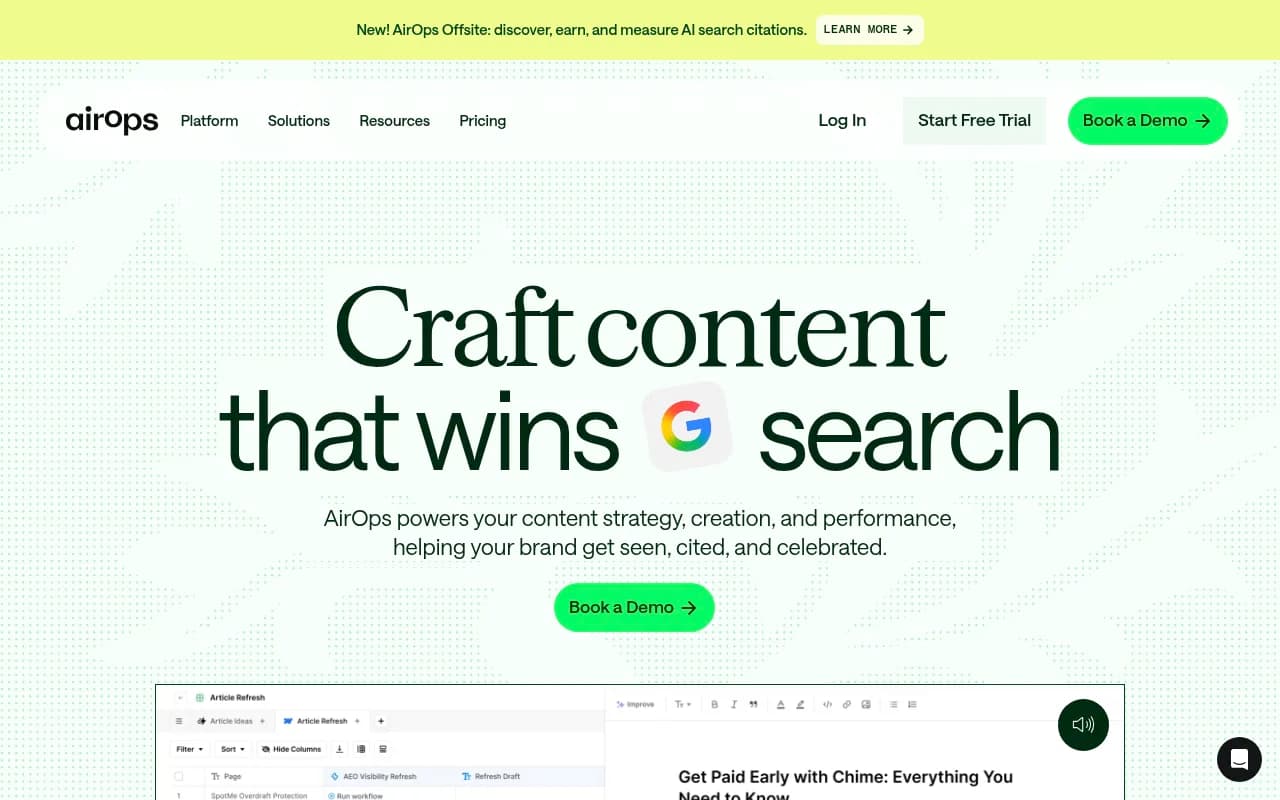
AirOps describes itself as an "end-to-end content engineering platform for AI search visibility," and that's a fair description. It's built for teams that want to produce content at scale and have it optimized for AI search signals.
The platform's strength is workflow. You can build content pipelines that pull in data, run it through AI models, and output structured articles. For teams with a clear content strategy and a backlog of topics to execute, AirOps is genuinely powerful.
AirOps also published a useful 2026 State of AI Search report (in collaboration with researcher Kevin Indig) that maps the signals that mattered most in 2025 — things like entity coverage, structured data, and topical authority. The research is solid and worth reading regardless of which tool you use.
Where AirOps gets complicated is the "what should I write?" question. It's a production tool more than a discovery tool. It doesn't show you which prompts your competitors are appearing for that you're missing. It doesn't surface citation gaps or tell you which topics AI models are actively pulling from. You bring the strategy; it executes it.
That's fine if you have a dedicated SEO or GEO strategist. If you're a marketing team trying to figure out where to focus, AirOps alone won't answer that.
Pricing isn't publicly listed in a simple tier structure — it's positioned for teams and enterprises, and you'll need to talk to sales for a number.
Searchable: monitoring plus content, but still finding its footing
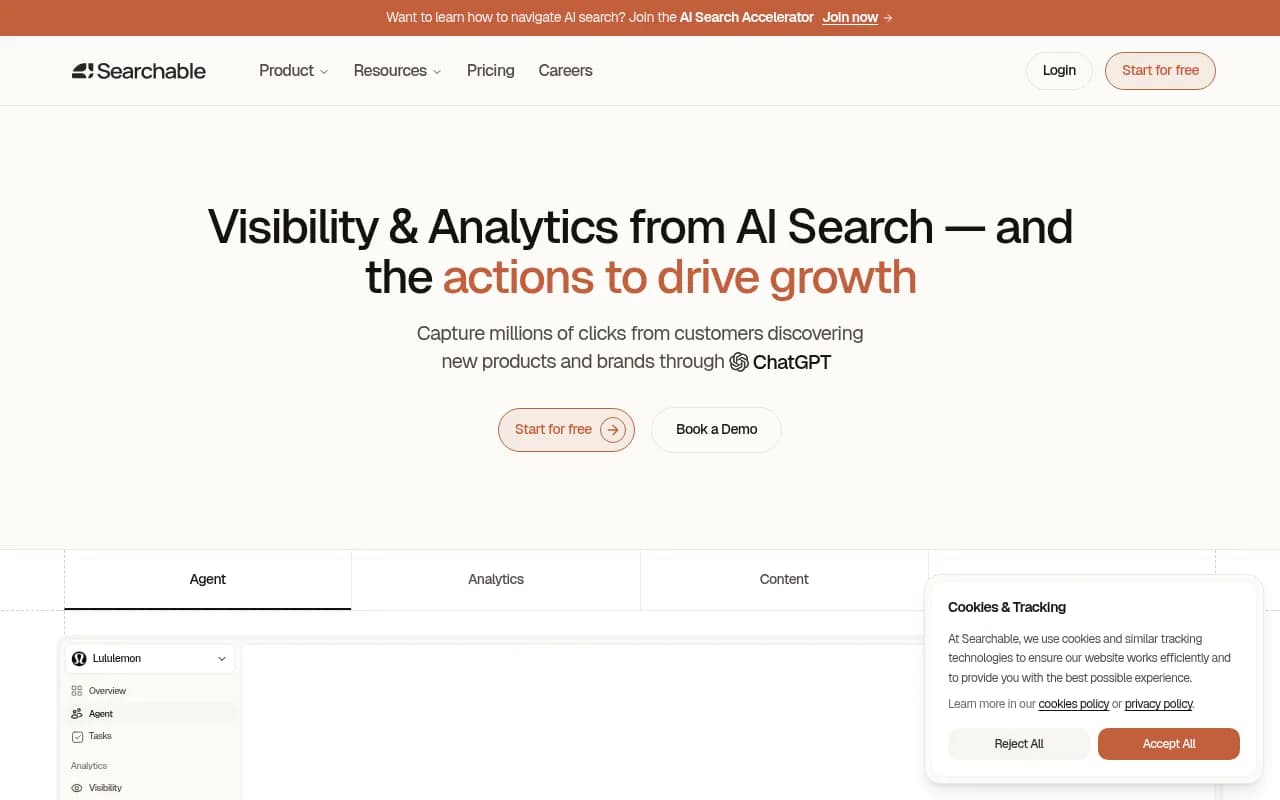
Searchable pitches itself as an "AI Search Visibility Platform with Built-In Content Generation," which is exactly the combination this comparison is about. The idea is right: see where you're invisible, then generate content to fix it.
In practice, Searchable does offer both monitoring and content creation in one interface. For smaller teams that want a single tool rather than stitching together a tracker and a separate AI writer, that's appealing.
The monitoring side covers the major AI engines — ChatGPT, Perplexity, Google AI Overviews — and gives you a view of where your brand appears and where it doesn't. The content generation side lets you create articles based on those gaps.
The limitations become apparent when you dig into the data. Searchable's citation database is relatively thin compared to platforms that have been processing AI responses at scale for longer. The content it generates is competent but not specifically grounded in what's actually being cited by AI models right now. There's also no traffic attribution — you can't connect your AI visibility improvements to actual website visits or revenue.
For a small brand or early-stage team that wants to get started without a big budget, Searchable is a reasonable entry point. For teams that need to prove ROI or operate at scale, the gaps start to show.
Junia AI: excellent SEO writer, not an AI visibility platform
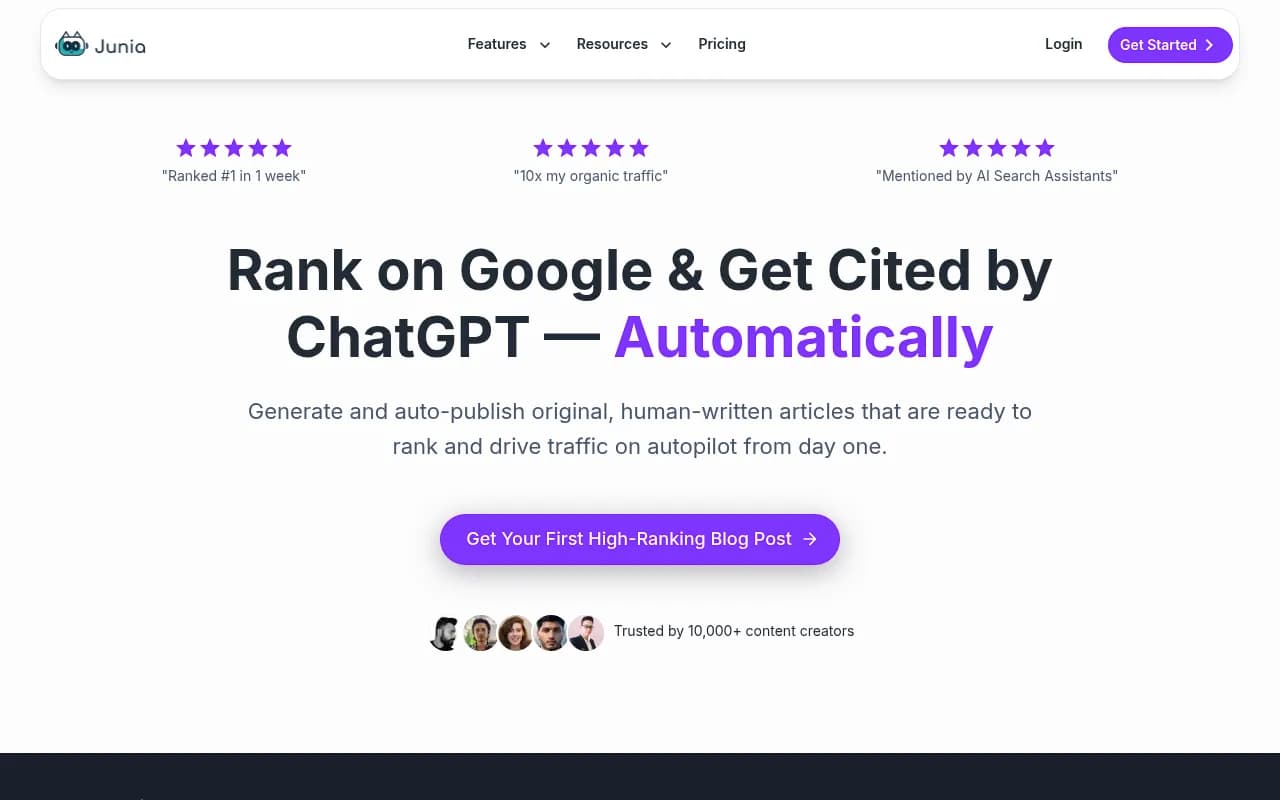
Junia AI is worth including in this conversation because it keeps coming up when people search for "AI content that ranks." It's a capable AI writing platform that generates SEO-optimized articles with solid structure, internal linking suggestions, and keyword targeting.
But here's the honest assessment: Junia is an SEO content tool, not a GEO or AI visibility platform. It doesn't track where your brand appears in ChatGPT or Perplexity. It doesn't show you which prompts your competitors are winning. It doesn't analyze citation patterns across AI models.
What it does well is write long-form content that's optimized for traditional search signals. If you're primarily focused on Google rankings and want AI assistance to produce more content faster, Junia is a solid choice.
If your goal is to appear in AI-generated answers — which is increasingly where discovery happens in 2026 — Junia doesn't give you the data to know whether you're succeeding. You'd need to pair it with a separate monitoring tool, and even then, the content it generates isn't grounded in AI citation data.
It's not a knock on Junia. It's just a different tool for a different job.
Promptwatch: the only one that closes the loop
Promptwatch takes a different approach from the others, and the difference is meaningful.

Most platforms in this space are monitoring dashboards. They show you data. Promptwatch is built around what happens after you see the data — the actual process of improving your AI visibility.
The workflow goes like this:
-
Find the gaps. Answer Gap Analysis shows you the specific prompts where competitors are being cited but you're not. Not vague category-level gaps — the actual questions AI models are answering, with your competitors' content and not yours.
-
Generate content that's grounded in citation data. The built-in AI writing agent creates articles, listicles, and comparisons based on 880M+ citations analyzed across 10 AI models. It knows what kinds of content get cited for which types of prompts, and it uses that to generate something with a real chance of being picked up.
-
Track whether it worked. Page-level tracking shows exactly which of your pages are being cited, by which AI models, and how often. Traffic attribution (via code snippet, Google Search Console integration, or server log analysis) connects those citations to actual visits and revenue.
This cycle — find gaps, generate content, track results — is what makes it an optimization platform rather than a reporting tool.
A few other capabilities that matter here:
- AI Crawler Logs show you when ChatGPT, Claude, Perplexity, and other AI crawlers visit your site, which pages they read, and whether they encounter errors. This is rare among competitors and genuinely useful for diagnosing why content isn't getting cited.
- Prompt Intelligence gives you volume estimates and difficulty scores for each prompt, so you can prioritize the ones worth going after.
- Reddit and YouTube tracking surfaces discussions that directly influence AI recommendations — a channel most platforms ignore entirely.
- ChatGPT Shopping tracking monitors when your brand appears in product recommendations and shopping carousels.
Promptwatch monitors 10 AI models: ChatGPT, Perplexity, Google AI Overviews, Google AI Mode, Claude, Gemini, Meta/Llama, DeepSeek, Grok, Mistral, and Copilot.
Pricing starts at $99/month (Essential: 1 site, 50 prompts, 5 articles), $249/month (Professional: 2 sites, 150 prompts, 15 articles, crawler logs), and $579/month (Business: 5 sites, 350 prompts, 30 articles). Agency and enterprise pricing is available on request.
Side-by-side comparison
| Feature | AirOps | Searchable | Junia AI | Promptwatch |
|---|---|---|---|---|
| AI visibility monitoring | Partial | Yes | No | Yes (10 models) |
| Content gap / answer gap analysis | No | Basic | No | Yes (deep) |
| AI content generation | Yes (workflows) | Yes | Yes | Yes (citation-grounded) |
| Citation data grounding | No | Limited | No | Yes (880M+ citations) |
| AI crawler logs | No | No | No | Yes |
| Traffic attribution | No | No | No | Yes (GSC, snippet, logs) |
| Reddit / YouTube tracking | No | No | No | Yes |
| ChatGPT Shopping tracking | No | No | No | Yes |
| Prompt volume / difficulty scores | No | No | No | Yes |
| Competitor heatmaps | No | Basic | No | Yes |
| Multi-language / multi-region | Limited | No | Yes | Yes |
| Pricing (entry) | Custom | Not listed | ~$19/mo | $99/mo |
| Best for | Content teams with strategy | Small teams starting out | SEO content production | Full GEO optimization cycle |
Which tool is right for you?
The honest answer depends on what problem you're actually trying to solve.
Choose AirOps if you have a content team that already knows what topics to target and needs a scalable production workflow. It's powerful for execution but won't tell you where your AI visibility gaps are.
Choose Searchable if you're a small team or solo marketer who wants a single tool that does basic monitoring and content generation without a steep learning curve or price tag. Expect to outgrow it.
Choose Junia AI if your primary goal is traditional SEO content production and you want AI assistance to write faster. Don't expect it to help you appear in ChatGPT or Perplexity.
Choose Promptwatch if you want to actually improve your AI search visibility, not just measure it. The combination of answer gap analysis, citation-grounded content generation, crawler logs, and traffic attribution is the most complete approach available in 2026. It's the only platform here that treats AI visibility as something you can systematically improve, not just observe.
The content generation question, answered honestly
The original question in this comparison was whether these platforms produce content that actually gets cited by AI models. Here's the direct answer:
Generic AI content — the kind that rewrites your existing pages or produces keyword-stuffed articles without understanding what AI models actually cite — rarely works. The platforms that generate content grounded in real citation patterns have a structural advantage.
AirOps generates content at scale but doesn't ground it in citation data. Searchable tries but has limited data depth. Junia generates good SEO content that isn't designed for AI citation at all.
Promptwatch's content generation is built on top of 880M+ analyzed citations, which means the articles it produces are shaped by what's actually working in AI search right now. That's a meaningful difference — not just in theory, but in whether the content you publish ends up cited in the answers your customers are reading.
If you're serious about AI search visibility in 2026, the monitoring-only era is over. The question isn't "where do we appear?" anymore. It's "what are we going to do about it?"