Key takeaways
- AthenaHQ, Otterly.AI, and Peec.ai are solid monitoring tools — they show you where your brand appears (or doesn't) in AI search engines, but largely stop there.
- The "monitoring-only trap" is real: knowing you're invisible in ChatGPT or Perplexity is only useful if you can do something about it.
- Promptwatch is the only platform in this comparison that closes the loop — from gap analysis to AI content generation to citation tracking — making it an optimization platform rather than a dashboard.
- If your team just needs basic brand tracking, Otterly.AI or Peec.ai may be enough. If you want to actually move the needle on AI visibility, you need something that helps you act.
There's a pattern playing out across marketing teams right now. Someone buys an AI visibility tool, sets up their brand prompts, and watches the dashboard for a few weeks. They see that competitors are getting cited in ChatGPT and Perplexity. They see that their own brand barely shows up. And then... they're stuck.
The data is clear. The problem is obvious. But the tool has nothing more to offer.
That's the monitoring-only trap, and it's affecting a lot of teams using AthenaHQ, Otterly.AI, and Peec.ai in 2026. This guide breaks down what each platform actually does, where each one stops, and why the gap between "monitoring" and "optimization" matters more than most buyers realize before they sign up.
What we're actually comparing
These four platforms all sit in the GEO (Generative Engine Optimization) and AI visibility category. They help brands understand how they appear — or don't appear — in AI-generated answers from tools like ChatGPT, Perplexity, Google AI Overviews, Gemini, and others.
But they're built around very different philosophies about what a tool in this category should do.
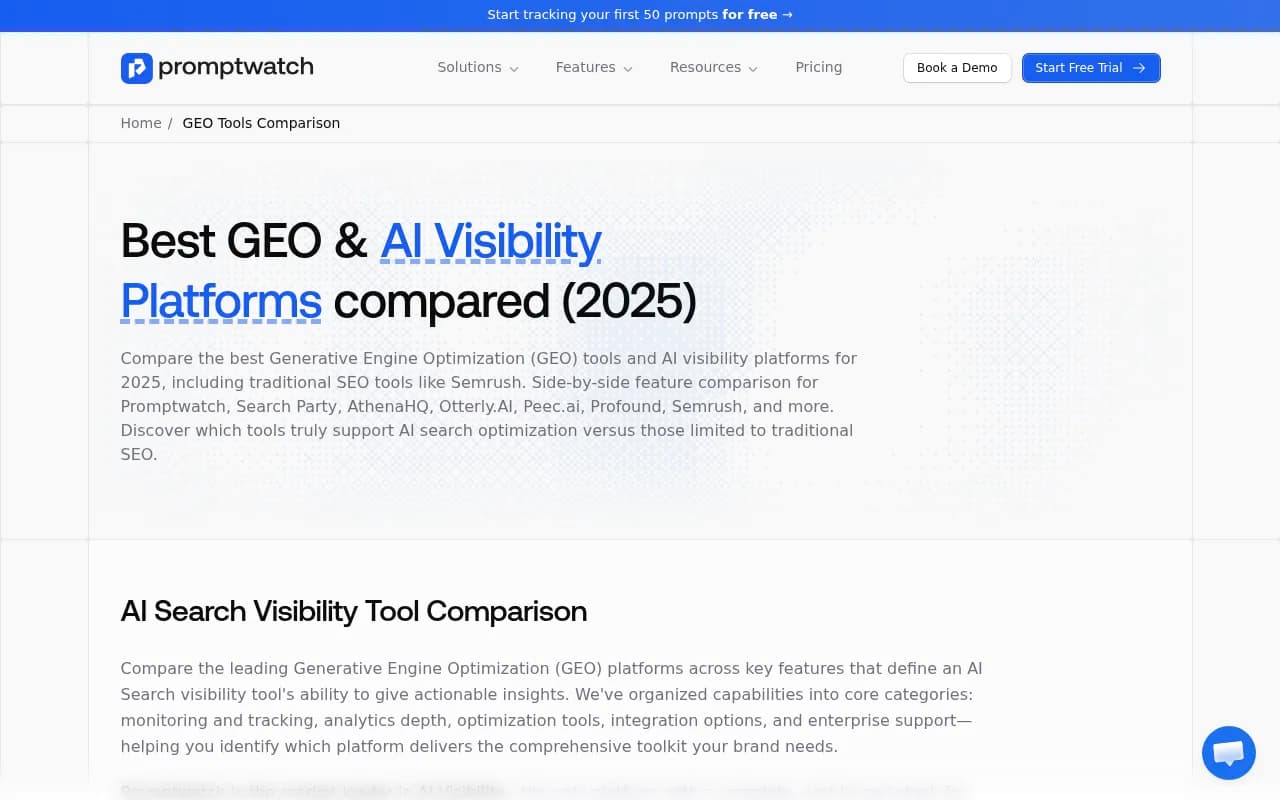
Here's a quick feature comparison before we go deeper:
| Feature | AthenaHQ | Otterly.AI | Peec.ai | Promptwatch |
|---|---|---|---|---|
| AI model coverage | Multiple | ChatGPT, Perplexity, AI Overviews | Multiple | 10+ models |
| Brand mention tracking | Yes | Yes | Yes | Yes |
| Competitor visibility | Yes | Yes | Yes | Yes |
| Prompt volume / difficulty scoring | Limited | No | No | Yes |
| Answer gap analysis | Limited | No | No | Yes |
| AI content generation | No | No | No | Yes |
| AI crawler logs | No | No | No | Yes |
| Reddit / YouTube insights | No | No | No | Yes |
| ChatGPT Shopping tracking | No | No | No | Yes |
| GA4 / GSC integration | Yes | No | Advanced plans | Yes |
| Traffic attribution | No | No | No | Yes |
| Multi-language / multi-region | Limited | Limited | Yes (115+ languages) | Yes |
| Free trial | Yes | Yes | Yes | Yes |
| Starting price | ~$199/mo | ~$29/mo | $95/mo | $99/mo |
Otterly.AI: the entry-level option
Otterly.AI is probably the most accessible tool in this group. It earned Gartner Cool Vendor recognition in 2025 and has strong user reviews (reportedly 4.9/5 across 250+ reviews), which tells you something about how well it works for its intended use case.
Otterly.AI

That use case is brand monitoring. Otterly.AI tracks how your brand appears in ChatGPT, Perplexity, and Google AI Overviews. You set up prompts, it runs them, and you see where you show up. The interface is clean, the setup is fast, and the price point (starting around $29/mo) makes it easy to justify.
What it doesn't do: help you fix anything. There's no content gap analysis, no AI content generation, no crawler logs, no prompt difficulty scoring. If you discover that a competitor is getting cited for "best project management software for remote teams" and you're not, Otterly.AI will show you that gap. It won't help you close it.
For small teams or solo marketers who just want a lightweight pulse on AI visibility, Otterly.AI is a reasonable choice. For teams that need to move the needle, it's a starting point, not a solution.
Peec.ai: solid monitoring with some depth
Peec.ai sits a step above Otterly.AI in terms of data depth. It tracks what real users see in AI interfaces (not just API outputs, which can differ), supports 115+ languages, and offers unlimited seats across all plans — which is genuinely useful for larger teams.

The pricing is structured around prompt volume: $95/mo for 50 prompts across 3 AI models, $245/mo for 150 prompts and 2 projects, $495/mo for 350 prompts with multi-country support and GSC/GA integrations. That's competitive with Promptwatch's pricing tiers, though the feature set at each tier is quite different.
Peec.ai also suggests prompts based on your industry, which helps teams that aren't sure where to start. And the UI scraping methodology (tracking what users actually see, not synthetic API responses) is a meaningful technical differentiator.
But the same ceiling applies. Peec.ai is a monitoring and analytics platform. It tells you where you stand. It doesn't generate content to improve your standing, doesn't show you AI crawler activity on your site, and doesn't connect visibility data to actual traffic or revenue.
AthenaHQ: the most optimization-adjacent of the three
AthenaHQ is the most interesting of the three monitoring-focused tools. Multiple sources describe it as "optimization-led" compared to pure monitoring plays, and it does have some features that push toward action — particularly its native GA4 and Google Search Console integrations, which are available on self-serve plans (not just enterprise tiers).

It also has documented case studies showing measurable AI visibility improvements, which is more than most tools in this category can point to. If you're evaluating monitoring tools and want the one most likely to give you something actionable, AthenaHQ is the strongest of the three.
That said, "optimization-adjacent" isn't the same as "optimization." AthenaHQ doesn't generate content. It doesn't have AI crawler logs showing which pages AI bots are reading on your site. It doesn't have prompt volume data or query fan-outs that help you prioritize which gaps to close first. It shows you the problem more clearly than Otterly.AI or Peec.ai, but it still largely leaves the solving to you.
The monitoring-only trap, explained
Here's the core issue. In traditional SEO, monitoring tools were enough because the optimization work happened in a separate workflow. You'd check rankings in Ahrefs or Semrush, then go write content or build links. The tools were decoupled from the work.
AI search doesn't work that way. The content that gets cited by ChatGPT or Perplexity is specific — it answers particular questions in particular ways. Understanding which questions you're missing requires prompt-level data. Knowing what to write requires seeing what AI models are actually pulling from your competitors. And confirming that your new content is working requires tracking when AI crawlers visit your pages and when those pages start getting cited.
That's a closed loop. And monitoring-only tools only give you the first part of it.
The teams that are winning in AI search right now aren't just watching dashboards. They're identifying specific prompt gaps, creating content engineered to fill those gaps, and tracking the results at the page level. That workflow requires a platform built around action, not just observation.
Promptwatch: where monitoring becomes optimization
Promptwatch is built around that closed loop. The core workflow is: find the gaps, create content that fills them, track the results.

The "find the gaps" part is Answer Gap Analysis — it shows you exactly which prompts competitors are visible for that you're not, with prompt volume estimates and difficulty scores so you can prioritize. You're not guessing which gaps matter. You're looking at data on which prompts have real search volume and which ones you can realistically win.
The "create content" part is Content Agents — AI-generated articles, listicles, comparisons, and briefs grounded in real prompt data, citation data, competitor analysis, and your brand guidelines. This isn't generic SEO content. It's content built specifically to answer the questions AI models are already exposing as gaps on your site.
The "track results" part is where Promptwatch separates itself most clearly from the competition. AI Crawler Logs (available on the Professional plan at $249/mo) show you in real time which AI crawlers — ChatGPT, Claude, Perplexity, and others — are hitting your site, which pages they're reading, what errors they encounter, and when pages move from crawled to cited. Most competitors don't have this at all.
Beyond that: Reddit and YouTube insights surface discussions that directly influence AI recommendations. ChatGPT Shopping tracking monitors when your brand appears in product recommendations and shopping carousels. Traffic attribution connects AI visibility to actual revenue, not just citation counts. And multi-language, multi-region support with customizable personas means you can track how AI models respond to your actual customers, not just generic English-language queries.
Promptwatch tracks 10 AI models: ChatGPT, Perplexity, Google AI Overviews, Google AI Mode, Claude, Gemini, Meta/Llama, DeepSeek, Grok, Mistral, and Copilot. That's broader coverage than any of the three monitoring-only tools in this comparison.
Pricing: Essential at $99/mo (1 site, 50 prompts, 5 articles), Professional at $249/mo (2 sites, 150 prompts, 15 articles, crawler logs), Business at $579/mo (5 sites, 350 prompts, 30 articles). A free trial is available.
Which tool is right for your situation
The honest answer is that it depends on what you're trying to accomplish.
If you want to know whether your brand shows up in AI search and you have a small budget, Otterly.AI gets you started cheaply. If you want more data depth and unlimited team access, Peec.ai is worth evaluating. If you want the most analytics-connected monitoring experience without going to a full optimization platform, AthenaHQ is the strongest of the three.
But if you're trying to actually improve your AI visibility — not just measure it — none of the three monitoring tools give you the workflow to do that. You'll hit the ceiling fast, and you'll end up doing the optimization work manually with no data to guide you.
The teams getting real results from AI search in 2026 are the ones treating it like a content strategy problem, not a monitoring problem. They're identifying specific gaps, creating content to fill them, and tracking the feedback loop from crawl to citation to traffic. That's what Promptwatch is built for.
A note on where the market is heading
The monitoring-only category isn't going away. For brands that just want a pulse on AI visibility, simple dashboards will always have a place. But the gap between monitoring and optimization is becoming harder to ignore as AI search captures more of the traffic that used to go to traditional search results.
Google AI Overviews, ChatGPT search, and Perplexity are now answering questions that used to send users to websites. If your brand isn't in those answers, you're not just missing citations — you're missing the consideration stage entirely. Knowing you're invisible is step one. Having a system to fix it is what actually matters.
The platforms that will define this category in the next two years are the ones that close the loop between data and action. Right now, in a comparison of these four tools, only one of them does that.