Key takeaways
- B2B SaaS buyers ask AI for shortlists. The prompts that matter most are category ("best X for Y"), alternatives ("alternatives to [competitor]"), comparison, and pricing prompts.
- Headline prices are misleading. Tools charge per prompt, per engine, per answer, or per credit, so compare cost per tracked prompt-engine pair.
- A mid-market SaaS team usually needs 150 to 450 prompts. Entry plans with 15 to 50 prompts are enough to start, not to run a program.
- Monitoring alone leaves the work to you. Look for citation data, crawler visibility and a way to act on gaps.
- Most rankings you will find online are written by vendors who place themselves first. Check pricing on the vendor's own page.
Why SaaS needs its own prompt tracking setup
A SaaS buyer used to open Google, scan ten blue links, then hit G2. Now a lot of them ask a chatbot for a shortlist first. G2 surveyed 1,076 B2B software buyers in March 2026 and, according to the KeepSync write-up of that survey, 54% said AI chatbots shape their shortlist most, ahead of review sites at 43%. If you are not in that first answer, the deal starts without you, and nothing in your CRM shows it happened.
Prompt tracking fixes the blind spot. You give a tool the questions your buyers ask, it reruns them on a schedule across ChatGPT, Gemini, Perplexity, Google AI Overviews and others, and you see who gets recommended, in what order, and which pages the AI cites.
One thing to understand before you buy anything: a single prompt tells you very little. Promptwatch Data found that 47.6% of ChatGPT responses with citations name 10 or more different domains (Sep 28 to Oct 4, 2026), and organic prompts like "best project management software for small teams" are the most crowded at 52.5%. Brand-specific prompts draw on fewer sources. So you want many prompts, tracked over time, with attention to position and tone, not just a yes/no on mentions.
The prompts B2B SaaS teams should track
Build the set around how buyers actually type, including segment and use case. Short keywords are the wrong model.
| Prompt type | Example | What it tells you |
|---|---|---|
| Category | best project management software for remote teams | Whether you make the shortlist |
| Alternatives | alternatives to Notion for technical docs | Whether you are suggested to buyers ready to switch |
| Comparison | [your product] vs [competitor] | How AI weighs you head to head |
| Pricing and ROI | is Gong worth the price for a 30-person sales team | What AI says about cost and value |
| Role or use case | best analytics tool for product managers | Which audiences AI associates with you |
| Integrations, security | does [product] integrate with Salesforce | Whether trust and fit questions go your way |
Start with category and alternatives prompts, because they decide shortlist membership. Add comparisons for your top two or three competitors, then integration and price prompts. Pricing prompts deserve extra attention: AI often pulls numbers from third-party pages that are out of date, and that is where wrong claims about your pricing come from.
The sources that feed these answers are mostly not your homepage. Promptwatch's software citation data (organic prompts, Sep 28 to Oct 4, 2026) shows GitHub, Microsoft's docs and G2 leading, with Capterra and Gartner also in the top group. Docs and help centers earned the largest share, and vendor sites plus docs together earned about three times the share of review sites. Keep your docs strong and your G2 and Capterra profiles current.
How these tools charge (and why headline prices mislead)
Pricing models do not line up. Some tools bill per prompt, some per engine, some per answer, some in credits, some in euros. The KeepSync analysis prices one setup, 50 prompts on four engines checked daily, and finds a spread of roughly $56 to $250 a month depending on the tool. That is a vendor-authored article, so treat the numbers as directional.
Three questions cut through it:
- How many prompts do I get, and does a prompt tracked on two engines count once or twice?
- How often does it run? Daily on every plan, or weekly on the cheap tier?
- Are the engines tracked from the real user interface or via API? User-facing answers and citations can differ from API output.
Prompt tracking tools compared
Prices below come from vendor pages as quoted in third-party roundups. Confirm on each vendor's pricing page before buying.
| Tool | Entry price | Entry plan prompts | Engines | Notes for B2B SaaS |
|---|---|---|---|---|
| Promptwatch | $95/mo (Essential) | 50 | All supported models on every plan | Tracking plus content, crawler logs, traffic attribution |
| Peec AI | $95/mo | 50 | 3 on Starter, 11 in total | Strong competitor benchmarking |
| Otterly.AI | $29/mo | 15 to 20 | 3 per plan, 7 in total | Cheapest way in |
| LLM Pulse | EUR 49/mo | 50 | 5 | Weekly on the entry plan, daily costs more |
| Semrush AI toolkit | $99/mo per domain | 25 | 2 to 3 | Sits next to SEO data |
| Profound | Free 7-day trial, then custom | 50 on trial | 3 on trial, up to 9 | Enterprise, sales-led |
| AthenaHQ | Free tier, then $295/mo | Credit-based | Up to 11 models | Widest model list |
| Rankscale | $20/mo | Credit-based | 17+ | Hourly to monthly frequency |
| Ahrefs Brand Radar | $199/mo add-on | 2,500 checks | 6 indexes | Custom prompt tracking from $50 |
Promptwatch
Promptwatch is the one I would put first for a SaaS team that wants to do something with the data, and I should say plainly that it is also a prompt tracking vendor and the platform 1001 SEO Media uses. It tracks the real interfaces of ChatGPT, Google AI Overviews, AI Mode, Gemini, Perplexity, Copilot and others, with prompt volumes and difficulty scores, personas, and query fan-outs. Where it goes past monitoring: Brand Narrative pulls out the individual claims AI makes about you ("expensive for small teams" is exactly the kind of pricing claim you want to catch), citation tracking covers G2-type directories plus Reddit and YouTube, and IP-verified crawler logs show whether AI bots can read your pricing and docs pages at all. The Content Agent then writes and publishes pages against the gaps, and visitor analytics measure what AI traffic converts.

Pricing: Essential $95/mo (50 prompts), Professional $245/mo (150 prompts, 2 projects), Business $579/mo (350 prompts, Content Agent, faster-than-daily tracking, Fact Check). Annual billing is 12 months for the price of 10, and there is a 7-day free trial on monthly billing. Confirm at promptwatch.com/pricing. Compare it head to head with Promptwatch vs Peec, vs Profound or vs Otterly, or run the free AI visibility report first.
Peec AI
Peec tracks three engines properly rather than many thinly, and it is popular for competitor benchmarking. Starter is $95/mo for 50 prompts, Pro $245 for 150 prompts, Advanced $495 for 350 prompts with multi-country tracking and Looker Studio. It is a monitoring tool. No crawler logs, no content generation.

Otterly.AI
The cheapest credible entry: Lite at $29/mo, Standard $189 for 160 prompts, Premium $489 for 535 prompts. For an early-stage SaaS that just wants to watch its 15 most important prompts, it is enough. Pricing climbs fast when you need a real prompt set, and KeepSync puts a full SaaS setup near $248.
Otterly.AI

LLM Pulse
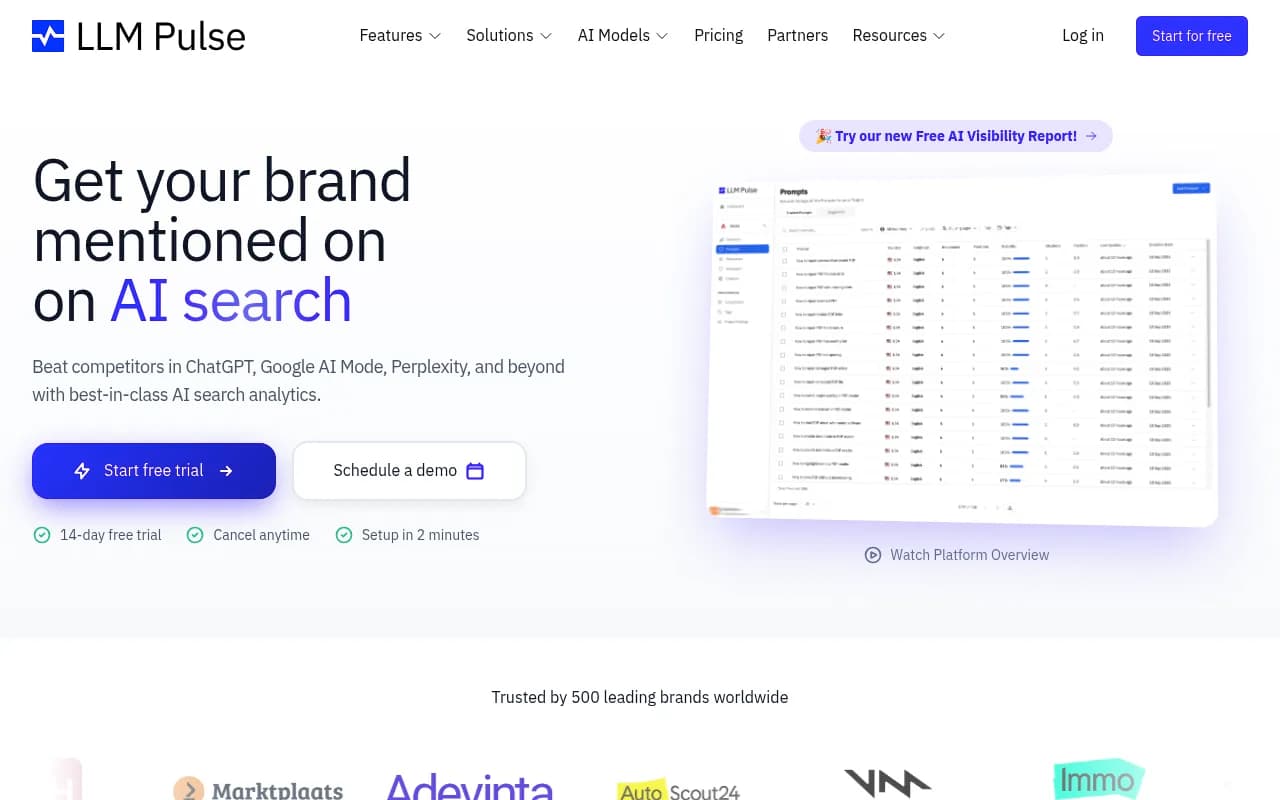
EUR 49/mo for 50 prompts on five engines (ChatGPT, Perplexity, Gemini, AI Overviews, AI Mode), Growth EUR 99 for 150 prompts, Scale EUR 299 for 450. The catch from KeepSync's math: the entry plan is weekly, and daily tracking costs about $94 for the same 50 prompts. LLM Pulse's own SaaS guide recommends itself first, so weigh that.
Semrush AI toolkit
Good if your team lives in Semrush already. $99/mo per domain gets 25 daily prompts on ChatGPT Search, AI Mode and Gemini with cited domains. Fixed prompt sets and shallower AI-specific data are the tradeoff.
Profound
Enterprise-oriented, with up to nine answer engines and custom pricing after a 7-day trial. It suits large SaaS companies with budget for sales-led onboarding. Expect higher price points than the mid-market tools above.
Profound

AthenaHQ
Credit-based tracking across 11 models, free tier with 300 credits, then $295/mo. Pick it if model breadth is your main criterion.

Rankscale and Ahrefs Brand Radar
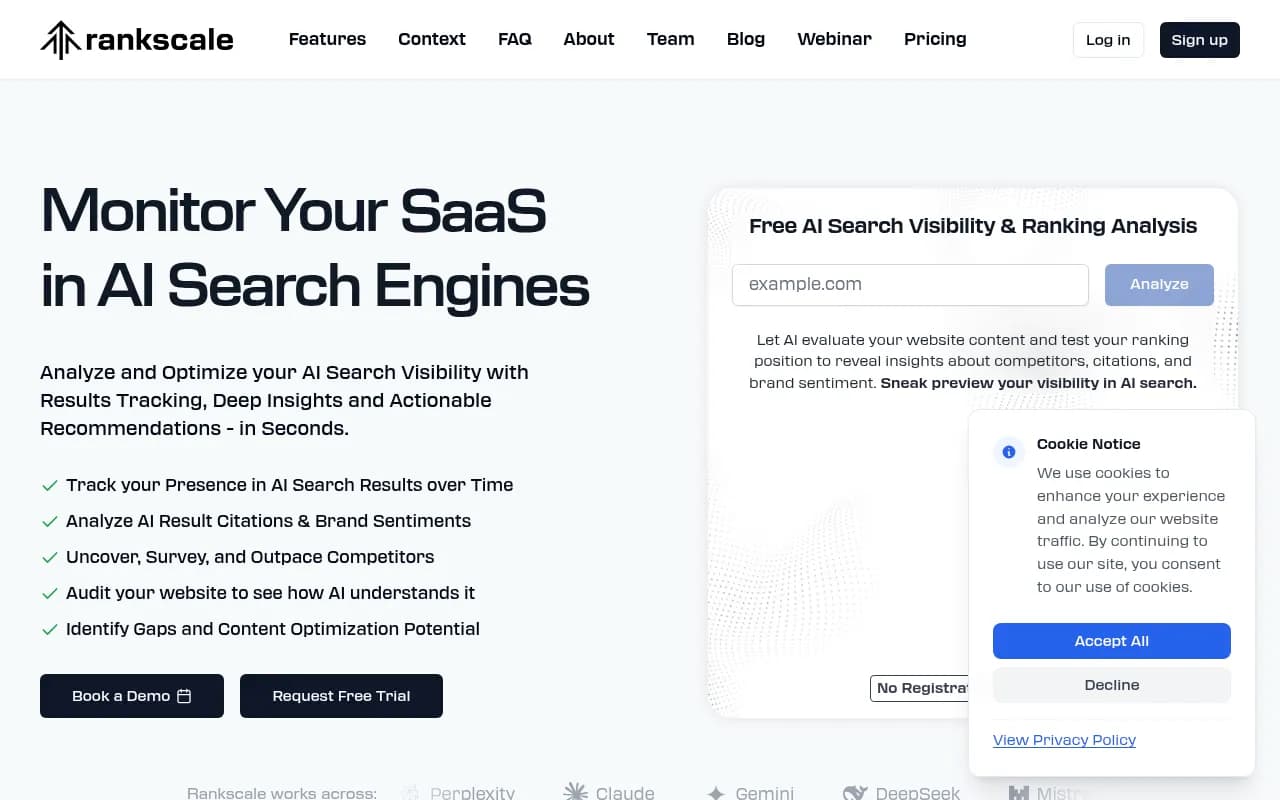
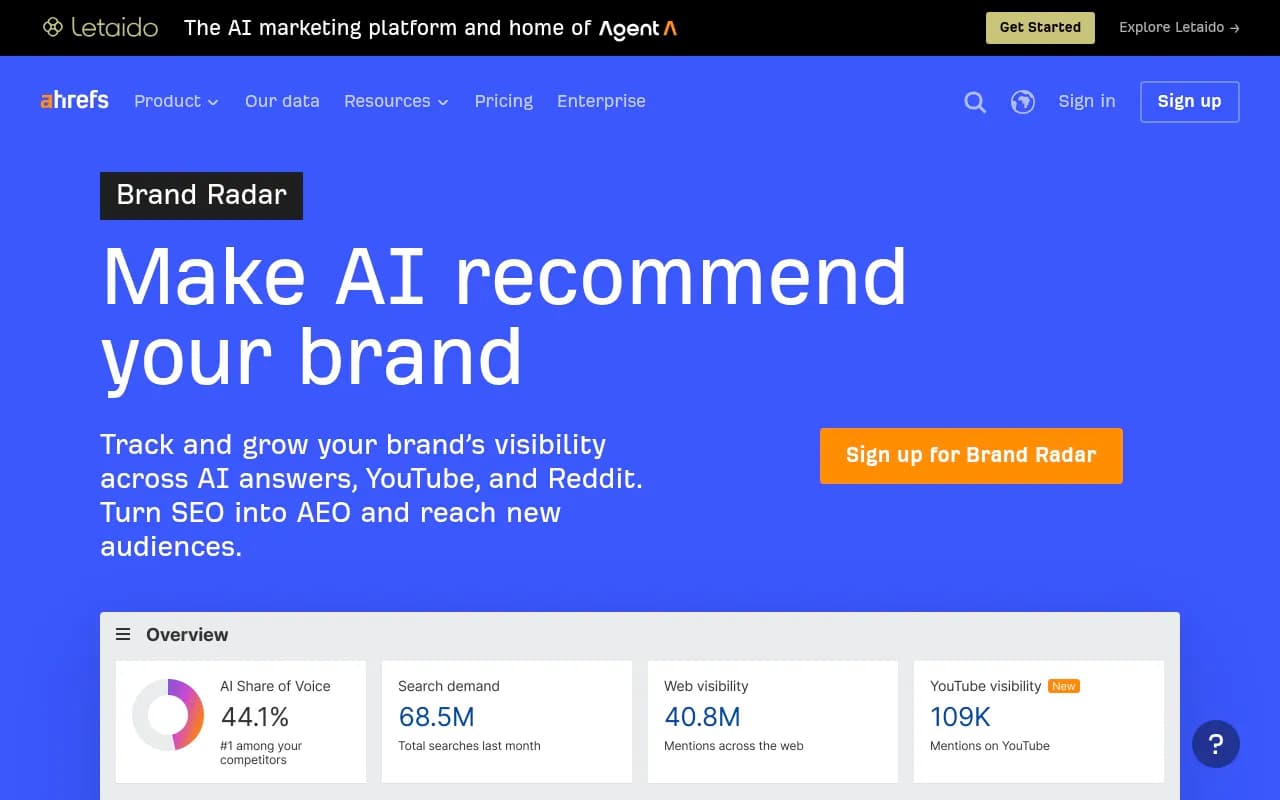
Rankscale starts at $20/mo with credits (120 credits cover up to 480 answers) and flexible frequency. Ahrefs Brand Radar starts at $199/mo for a platform index, with custom prompt tracking from $50 for 2,500 checks. Brand Radar is useful if you already have Ahrefs data.
Alternatives: matching the tool to your situation
| Situation | Likely fit |
|---|---|
| Seed stage, need to see 15 prompts | Otterly.AI Lite |
| Small team, 50 prompts, want to act on results | Promptwatch Essential or Peec Starter |
| Already on Semrush or Ahrefs | Their AI add-ons, then reassess |
| Mid-market, multiple product lines | 150 to 450 prompts: Promptwatch Professional/Business, Peec Pro/Advanced, LLM Pulse Growth/Scale |
| Enterprise with sales-led procurement | Profound, or Promptwatch Enterprise |
| Agency running SaaS clients | Promptwatch agency plans from $199/mo |
If you want a wider survey, the GEO software directory at bestgeosoftware.com lists more options.
How many prompts do you actually need?
LLM Pulse suggests 150 to 450 prompts for mid-market SaaS with multiple product lines and ICPs. That matches what I see in practice. Fifty prompts gets you through category, alternatives and comparison for one product and two or three competitors. Beyond that, each persona, integration and pricing question adds up quickly.
A sensible split for 150 prompts: about 40 category and use-case, 40 alternatives and comparison (one alternatives prompt per main competitor, plus head-to-heads), 30 pricing and ROI, 20 integration and security, 20 branded. Group them into topics so you can score each cluster separately.
Tracking pricing prompts specifically
Pricing prompts are where AI misleads buyers most often, and where tracking pays off fastest.
- Write them as buyers do: "how much does [product] cost for 50 seats", "is [product] worth it for a small team", "[A] vs [B] pricing".
- Read the claims, not just the mention. A tool that extracts individual statements (like Promptwatch's Brand Narrative) lets you see "no free plan" or "expensive" repeated across models.
- Trace the source. Wrong pricing usually comes from an old review page, a comparison post or a Reddit thread. Fixing it means updating or contacting that page, not rewriting yours.
- Make your own pricing page crawlable. If AI bots cannot read it, they cite someone else's version. Crawler logs show whether that is happening.
What the fan-out data means for your prompt set
The long conversational prompts you track are not what ChatGPT searches for. Promptwatch's query fan-out data shows the average at about 2.15 web searches per response in December 2025, easing to about 1.84 by March 2026, and query length dropping from roughly 117 characters to about 53 by April. The actual queries are short and keyword-like. (The page's intro still says 3 to 8 searches, which conflicts with the measured averages, so lean on the measurements.)
Practically: write headings on your comparison, pricing and alternatives pages the way people write search queries, and cover the sub-questions: X vs Y, pricing, alternatives, how-to.
A starting sequence
- Define the prompt set: category, alternatives, comparison, pricing, integrations, security.
- Pick two or three tools and run trials with the same 50 prompts. Compare cost per tracked prompt-engine pair, not headline price.
- Track weekly at minimum, daily if you can afford it. Review 7-day and 30-day trends instead of single runs.
- Check which pages get cited, especially G2, Capterra, Reddit and competitor comparison posts.
- Turn gaps into work: a stronger comparison page, an updated FAQ, a review-site refresh. Then check whether the next run moved.
Monitoring that never turns into content or outreach is a dashboard you pay for. The tools that close the loop earn the higher price.
Mistakes to avoid
- Trusting vendor-written rankings. LLM Pulse, KeepSync and MentionBird each place themselves first in their own guides. Use them for data points, then verify.
- Tracking only branded prompts. They flatter you and tell you nothing about shortlist odds.
- Reading one run as truth. Responses vary. Look at trends.
- Ignoring crawlability. A great page AI cannot fetch earns nothing.
- Skipping the competitor view. Position and who is named alongside you matter as much as presence.
FAQ
Which AI engines should a B2B SaaS track first?
ChatGPT, Google AI Overviews and Perplexity cover most buyer research, with Gemini and AI Mode next. Tools with every model on every plan remove the trade-off.
How much should I budget?
Expect $95 to $250 a month for a serious 50 to 150 prompt setup, and $500 or more once you need 350 prompts, faster tracking or content execution. Entry tiers under $30 work for a proof of concept.
Is a tool bundled in my SEO suite enough?
It can be a good start. Suites tend to have fixed prompt sets and thinner AI-specific data, so reassess once AI becomes a real pipeline channel.
Where can I find more tools?
The AI rank tracking directory at ai-rank-tools.com and the agentic SEO tools directory at agenticseotools.com cover the wider category.