Key takeaways
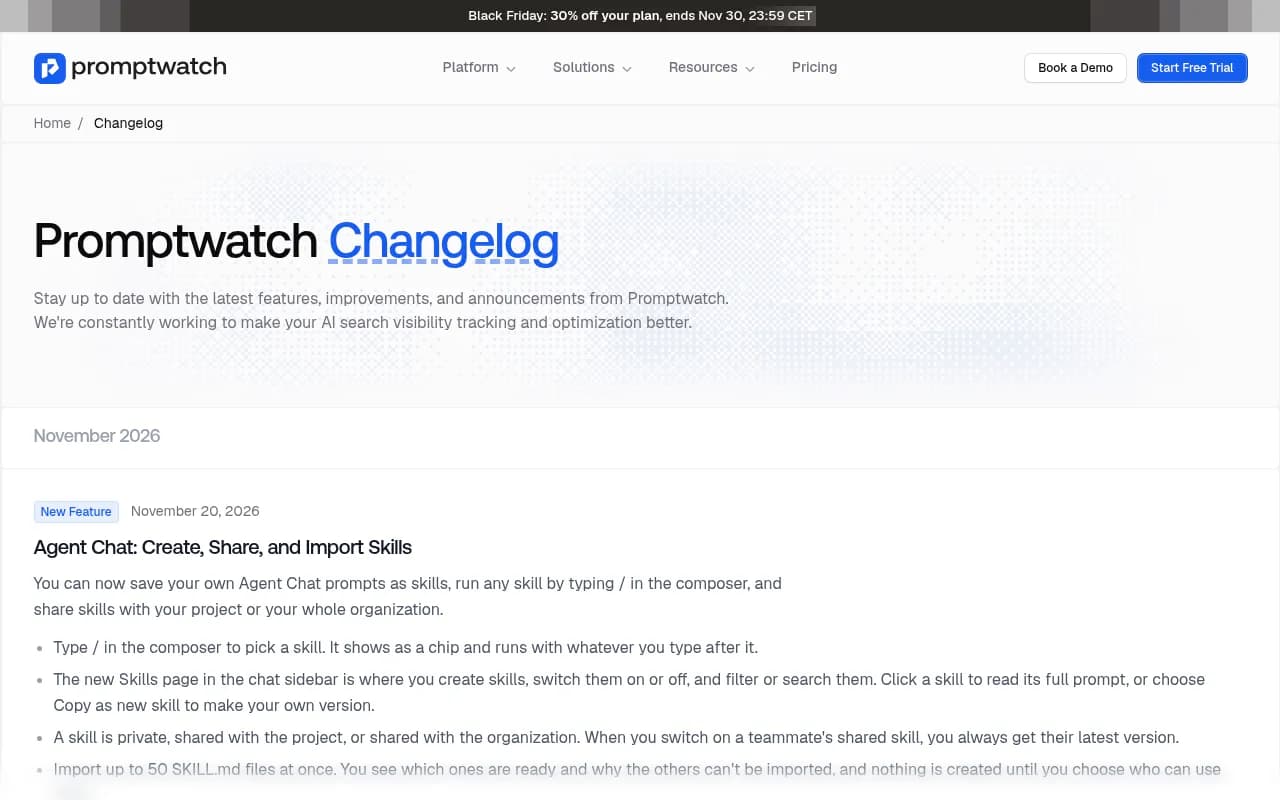
- The most recent Promptwatch changelog entries (November 13, 2026) are about doing work: submitting pages through IndexNow, scheduling content, tuning audits. Reporting is no longer the main story.
- Crawler logs, site audits, and indexing signals are being wired into the same product as prompt tracking, because AI visibility problems are often access problems.
- Agencies are being productized with per-plan report quotas, and everything is exposed through REST API, MCP, and Agent Chat.
- ChatGPT changed its search behavior overnight in August 2026, which is the best argument for continuous monitoring over one-off audits.
- Changelogs are underrated buyer research. Read the vendor's, and the competitors', before you sign anything.
Why read a changelog at all
Marketing pages tell you what a vendor wants to be. A changelog tells you what the team actually shipped this month. For a category as young as GEO (generative engine optimization), that difference matters. Everyone claims to be an "AI visibility platform", and the gap between a dashboard and a system that helps you fix problems shows up in the release notes long before it shows up on a homepage.
This guide reads the Promptwatch changelog as a case study. Promptwatch is one vendor, and I'm not claiming its roadmap is the whole industry's. But it ships often, publishes its notes publicly, and the November 2026 batch is detailed enough to draw some real conclusions. One caveat up front: I've only read the full text of the November entries. The September through April items (including GEO 360: Topic Insights on September 8) are listed in the changelog index, but I haven't verified their details, so I lean on them lightly.

What the November 13 batch actually shipped
Here is the list, trimmed to what matters.
| Release | What it does | What it signals |
|---|---|---|
| AI Visibility Reports for Agencies | PDF showing how ChatGPT, Gemini, and Google AI Mode answer about any site, ready in about five minutes. Quotas: Kick-off 20, Growth 40, Scale 60 per month | Agency pitching and onboarding are being productized |
| IndexNow | Submit new or changed pages to search engines instead of waiting for a recrawl | Freshness is now a lever you pull, not a thing you wait for |
| Ignore URLs in Site Audits | Skip a page, folder, or regex match so it isn't fetched, scored, or listed | Audits are being tuned for real, messy sites |
| Content Agent calendar | Drag pieces to a new day or time; background jobs no longer move pieces you scheduled yourself | Autonomous agents need human override |
| Topics: Manage tab | Suggested prompts that share words with a topic; nothing saves until you confirm | Prompt sets are being curated, not just dumped in |
| Sentiment and Citations dashboard tabs | Brand-by-topic heatmap; cited domains, top URLs, YouTube, Reddit, and LinkedIn posts; scheduled reports can follow any tab | Reporting is getting more granular |
| HubSpot + Cloudflare crawler log setup | Joins existing WP Engine, Webflow, Shopify, and Kinsta guides | Crawler data has to work on the stacks people really run |
| Smaller improvements | Language picker in Prompt Explorer, Host column in Crawler Logs, per-project AEO article allocation, new article structure | Multi-market, multi-project use is common enough to need plumbing |
None of these is glamorous. That is sort of the point.
Trend 1: from dashboard to execution loop
The first generation of GEO tools answered one question: was my brand mentioned? Plenty of them still stop there. The Promptwatch entries read differently. IndexNow, the Content Agent calendar, and the new article format (key takeaways at the top, each heading answered in its first lines, a FAQ at the end) are all about producing and shipping pages, then telling search engines about them.
That is a loop: find the gap, write the page, publish it, notify the index, check whether crawlers came, check whether it got cited. The same changelog covers most of those steps. If you want the longer argument for why this matters, Promptwatch's own comparison, the best GEO and AI visibility platforms compared in 2026, frames the market as monitoring-only tools versus end-to-end platforms.
My honest take: execution features are also where the risk sits. A tool that writes and publishes on a schedule can flood your site with mediocre pages. The calendar fix is a tell that the vendor knows this. Letting people drag a piece to a new slot, and stopping background jobs from overriding manual scheduling, is the kind of boring control that separates a useful agent from one you have to babysit.
Trend 2: crawler data moves next to citation data
Two entries point the same way: the HubSpot plus Cloudflare setup guide, and the Host column that flags crawler requests from hostnames outside your project. Both are about getting trustworthy server-side data into the product.
Why does that matter? Because a missing citation has at least two causes. Either AI engines can't read the page, or they read it and chose someone else. Prompt tracking alone can't tell those apart. Crawler logs can.
Promptwatch Data gives context for why this is getting more urgent. In its AI crawler traffic report, which covers IP-verified requests from June 8 to September 6, 2026, OpenAI accounted for 79.8% of verified requests in the week of August 31 to September 6, down from 94.8% in the week of June 8 to 14. The mix is diversifying. Separately, the Meta-WebIndexer report shows that crawler going from roughly 2% to nearly 38% of tracked AI crawler requests between mid-July and August 9, 2026.
The practical read: your robots.txt and CDN rules from a year ago probably don't cover the bots hitting you today. The report's own advice is to compare your logs against the overall mix, since a provider that's large overall but near zero on your site suggests you're blocking it. Promptwatch's AI crawler logs feature exists for exactly that check, and its free AI crawler URL inspector is a low-effort first pass.
Trend 3: continuous monitoring beats the quarterly audit
The strongest argument for products that run all the time came from outside the changelog. On August 8, 2026, ChatGPT Search started using the site: operator at scale. According to Promptwatch's site: operator report, the share of fanout queries using it jumped from about 0.37% to 16.8% in a single day, and average fanout queries per response rose from about 1.08 to about 1.83. Nobody announced it.
Six days later, reddit.com's share of ChatGPT citations fell from roughly 4% to 0.5%, as documented in Promptwatch's Reddit citation data. If you had audited in July and planned a Reddit strategy around it, you were working from stale assumptions by mid-August.
This explains a bunch of the smaller changelog items. Weekly site audits, scheduled reports that follow any dashboard tab, and the Sentiment and Citations tabs all assume the ground moves under you. Even the audit ignore rules fit: if you run continuous audits, noise (staging folders, parameter URLs) wastes your attention fast, so you need a way to suppress it.
If you're building a measurement habit, the query fan-outs explainer in Promptwatch's Academy is worth ten minutes, because fanout behavior is the thing that changed in August.
Trend 4: agencies get a product, not a pricing tier
The agency reports entry is the most commercially telling one. A PDF that shows how ChatGPT, Gemini, and Google AI Mode answer about any website, in about five minutes, is a sales and onboarding artifact. The quotas (20, 40, and 60 reports a month across Kick-off, Growth, and Scale) show the vendor thinking about how agencies actually work: pitching prospects, then reporting on clients.
Some details I like. The New report dialog shows a sample first page before you run anything. Burst requests queue instead of failing. A retry only re-asks the answers that are still missing, which saves real money when you're running dozens of reports. One oddity: reports ask Google AI Mode instead of Perplexity, so if a prospect cares specifically about Perplexity, you'll want to check that separately.
For agencies weighing platforms, Promptwatch's agency page and the GEO for agencies guide cover the workflow in more depth. Always confirm current plan details at promptwatch.com/pricing, since limits change.
Trend 5: everything gets an API
Count how many entries mention the REST API, MCP, or Agent Chat. Moving calendar pieces works through all three. That's deliberate. As GEO moves from a person staring at a dashboard to agents and scripts operating on the data, a platform without programmatic access becomes a dead end.
This is probably the least visible but most durable shift. If your team already lives in Claude, Cursor, or ChatGPT, a tool you can query and instruct from there will get used more than a tool with a better chart. The MCP server docs show the surface area.
Trend 6: freshness signals and technical hygiene come into scope
IndexNow is a small feature with a large implication. GEO vendors started as monitors of third-party AI engines. Adding IndexNow means they now touch classic search infrastructure too, because AI engines like ChatGPT lean on web search indexes. If your new page isn't indexed, it can't be retrieved, however well written.
The setup is plain: generate or paste a key under Project settings, verify it, then pick pages to submit from a list filtered by All, Changed since submission, Never submitted, and Failed. Every attempt is logged, failures included, with the reason IndexNow gave. That last detail is more useful than it sounds, because silent submission failures are exactly the kind of thing that wastes weeks.
The same hygiene theme runs through the audit changes. A health score you can't trust because it counts junk URLs is worse than no score.
How to read any GEO vendor's changelog
You can apply this method to any tool, not just Promptwatch. Here's what I look for.
- Cadence. Monthly or faster is healthy. A changelog that went quiet in the spring is a warning.
- Ratio of new surfaces to polish. Both matter. All new features and no fixes means a product that's brittle. All fixes means it's stalled.
- Closing the loop. For each new feature, ask: does it measure, diagnose, fix, or verify? A product that only measures is a dashboard.
- Data provenance. Do notes mention how data is collected, such as real interfaces versus APIs, IP verification for crawlers? Promptwatch publishes methodology with its data reports, which is a good sign. Compare to vendors who don't.
- Escape hatches. API, MCP, exports, manual overrides. If an agent can do something but you can't undo it, be wary.
A quick comparison across the category
The table below is a rough orientation, drawn from how the tools position themselves. Check each vendor's own changelog and pricing before deciding.
| Category of tool | Typical strength | Typical gap | Examples |
|---|---|---|---|
| End-to-end GEO platforms | Tracking plus content, crawler logs, publishing | Higher price than basic trackers | Promptwatch |
| Enterprise monitoring | Deep tracking, reporting for large brands | Pricey, less execution | Profound, Scrunch |
| Lightweight trackers | Cheap, quick to start | No crawler logs or content workflow | Otterly.AI, Peec AI |
| SEO suites with AI add-ons | Familiar interface, existing data | Fixed prompt sets, shallower AI data | Semrush, Ahrefs Brand Radar |
| Content generators | Fast drafting | Little grounding in citation data | AirOps, Jasper |
Profound

Otterly.AI




For head-to-head views, Promptwatch publishes pages such as Promptwatch vs Profound and Promptwatch vs Peec. Keep in mind these come from the vendor itself, so read them as one side of the argument. For a wider view of the category, the GEO software directory at bestgeosoftware.com lists many more options.
What third-party reviewers say
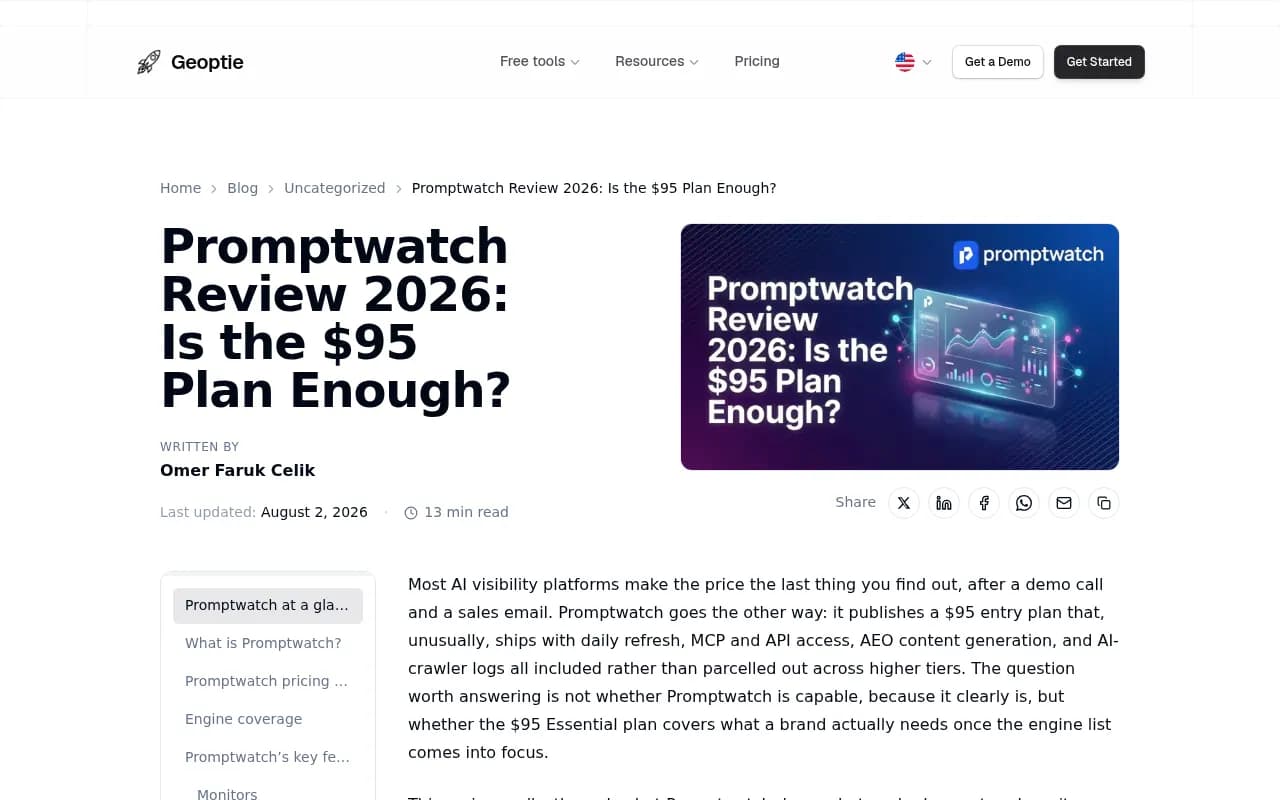
It's worth checking the vendor's story against outside views. A review on Geoptie describes Promptwatch's $95 Essential plan as unusually complete for the price, with daily refresh, MCP and API access, content generation, and crawler logs, while noting the interface is still maturing on a fast-moving product. Geoptie is also a competitor, so weigh that accordingly. SE Visible's review frames the buying decision around how many clients you report on and whether writers will ship content from inside the platform. Those two questions are good ones, and they line up with the execution and agency threads in the changelog. Plan details differ between sources and change often, so treat reviews as directional and confirm on the pricing page.
What this means for your 2026 planning
- Pick a measurement baseline now. Run a free scan, such as Promptwatch's free AI visibility report, so you know where you stand before changing anything.
- Check crawler access first. If AI bots can't read your pages, content work is wasted. Start with robots.txt, CDN, and WAF rules for every provider, not only OpenAI.
- Treat indexing as part of GEO. Use IndexNow or equivalent so new pages are discoverable.
- Decide how much execution you trust to automation. A review inbox before auto-publish is a sensible starting point, and you can loosen it once quality holds.
- Re-run fanout and prompt analysis after any major engine change. Keyword mappings built before August 8 are stale.
- Evaluate vendors by their changelog, not their pitch deck.
If you want a trial, Promptwatch offers a 7-day free trial on monthly billing, and you can start one here. A Black Friday promotion of 30% off was running through November 30 at the time of writing, so check the pricing page for what applies when you read this.
What to watch next
The September to April entries I didn't verify, including Topic Insights, are the place to look for earlier signals, and the changelog index at promptwatch.com/changelog is the primary source. Check it monthly. Then do the same for every other vendor on your shortlist. The ones that ship execution, verification, and access features steadily are the ones turning GEO into a channel you can run. The ones that only add charts will still be telling you that you're invisible next year.
For more tools in this category, the AI rank tracking directory at ai-rank-tools.com is a useful next stop, and Promptwatch's full dataset index at promptwatch.com/data tracks how engine behavior keeps shifting.