Key takeaways
- A wrong AI claim usually comes from one of two places: a page the engine read, or something the model learned before its training cutoff. The fix is different for each.
- Brand Narrative extracts the individual claims AI makes about you and competitors. Fact Check lets you mark a claim accurate or inaccurate, then finds the pages on your site that state it.
- Most wrong claims trace back to stale copies of a fact: old pricing pages, archived PDFs, partner listings, directories.
- Do not blame a page until you can quote the wrong sentence on it. Retest after the fix, and keep a log.
- Fact Check is on Promptwatch's Business, Agency Scale and Enterprise plans. Brand Narrative is on every plan.
Why claims matter more than mentions
Most AI visibility reporting stops at a question: was my brand mentioned? That is a fine first question. It is a poor last one.
An AI answer is often the first description of your company a buyer reads. If it says your starter plan costs $29 when you retired that price two years ago, the buyer shows up to the sales call with that number in their head. Nobody at your company wrote the claim, and nobody will see it until a customer complains.
This is not a rare edge case. Profound's research across 50,000 LLM responses found that 47% of response content is unsolicited, meaning the engine adds its own commentary about the brand instead of only answering the question asked. That is Profound's number from its own dataset, so treat it as one data point, but it matches what anyone sees when they read a few hundred responses. Engines editorialize. And some of that editorializing is wrong.
There are two separate problems here. First, what does AI actually claim about you? Second, which of those claims are false, and where did they come from? Brand Narrative handles the first. Fact Check handles the second.
What Brand Narrative does
Brand Narrative pulls individual claims out of every tracked AI response. Not the whole answer, the claims inside it. Things like "affordable for small teams" or "its mobile app lacks features."
From there it:
- groups repeated claims together
- shows how often each claim appears and which models say it
- files claims under themes such as Pricing, Features, Support or Reputation
- gives each theme a 0-100 score you can compare against competitors
Promptwatch includes Brand Narrative on every plan, which matters because it is the discovery step. You cannot fact-check claims you have never read. A visibility score of 62 tells you nothing about whether ChatGPT thinks your product is expensive or Gemini believes you dropped a feature.

Reading themes, not just claims
Individual claims are noisy. Themes are where patterns show up. If your Support theme scores far below a competitor's and the underlying claims all say "slow response times," that is a reputation problem and probably not a factual one. If your Pricing theme is full of claims that contradict your pricing page, that is a factual problem, and a fixable one.
This split matters. Reputation problems get fixed with reviews, case studies and product work. Factual problems get fixed by finding and correcting sources. Mixing them up wastes weeks.
What Fact Check does
Fact Check starts with a judgment from you. You open a claim in Brand Narrative and mark it Accurate or Inaccurate. Then Fact Check reads the pages crawled from your site and finds the ones that state the claim or its opposite. You get quotes and a recommended next step.
The point is the last part. You learn which of your pages the engine is probably learning the wrong thing from, with the sentence on screen.
Fact Check is available on Business, Agency Scale and Enterprise, and it uses Agent Credits. Check promptwatch.com/pricing for current plan details.
How this differs from the alternatives
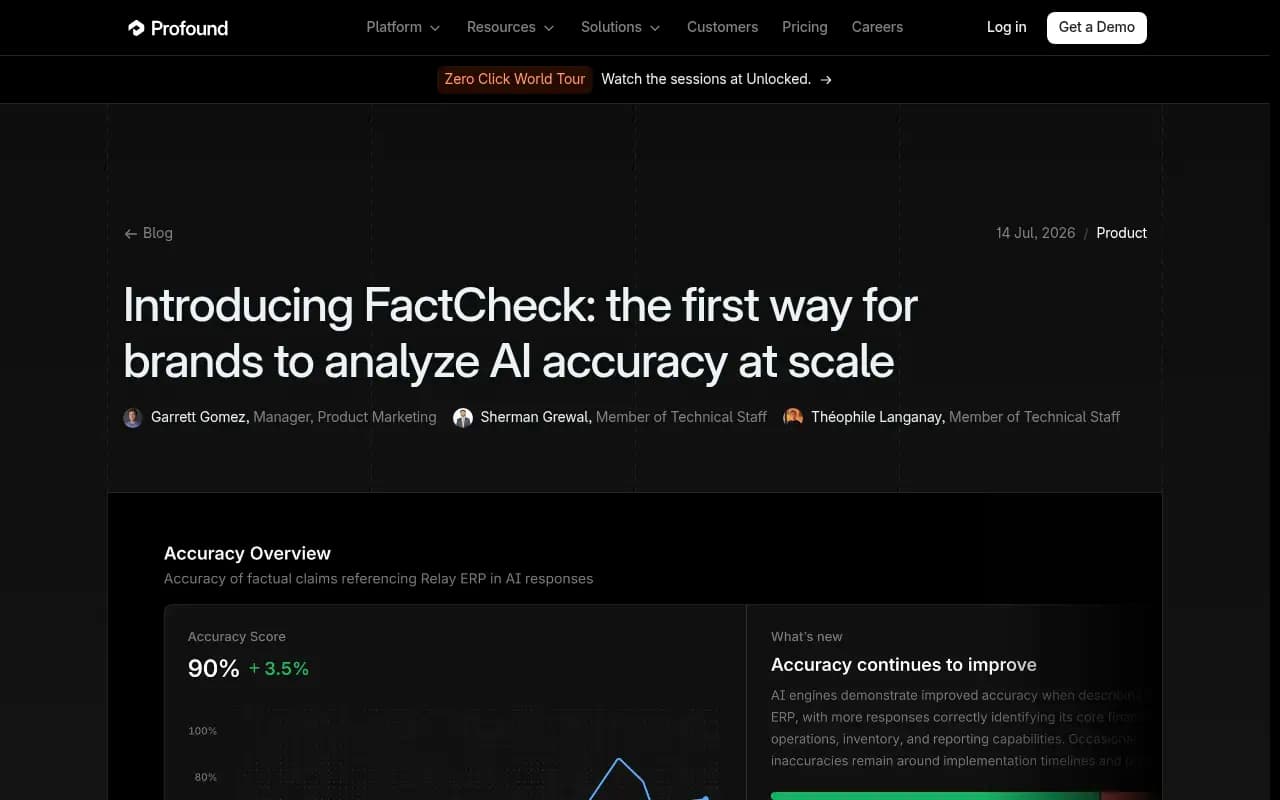
Profound launched a product also called FactCheck in July 2026. It compares claims against a customer-maintained Knowledge Base and attributes inaccuracies to URLs and domains. It is a real product aimed at the same problem, so it is worth a look if you are comparing options.
Profound

The broader category is small. Some visibility trackers, such as LLMClicks, advertise hallucination detection, but detection alone is half the job.

The approach I prefer is the one where detection feeds a fix and the fix gets measured. In Promptwatch that loop continues: the Action Board prioritizes what to change, the Content Refresh tool gives git-diff-style edits for existing pages, and Page Tracker and crawler logs show whether the corrected page got read and cited afterward. You can compare the full field in the GEO platform comparison, or browse the directory at bestgeosoftware.com.
Two sources of a wrong claim
Before chasing a page, work out whether a page is even involved. A wrong answer comes from one of two places.
| Page-driven | Model-driven | |
|---|---|---|
| How it gets there | The engine searches, reads a few pages, summarizes them | The model learned the fact before its training cutoff |
| What you usually see | Citations under the answer, one carrying the wrong fact | No citation, or citations that do not contain the fact |
| What can move it | Correcting the cited page or giving the engine a better one | The right fact stated widely enough to reach the next model |
| When it moves | When the engine next reads the page | With a newer model, if then |
| How to test | Wrong with search on, right or vague with it off | Wrong with search off |
The test in the last row is worth running. Ask the same question with web search on and off. If the wrong claim only appears with search on, a page is feeding it. If it appears either way, the model has it baked in, and editing one page of yours will not change much.
This is why monitoring the real interfaces matters. Promptwatch tracks the live ChatGPT, Google AI Overviews, Gemini and Perplexity interfaces alongside API models, so the page-driven versus model-driven split is visible in your data instead of guessed at. Background on method is in the how Promptwatch collects data guide.
Your fact has more copies than you think
Here is the part most teams skip. When Fact Check points at one page, it is usually not the only page.
Omnibound published a useful invented-but-realistic example. A brand states its starter price in nine places. The pricing page says $45. A 2024 PDF says $39. An archived page says $49. A partner page says $39. An AI-written summary page says $29. Four of nine copies disagree with the pricing page, and the engine has no way to tell which one is current.
That example is not a measured result, but I would bet most B2B brands find something similar the first time they look. It also changes how you should think about the fix. You are not correcting a page. You are reducing disagreement across every place a fact lives.
Inventory every copy of one fact
Pick the fact that is hurting you most, usually price or a feature, and do this:
- Write the approved value and the page that states it. This is your master record.
- Search your own site for the old value and old names, including archived pages, help articles, PDFs and downloads.
- Search directories, partner and reseller pages, review sites and press, using current and former wording.
- Look at forums and community posts, plus AI-written summary pages that mention you.
- Log each copy: where it appears, the value it states, when it was last updated, and how directly it answers a buyer question.
Then count disagreement before you count errors. A table like this makes the shape of the problem obvious:
| Where the copy lives | Copies | Copies that differ |
|---|---|---|
| Old pages on your site | 7 | 5 |
| Directory listings you did not claim | 9 | 3 |
| Partner and reseller pages | 5 | 3 |
| News and analyst pages | 5 | 1 |
| AI-written pages | 5 | 3 |
These figures are Omnibound's illustrative example, not a benchmark. The useful lesson is the format: your own old pages can be the biggest source of conflict, which matches what Profound reports about one customer. Their first FactCheck run found the single biggest source of inaccurate claims was the company's own website, in pages untouched for years.
Third-party sources count too
A source audit that stops at your own domain misses a lot. Promptwatch's Top ChatGPT Sources report shows which outside sites ChatGPT leans on. In that snapshot, Reddit was the only social platform cited at scale, G2 and Trustpilot were the main review sites, and Wikipedia was the most cited knowledge base. The report's dates are loosely stated, so read it as background, not a precise measurement.
It does not cover claim accuracy directly. Still, it tells you where wrong claims can come from. If you sell software, a stale G2 profile can supply the wrong pricing or feature claim. Promptwatch's software citation report found GitHub, Microsoft docs and G2 leading ChatGPT citations for software prompts from Sep 28 to Oct 4, 2026, with documentation and help centers earning the largest share. So your own help center is a high-value place to keep facts consistent.
Citation behavior also shifts quickly. Promptwatch Data recorded reddit.com's share of ChatGPT citations falling from about 4% to 0.5% on August 14, 2026 (see the Reddit citation report), and ChatGPT drew only 0.46% of its citations from social platforms in the week of Sep 28 to Oct 4, 2026, against 12.2% for Google AI Overviews (social citations by AI model). A wrong claim that comes from a forum thread may matter a lot in AI Overviews and barely at all in ChatGPT. Check per model.
The Citation Trends and Reddit, YouTube and LinkedIn reports in Promptwatch show which of those outside pages AI actually cites for your prompts. Offsite Mentions then finds third-party pages that name your brand without linking, which is where a lot of unclaimed, outdated listings hide.
What the research says about conflicting sources
There is academic work on what happens when an engine sees two conflicting passages. I would not overread any of it, because the setups are narrow, but two findings are useful.
- A UC Berkeley study (Wan, Wallace and Klein) used 238 controversial yes or no questions and 2,208 web paragraphs. Relevance to the question mattered most in which passage a model preferred. The model's own credibility rating of a passage did not track its choice. It only compared two passages at a time, with text only and no URLs or dates.
- An ICLR 2024 paper (Xie et al.) found models can be highly receptive to evidence that contradicts their memory when it is coherent and convincing, but show confirmation bias when evidence is mixed.
My reading, not the studies' conclusion: when two copies of your price disagree, the one that answers the buyer's question most directly may win, not the one that looks most authoritative. That is a reason to put the correct fact in plain sentences near the top of a page, instead of buried in a PDF.

The University of Maryland library guide makes a related point worth remembering: an AI can cite a real article that does not actually make the claim attributed to it. So a citation under a wrong answer is a lead, not proof. Open the page and look for the sentence.
A workflow you can run this month
1. Surface the claims
Open Brand Narrative and sort by theme. Start with Pricing and Features, because they are the easiest to verify against a source of truth and the costliest to get wrong. Note which models repeat each claim and how often.
2. Mark accuracy
For each claim that matters, mark it Accurate or Inaccurate. Be strict. A claim that is out of date is inaccurate, even if it was true in 2024.
3. Run Fact Check on the inaccurate ones
Fact Check reads your crawled pages and returns the ones that state the claim or its opposite, with quotes. Blame a page only when you can quote the wrong sentence on it. If no page of yours states it, the source is probably elsewhere, or in the model's memory.
4. Sort by harm
Rate each wrong fact from 1 to 3. A 1 is a minor detail. A 2 changes a buying decision, such as price or an integration. A 3 carries legal, safety, compliance or reputational exposure. Fix the 3s first even if a 2 appears more often.
5. Fix the source, then check access
Correct or redirect the stale page. Remove or update old PDFs. Claim directory listings. Then confirm AI crawlers can actually read the corrected page. Promptwatch's IP-verified AI crawler logs show whether bots such as GPTBot or ClaudeBot hit the page and where they fail, so you can tell an access problem from a content problem. Weekly site audits catch orphaned pages and pages missing from the sitemap, which are common reasons an updated page goes unread.
6. Retest and log it
Rerun the same prompts after the engine has had time to recrawl. Nobody outside the engine can schedule that, so give it a few weeks, not a few days. If nothing changes, you have not yet found the copy the engine is reading. Keep a dated log of before and after responses with the pages each answer cited. Any agency worth paying can show you exactly that.
When the wrong claim sits on a competitor's page
Quote the passage, send a short correction request with your evidence, and do not count on it. The retest that says you succeeded is a neutral page being cited beside or instead of theirs. In practice you win by publishing a clearer, better-linked page of your own, which Promptwatch's content gap analysis and Content Agent can draft against the prompts where the wrong claim appears.
Do not plant counter-claims
It is tempting to answer a false claim by seeding favorable content across the web. Do not. Jason Barnard argued on the Business Growth Talks podcast that lying to AI differs from gaming a fixed ranking algorithm, because models keep improving and cross-checking, and false claims tend to get caught over time. Fix the facts. Keep them consistent. That is the whole strategy, and it is white-hat by default.
Quick comparison of approaches
| Approach | Finds wrong claims | Traces to a page | Helps fix it | Measures the result |
|---|---|---|---|---|
| Manual spot checks in ChatGPT | Slowly | Only if you read citations | No | No |
| Basic prompt trackers | Mentions only | No | No | Partly |
| Hallucination-flagging trackers | Some | Limited | No | Partly |
| Promptwatch (Brand Narrative + Fact Check) | Yes, claim by claim | Yes, with quotes | Action Board, Content Refresh, Content Agent | Page Tracker, crawler logs, visitor analytics |
| Profound FactCheck | Yes | Yes, URLs and domains | Agents | Within Profound |
For wider tool options, the directory at ai-rank-tools.com lists AI rank trackers by category.
Where to start
If you want a baseline before paying for anything, run the free AI visibility report to see how ChatGPT, Gemini and Perplexity currently describe you. Then read the claims. Brand Narrative is on every plan, so you can try it on the 7-day free trial, and Fact Check is on Business and above. Start with one fact, price probably, and count how many copies of it exist. The number is usually higher than anyone expects.