Key takeaways
- For ordinary visibility metrics, daily tracking is enough. Profound's July 2026 experiment found that running prompts ten times a day moved visibility by only about 2 percentage points versus once a day.
- Hourly tracking mainly shortens how long it takes you to notice a platform-side change, from about 24 hours to a few. That matters for launches, crises and news-driven categories. It rarely matters otherwise.
- The biggest swings in 2026 came from the platforms, not from brands: ChatGPT's citation count per response dropped about 27% around March 4, and Reddit's ChatGPT citation share collapsed in August. Daily tracking caught both.
- Which prompts you track matters more than how often you run them. A bad prompt set run hourly is still a bad prompt set.
- Weekly tracking is fine for stable markets on small budgets, but it blurs cause and effect when something changes.
The actual question behind cadence
When people ask whether hourly tracking is worth it, they usually mean one of three things. Do I need to see changes faster? Do I need a more accurate number? Or am I just worried I'm missing something?
Those have different answers. Speed and accuracy are separate problems, and vendors tend to blur them together because "checked every hour" sounds like better data. It isn't automatically. More frequent runs give you faster alerts. They give you a sharper reading only in a narrow set of cases.
One caveat before we go further: I could not find any independent source that tests hourly tracking or documents hourly pricing across the market. Most tools in the market refresh daily at most, and some refresh every 72 hours or weekly. So hourly is something to verify per vendor, and the case for it below is partly my own inference from adjacent data.
What the data says about noise
Ask an AI model the same question twice and you often get two different answers. That's the intuition behind running prompts many times a day. Profound tested it directly, with a commercial caveat: Profound runs once a day, so it likes this result.
Their setup, published 8 July 2026, ran two tracking configurations side by side for 14 days. One ran each prompt once a day, the other ten times a day. Both covered 753 prompts across 7 platforms (ChatGPT, Gemini, Perplexity, Copilot, DeepSeek, AI Mode and AI Overviews), US only.
The results:
- Visibility over the window was 78.7% at once a day and 80.4% at ten times a day. The typical day-to-day gap was about 2 percentage points.
- Citation share was 10.24% versus 9.99%, a gap of about 0.3 points.
- Ten runs a day improved visibility precision by only about 10%.
- Ten runs cut citation-share day-to-day noise by about 40%, but a good chunk of the remaining movement came from platform drift, which repetition can't remove.
Profound's own summary: for almost every case, once a day is enough. Citation share is the one metric where extra runs helped a bit.
I'd read that as a reasonable result with a vendor's fingerprints on it. It's one experiment, US-only, over two weeks. But it matches common sense: if averaging over a hundred prompts already smooths out single-response randomness, adding more same-day runs of the same prompt buys little.
Three sources of movement
It helps to separate where changes in your numbers come from:
- Same-day randomness. The model answers differently each time. More prompts or more runs average this away.
- Phrasing sensitivity. Two prompts that mean the same thing can surface different brands. This is a prompt-choice problem, not a frequency problem.
- Platform drift. Model updates, retrieval changes, a shifting web. No amount of repeating the same prompt in the same hour fixes this, because you're measuring a moving target.
Hourly runs only attack the first source. That's the weakest argument for paying more.
What platform changes look like in practice
The stronger argument for faster monitoring is the third source. Platforms change overnight, and a change you detect a day late is a day of wrong decisions.
Two examples from Promptwatch Data in 2026:
- Citation slots shrank. In the week before the GPT-5.3 rollout on March 4, 2026, ChatGPT cited about 6.4 sources per search-enabled response. By late March it had settled at about 4.7 to 4.9, roughly 27% fewer, with no recovery a month later. The shift hit GPT-5.3, GPT-5.4 and GPT-5-Mini within a day. See the ChatGPT citation drop report. Promptwatch's conclusion is that citation behavior is a platform-controlled variable that can change overnight, which makes single-snapshot audits unreliable.
- Reddit nearly vanished. Reddit held a steady 3.83% average share of ChatGPT citations from Jul 18 to Aug 7, 2026. It dipped on Aug 8, the day ChatGPT changed its fanout behavior, then fell below 1% on Aug 14. The Aug 14 to 17 average was 0.52%, an 86.4% relative drop. Promptwatch notes a data-collection issue can't be fully ruled out, so treat the size as provisional. Details are in the Reddit citations report and the site: operator fanout report.
Both of these are step changes that daily tracking catches within about 24 hours. Hourly would catch them within a few. Does that difference change what you do? Almost never. You can't patch ChatGPT. The right response is to check the date against model releases, look at citations per response across all brands, and decide whether you lost visibility or everyone did.
Does your content decay fast enough to need hourly runs?
Another reason people give for faster polling is that cited pages churn quickly. Mostly they don't. Promptwatch tracked every page ChatGPT cited on Jul 6, 2026 for 90 days (see the content half-life report):
| Content type | Still cited after 30 days | Still cited after 60 days |
|---|---|---|
| Landing pages | 78% | 69% |
| Docs | 76% | 67% |
| Comparisons | 72% | 63% |
| Product pages, reviews, how-tos | n/a | 55% (half-life 74 to 77 days) |
| Listicles | n/a | 60% |
| News | about half gone by day 36 | 41% |
Most cited pages persist for weeks. News is the exception: half its pages are gone after 36 days, and almost a quarter are never cited again after day 0. Even that is a timescale of days to weeks, not hours. So slow content decay on its own doesn't justify hourly polling. Only event-driven or news-type categories turn over fast enough to be worth watching closely. That's my inference, not a Promptwatch claim.
Hourly, daily, weekly: a practical comparison
| Cadence | What it's good for | What it misses | Typical fit |
|---|---|---|---|
| Hourly (or every few hours) | Launches, PR crises, live events, news-driven categories, short campaign windows | Nothing material, but costs more and mostly tells you what daily would tell you a day later | Brands in a defined high-stakes window |
| Daily | Catching platform step changes, spotting trends with rolling averages, attributing movement to content changes | Intra-day swings during a fast-moving event | Most brands and agencies |
| Weekly | Stable markets, tight budgets, executive reporting | Platform changes land in the middle of a week and blur cause and effect | Small teams monitoring a handful of prompts |
A Scale Theory post suggests tracking daily for two weeks, which gives 14 data points per prompt instead of 2. That's a good minimum for deciding what to create, fix and pitch. A thread on r/aeotips lands in a similar place: daily runs are worth it for launches, fixing a problem, or busy seasons, and weekly suits stable markets or small budgets.
When hourly tracking is actually worth paying for
Here's where I'd pay for faster monitoring, and why.
A launch window
You're releasing a product, a pricing change or a rebrand, and you want to see within hours whether AI engines pick up the new facts or keep repeating the old ones. A 72-hour window with hourly runs gives you around 72 readings per prompt. You can correct a page the same afternoon instead of the next morning.
Crisis or reputation events
If something negative breaks and AI answers start repeating a claim about your brand, a few hours of lag matters. This is where sentiment and claim-level tracking pair well with faster cadence, because the question isn't "are we visible" but "what exactly are they saying."
News-driven or event-driven categories
Finance, politics, sports, and breaking-news niches see answers turn over in days. The news half-life data above is the evidence: half of cited news pages are gone within 36 days, and the first days matter most.
Short, expensive campaigns
If you're spending heavily over a two-week campaign, faster monitoring for those two weeks is cheap insurance. Then drop back to daily.
Competitor alerting
If a rival's launch or promotion could change which brand AI recommends, hourly runs on a small set of comparison prompts is a reasonable use. Keep the prompt list short.
Notice the pattern. Every case is temporary, narrow, or both. Permanent hourly tracking across hundreds of prompts is rarely the right spend.
When it isn't worth it
- Your prompt set is weak. Profound's TL;DR is blunt that which prompts you track matters more than how often you run them. Fix coverage first.
- Your real constraint is the prompt cap or engine coverage. Paying for faster runs on 15 prompts doesn't help if you need 150. Geoptie points out that a $29 plan can climb past $70 once missing engines are added, and a $95 plan can come with a single seat.
- You can't act on a faster signal. If it takes your team two weeks to ship a page, an hourly alert is a notification you ignore.
- Your market is stable. A slow-moving B2B category rarely changes enough in 24 hours to matter.
Common mistakes
- Reading platform drift as a content problem. If your visibility fell on March 4, 2026, check whether everyone's citations per response fell too before rewriting anything.
- Reading sampling noise as a trend. Use rolling averages, especially for gradual movers like Google AI Mode, which Promptwatch's Reddit data shows declining more slowly than ChatGPT.
- Tracking all engines as one blob. ChatGPT, AI Overviews and AI Mode behaved differently during the Reddit decline. Track each separately.
- Missing a data-collection artifact. Promptwatch itself says it can't rule one out for the Reddit drop. Cross-check big swings against a second source before reacting.
- Paying for more runs when you need better prompts. Check the prompt list before the billing page.
How tools handle cadence
Pricing and cadence vary a lot, and the figures below come from search snippets and third-party roundups, so verify on each vendor's pricing page.
Promptwatch runs prompts daily on every plan. On the Business plan ($579/mo) and Agency Scale ($799/mo), a monitor can run every 12, 6 or 1 hours instead, which is useful for a launch or campaign. It also adds IP-verified AI crawler logs and visitor analytics, so you can tell whether a visibility change came from the platform, your content, or a crawl problem. Confirm current pricing at promptwatch.com/pricing.

Others worth a look:
Otterly.AI

Otterly.AI lists entry plans from $29/mo, with daily runs. Plan details in third-party roundups conflict (15 versus 20 prompts), so check before buying.

Peec AI's Starter plan is around $80/mo billed annually for 50 prompts, 1 project and 1 country, per a third-party roundup.
Profound

Profound runs once a day by design and argues that's sufficient, backed by the experiment above.
Nightwatch's Starter plan is listed at 99 EUR/mo for 500 keywords and 50 prompts.
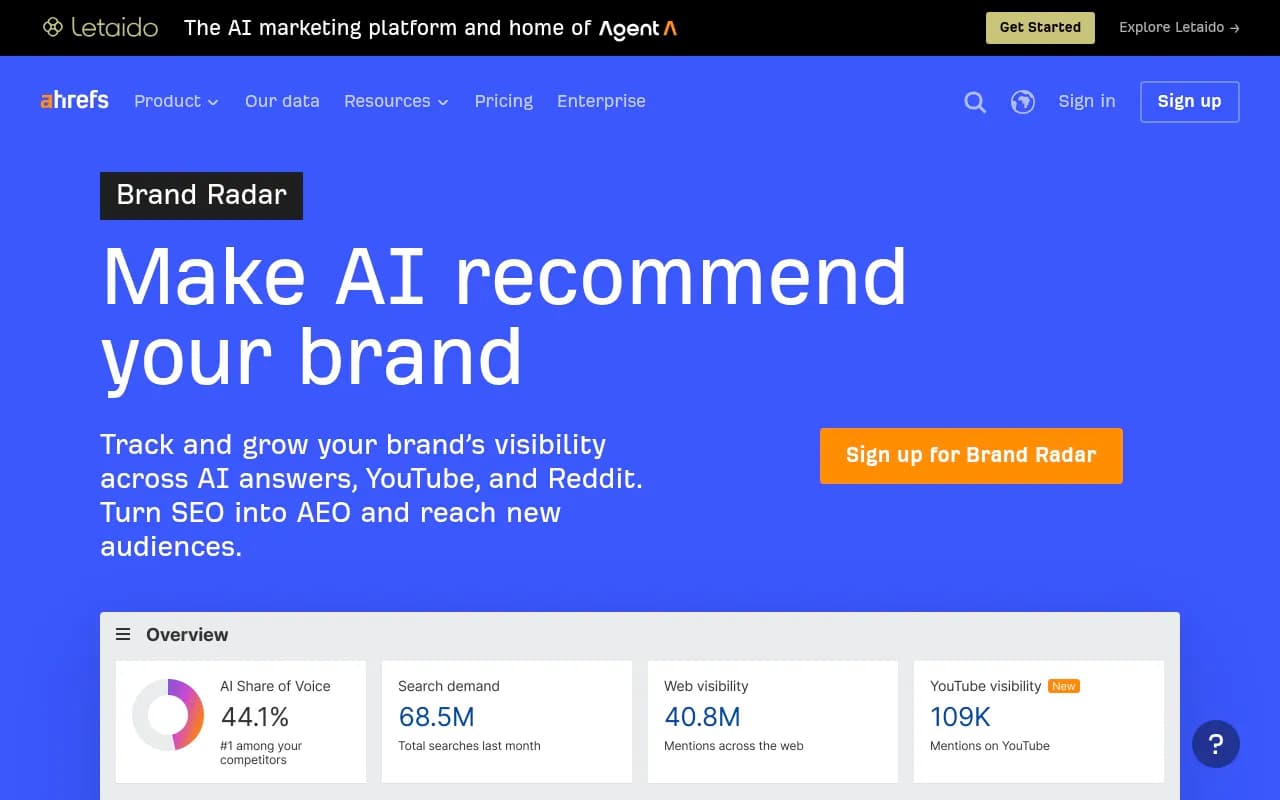
Ahrefs Brand Radar is listed at $50/mo in one roundup, though with fixed prompt sets rather than custom monitors.
| Tool | Cadence (reported) | Entry price (reported) | Notes |
|---|---|---|---|
| Promptwatch | Daily on all plans; 12, 6 or 1 hours on Business and Agency Scale | $95/mo Essential; $579/mo Business for faster runs | Crawler logs, visitor analytics, content tools |
| Otterly.AI | Daily | $29/mo | Basic prompt tracking |
| Peec AI | Daily | about $80/mo annual | 1 country on entry plan |
| Profound | Once a day | Enterprise pricing | Published once-a-day research |
| Nightwatch | Not verified | 99 EUR/mo | Pairs keywords with prompts |
| Radarkit Lite | Every 72 hours | $29/mo | 15 prompts |
Some entry plans refresh every 72 hours or weekly, and Promptrush's "daily scans" means data refreshes every 24 hours. Read the fine print on what "daily" actually means.
For a wider shortlist of options, the GEO software directory at bestgeosoftware.com is a good place to compare.
A cadence plan you can actually follow
- Start daily. Run your core prompt set daily for at least two weeks to establish a baseline and see normal variation.
- Use rolling averages. Judge trends over 7 days, not single readings.
- Segment by engine, topic and country. Mixed averages hide platform-specific shifts.
- Upgrade temporarily. Switch a small monitor of 10 to 30 launch or crisis prompts to hourly (or every few hours) for the event window only.
- Check the calendar when numbers jump. Compare dates to model releases and platform changes before touching content.
- Return to daily. Drop the cadence after the window closes and keep the saved data for the postmortem.
- Review the prompt list quarterly. Replace prompts that never produce signal, and add ones from real customer questions.
SeoClarity has a useful piece on whether prompt tracking is valid at all, worth reading for the skeptic's case.
The short version
Daily is the practical floor for most brands. It catches platform step changes within a day, supports rolling trends, and costs a lot less than faster cadences. Hourly earns its price in short, high-stakes windows where a few hours of lag changes what you'd do: a launch, a crisis, a live news cycle, a competitor move. Outside of those, put the money into more prompts, better prompt selection and more engine coverage. If you're unsure, run daily for two weeks and see how much your numbers actually move before paying for anything faster.