Key takeaways
- Around October 8, 2026, links in ChatGPT answers began to lose
utm_source=chatgpt.com, and most clicks still arrive with no referrer. Many ChatGPT visits were filed under Direct. - Profound reported that by the morning of October 16, about 99% of the cited-link answers it collected had at least one tagged source link again. The return does not repair the missing history.
- The returned tag sets a source only, with no medium. That means it can fall outside your default channel rules, so filter on the parameter itself.
- Adobe's Cedric Huesler measured the shift: on about 500 pages, ChatGPT visits fell 31k a day while Direct rose 26k a day. The traffic was relabeled, not lost.
- Treat Oct 8 to Oct 16 as an annotated gap, use server logs and landing-page patterns as a second source, and stop relying on the referrer alone.
What happened to ChatGPT referral tracking
If your reported ChatGPT traffic fell off a cliff on October 9, you were not imagining it, and your content probably did not suddenly get worse.
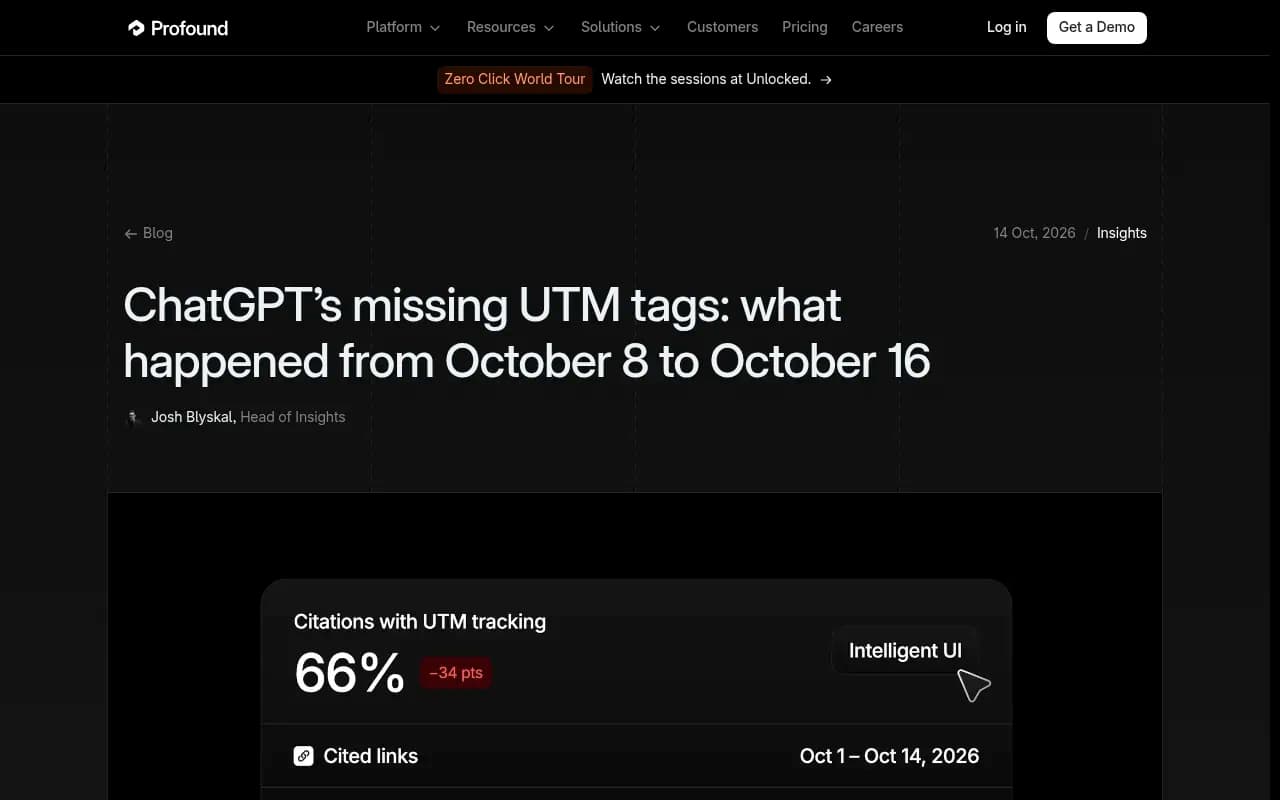
Profound traced the change to the launch of ChatGPT's Intelligent UI, part of the GPT-6 rollout. Many links in the new interactive answers were missing utm_source=chatgpt.com. That small parameter is how most analytics tools know a visitor came from ChatGPT. Profound's post is dated October 14, 2026, and its title dates the missing tags from October 8.
Search Engine Roundtable reported the same thing on October 14: OpenAI appeared to have removed or replaced the UTM parameters starting with GPT-6, about a week earlier. OpenAI first added UTM tracking to ChatGPT links in June 2025. I could not find an OpenAI statement, so whether the removal was intentional is still unclear.
Why a missing tag turns into Direct
A ChatGPT click normally carries two independent signals: the UTM parameter and the HTTP referrer. Either one is enough to identify the source. If both are gone, the visit has no source information, and analytics files it as Direct.
The likely cause of the missing referrer comes from Huesler, who wrote on LinkedIn that GPT-6 opens links with window.open(url, "_blank", "noopener,noreferrer") and drops the UTM. That is a LinkedIn claim, not an OpenAI confirmation, but it matches what analytics teams saw: no tag, no referrer, Direct.
What the data says about relabeling
Huesler compared October 9 to 13 against the week before across roughly 500 pages where ChatGPT drove 5% or more of visits. The numbers:
- ChatGPT visits fell by 31k a day on those pages.
- Direct rose by 26k a day on the same pages.
- Search fell 7%, the same as everywhere else, so search was not absorbing the loss.
- Direct rose on 2 in 3 pages that lost ChatGPT traffic. The week before, that was a coin flip.
- On mobile, the share of visitors seeing a consent banner (new to the site) went from 36% to 44%. For ChatGPT visitors it is 55%, which suggests the new Direct visitors behave like ChatGPT visitors.
Sébastien Billard also saw a sharp drop in ChatGPT human traffic from October 9 and a drop in ChatGPT-User bot traffic, while OAI-SearchBot traffic rose from October 7. Messy, in other words. But the pattern is consistent: the visitors showed up, the label did not.
What utm_source=chatgpt.com actually tells you
utm_source=chatgpt.com marks a link as coming from ChatGPT. The referrer can also show chatgpt.com, and older visits may show chat.openai.com. As the Hardal team puts it, treat either field as observed evidence on that visit, not a marker every ChatGPT click will carry. Some surfaces send one, some both, some neither. You can also see utm_source=chatgpt without the .com in some cases, so match on both.
In GA4's default channel grouping, ChatGPT traffic usually appears as chatgpt.com / referral, not as its own AI channel, unless you build a custom channel group.
The tag is back, but not the whole signal
According to Sitebrunch and Gen3 Marketing, after the fix almost all links carry utm_source=chatgpt.com again, but the referrer is still missing on most clicks. Two consequences follow.
- Filtering on the referrer will undercount. Filter on the
utm_sourceparameter instead. - The returned tag sets only the source, with no medium. A visit with that tag and no referrer matches neither an "AI Assistant" channel rule that expects a referrer or medium, nor Direct, because its source is chatgpt.com. It can land in an odd unassigned-looking bucket.
Why the missing history stays missing
Profound says it directly: the return of the tags does not automatically recover source information from earlier visits. Analytics tools stamp the source at the moment of the visit. Nothing retroactively re-labels a session from October 10 as ChatGPT.
It also cuts the other way. An uptick in ChatGPT traffic after the tags returned may be restored attribution rather than real growth. Do not celebrate October 17 as a recovery in demand, and do not mourn October 9 as a collapse in it.
| Period | What analytics likely showed | What probably happened |
|---|---|---|
| Before Oct 8 | ChatGPT referral at its usual level | Normal tagging |
| Oct 8 to Oct 16 | ChatGPT drop, Direct rise | Visits relabeled as Direct |
| After Oct 16 | ChatGPT rebounds, partly | Tag restored, referrer still missing |
How to recover attribution in GA4 and other tools
The research I found did not include an official GA4 walkthrough, so treat the steps below as general practice rather than a vendor procedure.
1. Build a rule on the parameter, not the referrer
In Google Analytics, create a custom channel group or segment where session source equals chatgpt.com or chatgpt, regardless of medium. Add the legacy chat.openai.com value too. Keep the raw observed value in a separate field so a future domain or parameter change does not get silently folded into Direct.
2. Annotate the gap
Mark October 8 to October 16 in every dashboard and report. Anyone reading a quarterly trend line needs to know the dip is a measurement artifact. Say so in the report instead of fixing it quietly in a slide later.
3. Estimate the relabeled traffic from Direct
You cannot reconstruct individual sessions, but you can model the shift. Look at pages that historically got a high share of ChatGPT visits. If Direct jumped on exactly those pages during the gap, and search stayed flat, that excess Direct is a reasonable estimate of ChatGPT traffic. Label it as an estimate. Huesler's page-level approach is a decent template.
4. Cross-check with server logs and crawler data
Analytics tags are one source. Server logs are another. ChatGPT-User and OAI-SearchBot hits show whether ChatGPT was reading your pages during the gap, even if the human clicks were mislabeled. Promptwatch Data found OpenAI made up 79.8% of IP-verified AI crawler requests from Aug 31 to Sep 6, 2026, down from 94.8% in mid-June, which is a useful baseline when comparing your own logs.
Promptwatch has not published its own measurement of the UTM bug, so I will not pretend it has. But if you want crawler logs, AI-referred visitor analytics and citation tracking in one place, Promptwatch covers that, and its visitor analytics includes an optional setting that counts visits tagged utm_source=chatgpt.com as ChatGPT traffic. The platform also notes that ChatGPT stopped sending a referrer on October 8, 2026, which matches the reports above. Its AI crawler logs separate an access problem from a content problem.

5. Check consent and redirect handling
Analytics can also miss ChatGPT traffic when the collection tag is blocked, consent rules prevent it from running, or a redirect drops the query string. If you strip query strings at the edge or in a redirect, the UTM is gone before your analytics ever sees it. Test with a manual URL: https://yoursite.com/page?utm_source=chatgpt.com, and confirm the parameter survives to the landing page and appears in your reports.
Landing URL: https://yoursite.com/product?utm_source=chatgpt.com
Alternative:  https://yoursite.com/product?utm_source=chatgpt
Possible referrer: https://chatgpt.com/
Tools that help close the attribution gap
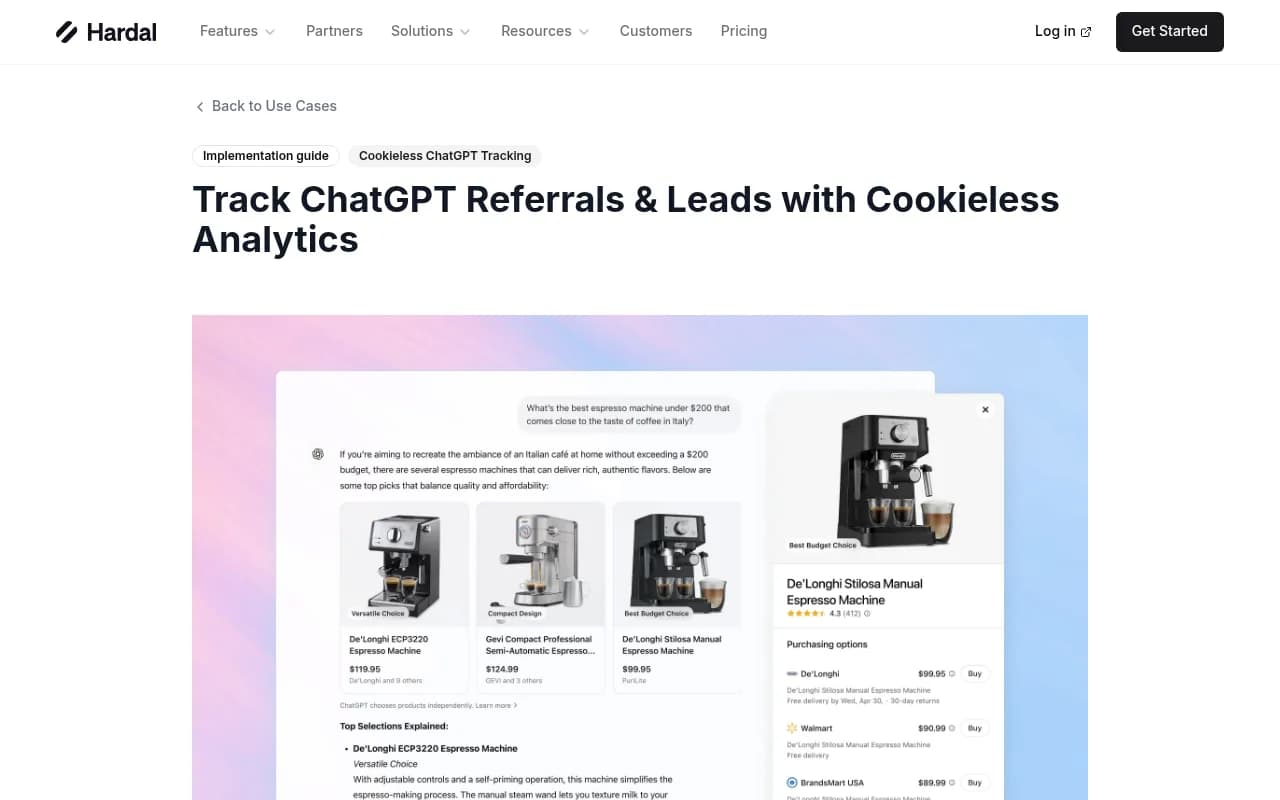
No tool can invent a source marker the browser never sent. Hardal says as much about its own product: it retains the markers that arrive and connects them to on-site events, but it cannot reconstruct what was never sent. Still, some tools are better than others at preserving what you do get.
| Approach | What it gives you | Limit |
|---|---|---|
GA4 custom channel on utm_source | Free, quick, works going forward | No retroactive fix |
| First-party or cookieless analytics (for example Hardal) | Raw UTM and referrer values kept per event | Consent and routing rules still apply |
| Server log analysis | Independent view of ChatGPT bots and visits | Needs engineering time |
| AI visibility platforms like Promptwatch | Crawler logs, AI traffic and citations together | Does not recover lost source data |
| Attribution tools such as Dreamdata or Ruler Analytics | Multi-touch and lead-level paths | Still depend on the source marker arriving |

For a wider look at tools in this space, the directory at bestgeosoftware.com lists GEO software, and Profound published the most detailed timeline of the incident.
Profound

Do not blame your content first
AI traffic dips have more than one cause. Promptwatch's citation drop report showed sources per search-enabled response falling from about 6.4 to about 4.7 to 4.9 around the GPT-5.3 rollout on March 4, 2026, roughly 27% fewer citation slots, with no recovery a month later. Its advice is to check model-release dates before blaming your own content. The same logic applies here. GPT-6 shipped, and your reporting changed the same week.
A quick diagnostic:
- Did Direct rise on the same pages that lost ChatGPT traffic?
- Did overall search move by about the same amount as everyone else's?
- Did your server logs still show ChatGPT-User or OAI-SearchBot hitting those pages?
- Did conversions hold steady even as reported ChatGPT sessions fell?
If the answers are yes, yes, yes, yes, you had a labeling problem, not a demand problem. If conversions fell too, look at citations and rankings next.
Making attribution less fragile
This was a one-week bug, but the fragility is permanent. ChatGPT controls what its links carry, and it changed them without announcement. A few habits make you less exposed.
- Watch Direct on pages that normally attract AI traffic. A sudden rise there is an early warning.
- Keep a raw log of source, medium, referrer and landing URL, not just the processed channel.
- Report AI traffic as a range with a stated confidence level, not a single precise number.
- Review your channel grouping rules each quarter, since AI platforms add and change parameters.
- Pair analytics with citation and crawler data so one broken signal does not blind you.
What to do this week
Start with the annotation and the custom rule. Both take minutes. Then estimate the October 8 to 16 gap from Direct on your top ChatGPT landing pages and tell stakeholders it is an estimate. Finally, check whether your redirects preserve query strings. The tag is back for now, and the referrer is not, so build your reporting around the parameter and a second independent source.