Key takeaways
- Prompt volume is a modeled estimate of how often a question or topic is sent to AI engines. It is built from consented panels and clustering, not from raw logs, so treat it as directional.
- Over 80% of AI prompts are unique, so exact-phrase volume is shaky. Topic and cluster volume is the more reliable number.
- Volume alone is a bad filter. Rank prompts by buyer relevance first, then use volume, competition, and your current mention rate to order the list.
- AI engines rewrite prompts into their own searches (query fan-outs), so the prompt people type is not always the query your page has to match.
- Re-check regularly. Platform behavior changed overnight in August 2026, and last quarter's mappings can go stale.
Why search volume stopped telling the whole story
For twenty years, content planning started with one number. A keyword had volume or it did not. Then buyers started asking ChatGPT, Gemini, and Perplexity full questions: "What's the best corporate credit card for small teams?" instead of "best corporate credit card."
That change breaks a few assumptions. Prompts are longer. They carry the use case, the constraints, and the decision criteria in one go. And many of them never touch Google at all, so they never appear in a traditional keyword gap analysis.
Profound's documentation lists three problems that follow when you lack data on real AI prompting: you track prompts based on SEO assumptions, you write for search engines while users talk to assistants, and you notice rising topics only after competitors have moved on them. I think that framing is fair, even if you do not use their product.
What prompt volume actually is
Prompt volume is the estimated number of times a prompt or prompt theme is sent to an AI engine in a defined period. The word estimated matters. Search volume from Google Search Console comes from Google's own logs. Prompt volume comes from somewhere else.
The common method looks like this:
- License or collect conversations from consented user panels.
- Clean and anonymize them (vendors say GDPR and CCPA compliant, PII scrubbed).
- Cluster similar prompts into topics.
- Apply probabilistic modeling to scale the panel up to a market-wide estimate.
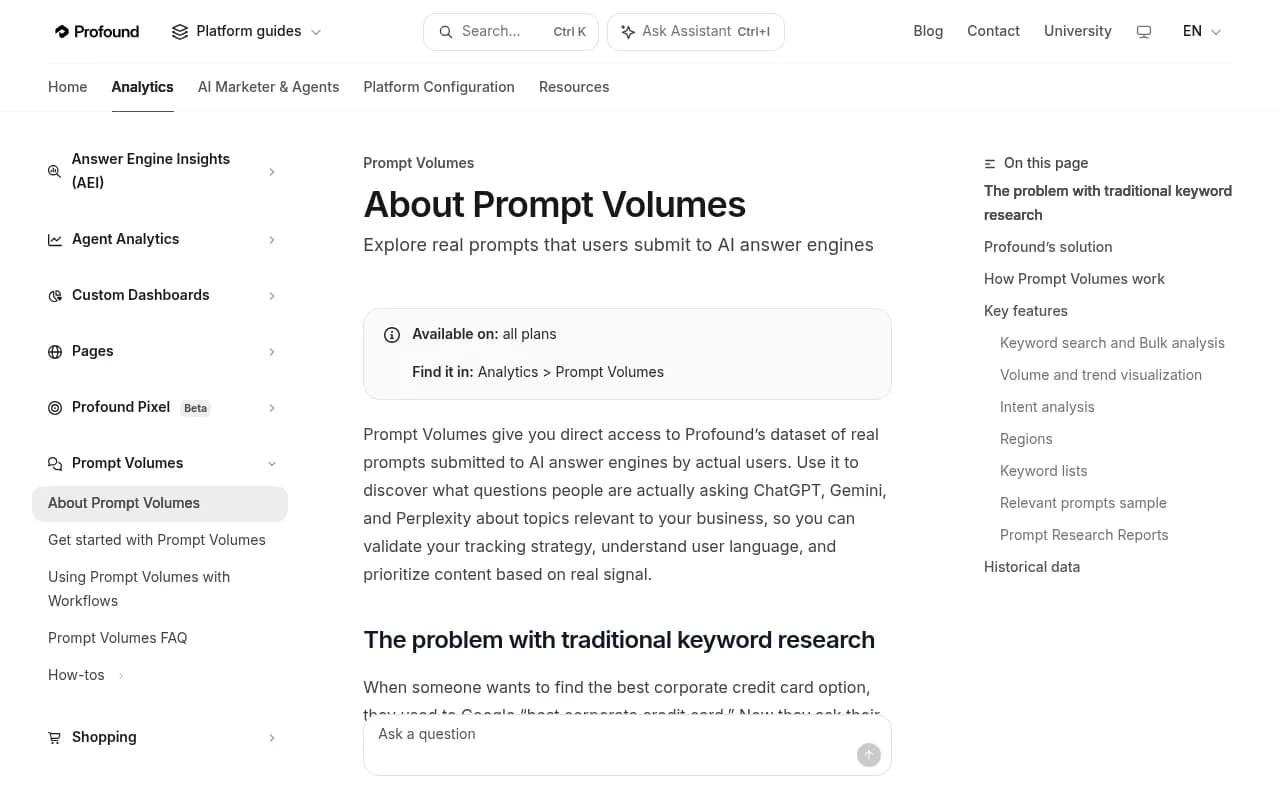
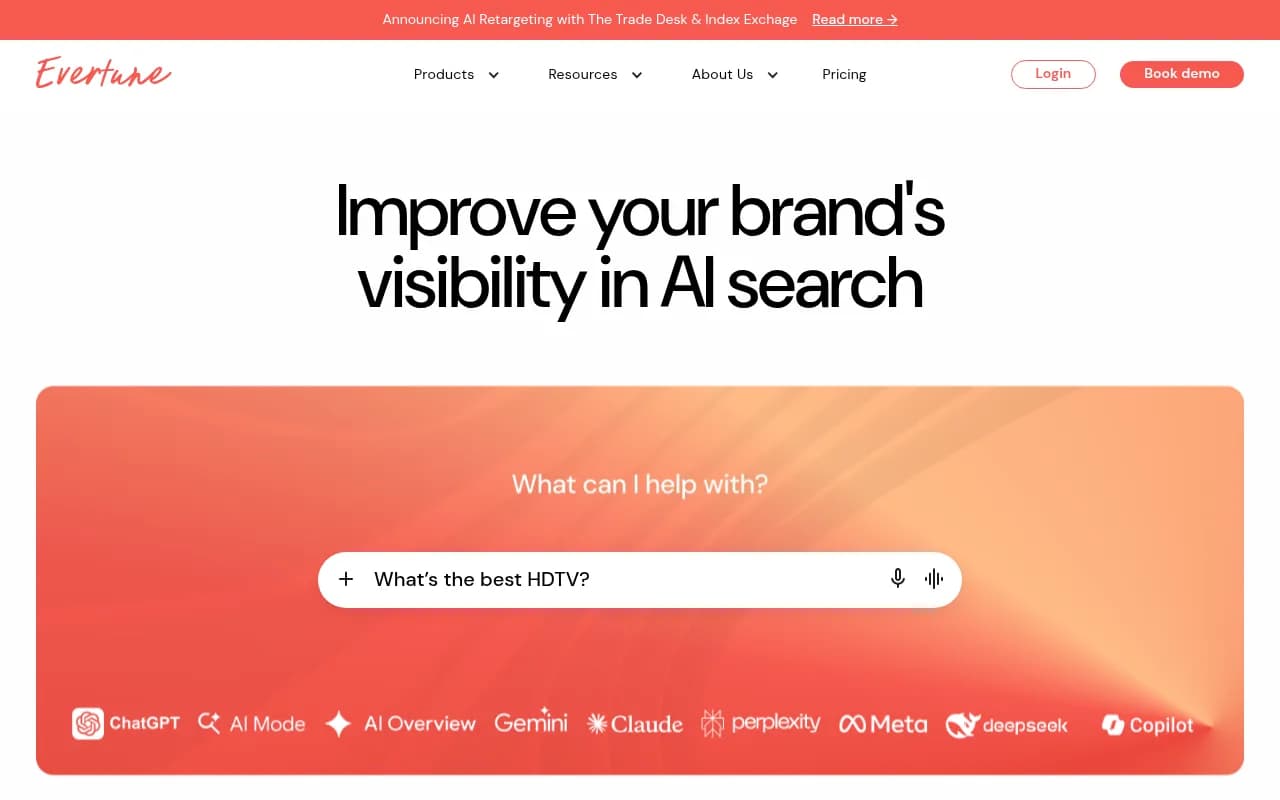
Profound's Prompt Volumes, for example, draws on ChatGPT, Gemini, and Perplexity conversations, and the company says coverage is strongest in the US, UK, and select European markets. Evertune describes a similar approach built on usage data from 25 million internet users. Both are modeled figures, not raw counts.
Why exact-phrase volume is unreliable
Evertune's FAQ puts it bluntly: over 80% of AI prompts are unique. Two people can ask the same thing in completely different words. That is why serious tools cluster prompts into topics instead of reporting a number for one exact sentence.
It also means any tool that shows a precise monthly figure for a long, specific prompt deserves some skepticism. Zerorank's guidance says the same thing from the other side: volume is an estimate for a prompt's exact phrasing, and changing the wording changes the number. Pick prompts for buyer relevance, then use volume to prioritize.
Prompt volume vs keyword volume
| Dimension | Keyword search volume | Prompt volume |
|---|---|---|
| What it counts | Short phrases typed into a search engine | Conversational prompts or prompt themes sent to AI engines |
| Source | Search engine logs, ads data, clickstream panels | Consented user panels, clustered and modeled |
| Repeats verbatim? | Often | Rarely |
| Best unit of analysis | Keyword | Topic or prompt cluster |
| Typical precision | Moderate | Directional |
| Intent signal | Inferred from the phrase | Often explicit in the prompt itself |
The practical difference: with keywords you chase a phrase. With prompts you try to be the recommendation inside an answer. A typical AI recommendation names only three to five brands, according to GenAI Ranker, so choosing the wrong battles costs more than it did when ten blue links were on offer.
The fan-out problem: the prompt is not the query
Here is the part most volume discussions skip. When ChatGPT answers with web search, it does not search for the user's literal prompt. It generates its own queries, called fan-outs, and those are what your page has to match.
Promptwatch's ChatGPT query fanout data tracked this from December 2025 to April 2026. A few things stood out:
- Average fan-outs per response ran about 2.15 in early December and about 1.84 by early March, then returned in April at 1.0 per response after a data gap.
- Average fan-out query length fell from about 117 characters in December to the high 80s in February and March, and about 53 characters once fan-outs returned in April.
Then on August 8, 2026, ChatGPT started using the site: operator at scale. Site-scoped fan-outs jumped from 0.37% to 16.8% of all fan-out queries in a day, and average fan-outs per response rose from about 1.08 to about 1.83. Those site: searches were added on top of generic ones.
Why does this matter for prioritization? Because a high-volume prompt only pays off if your content matches the sub-queries the engine fires. Nick Lafferty's write-up of Profound's research makes a related point: ChatGPT generates about 91% unique queries when it searches on a user's behalf, so a keyword list cannot reconstruct prompt demand. If you are building a plan from exported keywords, you are measuring a different system.
A scoring framework that works
The LinkedIn piece on this topic says to use demand, intent, visibility, competition, and business relevance together. That matches what I would do. Here is a concrete version.
Step 1: start from buyer relevance, not volume
List the questions your buyers would ask at each stage: problem discovery, category comparison, vendor shortlist, and objection handling. Include persona variants. A procurement lead and a founder phrase the same need differently.
Do this before opening any volume tool. Volume can only rank a list you already trust.
Step 2: cluster into prompt families
Group by buyer need, funnel stage, and entity set. "Best CRM for small remote sales teams," "CRM with pricing for 10 reps," and "affordable CRM for distributed teams" are one family. You track the family and read its combined demand.
Step 3: add the demand signal
Use whatever you can access:
- Panel-based prompt volume from a platform (more on options below).
- Proxy signals when panel data is out of reach: Search Console impressions, People Also Ask, sales call transcripts, support tickets, and community threads.
- Your own tracked-prompt data over time, which shows which topics keep producing citations.
GenAI Ranker argues that practical proxies, meaning network demand and answer competitiveness, get you most of the value without enterprise-gated panel data. I would not go that far for large budgets, but for a small team it is a sensible start.
Step 4: overlay competition and your current mention rate
For each cluster, check who gets named and which sources get cited. Then compare to your mention rate. The sweet spot is high demand, high buyer value, and low current visibility. A prompt you already win does not need new effort. A prompt where three entrenched competitors dominate with strong sources may be a longer game.
Step 5: score and sort
A simple weighted sheet is enough:
| Factor | Weight | How to score 1-5 |
|---|---|---|
| Buyer relevance | 30% | Would an answer here influence a purchase? |
| Demand (cluster volume) | 25% | Relative rank within your list |
| Visibility gap | 20% | Low current mention rate scores higher |
| Competitive difficulty | 15% | Easier to displace scores higher |
| Content effort | 10% | Do you already have a page to refresh? |
The weights are a starting point. Change them to suit your business, but keep buyer relevance on top.
Where to get prompt volume data
Several platforms now sell or include some form of prompt demand data. They are not interchangeable.
Promptwatch includes prompt volumes and difficulty scores alongside query fan-outs, so you can see both how often a topic is asked and which web searches the engines run for it. Its prompt volumes feature sits next to tracking, citation data, and a content gap view, so prioritization and execution live in one place. Pricing starts at $95/mo for Essential; confirm current plans at promptwatch.com/pricing.

Profound offers a Prompt Volumes dataset of real prompts from ChatGPT, Gemini, and Perplexity, with phrase and exact match search, keyword lists, and a sample of prompts that led an engine to cite a specific page. Bulk analysis is Enterprise-only. The docs list the feature as available on all plans, but check what your tier includes before you plan around it.
Profound

Evertune clusters prompts into topics and reports estimated monthly volume, trends, and share across AI assistants, which helps with competitor mindshare comparisons.
Search Atlas ties prompt research to keyword research, topical maps, and content briefs, which suits teams that want to keep the proven search layer connected.

If you want to compare more options, the directory at bestgeosoftware.com lists GEO platforms side by side.
| Tool | Volume approach | Strength | Watch out for |
|---|---|---|---|
| Promptwatch | Volumes and difficulty with fan-outs | Connects demand to content gaps and execution | Faster tracking and content agent need higher tiers |
| Profound | Licensed conversation dataset | Real prompt samples, intent and region views | Bulk analysis is Enterprise; coverage strongest in US, UK, parts of Europe |
| Evertune | Topic clusters from a 25M-user panel | Competitor share and related topics | Enterprise focus |
| Search Atlas | Prompt families mapped to keywords | Links prompts to briefs and optimization | Less depth on AI-specific citation analytics |
What to do with the data once you have it
Find whitespace that keyword tools miss
Topics with high prompt volume and low search volume are demand that AI engines created. They will not show up in a standard keyword gap report. Nick Lafferty's summary of Profound's work calls this the whitespace, and it is where I would look first.
Build pages for the sub-questions
Because of fan-outs, focused pages beat one giant overview. Promptwatch's fan-out research recommends separate pages for sub-questions like "X vs Y," pricing, alternatives, and how-tos, with headings written like short keyword queries and the entity and category up front. Something like "Best CRM for small agencies 2026" works better than a clever title.
Match the content type to what gets cited
Promptwatch's ChatGPT content type data found product pages were the most cited type at 22.4% of citations from Sep 28 to Oct 4, 2026, followed by landing pages and listicles. Its content half-life study shows landing pages and docs stay cited longest, while news lost half its pages within 36 days. If a high-volume prompt family is commercial, a durable landing or comparison page is a safer bet than a news-style post.
Check the domain landscape before you commit
Promptwatch's August 2026 data shows mid-authority sites (DR 46-75) earned almost half of ChatGPT citations, while DR 91-100 fell to about 3%. That is encouraging for smaller brands. A competitive prompt is not automatically closed to you.
Close the loop with measurement
Prompt volume is the input. Citation share and AI-referred traffic are the output. You need both. Track whether the pages you publish get crawled, cited, and clicked, then feed that back into your priority list. Promptwatch's AI crawler logs help separate an access problem from a content problem, which saves a lot of guessing.
Common mistakes
- Treating a modeled number as a precise count. Look at ranges and relative order.
- Chasing the biggest number. A 10x volume prompt with no buying intent loses to a smaller prompt a decision-maker asks.
- Tracking exact sentences. Track clusters and personas instead.
- Auditing once. Fan-out behavior changed in steps through 2026. Mappings built before August 8 are already out of date for ChatGPT.
- Ignoring geography. Panel coverage is uneven, so volume for smaller markets is shakier.
A simple monthly routine
- Refresh your prompt families and add any new buyer questions from sales and support.
- Pull cluster-level volume and trends.
- Re-score using the table above.
- Pick the top three gaps and ship or refresh pages for them.
- Review citations and AI traffic for last month's pages, and push underperformers back into the queue.
For more general demand-side research, tools like AlsoAsked and AnswerThePublic still help surface the question phrasing your buyers use, even if they are not AI volume sources. If you want a broader view of the category, the Promptwatch Data hub has current research on how AI engines pick sources.
The bottom line
Prompt volume is useful, imperfect, and easy to misuse. Use it to order a list that buyer relevance already built, read it at the cluster level, and expect the underlying engine behavior to shift. Teams that pair demand data with citation and crawl measurement will make better calls than teams staring at a single big number.