Key takeaways
- Most AEO tools default to branded query tracking, which tells you how visible you are to people who already know you — not to new buyers.
- Non-branded queries ("best CRM for startups", "how to reduce churn") are where AI search drives discovery, and they're systematically undertracked.
- The tools that matter most for non-branded AEO combine prompt-level analytics, answer gap analysis, and content generation — not just monitoring dashboards.
- A handful of platforms in 2026 have built genuine workflows around this problem; most others are still monitoring-first.
- Promptwatch is the only platform currently rated as a leader across all AEO categories, with specific features built around finding and closing non-branded visibility gaps.
Why non-branded queries are the real AEO opportunity
Here's the uncomfortable truth about most AEO strategies in 2026: they're built around protecting brand visibility, not building it.
Teams set up tracking for "[Brand Name] reviews", "[Brand Name] vs competitor", "[Brand Name] pricing" — and then congratulate themselves when the numbers look decent. But those queries are already coming from people who know you exist. The AI is just confirming what they already believe.
Non-branded queries are different. "What's the best project management tool for remote teams?" "How do I reduce customer churn?" "Which email platform works best for ecommerce?" These are the questions buyers ask before they've ever heard of you. They're discovery moments. And in AI search, whoever gets cited in those answers gets the consideration.
Traditional SEO had a version of this problem too, but it was easier to address — you could see your rankings for any keyword. In AI search, there's no rank position. There's cited or not cited. And the only way to know which non-branded prompts are citing your competitors (but not you) is to actually track them.
Most teams aren't doing this yet. That's the opportunity.
What makes non-branded AEO tracking different
Branded tracking is relatively simple: you define your brand name, set up monitoring, and watch the results come in. Non-branded tracking is harder for a few reasons.
First, the prompt space is enormous. There are thousands of ways a buyer might ask about the problem your product solves. You can't manually enumerate all of them. You need tools that surface prompt clusters, estimate volumes, and prioritize which ones are actually worth winning.
Second, you need competitor context. Knowing that ChatGPT doesn't cite you for "best HR software for small businesses" is only half the picture. You need to know who it does cite, and why. That tells you what content to create and what sources to build authority on.
Third, the gap between "tracked" and "fixed" is where most teams get stuck. A monitoring dashboard that shows you're invisible for 200 non-branded prompts is useful data. But if the tool can't help you do anything about it, you're just staring at a problem.
The best AEO tools in 2026 address all three of these. Many address only one.
The core features to look for
Before getting into specific tools, here's what actually matters for non-branded query tracking:
Prompt discovery and clustering. Can the tool surface prompts you haven't thought of? Does it group related queries so you can see topical gaps rather than individual keyword misses?
Volume and difficulty estimates. Not all non-branded prompts are worth the same effort. A tool that shows you prompt volume and competitive difficulty helps you prioritize.
Competitor citation analysis. Who's getting cited for the prompts you're missing? What pages, Reddit threads, or third-party sources are driving those citations?
Answer gap analysis. A structured view of which prompts competitors appear in that you don't — ideally with the specific content gaps called out.
Content generation tied to gaps. Can the tool go from "here's a gap" to "here's the content that would close it"? This is where most tools fall short.
Multi-model coverage. ChatGPT, Perplexity, Google AI Overviews, Gemini, Claude — non-branded queries behave differently across models. You need coverage across all of them.
The best AEO tools for non-branded query tracking in 2026
Promptwatch
Promptwatch is the most complete platform for this specific use case. The Answer Gap Analysis feature does exactly what the name suggests: it shows you which non-branded prompts your competitors are visible for that you're not, with the specific content gaps called out. That's the foundation of a non-branded AEO strategy.
What separates it from monitoring-only tools is the action loop. You find the gap, generate content through the Content Agents (which pull from real prompt data, citation data, and competitor analysis), then track whether the new content starts getting cited. Page-level tracking shows which specific pages are being cited by which models, and AI Crawler Logs show when AI crawlers hit your site and when pages move from crawled to cited.
For non-branded query work specifically, the Prompt Intelligence features matter a lot: volume estimates, difficulty scores, and query fan-outs that show how a single prompt branches into sub-queries. That's how you prioritize which non-branded gaps to close first.
It monitors 10 AI models including ChatGPT, Perplexity, Google AI Overviews, Claude, Gemini, Grok, DeepSeek, and Copilot. Pricing starts at $99/month.

Profound
Profound is a strong enterprise option with solid prompt volume data and answer engine insights. It tracks non-branded queries across major AI platforms and has content agent functionality for creating optimization-focused content. The platform is well-built for larger teams that need structured workflows and compliance features.
Where it differs from Promptwatch is primarily price point — Profound skews toward enterprise budgets — and it lacks Reddit and YouTube citation tracking, which matters because those sources heavily influence AI responses to non-branded queries.
Profound

SE Visible (by SE Ranking)
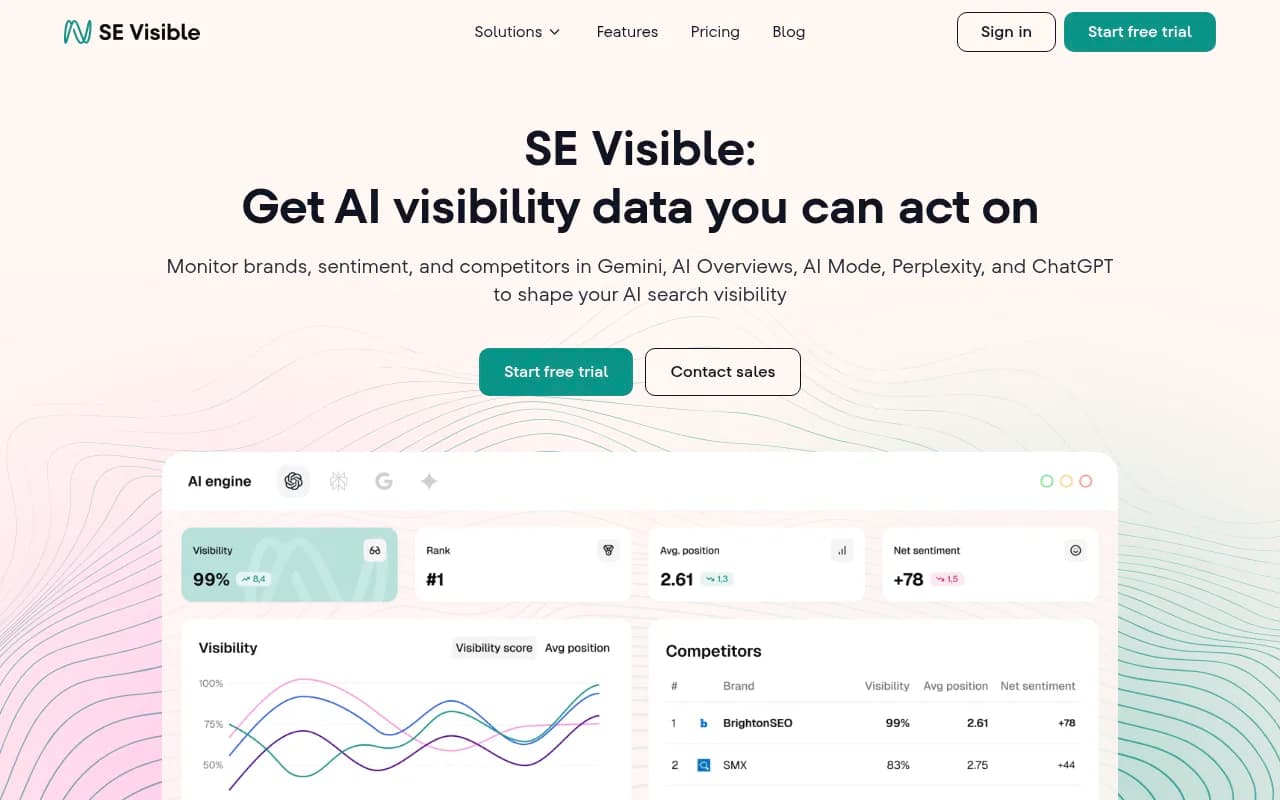
SE Visible is the AI visibility layer built on top of SE Ranking's traditional SEO infrastructure. For teams already using SE Ranking, it's a natural extension. It tracks brand mentions and citations across AI models, with competitor comparison and sentiment scoring.
The limitation for non-branded work is that it's primarily a monitoring tool. It shows you what's happening but doesn't have the content generation or gap analysis workflows to help you change it. Good for visibility into the problem; less useful for solving it.
Nightwatch
Nightwatch takes an interesting approach by combining classic rank tracking with AI visibility monitoring. It's particularly strong for agencies managing multiple clients, and its zip-code level local tracking is useful for businesses where non-branded queries have a geographic component ("best dentist near me" type queries in AI search).
The AI tracking is an add-on ($99/month on top of the base plan), which makes the total cost reasonable for what you get. It covers ChatGPT, Google AI Overviews, Bing Copilot, Perplexity, and Claude.
Otterly.AI
Otterly.AI is a monitoring-focused tool that's straightforward to set up and use. It tracks brand and topic mentions across ChatGPT, Perplexity, and Google AI Overviews. For teams just getting started with AEO tracking, it's a reasonable entry point.
The gap for non-branded strategy is that Otterly doesn't have prompt discovery, volume data, or content generation. You can track prompts you've already defined, but it won't surface the ones you're missing.
Otterly.AI

AthenaHQ
AthenaHQ focuses on AI search monitoring with a clean interface and solid coverage across major models. It's built for marketing teams that want visibility into how their brand and category appear in AI answers.
Like several others in this space, it's monitoring-first. The platform shows you where you stand but doesn't have the optimization layer to help you improve. For non-branded tracking specifically, you'd need to bring your own prompt list rather than relying on the tool to surface gaps.

Scrunch AI
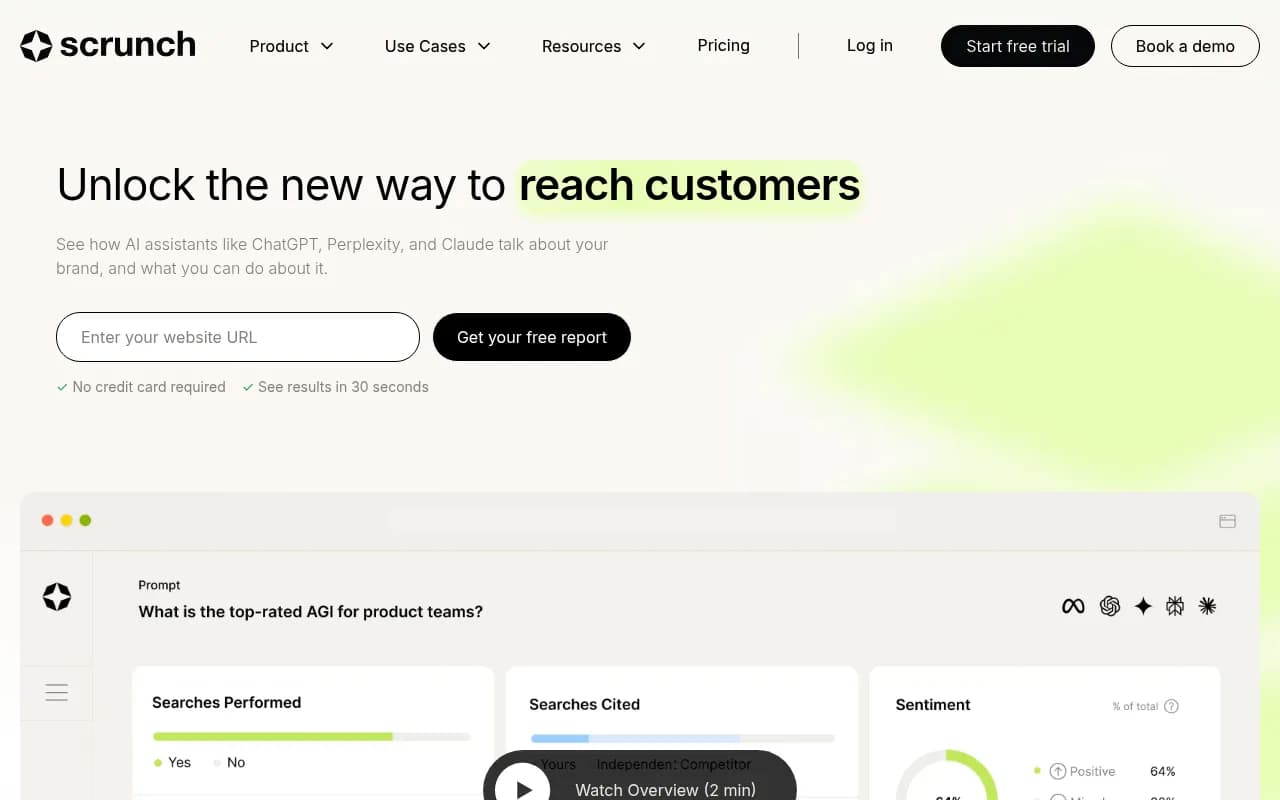
Scrunch AI tracks brand mentions and citations across LLMs with a focus on competitive benchmarking. It's useful for understanding share of voice in AI search — including for non-branded category queries — and has decent reporting for stakeholder presentations.
Writesonic (GEO features)
Writesonic has expanded beyond content generation to include AI visibility tracking and citation analysis. For teams that want to combine content creation with AEO monitoring in one platform, it's worth evaluating. The GEO workflows connect visibility data to content output, which is closer to the action loop than pure monitoring tools.

AEO Engine
AEO Engine is built specifically for SaaS brands and focuses on the intersection of traditional SEO and AI visibility. It has content optimization guidance and tracks AI responses across major platforms. Smaller in scale than the enterprise options but well-suited for growth-stage SaaS teams.
Tool comparison: non-branded AEO capabilities
| Tool | Prompt discovery | Gap analysis | Content generation | Multi-model coverage | Crawler logs | Best for |
|---|---|---|---|---|---|---|
| Promptwatch | Yes | Yes (Answer Gap Analysis) | Yes (Content Agents) | 10 models | Yes | Full optimization loop |
| Profound | Partial | Partial | Yes (Agents) | 9+ models | Yes | Enterprise teams |
| SE Visible | No | No | No | 5 models | No | SE Ranking users |
| Nightwatch | No | No | No | 5 models | No | Agencies, local SEO |
| Otterly.AI | No | No | No | 3 models | No | Basic monitoring |
| AthenaHQ | No | No | No | Multiple | No | Monitoring-focused teams |
| Scrunch AI | No | Partial | No | Multiple | No | Share of voice tracking |
| Writesonic | No | Partial | Yes | 6 models | No | Content + monitoring |
| AEO Engine | No | No | Partial | Multiple | No | SaaS brands |
A practical workflow for non-branded AEO
Knowing which tools exist is one thing. Here's how to actually use them to build non-branded visibility.
Step 1: Map your category's prompt landscape
Start by identifying the non-branded prompts that matter to your buyers. Think about the questions they ask before they know your product exists: problem-aware queries ("how do I fix X"), category queries ("best tools for Y"), and comparison queries ("X vs Y for Z use case").
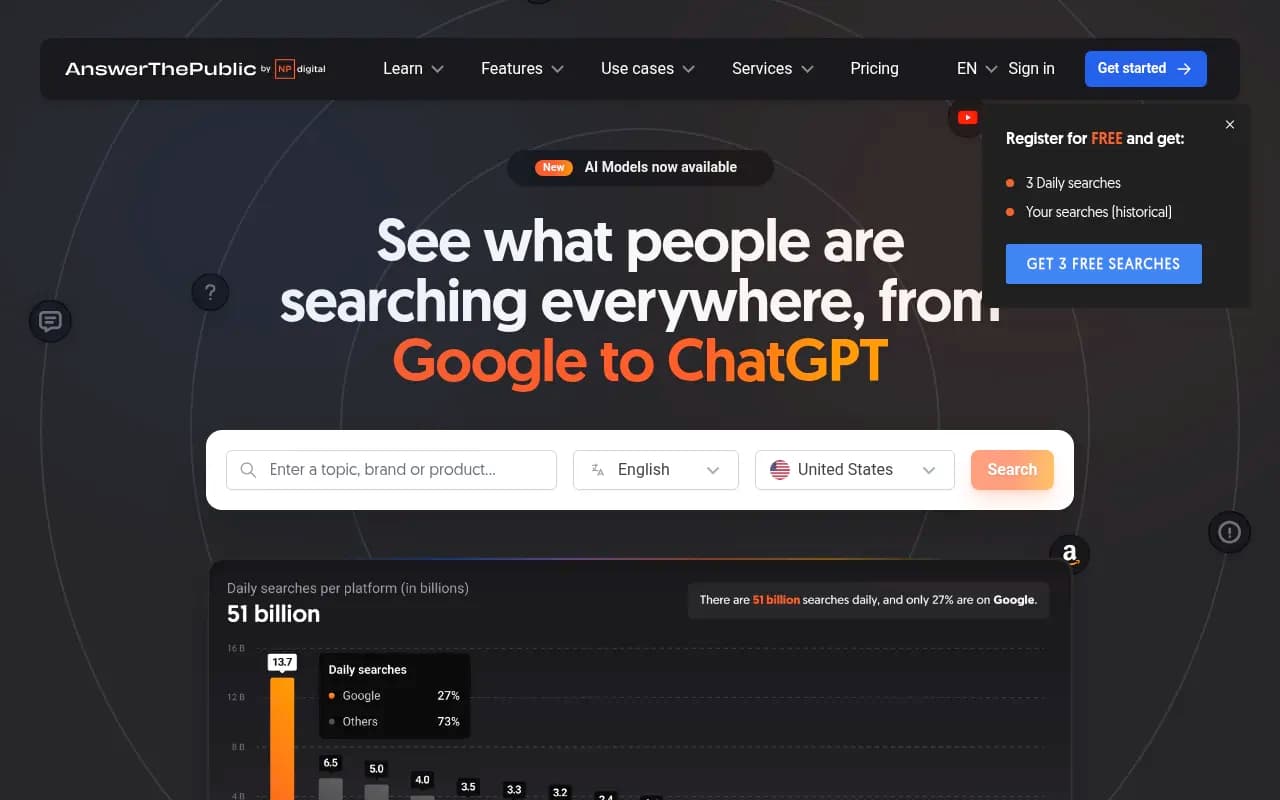
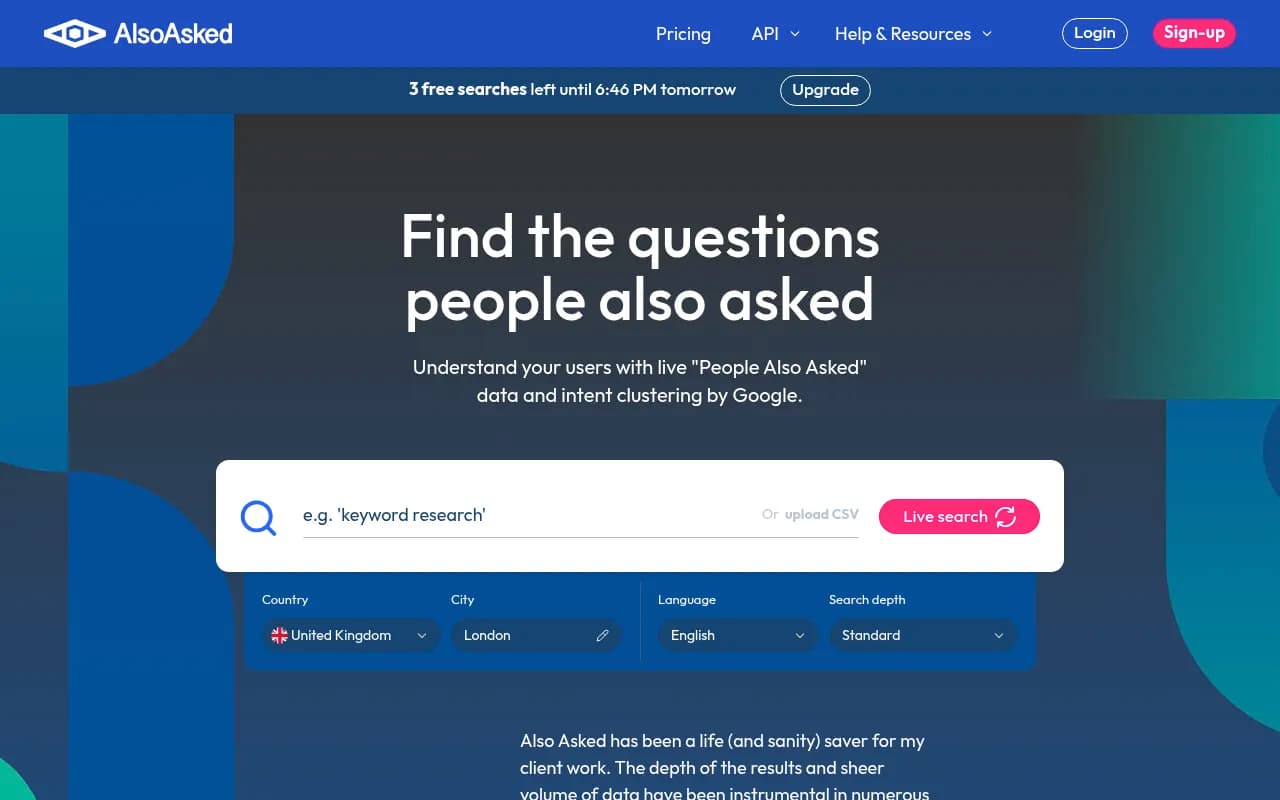
Tools like AnswerThePublic and AlsoAsked are useful here for surfacing question clusters. But for AI-specific prompt data with volume estimates, you need a dedicated AEO platform.
Step 2: Run a gap analysis against competitors
Once you have a prompt list, find out who's getting cited for those prompts — and who isn't. This is the core of non-branded AEO strategy. If three competitors are consistently cited for "best [category] for [use case]" and you're not, that's a content gap with a clear fix.
Platforms with answer gap analysis (Promptwatch being the most complete) will surface these gaps automatically rather than requiring you to check each prompt manually.
Step 3: Prioritize by volume and winnability
Not every gap is worth closing. A prompt that gets asked 50 times a month is more valuable than one asked 5 times. A prompt where you have existing authority is easier to win than one dominated by established players.
Prompt Intelligence features — volume estimates, difficulty scores, query fan-outs — let you build a prioritized roadmap instead of guessing.
Step 4: Create content engineered for AI citation
This is where most teams make a mistake. They create content optimized for traditional SEO (keyword density, backlinks) and wonder why AI models don't cite it. AI citation works differently. Models cite sources that directly and clearly answer the question, with structured information, factual specificity, and appropriate depth.
Content Agents in platforms like Promptwatch generate content grounded in the actual prompt data, citation patterns, and competitor analysis — which is meaningfully different from generic SEO content generation.
Step 5: Track the citation timeline
After publishing, monitor which AI crawlers hit the new content and when it moves from crawled to cited. This feedback loop tells you whether your approach is working and how long the lag is between publishing and visibility. AI Crawler Logs in Promptwatch show exactly this — which is data most teams have never had access to before.
Common mistakes in non-branded AEO
Only tracking prompts you already know about. If you define your prompt list manually, you'll only track what you already know. The most valuable gaps are often the ones you haven't thought of.
Treating all AI models the same. ChatGPT and Perplexity cite very differently. Google AI Overviews has its own citation logic. A prompt where you're visible in one model but invisible in another is a specific, fixable problem — but only if you're tracking at the model level.
Ignoring offsite citations. AI models frequently cite Reddit threads, YouTube videos, and third-party review sites for non-branded queries. If your brand isn't mentioned in those sources, you won't appear in the answers. Tracking offsite citations (not just your own pages) is essential.
Publishing content and forgetting it. Non-branded AEO isn't a one-time project. AI models update their training data and retrieval sources continuously. Content that gets cited today might lose visibility in three months if competitors publish something better. Ongoing tracking and iteration is the job.
The bottom line
Non-branded queries are where AI search drives new buyer discovery. They're also the queries that most AEO strategies ignore, because branded tracking is easier to set up and easier to report on.
The teams that figure this out in 2026 will have a meaningful advantage. The ones that don't will keep optimizing for people who already know them while their competitors get cited in every discovery conversation.
The tools exist to do this properly. The question is whether you're using them for monitoring or for optimization — because those are very different outcomes.