Key takeaways
- YouTube has overtaken Reddit as the most frequently cited social platform in AI-generated responses, according to data reported by Adweek in 2026 -- making video content a serious GEO channel, not just a nice-to-have.
- Most AI visibility tools only monitor your own domain. Offsite citations -- Reddit threads, YouTube walkthroughs, G2 reviews, Medium articles -- are often what actually gets your brand into AI answers.
- A handful of platforms now track offsite citation sources, but they vary wildly in depth. Some show you which external pages AI models cite; very few help you do anything about it.
- The tools that matter most here are the ones that combine offsite citation analysis with content gap identification and actual content generation -- otherwise you're just watching competitors win.
- Promptwatch is the only platform in this space that closes the full loop: find offsite gaps, understand which external sources AI models trust, and generate content to fill those gaps.
Why offsite citations are the hidden lever in AI search
If you've been focused entirely on optimizing your own website for AI search, you're probably missing half the picture.
When ChatGPT, Perplexity, or Google AI Overviews answer a question about your category, they don't just pull from your homepage or your blog. They pull from Reddit discussions, YouTube tutorials, G2 review pages, Trustpilot listings, LinkedIn posts, and Medium articles. These third-party sources often carry more weight in AI responses than your own content -- because AI models treat them as independent validation.
Adweek reported in 2026 that YouTube has overtaken Reddit as the most frequently cited social platform in AI-generated responses. That's a significant shift. It means a well-structured YouTube walkthrough of your product could be generating more AI citations than your entire content library.
The problem: almost no one is tracking this properly.
Most AI visibility tools were built to answer one question: "Does my website appear in AI answers?" That's useful, but it's incomplete. The better question is: "What sources are AI models actually citing when they answer questions in my category -- and am I present in those sources?"
That's a fundamentally different tracking problem, and it requires a different kind of tool.
What offsite citation tracking actually means
Before getting into specific tools, it's worth being precise about what "offsite citation tracking" covers. There are a few distinct things you might want to know:
Which external pages AI models cite in responses about your category. When someone asks Perplexity "what's the best project management tool for remote teams," which Reddit threads, YouTube videos, and review pages show up in the cited sources? Are you mentioned in any of them?
Which third-party pages mention your brand and get cited. A G2 review page that lists your product might be getting cited by ChatGPT hundreds of times a day. Do you know which one? Do you know what it says?
Which competitor brands appear in external sources you don't. If your competitor has a well-cited YouTube comparison video and you don't, that's a gap you can close. But you have to know it exists first.
How offsite mentions correlate with AI visibility scores. Some tools can show you that your overall AI visibility improved after a Reddit thread about your product gained traction. That kind of attribution is rare but genuinely useful.
Most tools handle one or two of these. A few handle all of them.
The tools worth knowing about
Promptwatch
Promptwatch is the most complete option here, and it's the one I'd recommend if offsite citation analysis is a real priority for your team.

What separates it from most competitors is that it tracks offsite citations as part of a broader optimization workflow -- not just as a monitoring dashboard. The platform shows you which external pages, Reddit threads, YouTube videos, and third-party domains AI models are citing in responses relevant to your brand and category. You can see exactly which sources are driving AI visibility for your competitors, and which ones you're absent from.
The Reddit and YouTube Insights features are particularly useful here. Promptwatch surfaces discussions and videos that are directly influencing AI recommendations -- the specific threads and videos that AI models keep returning to. Most platforms ignore these channels entirely.
From there, the platform connects offsite gap data to its content generation tools. If you discover that a competitor is getting cited because of a YouTube comparison video you don't have, or a Reddit thread where they're recommended but you're not, Promptwatch's Content Agents can generate content briefs and articles designed to fill those gaps. That's the part most monitoring tools skip.
It also tracks AI crawler behavior on your own site, which matters because understanding how AI models discover and index your content helps you understand why certain offsite sources get cited and yours don't.
Pricing starts at $99/month for the Essential plan (1 site, 50 prompts, 5 articles). The Professional plan at $249/month adds crawler logs and more prompt volume, which is where the offsite citation analysis becomes most powerful.
Semrush
Semrush has added AI visibility features to its existing SEO platform, and for teams already using it for traditional SEO, it's a reasonable starting point.
The cited sources and pages feature shows which domains AI models reference in their responses, and you can use this to identify high-authority third-party pages in your category. The limitation is that Semrush uses fixed prompt sets -- you can't fully customize the queries it monitors, which matters when you're trying to track niche conversations or specific competitor comparisons. It also lacks Reddit-specific tracking and doesn't have AI traffic attribution, so you can see which sources get cited but not how that translates to actual traffic.
For offsite citation work specifically, Semrush is useful for identifying which domains carry weight in AI responses. It's less useful for understanding the specific Reddit threads or YouTube videos driving those citations.
Otterly.AI
Otterly is a monitoring-focused platform that tracks brand mentions across ChatGPT, Perplexity, and Google AI Overviews.
Otterly.AI

It's clean and relatively easy to use, which makes it popular with smaller teams. But for offsite citation tracking specifically, it's limited. The platform shows you when your brand appears in AI answers, but it doesn't surface the external sources driving those appearances in much depth. There's no Reddit or YouTube tracking, no content generation, and no crawler logs. If you want to understand the offsite citation ecosystem in your category, you'll hit a ceiling quickly.
Profound
Profound is an enterprise-oriented platform with strong monitoring capabilities across 9+ AI search engines.
Profound

It does include source analysis -- you can see which external pages AI models cite in responses -- and the competitor analysis features are solid. For large brands that need comprehensive monitoring across multiple markets, it's worth evaluating. The price point is higher than most alternatives, and it doesn't have the Reddit/YouTube-specific insights or content generation that would make it a complete offsite citation solution. It's more of a "what's happening" tool than a "here's what to do about it" tool.
AthenaHQ
AthenaHQ is a monitoring platform that tracks brand visibility across AI search engines with a reasonably clean interface.

It includes some source analysis features, but like most monitoring-only tools, it stops at showing you data. There's no content gap analysis tied to offsite sources, no Reddit or YouTube tracking, and no content generation. For teams that just need a dashboard to report on AI visibility, it works. For teams that want to actively improve their offsite citation presence, it's not enough on its own.
Peec AI
Peec AI is a lighter-weight option that tracks AI search visibility for marketing teams.
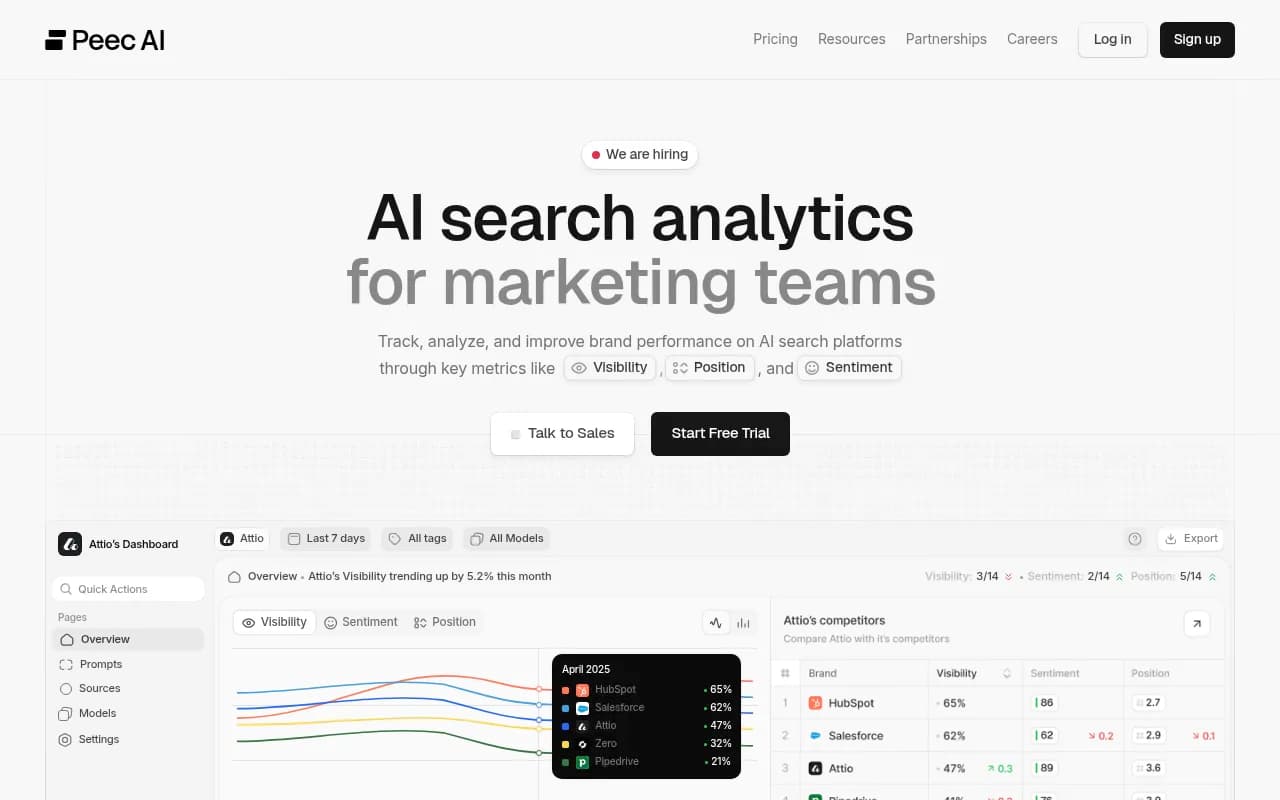
It's positioned as an accessible entry point for teams new to AI visibility monitoring. The offsite citation tracking is basic -- you can see some source data, but the depth isn't there for serious competitive analysis. No crawler logs, no content generation, no Reddit or YouTube insights. Good for getting started, not for going deep.
Scrunch AI
Scrunch tracks brand mentions across LLMs and includes some source analysis.
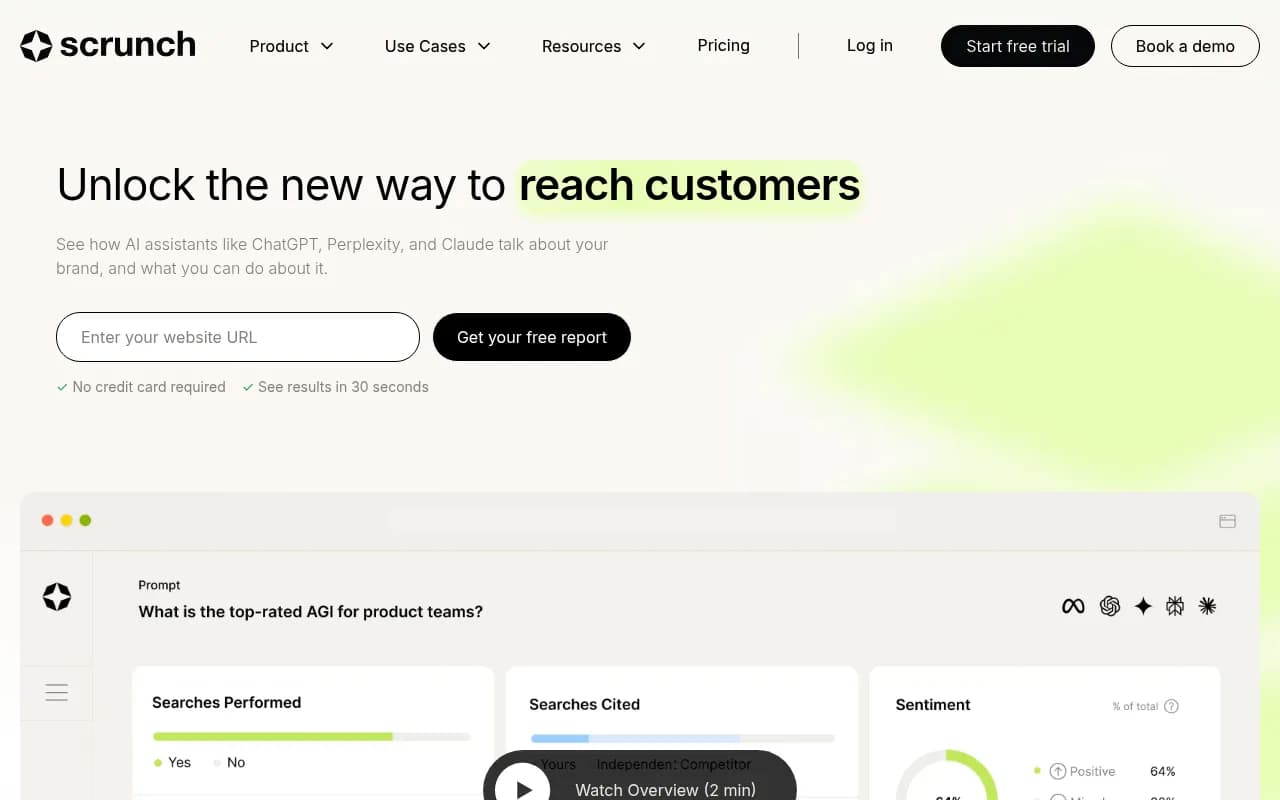
It's a mid-tier option that does more than basic monitoring but less than a full optimization platform. The source analysis shows which external pages are being cited, which is useful for identifying high-value third-party placements. Like most competitors, it doesn't close the loop into content creation or Reddit/YouTube-specific tracking.
Feature comparison
Here's how the main platforms stack up on the capabilities that matter most for offsite citation tracking:
| Tool | Offsite source analysis | Reddit tracking | YouTube tracking | Content generation | AI crawler logs | Pricing (from) |
|---|---|---|---|---|---|---|
| Promptwatch | Yes | Yes | Yes | Yes (Content Agents) | Yes | $99/mo |
| Semrush | Partial | No | No | Via ContentShake | No | $165/mo |
| Profound | Yes | No | No | No | No | Custom |
| AthenaHQ | Partial | No | No | No | No | Custom |
| Otterly.AI | No | No | No | No | No | $49/mo |
| Peec AI | Partial | No | No | No | No | $49/mo |
| Scrunch AI | Partial | No | No | No | No | Custom |
The pattern is clear: most platforms stop at monitoring. The ones that go further into offsite source analysis are mostly enterprise-priced. Promptwatch is the only option that combines offsite citation tracking, Reddit/YouTube insights, content generation, and crawler logs at a mid-market price point.
How to actually use offsite citation data
Knowing which external sources AI models cite is only useful if you do something with it. Here's a practical workflow:
Step 1: Map the citation landscape in your category
Start by running your core category prompts through a tracking tool and looking at the cited sources -- not just whether your brand appears, but which external pages, communities, and videos AI models are pulling from. You're looking for patterns: Are certain Reddit communities consistently cited? Are there YouTube channels that keep showing up? Which review platforms carry the most weight?
Step 2: Audit your presence in high-citation sources
Once you know which external sources matter, check whether your brand is present in them. If a particular Reddit community is consistently cited by Perplexity when answering questions in your category, are you mentioned in the top threads? If a YouTube channel regularly gets cited by ChatGPT for product comparisons, have you engaged with them or created similar content?
Step 3: Identify competitor advantages
This is where offsite citation analysis gets genuinely useful. Look for sources where competitors appear but you don't. A competitor being cited from a G2 comparison page you're not listed on, or a Reddit thread where they're recommended and you're not mentioned, is a concrete gap you can close.
Step 4: Create content that fills the gaps
This is the step most monitoring tools leave you to figure out on your own. Platforms like Promptwatch that include content generation can take the gap data and turn it into content briefs or articles designed to be cited by AI models. The goal isn't just to publish more content -- it's to publish content that answers the specific questions AI models are already looking for answers to.
Step 5: Track the impact
After publishing new content or securing placements in high-citation sources, watch whether your AI visibility scores change. Page-level tracking and citation timeline data (when a page moves from crawl to citation) tells you whether your offsite strategy is working.
The YouTube shift: what it means for your strategy
The fact that YouTube has overtaken Reddit as the most cited social platform in AI responses is worth sitting with for a moment. It changes the calculus for teams building AI visibility strategies.
A few years ago, the conventional wisdom was that Reddit was the primary social signal AI models trusted. That's still partly true -- Reddit threads remain heavily cited, particularly for product comparisons and "best of" queries. But YouTube's rise means that video content is now a legitimate AI citation channel, not just a brand awareness play.
Practically, this means:
- Product walkthrough videos, comparison videos, and tutorial content on YouTube can directly influence AI citations in your category.
- If competitors have strong YouTube presences and you don't, that's a citation gap that won't be fixed by publishing more blog posts.
- Tracking which YouTube videos AI models cite in your category is now a real competitive intelligence task, not an optional extra.
Most AI visibility tools don't track YouTube citations at all. This is a genuine gap in the market, and it's one reason why platforms that do track YouTube (like Promptwatch) have a meaningful advantage for teams serious about offsite citation strategy.
What to look for when evaluating tools
If you're shopping for an AI visibility tool specifically for offsite citation tracking, here are the questions worth asking:
Does it show you the specific external pages AI models cite, or just aggregate domain data? Page-level citation data is far more useful than knowing "Reddit gets cited a lot."
Does it track Reddit and YouTube separately, or just lump them into "social"? The specific communities and channels matter. A citation from a niche subreddit with 50k members who are all in your target market is worth more than a citation from a generic YouTube channel.
Does it connect offsite citation data to content recommendations? Monitoring without action is just reporting. The tools that help you understand what content to create based on offsite citation gaps are the ones that actually move the needle.
Does it track AI crawler behavior on your own site? Understanding how AI models discover and index your content is part of understanding why certain offsite sources get cited and yours don't.
Can you customize the prompts it monitors? Fixed prompt sets miss the long-tail queries where offsite citations often matter most.
The bottom line
Offsite citation tracking is one of the most underserved areas in AI visibility tooling right now. Most platforms were built to answer "is my website visible in AI search?" -- which is a useful question, but not the full picture.
The brands winning in AI search in 2026 are the ones that understand the full citation ecosystem: which Reddit communities AI models trust, which YouTube channels they reference, which third-party review pages carry weight. And then they're doing something about it.
That requires tools that go beyond monitoring. For most teams, Promptwatch is the most complete option available -- it tracks the offsite sources that matter, surfaces the gaps, and helps you create content to fill them. For enterprise teams with larger budgets, Profound is worth evaluating for its depth of monitoring. For teams just getting started, Otterly or Peec AI are reasonable entry points, with the understanding that you'll need additional tools to actually act on what you find.
The offsite citation game is winnable. But you have to be able to see it first.