Key takeaways
- Shoppers ask AI "what should I buy," not "tell me about your brand." Tools that only track brand-name prompts miss most of the consideration set.
- Product pages and landing pages together earn about 39% of ChatGPT citations, so what you publish on your own site matters more than most consumer teams assume.
- Reddit has nearly vanished from ChatGPT citations, while Google AI Overviews still pulls 12.2% of its citations from social platforms. Your channel plan should differ by engine.
- Monitoring-only tools tell you that you are invisible. For consumer brands, the useful ones also show why (crawler logs, citations) and help you fix it.
- Pricing varies a lot. Check each vendor's pricing page before you commit, because plans and limits change often.
Why consumer brands need a different kind of AI visibility tool
Most "best AI visibility tools" lists were written for B2B SaaS. A software buyer asks ChatGPT for the best CRM. A consumer asks which moisturizer is gentle on sensitive skin, which carry-on survives a year of travel, or which running shoes suit flat feet. Different prompts, different sources, different winners.
Three things change when you sell products to people:
- Prompts are category and attribute questions. "Best sunscreen for sensitive skin" is the real prompt. "What is [your brand]?" is rare by comparison. A tool that lets you track only a handful of brand-name prompts will flatter you.
- The cited sources are different. For product questions, engines lean on product pages, listicles, review sites, YouTube and affiliate editorial.
- SKUs matter. A brand can be visible at the company level and invisible for the one product that drives revenue.
Third-party surveys point the same way. A Q2 2026 Locus survey of 1,000+ US online shoppers found 45% now use AI tools in their shopping journey, and Adobe data cited by Yotpo shows AI-referred traffic to US retail sites growing sharply year over year. Treat those as directional, since I could not verify the underlying methodology, but they match what we see in citation data.
What shoppers' prompts actually pull from
Before comparing tools, it helps to know what you are trying to move. Promptwatch Data's ChatGPT citation share by content type report (Sep 28 to Oct 4, 2026) breaks down what ChatGPT cites:
| Content type | Share of ChatGPT citations | Share on commercial prompts |
|---|---|---|
| Product pages | 22.4% | 26.0% |
| Landing pages | 16.8% | 20.6% |
| Listicles | 13.6% | 15.0% |
| How-tos | 8.7% | n/a |
| Documentation | 7.5% | n/a |
| Comparisons | 5.9% | 7.9% |
| News | 5.7% | n/a |
| Reviews | 1.7% | 5.6% on branded prompts |
The practical read: for commercial prompts, product pages, landing pages, listicles and comparisons make up almost 70% of citations. Your own product pages are doing the heavy lifting, which is good news because you control them. The same report suggests making product pages easy to compare (clear pricing, specs, target audience), getting into the "best of" roundups ChatGPT cites, collecting reviews on trusted sites and adding a brand FAQ.
Social is not one thing anymore
Consumer marketers love to say "get on Reddit and YouTube." The data says it depends on the engine. In Promptwatch's social media citations by AI model report (Sep 28 to Oct 4, 2026), all seven major social platforms together made up just 0.46% of ChatGPT citations. Reddit alone fell from 5.19% to 0.09% in that comparison, and the Reddit citation drop report dates the collapse to August 14, 2026.
Google AI Overviews is the opposite. It gets 12.2% of its citations from social platforms: YouTube 4.28%, Facebook 2.38%, Reddit 2.15%, Instagram 1.61% and LinkedIn 1.55%. Perplexity sits at 2.7%.
So a YouTube and Instagram push can help you in AI Overviews while doing close to nothing for ChatGPT. A good tool should split visibility by engine so you can see this, not blend everything into one score.
ChatGPT shopping cards are tuned, not constant
Promptwatch's ChatGPT shopping feature usage data shows product cards and price comparisons attach to only a low single-digit percentage of web-search responses, concentrated in commercial prompts. The rate moves in steps, which looks like OpenAI adjusting when cards appear. If you sell physical products, tracking who fills those cards is its own job.
What to look for in a platform
Here is the checklist I would use, adapted from how consumer teams actually work.
- Prompt volume you can afford. Shopper prompts are numerous. Fifty prompts will not cover a catalog.
- Real interface data. Answers in ChatGPT's actual UI can differ from API output, especially for shopping.
- Shopping and product tracking. Carousels, product cards, and ideally SKU-level visibility.
- Citation sources. Which pages, review sites, YouTube videos and listicles get you cited.
- Crawler visibility. Whether AI bots can even read your product pages.
- Traffic attribution. Sessions and conversions from AI, not just mentions.
- A way to act. Content gap analysis, publishing, and checking whether the fix worked.
- Multi-region support. Consumer brands often sell in several countries.
The platforms, compared
| Platform | Best for | Shopping/product angle | Takes action? |
|---|---|---|---|
| Promptwatch | Brands wanting tracking plus execution | ChatGPT shopping carousels, Alexa product results, catalog upload | Yes (Content Agent, Action Board) |
| Profound | Enterprise monitoring budgets | Shopping research on personal context in answers | Mostly monitoring |
| Peec AI | Marketing teams wanting a simple tracker | Prompt tracking | Mostly monitoring |
| Otterly.AI | Low-cost entry monitoring | Brand mentions and citations | Monitoring |
| Yotpo Discover | Brands already on Yotpo reviews | Review-backed product pages and site fixes | Yes, via agents |
| Rank Monster / Orchly | Large catalogs needing SKU-level views | SKU-level tracking | Guidance |
| Semrush / Ahrefs Brand Radar | Teams already inside an SEO suite | Add-on AI tracking | Limited |
I have not verified current pricing or feature limits for every vendor above, so confirm those on each vendor's site.
Promptwatch
Promptwatch is the one I would shortlist first for consumer brands, mainly because it covers the parts shoppers touch. It tracks the real ChatGPT, Google AI Overviews, AI Mode, Gemini, Perplexity, Copilot, Alexa and Meta AI interfaces by country and language, and its AI Shopping module shows product visibility in ChatGPT shopping carousels and Amazon Alexa product results. You can upload your catalog to track your own products.

The bigger difference is what happens after the tracking. IP-verified crawler logs show whether GPTBot, OAI-SearchBot and ChatGPT-User can read your product pages, citation analytics show which pages and third-party sources get you cited, and visitor analytics ties AI traffic to conversions. Then the Content Agent and Action Board turn gaps into content and a prioritized to-do list. Crisp, for example, reported 2x higher conversion rates from AI traffic than traditional channels.
Prompt intelligence (volumes, difficulty, query fan-outs, personas) helps you build the buyer-question set properly rather than guessing. Local GEO targeting at exact coordinates is useful for "near me" retail queries. Pricing starts with a free Explore tier (10 prompts, ChatGPT only) and paid plans from $95/mo; the Business plan at $579/mo adds the automated Content Agent, state and city tracking and Shopping Insights. Check promptwatch.com/pricing for current numbers.
Where it is weaker: it is a platform with a lot in it, so a small brand that only wants a weekly mention count may find a simpler tool quicker to learn.
Profound
Profound is a well-known enterprise monitoring platform. Its research on personal context is interesting for consumer teams: across 2,240 shopping answers from ChatGPT and Muse Spark, it found that details about a user's work, hobbies and existing equipment change which products get recommended. That is a useful reminder to write product pages with clear use cases and compatibility information. The tradeoff is price and a monitoring focus.
Profound

Peec AI and Otterly.AI
Both come up constantly when people ask what to use. A Quora answer from an SEO professional in September lists Profound and Otterly as the names people hear most, with Peec AI and Scrunch picking up steam. They are reasonable starting points if you mostly want to see mention and citation trends. Expect to pair them with other tools for crawler data, traffic attribution and content production.

Otterly.AI

Yotpo Discover
Yotpo Discover is Yotpo's pick in its own roundup (so take the ranking with salt), but the concept fits consumer brands: three agents that fix sites and build review-backed pages, plus citation tracking across ChatGPT, Gemini and Google AI Mode. If your reviews already live in Yotpo, it is worth a look. It is not in our tools catalog, so read its page directly.
Rank Monster and Orchly for big catalogs
Rank Monster's own guide argues that brands with 500+ SKUs need SKU-level tracking, and cites figures such as 25 to 50% more AI mentions within 90 days of active optimization. Those numbers come from vendor content with secondary references, so I would not plan around them. The underlying point is sound, though: within one brand, a few hero SKUs get most of the attention.
Suite add-ons: Semrush and Ahrefs Brand Radar
If your team already lives in Semrush or Ahrefs, their AI modules are convenient.
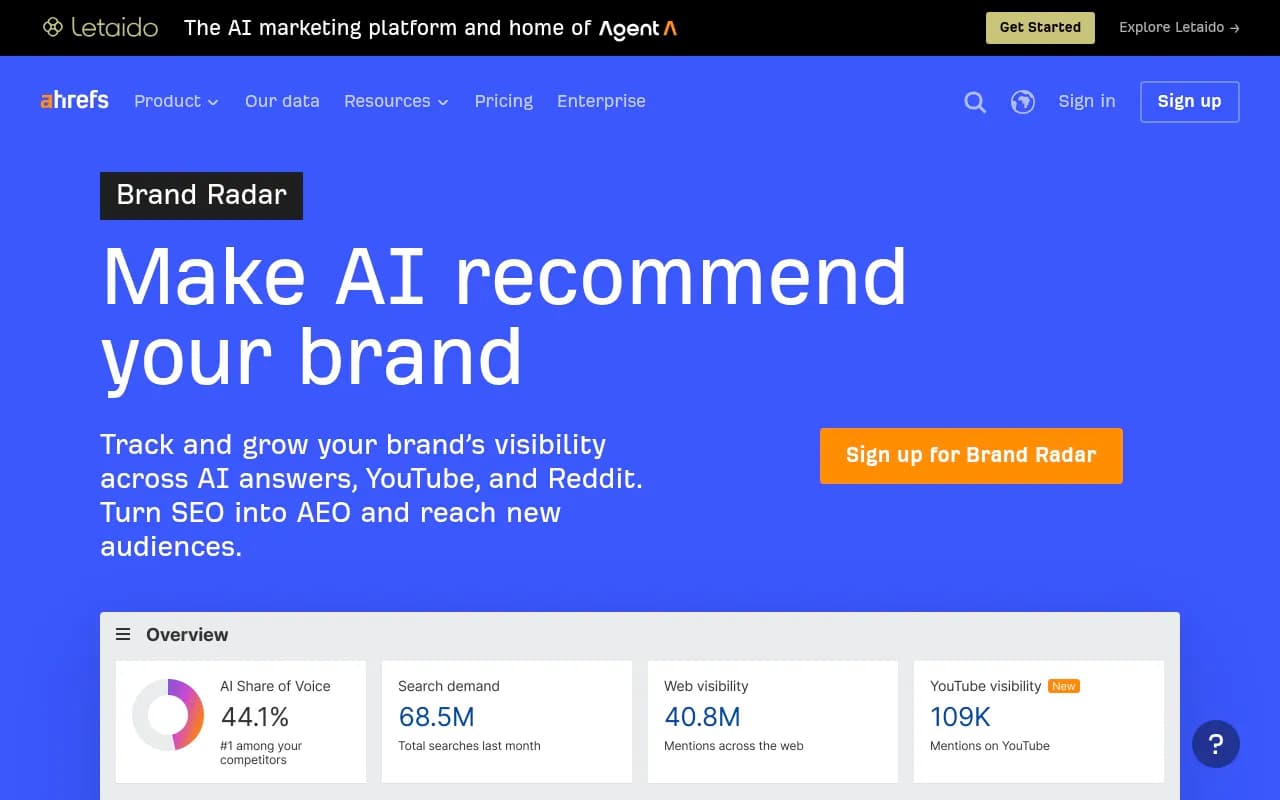
The usual limitation is shallower AI-specific data: fixed prompt sets, and no crawler logs or AI traffic attribution.
Do you need an agency instead?
Some consumer brands will want people to do the work. New Engen's guide covers four agencies (New Engen, Darkroom, NoGood and Avenue Z) and argues that consumer AI visibility depends on creator, affiliate and editorial placement, not just technical SEO. That is plausible, and it is also written by an agency selling that service. If you are weighing hiring help, 1001 SEO Media works on AI search and GEO alongside classic SEO, and pairs with a platform like Promptwatch for measurement.
A simple workflow for a consumer brand
- Write 30 to 100 real shopper prompts. Category, "best for X," price-bounded, comparison, and a few brand-name ones. One Quora contributor suggests starting with about 15 questions, fresh chat each time. That is fine for a manual audit.
- Run them across engines and countries. Look at mentions, position, and whether facts are correct.
- Map the cited sources. Note which listicles, review sites and YouTube channels show up. Those are your outreach targets.
- Check crawler access. If AI bots hit errors on your product pages, nothing else matters yet.
- Fix product pages first. Clear pricing, specs, audience, Product schema, accurate availability, and a clean merchant feed.
- Match channels to engines. YouTube, Facebook and Instagram for AI Overviews. Listicles, product pages and reviews for ChatGPT.
- Measure traffic, not just mentions. Tie AI sessions to conversions.
For more options by category, the GEO software directory lists dozens of tools beyond the ones above.
Which one should you pick?
- Small DTC brand, tight budget: start with a free scan or Promptwatch's Explore tier, or Otterly or Peec for light tracking.
- Mid-size brand with a content team: Promptwatch, because tracking, content gaps and publishing sit in one place.
- Large catalog: pair a main platform with SKU-level tooling like Orchly or Rank Monster.
- Enterprise with agency support: Profound or Promptwatch Enterprise, depending on whether you need execution as well as reporting.
- Already deep in an SEO suite: use the add-on for a first look, then graduate when you hit its limits.
The one thing I would not do is buy a tracker, look at one report, and never open it again. That is the most common failure mode people describe. Pick the tool whose output your team will act on weekly.
Promptwatch Data's hub is worth bookmarking, since the numbers above move month to month.