Key takeaways
- Test any AI visibility tool with a prompt set split by intent (commercial, informational, branded). Promptwatch Data shows each intent cites a different mix of content.
- For B2B SaaS, vendor sites and docs earn about 3x the ChatGPT citations of review sites and analysts, so crawlability of your own pages matters more than most teams assume.
- Most tools in this category are diagnostic. They tell you where you are missing, but the content work still falls on you. Weigh execution features as heavily as dashboards.
- Monitoring-only entry pricing runs from roughly 89 EUR to about 400 USD a month, according to Discovered Labs. Budget separately for content.
- Promptwatch is the pick if you want the loop closed (monitor, trace, act, measure). LLM Pulse, Peec AI, and Otterly.AI suit smaller budgets where tracking is enough.
Why B2B SaaS needs its own testing approach
Most roundups of AI visibility tools score them on feature checklists. That tells you very little about whether a tool will surface what a software buyer sees when they ask ChatGPT for a shortlist.
B2B SaaS buyers do not search like consumers. They run a string of prompts over days: "best CRM for a 50-person sales team", "how does X compare to Y", "is Z good for startups", "what integrations does it have". Third-party research from CompetLab claims AI assistants compress consideration sets from around 12 vendors to 3-5, and DerivateX's 2026 benchmark of 50 SaaS companies across 1,400 buyer-intent prompts reportedly found 44% functionally invisible. I have not verified those figures independently, so treat them as directional. The logic is plausible, though: if you are not in the answer, you are not on the list.
So the question for a tool is not "does it have a dashboard". It is: can it run the prompts my buyers run, in the interfaces they use, and show me why I am or am not cited?
How to build a buyer-research prompt set
The most useful structural idea comes from Promptwatch Data. In Promptwatch's ChatGPT citation share by content type report (Sep 28 to Oct 4, 2026), the content ChatGPT cites changes sharply with prompt intent:
| Prompt intent | Example | Top cited types |
|---|---|---|
| Commercial | "best CRM for small businesses" | Product pages 26.0%, landing pages 20.6%, listicles 15.0%, comparisons 7.9% |
| Informational | "how to set up lead scoring" | Product pages 19.1%, landing pages 13.9%, listicles 13.6%, how-tos 10.7%, docs 8.5% |
| Branded | "is HubSpot good for startups" | Product pages 23.3%, landing pages 22.8%, reviews 5.6%, FAQ 4.8%, social 3.0% |
Across all prompts, product pages take 22.4% of citations, landing pages 16.8%, and listicles 13.6%. For commercial prompts, those first four types make up almost 70% of citations.
The practical consequence: if you test a tool with one blended list of 50 prompts, you cannot tell whether a gap is a comparison-page problem, a docs problem, or a reputation problem. Split the set into three monitors.
A starter prompt set
For each intent, write 15 to 20 prompts. A rough template:
- Commercial: "best [category] software for [segment]", "top [category] tools for [use case]", "[category] tools with [integration]"
- Informational: "how do I [job your product does]", "what is [concept in your category]", "[category] implementation checklist"
- Branded and competitor: "is [your brand] good for [segment]", "[your brand] vs [competitor]", "[your brand] pricing", "[competitor] alternatives"
Add personas if the tool supports them. A CFO and a head of RevOps ask the same category question in very different words.
Scoring each tool
Run the same prompt set through each tool's free trial and check five things:
- Does it collect from the real interface of ChatGPT, Google AI Overviews, Perplexity, and Gemini, or only from APIs? User-facing answers can differ from API output.
- Can you see which URLs get cited, and where your domain lands in the source list?
- Can it tell competitor mentions from brand mentions when your name is a common word?
- Does it show query fan-outs, so you know what sub-questions to answer?
- What happens after diagnosis? Does the tool help you write, publish, and check the fix?
What B2B SaaS teams should know about where AI cites software
Before picking a tool, it helps to know what you are trying to influence. Promptwatch's software citation report (ChatGPT, Sep 28 to Oct 4, 2026) lists the most cited domains for organic software prompts: GitHub at 1.2%, learn.microsoft.com at 0.98%, G2 at 0.73%, AWS docs at 0.41%, Google Cloud docs at 0.35%, Gartner at 0.34%, Capterra at 0.32%, Intercom at 0.28%, and Zapier at 0.24%.
Grouped by source type, docs and help centers earned 2.64% of software citations, vendor sites 2.01%, review sites and analysts 1.57%, GitHub 1.2%, and app stores 0.47%. Vendor sites plus docs total 4.65%, about three times review sites and analysts. G2 is the most cited review site.
I find that interesting because many SaaS teams pour effort into review-site campaigns and neglect their own docs. Keep docs and help pages crawlable, keep G2 and Capterra profiles complete, and keep a public GitHub presence if you sell to developers.
Two more data points shape how you test. Promptwatch's ChatGPT content half-life report found landing pages and docs stay cited longest, while news loses half its cited pages within about 36 days. And Reddit's share of ChatGPT citations fell from roughly 4% to 0.5% on August 14, 2026, so a tool's Reddit view matters less for ChatGPT than it did a year ago, though Google surfaces still lean on social more.
The tools, compared
I did not look up current pricing for every tool below, so use the table for positioning and confirm prices on each vendor's site. Where I give a number, it is from the Promptwatch pricing page.
| Tool | Strength | Closes the loop (content + measurement)? | Best for |
|---|---|---|---|
| Promptwatch | Monitor, trace, act, measure in one product | Yes: Content Agent, CMS publishing, crawler logs, visitor analytics | SaaS teams that want fixes, not just reports |
| LLM Pulse | SaaS-oriented tracking, per-product sentiment, citation sources | Mostly monitoring | Startups to mid-market tracking categories |
| Profound | Enterprise monitoring depth | Monitoring-focused | Large brands with budget |
| Peec AI | Simple prompt tracking | No | Small teams on a tight budget |
| Otterly.AI | Lightweight brand mention tracking | No | Budget-conscious early starts |
| Scrunch | Monitoring with a strong feature set | Limited | Mid-market and enterprise |
| Semrush / Ahrefs Brand Radar | AI tracking added to an SEO suite | No | Teams already living in those suites |
Promptwatch
Promptwatch is the one I would test first for B2B SaaS, mainly because of what happens after the dashboard. It collects from the real interfaces of ChatGPT, Google AI Overviews, Google AI Mode, Gemini, Perplexity, Copilot, and others, in the country and language you choose. You can split prompts into monitors by intent, use personas, and see Visibility Score, Share of Voice, Position, and sentiment per topic.

The parts that matter for a SaaS buyer-research test:
- Prompt volumes, difficulty, and query fan-outs, so your prompt set is not guesswork.
- Brand Narrative, which pulls out the individual claims AI makes about you ("expensive for small teams", "weak integrations") and groups them by theme.
- IP-verified AI crawler logs, which separate an access problem (bots cannot read your pricing page) from a content problem. Most competitors lack this.
- The Action Board and Content Agent, which turn content gaps into drafts you can publish to WordPress, Webflow, or Framer, then track whether the new page gets crawled, cited, and clicked.
- Visitor analytics for AI-referred traffic and conversions. Crisp reported 2x higher conversion rates from AI traffic than traditional channels in its case study.
Pricing, per promptwatch.com/pricing: Essential is $95/mo, Professional $245/mo, and Business $579/mo. The Content Agent and faster-than-daily tracking start at Business. Agencies get Kick-off at $199/mo, Growth at $399/mo, and Scale at $799/mo. All plans include a 7-day free trial on monthly billing for the main tiers. Confirm current numbers before buying. The comparison pages Promptwatch vs Profound and Promptwatch vs Peec go into detail.
LLM Pulse
LLM Pulse positions itself directly at SaaS, from seed-stage teams tracking 50 category prompts to larger companies with thousands. Its SaaS extras include sentiment broken out per product line, citation source analysis (which Reddit threads or G2 listings AI cites for your category), and fan-out visibility for Google AI Mode.
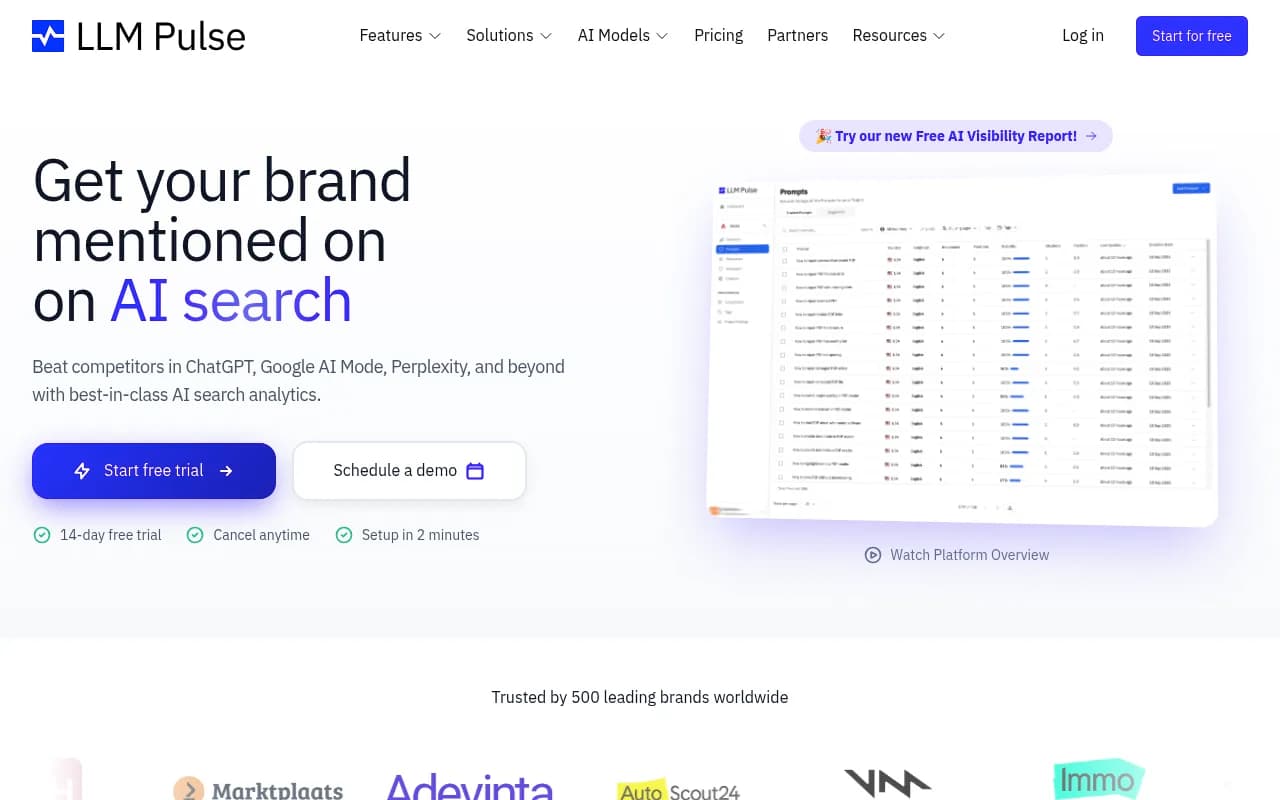
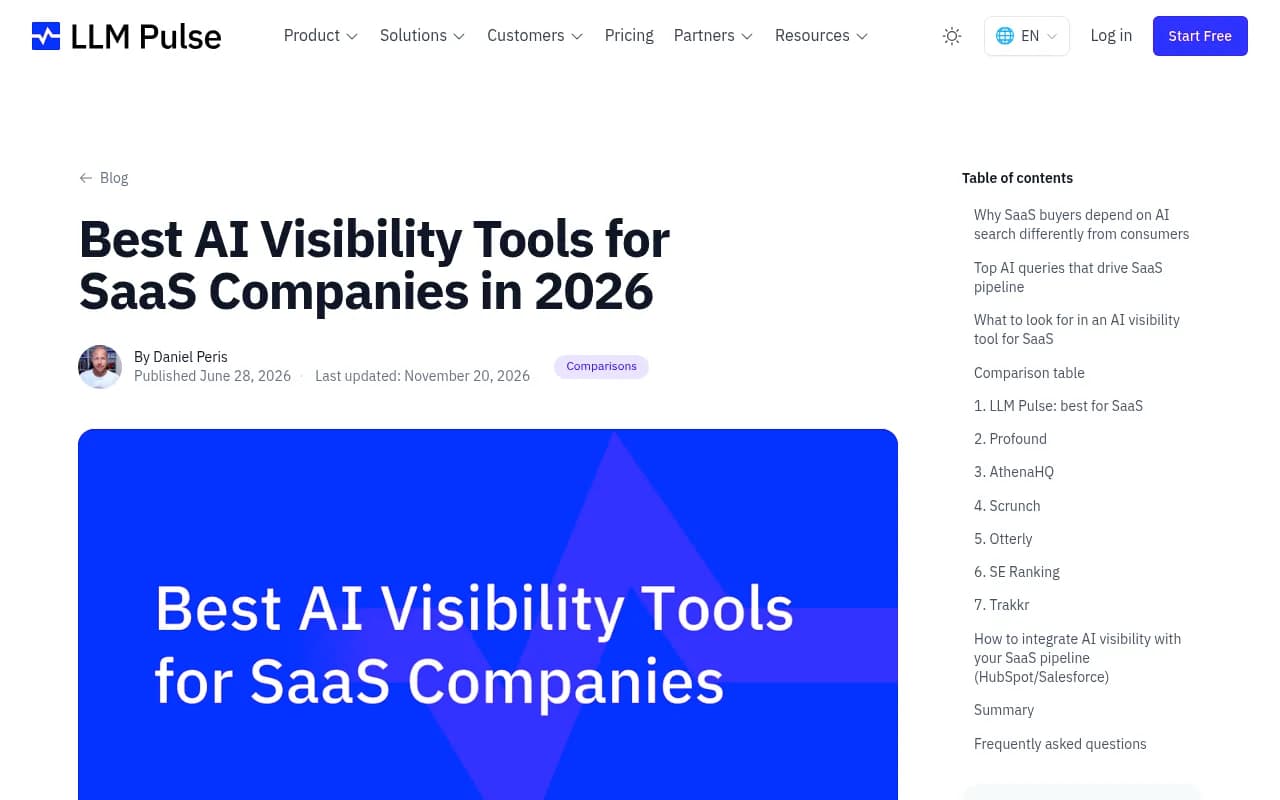
It is a strong tracking pick. The gap is on the execution side: you will take its findings elsewhere to write and ship content. Note that this comparison comes from LLM Pulse's own blog, which ranks itself first, so weigh it accordingly.
Profound
Profound

Profound is an enterprise monitoring platform with wide engine coverage. It is a legitimate choice for large brands, but it sits at a higher price point, and in our comparison it lacks Reddit tracking, ChatGPT Shopping, and agentic content execution.
Peec AI and Otterly.AI

Otterly.AI

Both are easy to start with and cheap. Both are basically prompt trackers. If your question is only "was we mentioned?", they answer it. If you need crawler logs, AI traffic attribution, or content generation, you will outgrow them or bolt on other tools.
Scrunch and AthenaHQ
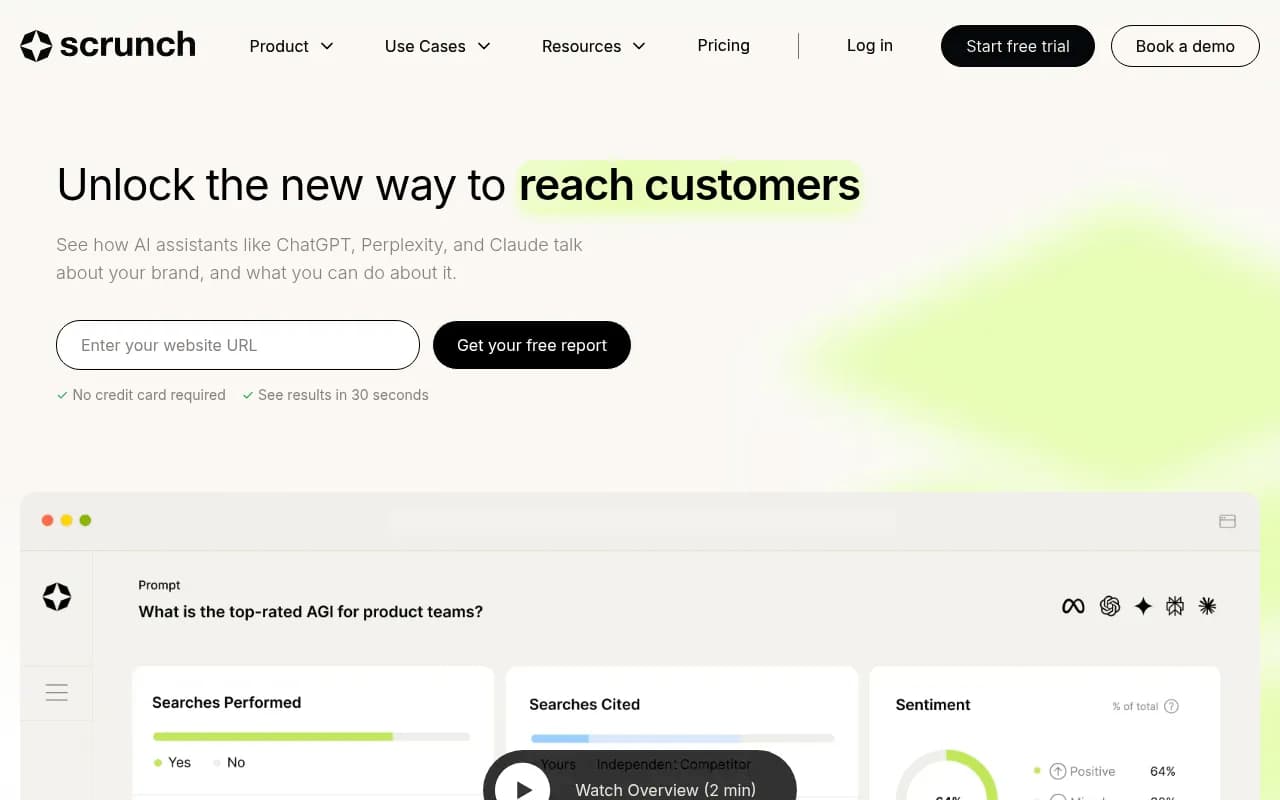

Scrunch has a solid monitoring feature set at a higher price. AthenaHQ is monitoring-focused. Discovered Labs evaluated Scrunch, Profound, Peec, and Trysight on pricing, citation fidelity, and team fit, and concluded the tools are diagnostic: they show gaps, but closing them requires structured content built for passage retrieval.
Semrush and Ahrefs Brand Radar
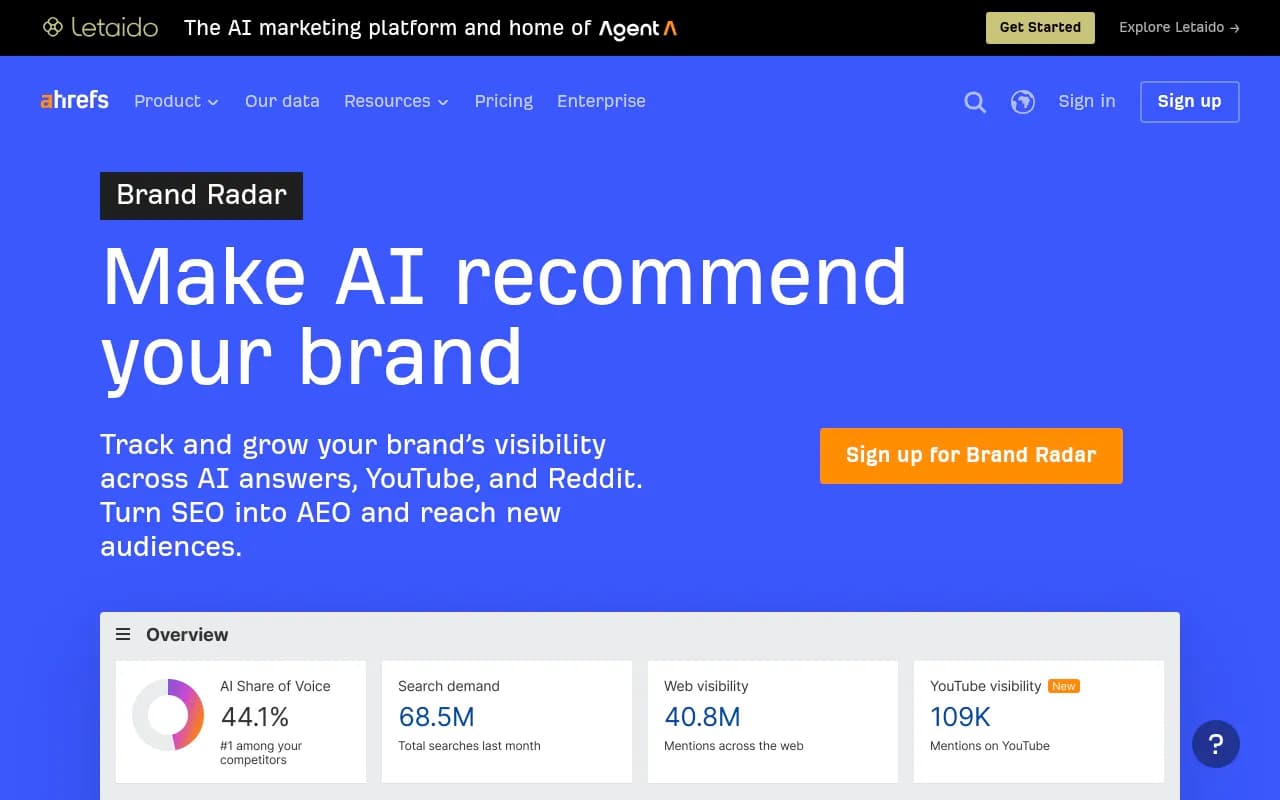
If your team already lives in these suites, the convenience is real. The tradeoff is typically fixed prompt sets and shallower AI-specific data, with no crawler logs or AI traffic attribution.
Which tool for which SaaS team
- Seed to Series A, under 50 prompts, tight budget: Peec AI, Otterly.AI, or LLM Pulse for tracking, or Promptwatch Essential if you want crawler and visitor data from day one. Use the free AI visibility report first to see your baseline.
- Series B to mid-market with a content team: Promptwatch Professional or Business. The Content Agent, content gap analysis, and the Action Board matter once you are shipping several pages a week.
- Enterprise with security review: Promptwatch is ISO/IEC 27001 certified and GDPR compliant, with SSO on Enterprise. Profound and Scrunch are the other names that usually reach procurement.
- Agencies running this for SaaS clients: look at the agency plans, or browse the GEO software directory at bestgeosoftware.com for alternatives.
A test protocol you can run in a week
- Day 1: build three monitors (commercial, informational, branded) with 15 to 20 prompts each, in your target country and language.
- Days 2 to 3: let two or three tools run the same set. Export results.
- Day 4: compare which cited URLs each tool captured for ten prompts you check by hand in the real ChatGPT and Perplexity interfaces. Differences here reveal how faithful the collection is.
- Day 5: for your top three gaps, check what the tool tells you to do. A vague "improve content" is a diagnostic. A specific page brief or draft is execution.
- Days 6 to 7: check whether crawler data or AI traffic data exists at all. If AI bots cannot read your pricing page, nothing else matters.
Then repeat in 30 days. Promptwatch's query fanout data shows average fan-outs per response moved from 2.15 in early December 2025 to about 1.84 by early March 2026, and query length shrank over the same period, so AI search behavior shifts quickly and a one-time test goes stale. Also note ChatGPT began using the site: operator at scale on August 8, 2026, per Promptwatch Data, which makes your own site structure more visible to its searches.
Mistakes to avoid
Buying on dashboard polish. A pretty score with no explanation is a vanity metric.
Tracking only branded prompts. Branded prompts tell you what AI says about you after the buyer already knows your name. The commercial set is where shortlists form.
Ignoring citation concentration. Promptwatch Data shows almost half of ChatGPT responses cite 10 or more unique domains, per its unique domains report. That means many slots to compete for, but also many pages you do not control.
Treating tracking as the finish line. As Discovered Labs puts it, data without execution is overhead. Budget for content separately if your tool does not do it.
Bottom line
For B2B SaaS, pick the tool by what happens after the diagnosis. If you only need a pulse check, LLM Pulse, Peec AI, or Otterly.AI will do. If you want one product that monitors, traces citations to pages, writes and publishes fixes, and measures AI traffic, start the Promptwatch free trial and run the three-monitor test above. The numbers will tell you quickly whether the gap is coverage, prominence, or crawlability.