Key Takeaways
- No single AI writer wins. The best setups pair a general model (ChatGPT or Claude) with an SEO scoring tool (Surfer, Frase, Clearscope) and a way to measure AI citations.
- Blog posts are not the main thing ChatGPT cites. In Promptwatch Data (Sep 28 to Oct 4, 2026), product pages made up 22.4% of ChatGPT citations, landing pages 16.8%, and listicles 13.6%.
- Comparison pages and listicles hold their citations well. News decays fastest, with half of cited news pages gone after 36 days.
- We have no 40-article results to report, and we won't invent any. Below is a test design you can run yourself, plus a tool-by-tool breakdown.
- Check current pricing on each vendor's own site. Plans change often.
A note on the 40-article premise
The original idea for this guide was "we published 40 articles and tracked the results." We did not have that dataset when writing this, and a made-up leaderboard would be worse than useless. So this guide does two things: it sorts the main AI writing tools by what they actually do, and it gives you a 40-article experiment design so you can produce your own numbers.
That is also the honest answer to "which tool is best." It depends on your niche, your editors, and your domain. Vendor roundups (including the ones that rank their own product first) can't tell you that.
Two meanings of AI SEO writing tool
Tim Soulo from Ahrefs made a useful split in his February 2026 Medium breakdown: "AI SEO tool" means either AI that makes traditional SEO work faster, or tools that track how you show up inside AI search. Writing tools sit in the first group, but in 2026 you need both, because the page you publish now has to rank in Google and get cited by ChatGPT, Gemini, Perplexity and AI Overviews.
It helps to think in three layers:
- A drafting engine (a general LLM or a purpose-built writer).
- An optimization layer that scores the draft against ranking pages.
- A measurement layer that shows whether the page got crawled, cited, and clicked.
Most people buy layer 1 or 2 and skip 3. Then they can't tell whether any of it worked.
What actually gets content cited in AI search
Before picking a tool, know what you want it to produce. The Princeton GEO paper (arXiv 2311.09735) tested tactics for generative engines. Its direction is consistent: adding authoritative citations, specific statistics, and expert quotes helped visibility, while keyword stuffing did not. Several roundups quote exact percentage lifts from it, but those are secondhand, so check the paper before repeating a number.
Then there is the format question. Promptwatch Data on ChatGPT citation share by content type (Sep 28 to Oct 4, 2026) shows where citations land:
| Content type | Share of ChatGPT citations |
|---|---|
| Product pages | 22.4% |
| Landing pages | 16.8% |
| Listicles | 13.6% |
| How-to guides | 8.7% |
| Documentation | 7.5% |
| General articles | 6.1% |
| Comparisons | 5.9% |
| News | 5.7% |
For commercial prompts like "best CRM for small businesses", product pages, landing pages, listicles and comparisons make up almost 70% of citations. So if your AI writer only cranks out generic blog posts, you are feeding the smallest slice. Use it for comparison pages, "best X for Y" listicles, and step-by-step guides for informational queries.
Longevity matters too. In Promptwatch's content half-life data (pages cited on July 6, 2026, tracked to October 4), ChatGPT still cited 72% of comparison pages after 30 days, against half of news pages gone by day 36. Product pages, reviews and how-tos reached their half-life at roughly 74 to 77 days. Plan refreshes accordingly.
The drafting engines
ChatGPT and Claude
A general model writes a perfectly good first draft if you feed it a real brief: audience, angle, your own data, and sources to cite. Where they fall down is invented facts and a bland voice. Claude tends to hold a longer, more consistent tone across a long article; ChatGPT is easier to wire into workflows and browsing. I would not publish either raw.
Jasper, Writesonic and Copy.ai
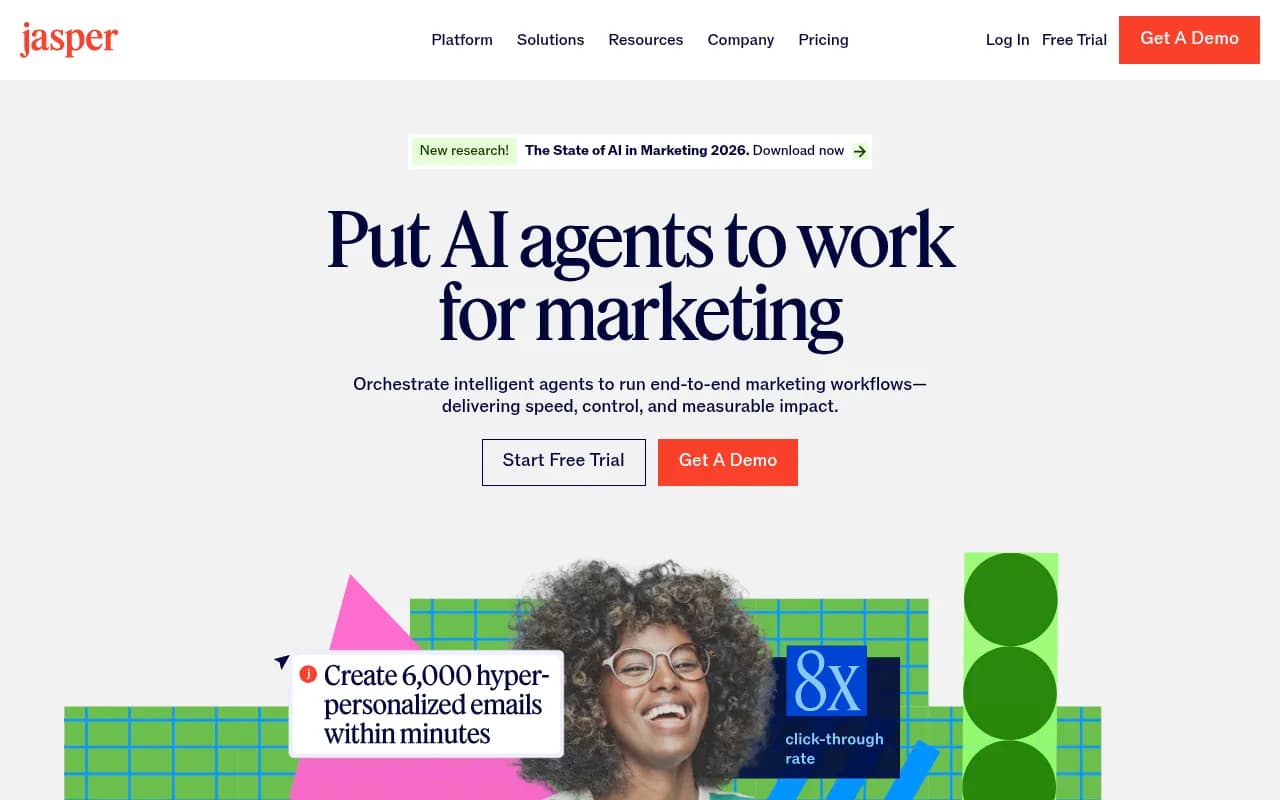
These are marketing-copy platforms that added SEO modes. Jasper leans toward brand voice and agent workflows for teams. Writesonic focuses on blog automation. Copy.ai is better for short-form and sales content than for long SEO articles. If your output is mostly ad copy and landing page variants, they fit. For research-heavy articles, I'd look at the next group.


The SEO-optimized writers and scorers
Surfer SEO
Surfer scores your draft against top-ranking pages for term coverage, structure and length, and can generate a draft too. It is the default pick for teams who already think in "content score" terms. The risk is over-optimizing to a number, which the GEO research suggests doesn't help for AI engines.
Frase
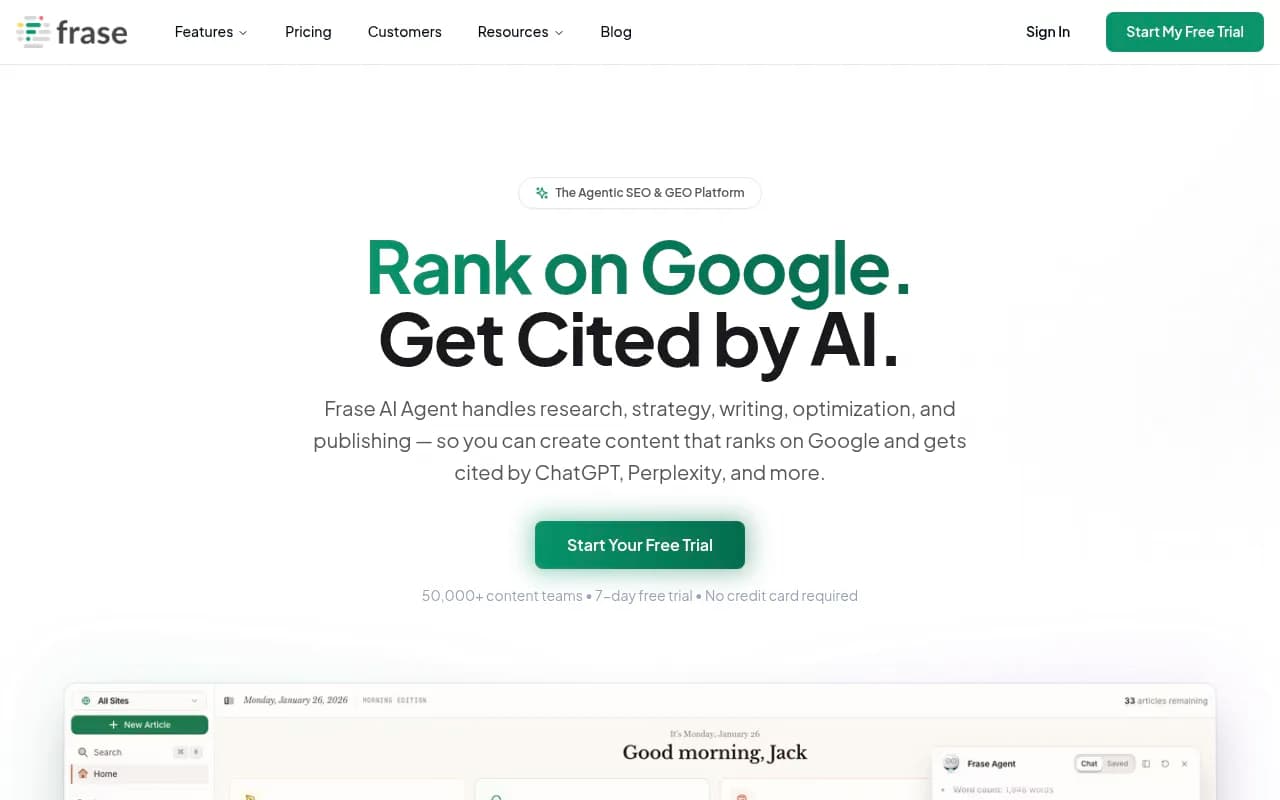
Frase bundles research, briefs, drafting and publishing, and one 2026 roundup calls it the best blog writer for most small teams, starting at $49 a month. That's a vendor-adjacent claim, so confirm the plan on Frase's site. It is a sensible pick when you want one tool, not a stack.
Clearscope, MarketMuse and NeuronWriter
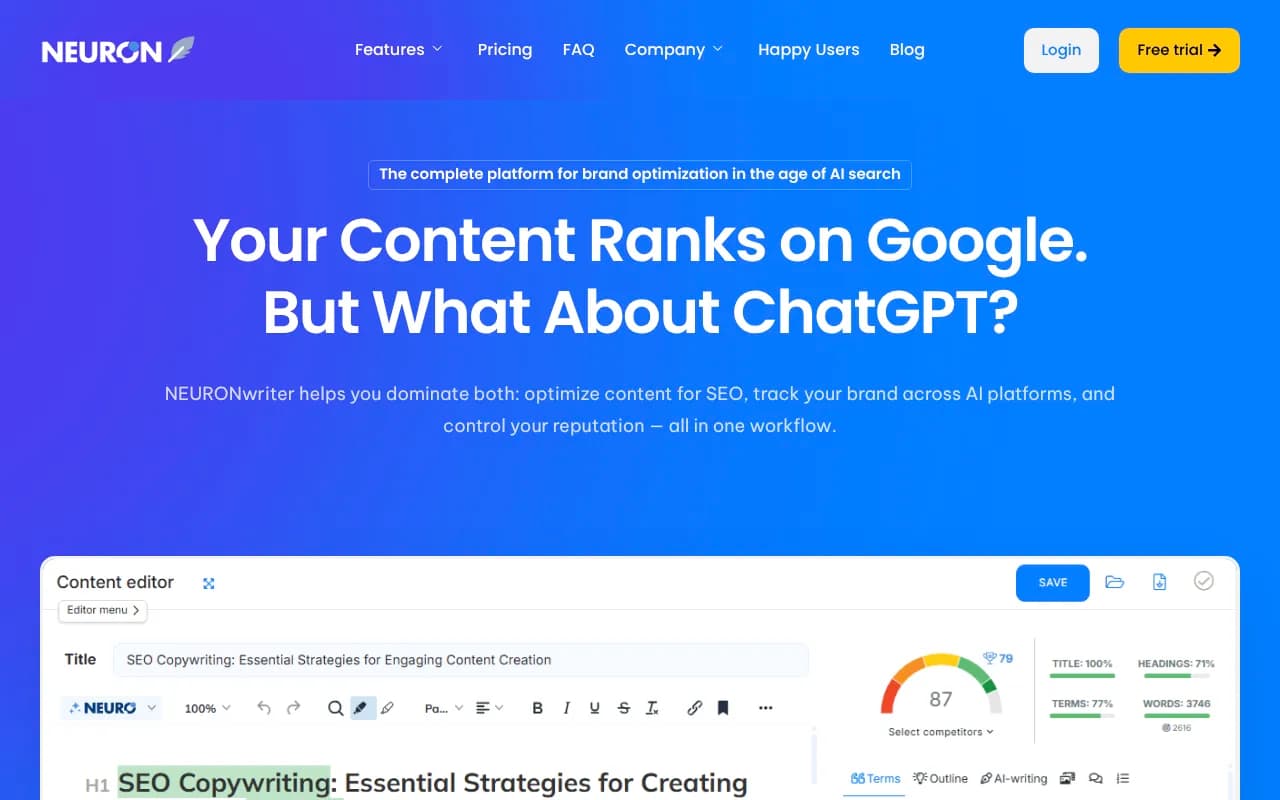
Clearscope is the polished editorial option: briefs and grading, no autopilot drafting. MarketMuse is stronger on topic planning and content inventory across a whole site. NeuronWriter is the budget-friendly alternative with similar term-based guidance.

Semrush and ContentShake AI
If you already pay for Semrush, ContentShake AI and the writing assistant keep keyword data and drafting in one place. Convenient, not best-in-class at any single piece.
Side-by-side comparison
| Tool | Main job | Drafts for you | Best for |
|---|---|---|---|
| ChatGPT / Claude | General drafting and research | Yes | Flexible first drafts with a strong brief |
| Jasper | Brand-voice marketing content | Yes | Teams with style guides |
| Writesonic | Blog automation | Yes | Fast volume on a budget |
| Surfer SEO | Scoring against SERPs | Yes (optional) | Teams who optimize to a benchmark |
| Frase | Research to publish in one tool | Yes | Small teams wanting one tool |
| Clearscope | Briefs and grading | No | Editorial teams |
| MarketMuse | Topic strategy and gaps | Limited | Large content inventories |
| Semrush | Keywords plus writing | Yes | Existing Semrush users |
For a wider look at what's out there, the directories at surferstack.com list many more writers and optimizers with reviews.
Measuring whether any of it worked
Here is the part most roundups skip. A content score tells you the draft resembles pages that already rank. It does not tell you whether ChatGPT cited your page, whether GPTBot even fetched it, or whether AI traffic converted.
That is where an AI visibility platform fits. Promptwatch tracks how ChatGPT, Gemini, Perplexity, Claude and Google AI Overviews mention and cite your brand. It also shows IP-verified AI crawler logs, so you can tell a crawl-access problem from a content problem, and its Page Tracker shows which prompts cite a specific URL. For a writing test, that closes the loop: publish, see whether bots read it, see whether it gets cited, see whether it sends traffic.

If you want to compare options first, the GEO software directory at bestgeosoftware.com covers the category. Pair whatever you choose with Google Search Console for the classic ranking side.
A 40-article test you can run yourself
This is the design I would use if I wanted real numbers instead of vendor claims.
Set up the groups
Pick one topic cluster and one domain, so authority is constant. Split 40 articles into four groups of 10:
- Raw LLM draft, light human edit.
- LLM draft, scored and revised in an SEO tool (Surfer, Frase or Clearscope).
- Purpose-built AI writer, full pipeline.
- Human-written control, with the same brief.
Match formats across groups. Because comparisons and listicles are cited more than generic articles, mixing formats unevenly will wreck the comparison. Use the same mix of how-tos, comparisons and listicles in each group.
Hold the quality bar constant
Every article gets the same editorial checklist: original data or a first-hand observation, named sources with links, statistics checked against the source, an author with a real bio, and a visible updated date. If one group skips fact-checking, you are measuring editing, not tools.
Pick metrics before you publish
- Indexed within 14 days (Search Console).
- Impressions and average position at 30, 60 and 90 days.
- AI crawler hits per page (GPTBot, OAI-SearchBot, PerplexityBot, ClaudeBot).
- Citations across ChatGPT, Perplexity and AI Overviews for a fixed prompt set.
- Clicks and conversions from AI referrals.
- Edit time per article, since a cheap tool that needs three hours of rewriting is not cheap.
Read the result honestly
Ten articles per group is a small sample. Treat differences under a wide margin as noise, and look at distributions, not just averages. Expect the biggest variance to come from topic and format, not the tool. And rerun at 90 days, since content half-life means early citations fade for some page types.
What I would buy, by situation
- Solo blogger or small team: Frase, or ChatGPT/Claude plus Clearscope or NeuronWriter if you like editing by hand.
- Agency or content team with brand rules: Jasper or a general LLM with a strong style brief, then Surfer or Clearscope for grading.
- Large site with hundreds of pages: MarketMuse for planning, then drafting and refreshes in whichever tool your editors tolerate.
- Anyone who cares about AI citations: add a measurement layer from day one. Without it you are guessing.
What to avoid
Don't chase the highest content score, and don't publish unedited bulk output because a tool promises 30 articles a month. Bulk volume of generic posts targets the formats AI engines cite least. Put the effort into product pages, comparisons, and original data, then refresh them on a schedule.
Pricing and features change quickly, so verify each tool's current plan on its own site before buying. Run the test, read your own numbers, and keep the tool that saves editing time without lowering citations.