Key takeaways
- HR and payroll buyers now ask ChatGPT and other AI engines questions like "best payroll software for 50 employees" before they ever open Google. Vendors that are not cited lose the shortlist.
- Promptwatch data shows ChatGPT cites docs, help centers and vendor sites more than review sites for software prompts, so your own site is your main citation source.
- Product pages, landing pages and listicles make up almost 70% of ChatGPT's citations for commercial prompts. Comparison pages earn a bigger share there than anywhere else.
- Monitoring-only tools tell you that you are invisible. HR and payroll teams with small content teams need a tool that also helps fix the gaps.
- The shortlist below covers Promptwatch, Profound, Scrunch, Otterly.AI, Peec AI, AthenaHQ, Semrush and Ahrefs Brand Radar, with a table matching each to a type of HR or payroll vendor.
Why HR and payroll vendors need GEO now
HR and payroll is a crowded category. Paychex, Paycor, Paylocity, Rippling, ADP, Gusto, BambooHR, Workday, HiBob and Deel all fight for the same "best HR software" prompts. A survey cited by Customer Experience Magazine found 75% of HR professionals expect to buy new HR or payroll software within the next year, and 43% put tech upgrades at the top of their 2026 agenda. Those buyers research with AI.
Here is the awkward part. Ask ChatGPT for the best payroll software and it will name a handful of vendors, cite a few listicles, and move on. If you are not in that answer, no amount of page-one Google ranking fixes it. That is what GEO (generative engine optimization) is for: measuring how AI engines mention and cite you, then changing your content and site so they do it more often.
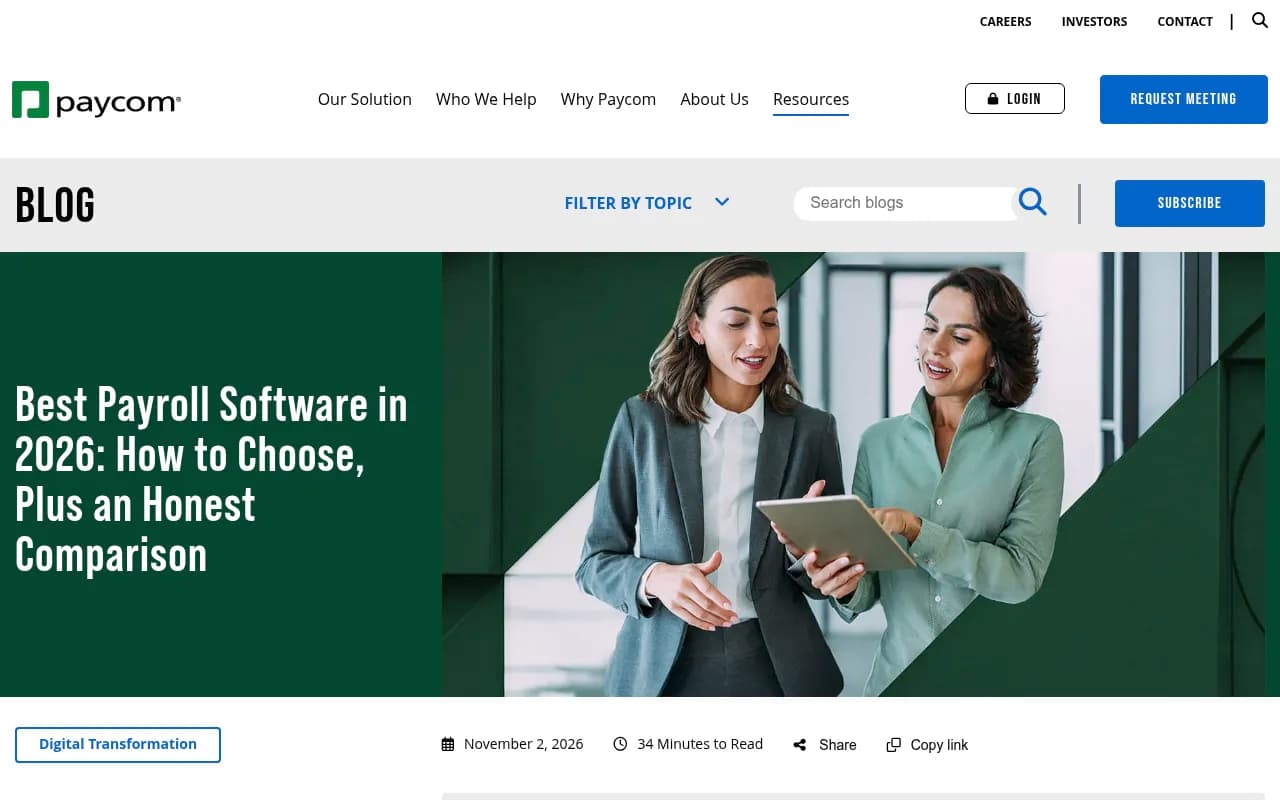
Notice what Paycom did above: it published its own "best payroll software in 2026" comparison, with itself in it. Tabulera and Gusto did the same with HR tools. Vendors in this category already know the roundup format works. GEO tools tell you whether it is working in AI answers, not just in Google.
What AI engines actually cite for software prompts
Before picking a tool, it helps to know what you are trying to move. HR and payroll vendors are SaaS vendors, so the closest dataset is Promptwatch's report on software prompts.
According to Promptwatch's data on the most cited sites in ChatGPT for software prompts (Sep 28 to Oct 4, 2026), GitHub, Microsoft's docs and G2 lead. By source type, the split looks like this:
| Source type | Share of software citations |
|---|---|
| Docs and help centers | 2.64% |
| Vendor sites | 2.01% |
| Review sites and analysts | 1.57% |
| GitHub | 1.2% |
| App stores | 0.47% |
Vendor sites and docs together earn 4.65%, about three times the share of review sites and analysts. G2, Gartner, Capterra and Software Advice together earn 1.57%, which is more than any single vendor. G2 alone gets 0.73%.
My read: payroll vendors obsess over G2 reviews, and that is fine, but your help center and product docs are doing more citation work than most teams realize. Tax-filing guides, state compliance pages, integration docs. That is where the answer to "does this payroll tool handle multi-state tax?" lives.
Which content formats win
The Promptwatch report on content types ChatGPT cites (same period) breaks down what kind of page gets cited. For commercial prompts, the "best X for Y" type that HR buyers use:
| Content type | Share of commercial citations |
|---|---|
| Product pages | 26.0% |
| Landing pages | 20.6% |
| Listicles | 15.0% |
| Comparisons | 7.9% |
Those four types make up almost 70% of commercial citations. Comparisons earn 7.9% here versus 5.9% across all prompts. So a "Gusto vs Paychex vs your product" page is worth building properly.
Freshness matters less for some formats than others. In Promptwatch's content half-life data, news pages lost half their citations within about 36 days, while landing pages and docs kept most of theirs for months. Evergreen product and compliance pages are the safer investment.
What to look for in a GEO tool for HR and payroll
A few requirements are specific to this category.
- Prompt coverage by buyer segment. "Payroll for restaurants", "HRIS for 200 employees", "best PEO", "payroll with benefits administration". You need to track dozens of these, grouped by topic and persona.
- Competitor tracking. Your rivals are Gusto, Rippling, ADP and others. Share of voice against them is the metric that matters.
- Citation sources. You need to see whether AI is pulling from G2, a competitor's listicle, a Reddit thread or your docs.
- Claim accuracy. Payroll is regulated. If an AI says your product does not support a state or integration it actually supports, you want to know which page taught it that.
- Crawler access. If GPTBot cannot read your help center, nothing else matters.
- Execution. Most HR vendor marketing teams are small. A tool that stops at a dashboard leaves the work on your desk.
The best GEO tools for HR and payroll software in 2026
Promptwatch
Promptwatch is an end-to-end AI visibility platform rather than a prompt tracker, and that matters for this category. It monitors ChatGPT, Gemini, Perplexity, Claude, Google AI Overviews, Google AI Mode, Copilot and others using the real interfaces, in the countries and languages you pick. That is useful if you sell payroll across the US, UK and Netherlands, where the compliance story and the vendors differ.

For an HR vendor, the pieces that earn their keep:
- Brand Narrative pulls out the individual claims AI makes about you ("affordable for small teams", "limited reporting") and scores themes like Pricing, Features and Support against competitors. Fact Check lets you mark a claim inaccurate and finds the page on your site that is teaching AI the wrong thing. On Business plans and above.
- AI crawler logs are IP-verified, so you can see whether GPTBot, ClaudeBot or PerplexityBot actually read your help center and where they hit errors.
- Content gap analysis maps your pages against the prompts AI answers. The Content Agent then writes and publishes to WordPress, Webflow or Framer, with a review inbox if you want a human in the loop.
- Citation Trends classify sources into types, including directories like G2 and Capterra, so you can see how much review-site influence you face.
- Visitor analytics tie AI-referred traffic to conversions, which is how you prove a demo request came from ChatGPT.
Pricing, confirmed at promptwatch.com/pricing: Essential is $95/mo, Professional $245/mo, and Business $579/mo. The Content Agent and Fact Check start on Business. Agencies running this for several HR clients have Kick-off ($199/mo), Growth ($399/mo) and Scale ($799/mo) plans. There is a 7-day free trial on monthly billing, and a free AI visibility report if you want a first look before committing.
The honest caveat: if you only want a weekly screenshot of mention counts, Promptwatch is more than you need.
Profound
Profound is an enterprise AI visibility platform tracking brand mentions across ChatGPT, Perplexity and other AI engines. It has strong monitoring and reporting, and suits large HR suites with enterprise budgets and a dedicated analyst. The tradeoffs are a higher price point, and no Reddit tracking, no ChatGPT Shopping and no agentic execution. See Promptwatch vs Profound for a head-to-head.
Profound

Scrunch AI
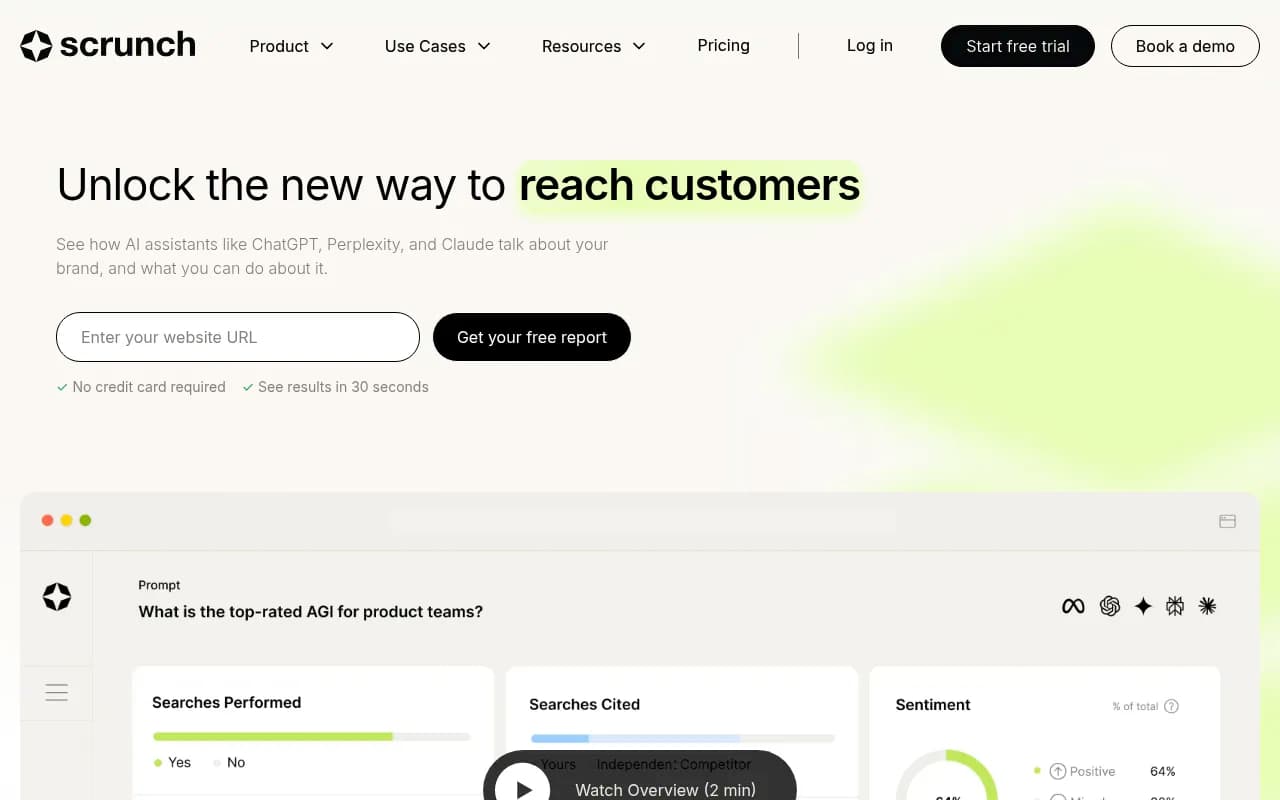
Scrunch tracks brand visibility across LLMs and is a reasonable pick for mid-market and enterprise marketing teams that want a polished monitoring layer. Like Profound, it leans on monitoring more than execution. Compare in Promptwatch vs Scrunch.
Otterly.AI
Otterly.AI is a simple, affordable monitor for mentions and citations across ChatGPT, Perplexity and Google AI Overviews. It suits a small payroll startup that wants a baseline and nothing else. It does not have crawler logs, visitor analytics or content generation.
Otterly.AI

Peec AI
Peec AI is another lightweight tracker aimed at marketing teams. Setup is quick and the interface is clean. The same limits apply: you see the problem, then you go solve it somewhere else.

AthenaHQ
AthenaHQ tracks and helps optimize brand visibility across AI search. It is monitoring-focused and lacks CMS publishing and agentic workflows, so plan on separate tooling for content.

Semrush
If your SEO team already lives in Semrush, its AI toolkit is a convenient first step. Expect a fixed prompt set and shallower AI-specific data than a dedicated platform, and no crawler logs or AI traffic attribution.
Ahrefs Brand Radar
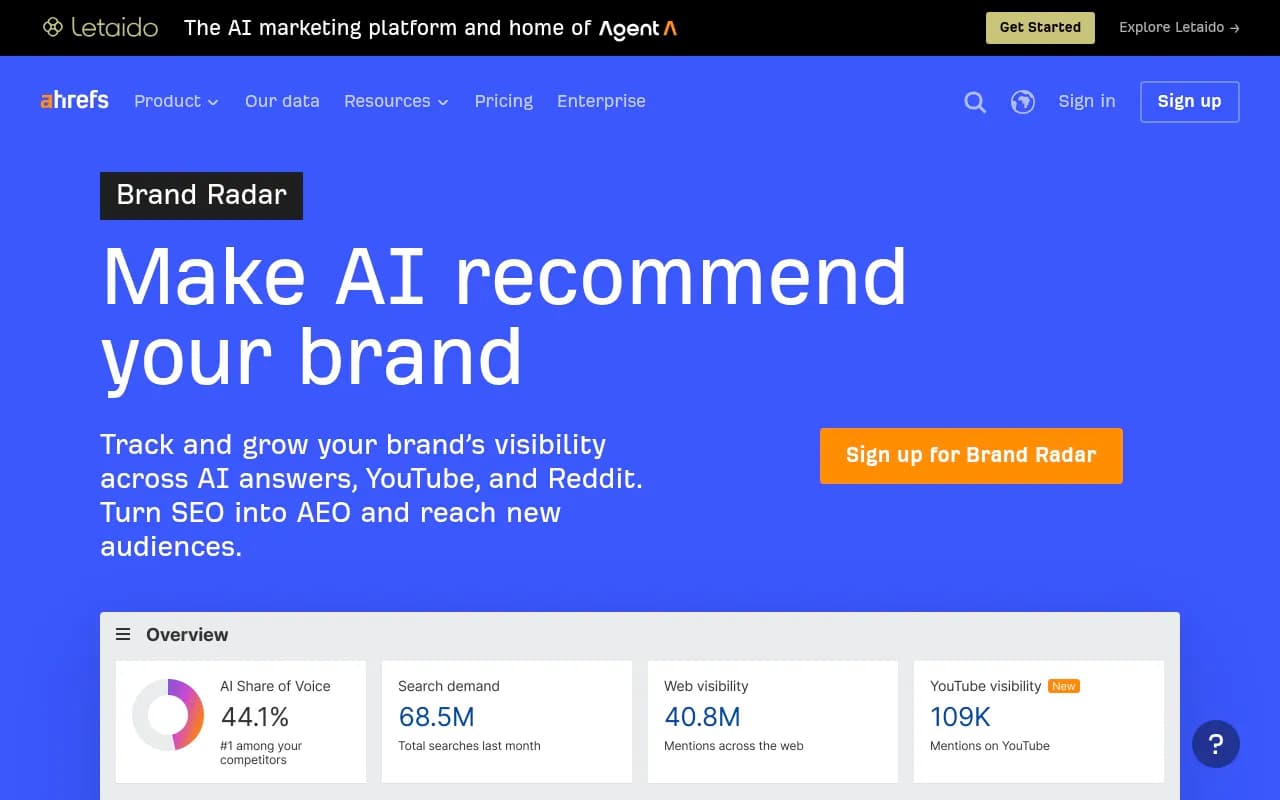
Ahrefs Brand Radar adds AI visibility tracking to a familiar SEO suite. Good for seeing how often your brand is mentioned relative to competitors if you already pay for Ahrefs. It is not built to fix what it finds.
Comparison table
| Tool | Best for | Crawler logs | Content creation and publishing | Claim accuracy checks |
|---|---|---|---|---|
| Promptwatch | HR and payroll vendors that want to fix gaps, not just see them | Yes, IP-verified | Content Agent, CMS publishing | Brand Narrative and Fact Check |
| Profound | Large enterprise suites with big budgets | Limited | No agentic execution | Monitoring only |
| Scrunch AI | Mid-market and enterprise monitoring | No | Limited | Monitoring only |
| Otterly.AI | Small payroll startups needing a baseline | No | No | No |
| Peec AI | Lean marketing teams | No | No | No |
| AthenaHQ | Teams wanting monitoring with light optimization | No | Limited | No |
| Semrush | Teams already inside Semrush | No | Separate tools | No |
| Ahrefs Brand Radar | Teams already inside Ahrefs | No | No | No |
To browse more options beyond this shortlist, the GEO software directory at bestgeosoftware.com lists a wider set of platforms.
A practical GEO workflow for an HR or payroll vendor
1. Build a prompt set from real buyer language
Start with 50 to 150 prompts. Group them by segment (restaurants, healthcare staffing, nonprofits), company size, and intent. Include branded prompts ("is Paycor good for...") and competitor comparisons ("Gusto vs Rippling"). Use personas: an HR manager and a CFO ask different questions about the same product.
2. Find where you are missing
Look at Share of Voice and position by topic. Mentions without citations to your own domain usually point to a content or crawlability problem. Low mentions overall is a coverage problem. These are different fixes, and a tool that separates them saves you weeks.
3. Fix crawler access first
Check robots.txt, CDN rules and JavaScript rendering. HR vendors often gate resources behind forms or render help content client-side. If AI bots cannot read it, it will not be cited. The Agentic Readiness Check is a free way to see which AI crawlers can get in.
4. Publish the formats AI cites
Given the data above, prioritize:
- Product and landing pages per segment, with plain-language facts (pricing model, states supported, integrations).
- Crawlable help-center and compliance docs.
- Honest comparison pages against the competitors buyers actually shortlist.
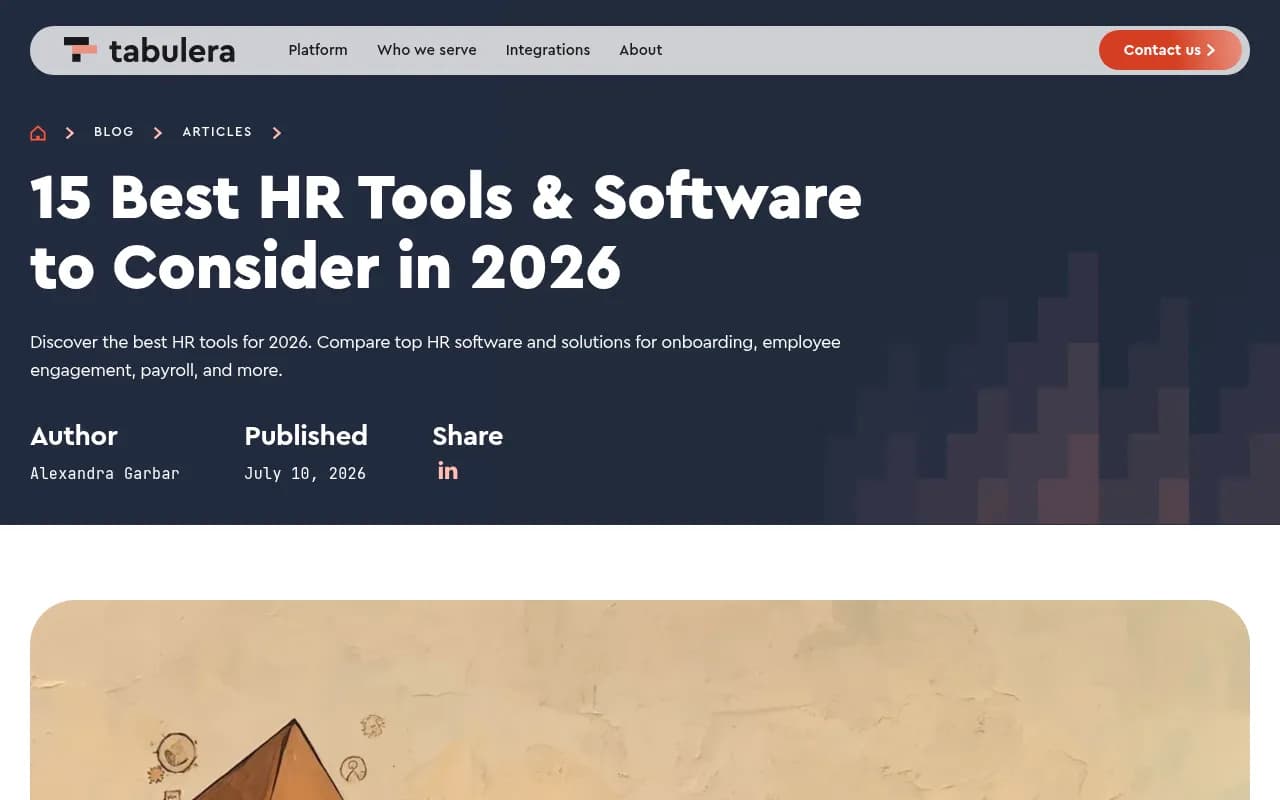
- A well-maintained "best HR software" or "best payroll software" guide, the way Paycom, Tabulera and Gusto have done.
5. Keep G2 and Capterra profiles current
Review sites are a smaller slice than vendor sites in the software data, but they are the most cited third-party source. Complete profiles, recent reviews, accurate feature lists. It is cheap work.
6. Measure traffic, not just mentions
Visibility is a vanity metric until it connects to demos. Track AI-referred visits and conversions. Note that ChatGPT stopped sending a referrer on October 8, 2026, so tagging links with utm_source=chatgpt.com matters if you want clean attribution.
Which tool should you pick?
- You are a mid-market HR or payroll vendor with a small content team: Promptwatch, because the tracking and the content execution live in one place.
- You are an enterprise suite with an analyst team and budget for monitoring: Profound or Scrunch are worth a demo alongside Promptwatch.
- You are a seed-stage payroll startup that just wants to know if you exist in ChatGPT: start with the free AI visibility report, or Otterly.AI or Peec AI if you want a basic ongoing tracker.
- You run an agency managing several HR software clients: look at agency plans with unlimited projects, not per-brand seats. Agencies can also read Promptwatch's guide to GEO for agencies.
- You are already deep in Semrush or Ahrefs: use their AI add-ons as a first look, then reassess when you need crawler data or content workflows.
If you would rather hand the whole program to specialists, a GEO-focused agency like 1001 SEO Media runs technical SEO, content and AI search work on top of platforms like Promptwatch.
Common mistakes
- Tracking only branded prompts. Buyers rarely type your name first.
- Ignoring the help center. Docs are the largest citation source type for software.
- Treating AI sentiment as a PR problem. Often it is one outdated pricing page.
- Publishing news-style posts and expecting lasting citations. Evergreen pages outlast news by months.
- Buying a dashboard when you needed an execution tool.
For more background on how the numbers move, the Promptwatch Data hub publishes updated citation research. The figures above cover a single week in late 2026, so check the source reports for the current picture before you set targets.