Key takeaways
- There is no GEO tool built specifically for manufacturers. The practical choice is between monitoring-only trackers and platforms that also help you fix content, crawler access and attribution.
- Industrial content (datasheets, product pages, application pages, docs) is exactly the content type ChatGPT cites most, so manufacturers have a structural advantage if their pages are complete and crawlable.
- Start by checking whether AI crawlers can read your site. A lot of industrial sites hide specs in PDFs, gated forms and JavaScript widgets.
- Budget teams can start with a cheap tracker, but shortlist an end-to-end platform if you need content, crawler logs and AI traffic attribution in one place.
- Most buyer-behavior stats you will see for industrial AI search come from agencies selling services. Treat them as unverified.
Why manufacturers need a different GEO shortlist
Most "best GEO tools" lists are written for B2B SaaS. That is a different problem. A SaaS company worries about "best CRM for startups" prompts. A manufacturer worries about "stainless steel hygienic pump for dairy processing" or "IP67 rated industrial connector supplier" prompts. Those are long, technical, low-volume, high-value queries, and the answers depend heavily on specs, certifications and application details.
I went looking for a tool built only for manufacturing and did not find one. What exists is a set of general GEO platforms, and the useful work is picking one that matches how industrial buying actually happens: many stakeholders, engineers doing the research, long cycles, and distributors and marketplaces sitting between you and the buyer.
A word on buyer statistics. Several agency articles in this space claim things like "90% of B2B buyers use AI to research purchases" or "300% more qualified leads in 90 days." Those posts rank the publishing agency first and cite no primary sources, so I would not put them in a board deck. The one credible adjacent number is a G2 study, reported via PR Newswire, finding about 51% of B2B software buyers start research in an AI chatbot. That is software buyers, not industrial ones. Nobody has published solid third-party data for manufacturing buyers yet, so test it yourself: run your own prompts and see what comes back.
What ChatGPT actually cites, and why it favors manufacturers
There is no Promptwatch industry report for manufacturing. But Promptwatch Data's report on ChatGPT content types (Sep 28 to Oct 4, 2026) is useful as a proxy:
- Product pages are the most cited type at 22.4% of classified citations, and landing pages follow at 16.8%. Together that is 39% of citations going to pages describing what a company sells.
- Documentation gets 7.5%, FAQ pages 3.3% and reviews 1.7%.
- For commercial prompts ("best X for..."), product pages hit 26.0% and landing pages 20.6%. Add listicles and comparisons and those four types are almost 70% of commercial citations.
- For branded prompts, reviews are 5.6%, more than three times their overall share.
My inference, not a measured result: spec sheets, application pages and technical docs are product, landing and docs content. That is the format ChatGPT leans on. Manufacturers already produce it. The problem is usually that it is locked in PDFs, buried behind login walls, or missing the comparison details an AI needs.
Longevity matters too. In Promptwatch's content half-life study, pages cited on July 6, 2026 were tracked for 90 days. After 60 days ChatGPT still cited 69% of landing pages and 67% of docs, while news lost half its pages within 36 days. For an industry with long sales cycles, that is good news: invest in durable product, application and documentation pages, and use press releases for short bursts only.
The software-prompt report is another hint at how vendor research works. In Promptwatch's software citation data, vendor sites and docs together earned about three times what review sites and analysts did. If that pattern holds for industrial categories, your own technical content matters more than third-party listings. Be careful, though: the automotive report shows the opposite can happen. In August 2026, marketplaces like Autotrader and Cars.com outranked every car brand. Industrial distributors and marketplaces may play that role in your category, so check.
What to look for in a GEO tool as a manufacturer
The most useful framing from the B2B SaaS comparisons is monitoring versus optimization. Monitoring tools run your prompts on a schedule and show mention rates. Optimization tools help you change the outcome. Buy monitoring when you need optimization and you will spend a quarter watching an accurate chart that never moves.
For manufacturers, I would add these criteria:
- Prompt customization. You need part-number, standard-number and application-specific prompts, not generic brand queries.
- Multi-country and multi-language tracking. Industrial buyers search in German, Chinese, Spanish and Portuguese. A monitor should be fixed to a language and country so markets do not blur together.
- Crawler visibility. If AI bots cannot read your PDFs or JavaScript catalog, no amount of content will help. You want to see which bots hit which pages and what errors they hit.
- Competitor and distributor tracking. Know which distributors AI recommends instead of you.
- Content support. Gap analysis against the prompts AI answers, plus a way to publish to your CMS.
- Attribution. Industrial leads come through forms, RFQs and calls. You need AI-referred visits tied to conversions, with the caveat that referrers get stripped (ChatGPT stopped sending one on October 8, 2026, so UTM tagging matters).
Tool comparison for industrial B2B teams
This table reflects the product categories, not a lab test. Check each vendor's pricing page before you buy, since I did not verify current prices for most of them.
| Tool | Type | Strength for manufacturers | Gap to check |
|---|---|---|---|
| Promptwatch | End-to-end platform | Prompt tracking, crawler logs, content gap analysis, CMS publishing, AI traffic | Content Agent starts on Business plan |
| Profound | Enterprise monitoring | Deep analytics for large brands | Enterprise pricing, no content execution |
| Peec AI | Monitoring | Multilingual depth, accuracy | Limited action layer |
| Otterly.AI | Entry-level monitoring | Low cost start (vendor-published from about $29/mo) | No crawler logs or content workflows |
| AthenaHQ | Monitoring and recommendations | Technical rigor | Check pricing and fit for non-SaaS |
| Semrush AI Toolkit | SEO suite add-on | Convenient if you already use Semrush | Fixed prompt sets, shallow AI data |
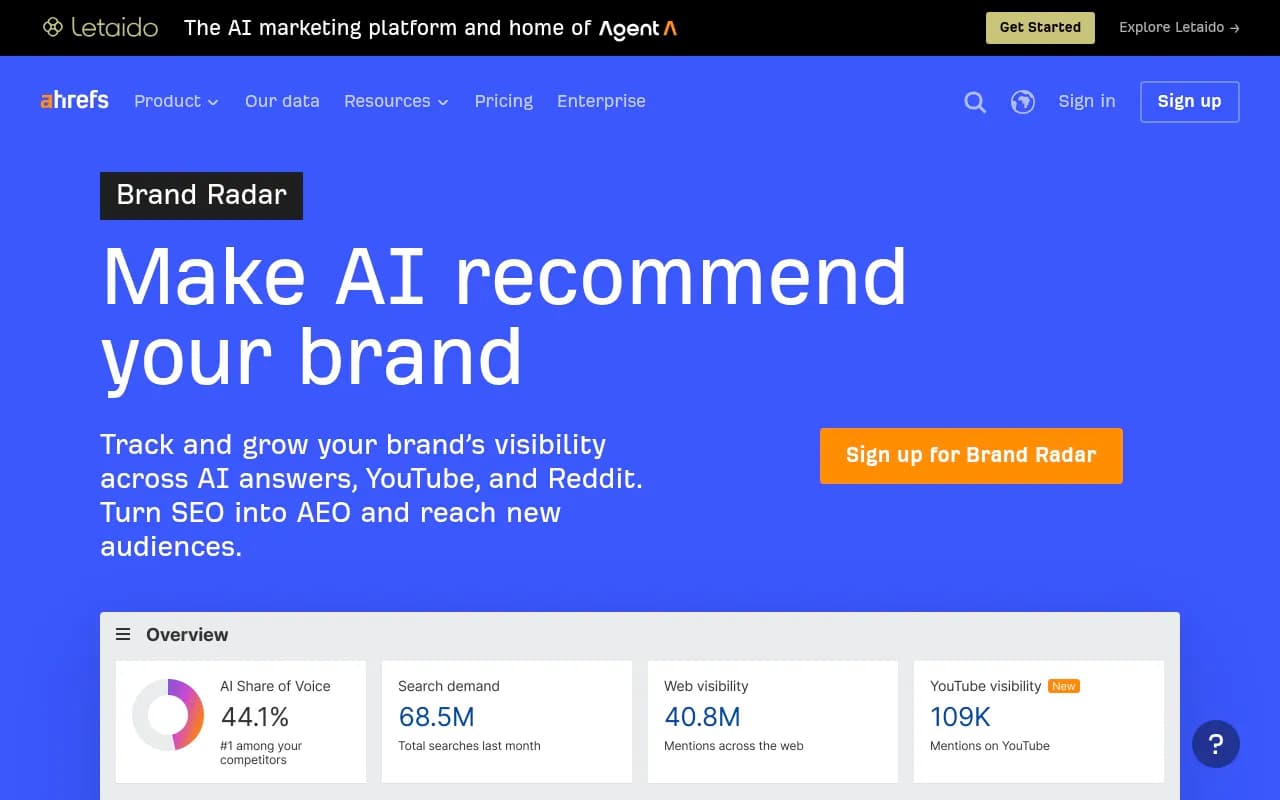
| Ahrefs Brand Radar | SEO suite add-on | Brand mention tracking next to backlink data | No crawler logs or content creation |
Promptwatch: the end-to-end pick
Promptwatch is the one I would shortlist first for a manufacturer that wants to act, not just watch. It tracks ChatGPT, Gemini, Perplexity, Claude, Google AI Overviews, Google AI Mode, Copilot and more across the countries and languages you choose, and it works from the real interfaces rather than only APIs.

Three features matter specifically for industrial sites:
- AI crawler logs are IP-verified, so you can see whether GPTBot, ClaudeBot or PerplexityBot actually read your datasheet pages and where they hit errors. That separates a crawl-access problem from a content problem.
- The content gap analysis maps your pages against the prompts AI answers, and the Content Agents can write and publish to WordPress, Webflow or Framer. Business is the first plan with the automated Content Agent.
- Visitor analytics tie AI-referred traffic to conversions, which is how you justify the spend to sales leadership.
Pricing as listed: Essential $95/mo, Professional $245/mo, Business $579/mo (confirm at promptwatch.com/pricing). Business also adds state and city tracking and local targeting, useful for regional distributors. Agencies serving several manufacturers can look at the Kick-off ($199/mo), Growth ($399/mo) and Scale ($799/mo) plans. There is a 7-day free trial, and the free AI visibility report is a no-login way to see where you stand today.
If you are comparing, the head-to-head pages cover Promptwatch vs Profound and Promptwatch vs Peec.
Profound
Profound is the enterprise monitoring choice, with deep analytics and enterprise pricing. For a large industrial group with a dedicated analyst it makes sense. For a mid-size manufacturer with a two-person marketing team, you would be paying for dashboards you cannot act on.
Profound

Peec AI
Peec AI is regarded as one of the strongest pure monitoring tools for accuracy and multilingual depth, which counts if you sell into several language markets. It stops at monitoring, so pair it with your own content workflow.

Otterly.AI
Otterly is the cheap way in. The Anagram post cites it from $29/month, a vendor-published number I could not verify. It is fine to learn what your baseline looks like, but you will outgrow it once you need crawler data or content help.
Otterly.AI

AthenaHQ
AthenaHQ gets described as technically sophisticated. The comparisons I read are all B2B SaaS-focused, so test it with industrial prompts before committing.

Semrush and Ahrefs add-ons
If you already pay for Semrush or Ahrefs, try their AI visibility features first. The trade-off is fixed prompt sets and shallower AI-specific data, and neither gives you AI crawler logs.
What the competitor roundups say
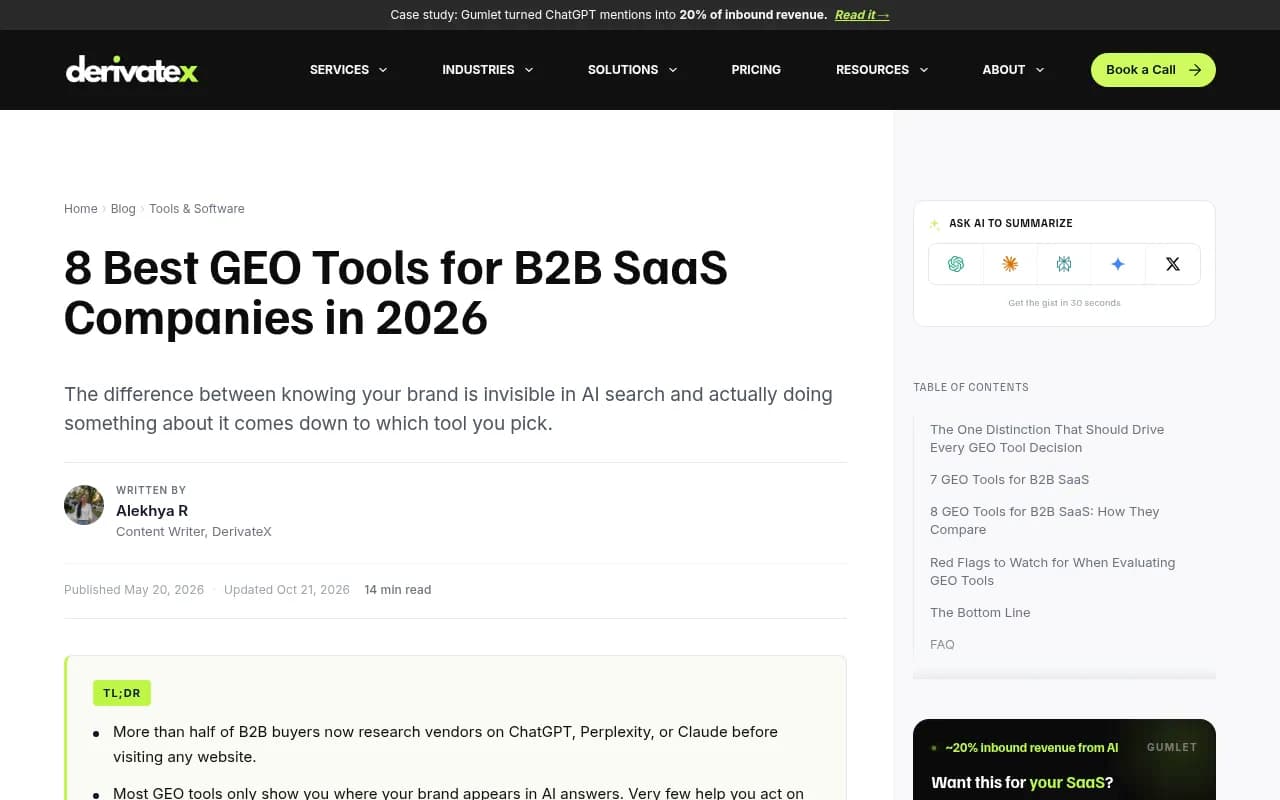
The DerivateX guide splits the market into budget (Otterly AI, GrackerAI), enterprise (Profound, AthenaHQ) and suite add-ons (Semrush, Ahrefs). That is a sensible tiering, though it was written for software companies.
The Anagram startup guide covers the cheap end, with similar tiers around monitoring, optimization and conversion.
Agencies versus tools
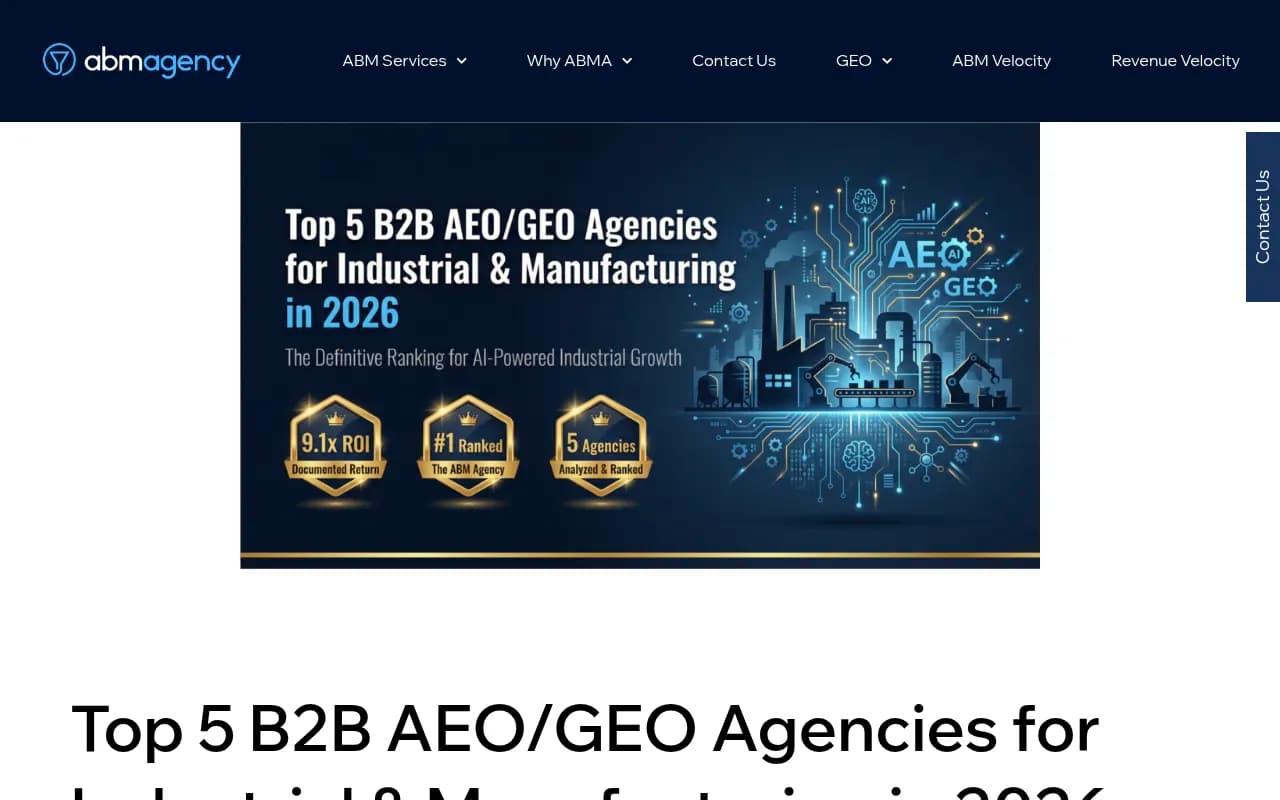
Some manufacturers would rather outsource. The ABM Agency's roundup of industrial GEO agencies names itself #1 and also lists First Page Sage, Gorilla 76, TREW Marketing and Weidert Group. Self-ranked lists deserve skepticism, and its headline stats (9.1x ROI, 300% lead lift) have no cited source. Still, the agency names are a starting list for calls.
If you want an agency that uses a GEO platform and is transparent about it, 1001 SEO Media covers technical SEO, content and AI search work with no long-term contracts, and it runs on Promptwatch. For more tool options, the GEO software directory lists far more than I can fit here.
A practical 30-day plan for a manufacturer
Week 1: baseline and access
Run the free AI visibility report, then check whether AI crawlers can read your site. The free Agentic Readiness Check and AI crawler URL inspector are quick. Look at your robots.txt for accidental AI bot blocks, and note which specs live only in PDFs.
Week 2: build the prompt set
Write 40 to 100 prompts the way engineers and buyers actually ask: by application, material, standard, certification, tolerance and "alternative to [competitor part]". Add persona variants (design engineer, procurement lead, plant manager). Group them by product line.
Week 3: fix the pages AI cites first
Per the content-type data, make product and landing pages complete: specs, certifications, compatible parts, price ranges where you can, and comparison tables. Convert key PDF datasheets into crawlable HTML pages. Keep documentation public. Add FAQ sections for the questions your sales engineers answer weekly.
Week 4: measure and decide
Check which pages got crawled, which got cited, and whether AI-referred visits arrived. Decide whether a monitoring tool is enough or you need an end-to-end platform. Also see which distributors and marketplaces AI recommends instead of you, because that tells you whether to fix your own pages or get listed on theirs.
Which tool for which manufacturer
- Small marketing team, wants results: Promptwatch Professional or Business.
- Large enterprise with analysts: Profound or Promptwatch Business and Enterprise.
- Just testing the idea: Otterly, or the free AI visibility report.
- Already on an SEO suite: use the suite's AI add-on for a month, then see what you are missing.
- Managing several manufacturer clients: an agency plan, or a specialist agency.
For any of these, run a pilot on one product line with your real prompts before you sign an annual contract. The gap between a tracker and a platform only shows up when you try to move a number.