Key takeaways
- Buyers increasingly use ChatGPT, Perplexity, and Google AI Overviews to evaluate software features before visiting a vendor's website -- if you're not cited, you're not in the consideration set.
- GEO (Generative Engine Optimization) tools let product managers see exactly which prompts AI models answer about their category, which competitors get recommended, and where their own product is missing.
- Most GEO tools only monitor. The ones worth using for product teams go further: they surface content gaps, show which pages AI engines actually crawl, and help you create content that closes those gaps.
- For product managers specifically, the most useful signals are prompt-level data (what buyers ask), feature-level citation tracking (which capabilities AI mentions), and competitor heatmaps (who's winning which prompts).
- Promptwatch is the only platform in 2026 rated as a leader across all GEO categories -- monitoring, content gap analysis, content generation, and crawler analytics.
Why product managers need to care about AI search in 2026
Here's a scenario that's playing out constantly right now: a procurement manager at a mid-size company opens ChatGPT and types "what project management tools have the best resource planning features?" They read the response, note two or three names, and then go look those up. Your product might be objectively better, but if it's not in that AI-generated answer, you don't exist to that buyer.
This isn't a marketing problem in isolation. It's a product visibility problem. And product managers are uniquely positioned to fix it -- because they know the features, the use cases, and the language buyers actually use.
Traditional SEO told you where you ranked on a results page. GEO tells you whether AI engines recommend you at all, which features they associate with your product, and what your competitors are getting credit for that you're not. That's product intelligence.
According to SparkToro's analysis of Similarweb clickstream data from early 2026, about 68% of Google searches ended without a click -- the answer was right there in the AI overview. ChatGPT reached roughly 900 million weekly active users in February 2026. These aren't edge cases anymore. This is where your buyers are doing their research.
What GEO tools actually do (and what most get wrong)
Before picking a tool, it helps to understand what the category actually covers.
At the basic level, GEO tools send prompts to AI engines (ChatGPT, Perplexity, Gemini, Claude, etc.) and record whether your brand appears in the response. That's monitoring. It's useful, but it's table stakes.
The more interesting question is: why aren't you appearing? And what do you do about it?
That's where most tools fall short. They'll tell you "you appeared in 12% of responses for this prompt" but they won't tell you what content is missing from your site, which pages AI crawlers are actually reading, or how to write something that would change that number.
For product managers, the gap between monitoring and optimization matters a lot. You don't just want a dashboard showing you're invisible -- you want to know which feature pages are being ignored, which competitor comparison queries you're losing, and what content would make AI engines start recommending you.
The prompts that matter for product teams
Before you pick a tool, think about the prompt categories that actually affect your pipeline:
Feature comparison prompts -- "What tools have the best [feature] for [use case]?" These are the highest-intent queries. A buyer has already decided they need a solution; they're now comparing capabilities.
Category definition prompts -- "What is [category] software?" or "How does [feature] work?" These shape how AI engines understand your product space. If your product isn't cited in these definitional answers, you're not part of the category in the AI's mental model.
Competitor comparison prompts -- "How does [your product] compare to [competitor]?" These are dangerous to ignore. If a buyer asks this and the AI only has information from your competitor's content, the answer will be skewed.
Use case prompts -- "Best tool for [specific workflow]" or "How do I solve [specific problem]?" These are where feature-level content wins. A detailed help article or feature page that directly addresses a workflow is exactly what AI engines want to cite.
A good GEO tool lets you track all of these. The best ones show you which prompts your competitors are winning and help you figure out why.
The best GEO tools for product managers in 2026
Promptwatch -- best for the full optimization loop
Promptwatch is the most complete platform in this category. Where most tools stop at showing you data, Promptwatch is built around a loop: find the gaps, create content to close them, track the results.

For product managers, the most useful features are:
The Answer Gap Analysis shows you exactly which prompts competitors are visible for that you're not. You can see the specific topics and questions AI models want to answer but can't find on your site. That's a direct brief for your content team.
AI Crawler Logs show which pages ChatGPT, Claude, and Perplexity are actually reading on your site, how often they return, and whether they're encountering errors. If your feature pages aren't being crawled, they can't be cited -- and this is the only tool that shows you that in real time.
Prompt Intelligence gives volume estimates and difficulty scores for each prompt, plus query fan-outs that show how one prompt branches into sub-queries. This is genuinely useful for prioritization -- you can see which feature-related prompts have the most buyer activity and which ones are winnable.
Content Agents generate articles, comparisons, and briefs grounded in real prompt data. This isn't generic content -- it's built around the specific gaps AI models are exposing.
Promptwatch monitors 10 AI models: ChatGPT, Perplexity, Google AI Overviews, Google AI Mode, Claude, Gemini, Meta/Llama, DeepSeek, Grok, and Copilot. It also tracks ChatGPT Shopping and Reddit/YouTube discussions that influence AI recommendations -- two channels most competitors ignore entirely.
Pricing starts at $99/month (Essential: 1 site, 50 prompts, 5 articles), $249/month (Professional: 2 sites, 150 prompts, 15 articles, crawler logs), and $579/month (Business: 5 sites, 350 prompts, 30 articles). Free trial available.
Profound -- best for enterprise-scale tracking
Profound is the strongest dedicated monitoring platform for enterprise teams. It covers 10+ AI platforms, provides prompt volume data, and has solid reporting for larger organizations.
Profound

Where it falls short for product managers: it's primarily a monitoring tool. You'll see where you're invisible, but Profound doesn't help you fix it. No content generation, no crawler logs, no Reddit tracking. For a team that already has content resources and just needs deep tracking data, it works well. For a team that needs to act on what they find, it's only half the picture.
Otterly.AI -- best for SMBs getting started
Otterly.AI is one of the most widely used GEO platforms, with 20,000+ marketing and SEO professionals using it. It covers ChatGPT, Perplexity, AI Overviews, AI Mode, Gemini, and Copilot, and Gartner named it a Cool Vendor in AI Marketing.
Otterly.AI

It's a solid entry point for product teams that want to start tracking AI visibility without a large budget. The interface is clean, setup is fast, and it gives you a clear picture of brand mention frequency across platforms. The limitation is the same as most monitoring tools: it shows you the problem but doesn't help you solve it. No content gap analysis, no crawler logs, no content generation.
Peec AI -- best for quick competitive snapshots
Peec AI focuses on AI search visibility tracking for marketing teams. It's straightforward: set up your prompts, track your mentions, compare against competitors.
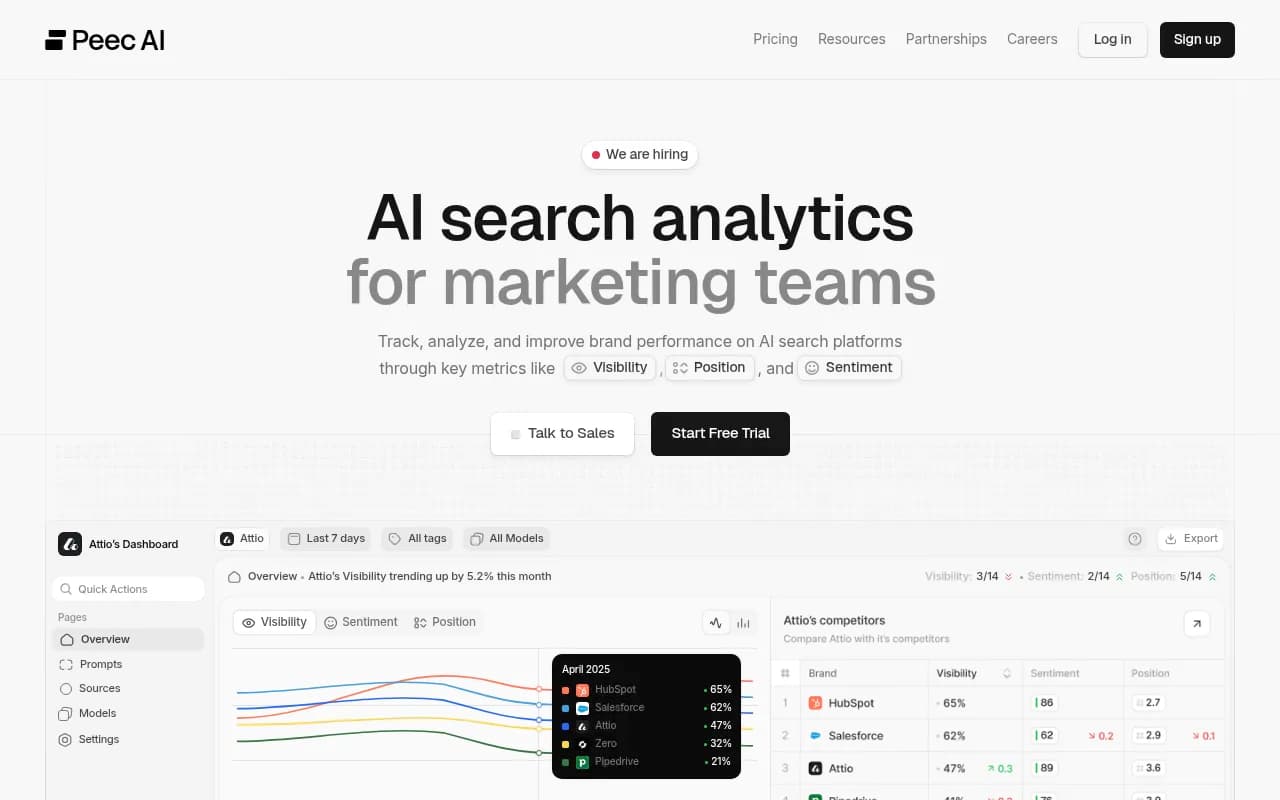
For product managers who want a lightweight way to check competitive positioning in AI answers -- "is our product being mentioned alongside [competitor] in feature comparison queries?" -- Peec AI does that cleanly. It won't give you the depth of Promptwatch or Profound, but it's fast to set up and easy to interpret.
AthenaHQ -- best for teams with strong content resources
AthenaHQ covers 8 AI platforms and has built a reputation for strong case studies. It's YC-backed and takes a thoughtful approach to AI visibility measurement.

The catch for product teams: it's monitoring-focused. AthenaHQ doesn't have content optimization or generation capabilities, so you'll need a separate workflow to act on what you find. At $295/month starting price, it's also on the higher end for what is essentially a tracking tool. Teams with dedicated content writers who just need the data will find it useful; teams looking for an end-to-end solution should look elsewhere.
Semrush -- best for teams already on the platform
If your team is already using Semrush for traditional SEO, the AI Toolkit adds AI visibility tracking without requiring a separate tool.
The limitation is that Semrush uses fixed prompts rather than letting you define your own, and it doesn't have AI traffic attribution. For product managers who want to track specific feature-related prompts, that's a real constraint. It's a reasonable add-on if you're already paying for Semrush, but not a reason to choose Semrush over a dedicated GEO platform.
Airefs -- best for source-level citation tracking
Airefs focuses on source-level citation analysis -- which specific pages, Reddit threads, and external sources AI models cite when they answer questions in your category.
For product managers trying to understand why a competitor is being recommended, this is useful. If Perplexity keeps citing a competitor's comparison page, you can see that directly and decide whether to create something better. It's a narrower tool than Promptwatch but does source analysis well.
Tool comparison table
| Tool | Monitoring | Content gap analysis | Content generation | Crawler logs | Reddit/YouTube tracking | Starting price |
|---|---|---|---|---|---|---|
| Promptwatch | 10 AI models | Yes | Yes (Content Agents) | Yes | Yes | $99/mo |
| Profound | 10+ AI models | Limited | No | No | No | $99/mo |
| Otterly.AI | 6 AI models | No | No | No | No | $29/mo |
| Peec AI | Multiple | No | No | No | No | Custom |
| AthenaHQ | 8 AI models | No | No | No | No | $295/mo |
| Semrush AI Toolkit | Multiple | Limited | No | No | No | Bundled |
| Airefs | Multiple | Partial | No | No | Limited | $24/mo |
How to use GEO data as a product manager
Tracking AI visibility is only useful if you do something with it. Here's how to translate GEO data into product and content decisions.
Build a prompt library for your product
Start by mapping out the prompts buyers actually use. Think about:
- Feature comparison queries: "best tools for [specific capability]"
- Use case queries: "how to [workflow your product solves]"
- Competitor comparison queries: "[your product] vs [competitor]"
- Category queries: "what is [your product category]"
Run these through a GEO tool and record what comes back. Which prompts are you winning? Which are you losing? Which ones don't mention you at all?
This becomes your visibility baseline. Track it monthly.
Use answer gaps to prioritize content
When you see a prompt where a competitor is cited and you're not, the question is: what content does the AI have access to that makes it recommend them? Usually it's a specific page -- a feature comparison, a use case guide, a detailed help article.
Answer gap analysis (available in Promptwatch) surfaces these systematically. You don't have to manually reverse-engineer every response. The tool shows you the specific topics your site is missing.
Check which feature pages are being crawled
This is underappreciated. You might have excellent feature documentation, but if AI crawlers aren't reading it, it can't influence their responses. Crawler logs show you exactly which pages are being visited, how often, and whether there are errors blocking access.
If your most important feature pages aren't showing up in crawler logs, that's a technical problem to fix before you create any new content.
Track competitor heatmaps by prompt
Competitor heatmaps show you who's winning for each prompt across different AI models. You might be winning on ChatGPT but invisible on Perplexity. Or a specific competitor might dominate feature comparison queries while you win on use case queries.
This level of detail lets you prioritize. Instead of trying to improve everywhere at once, you can focus on the specific prompts and platforms where the gap is largest and the buyer intent is highest.
What good AI-visible content looks like for product features
Once you know which gaps to close, you need to create content that AI engines will actually cite. A few patterns that work:
Direct question-answer structure. AI engines are looking for content that directly answers the question a user asked. A page titled "How does [your product] handle resource planning?" that actually answers that question in the first paragraph is more likely to be cited than a generic features page.
Specific, factual claims. AI models prefer content with concrete details -- numbers, specific capabilities, named integrations. "Supports real-time collaboration for up to 50 users with role-based permissions" is more citable than "powerful collaboration features."
Comparison content. Pages that compare your product to competitors on specific dimensions are frequently cited in comparison queries. They're also some of the highest-intent pages you can create.
Use case documentation. Detailed walkthroughs of specific workflows -- not just "here's the feature" but "here's how a team uses this feature to solve [specific problem]" -- tend to get cited in use case queries.
The practical workflow for product teams
A reasonable starting cadence for a product manager new to GEO:
- Set up a GEO tool with 20-30 prompts covering your key features, use cases, and competitor comparisons.
- Run a baseline measurement. Record your visibility score and which prompts you're winning vs. losing.
- Pull the answer gap analysis. Identify the 5-10 prompts with the highest buyer intent where competitors are visible and you're not.
- Check crawler logs for your most important feature pages. Fix any access issues.
- Create or update content for the top 3 gaps. Use real prompt data to guide the structure and angle.
- Track for 4-6 weeks. AI engines typically crawl and incorporate new content within that window.
- Repeat.
This isn't a one-time project. AI models update their training and retrieval continuously, and competitors are creating content too. The teams that treat GEO as an ongoing program -- not a one-time audit -- are the ones building durable visibility.
Bottom line
Product managers have always cared about how their product is perceived and positioned. AI search just added a new channel where that perception is being formed -- one that most product teams aren't tracking yet.
The tools exist to change that. Start with a clear prompt library, pick a platform that goes beyond basic monitoring, and treat the data as a direct input to your content roadmap. The product that AI engines recommend most confidently in your category will have a real advantage in the buying process -- and right now, that position is still up for grabs in most markets.