Key takeaways
- Most GEO tools track brand mentions at a surface level -- they tell you "your brand appeared in X% of responses" but can't break that down by product, feature, or use case.
- Product-level AI visibility tracking requires prompt engineering at scale: you need to ask AI models about specific features, comparisons, and use cases, not just your brand name.
- A handful of platforms -- including Promptwatch, Profound, and ZipTie -- offer the granularity needed for product-level analysis, but they differ significantly in how they get there.
- The platforms that go deepest combine prompt customization, page-level citation tracking, and content gap analysis. Monitoring-only tools leave you with data but no path forward.
- If you're running a multi-product business or SaaS company, brand-level visibility scores are almost useless for prioritization. You need feature-level data to know where to invest.
Why brand-level monitoring isn't enough anymore
When GEO tools first emerged, the core question was simple: "Does ChatGPT mention us?" That was a reasonable starting point. Most brands had no idea whether they appeared in AI-generated answers at all.
But that question is now table stakes. If you're a SaaS company with six product lines, or an ecommerce brand with hundreds of SKUs, knowing that "your brand appeared in 34% of responses" tells you almost nothing actionable. Which product? Which use case? Which competitor is stealing visibility for your most profitable feature?
The gap between brand-level monitoring and product-level intelligence is where most GEO tools fall short. They're built to answer "are we visible?" not "where exactly are we losing, and why?"
This guide is specifically for teams who need the second kind of answer.
What product-level AI visibility tracking actually means
Before comparing tools, it's worth being precise about what we mean by "product feature level" tracking.
Brand-level monitoring asks prompts like:
- "What is [Brand]?"
- "Tell me about [Brand]'s products"
- "Is [Brand] a good choice for X?"
Product-feature-level tracking goes deeper:
- "What's the best tool for [specific use case your feature solves]?"
- "How does [Feature A] compare to [Competitor Feature B]?"
- "Which platforms offer [specific capability]?"
- "What are the limitations of [your product's core function]?"
The difference matters because AI models often recommend specific features or capabilities without mentioning the brand at all. A user asking "what's the best AI search visibility tool with crawler log monitoring?" might get an answer that names Promptwatch's crawler logs feature -- or a competitor's equivalent -- without the brand name appearing prominently. If you're only tracking brand mentions, you miss that entirely.
The three levels of AI visibility tracking
It helps to think about this as a hierarchy:
Level 1: Brand mention tracking The most basic form. Did your brand name appear in the response? Most tools do this. It's useful for brand health monitoring but insufficient for product strategy.
Level 2: Category and use-case tracking Tracking prompts organized around specific use cases, categories, or buyer intents. "Best tools for X" queries. This is where many mid-tier platforms operate.
Level 3: Feature and comparison tracking Tracking prompts that ask about specific capabilities, head-to-head comparisons, and feature-specific questions. This is where you understand whether AI models recommend your product for its actual differentiators -- and whether competitors are stealing those specific conversations.
Most teams need Level 2 at minimum. Product marketers, competitive intelligence teams, and anyone doing serious GEO optimization need Level 3.
Which platforms actually support product-level tracking
Promptwatch
Promptwatch is the platform that gets closest to true product-feature-level tracking, because it's built around the idea that you define the prompts. You're not limited to a preset library of brand queries -- you can build prompt sets around specific features, use cases, and competitive comparisons.
The Answer Gap Analysis is particularly relevant here. It surfaces the exact prompts where competitors are visible but you're not, broken down by topic and intent. For a product team, this means you can see that a competitor is getting cited for "AI crawler log monitoring" or "prompt difficulty scoring" while your equivalent features aren't being mentioned -- and then use the built-in content generation tools to close that gap.
Page-level citation tracking adds another layer: you can see which specific pages on your site are being cited by which AI models, and for which prompts. That's the kind of data that tells you whether your feature-specific landing pages are actually working.

Profound
Profound is the enterprise-tier option that comes up most often in discussions about deep AI visibility. It tracks across 9+ AI engines and offers strong competitive analysis. The prompt customization is solid, and it's one of the few tools that lets you build out detailed prompt taxonomies -- which is how you get to feature-level tracking.
The main friction point is price. At $499/month as a starting point, it's built for large brands with dedicated GEO teams. For a mid-market SaaS company trying to understand feature-level visibility, the cost-to-value ratio is harder to justify unless you're already running a mature GEO program.
Profound

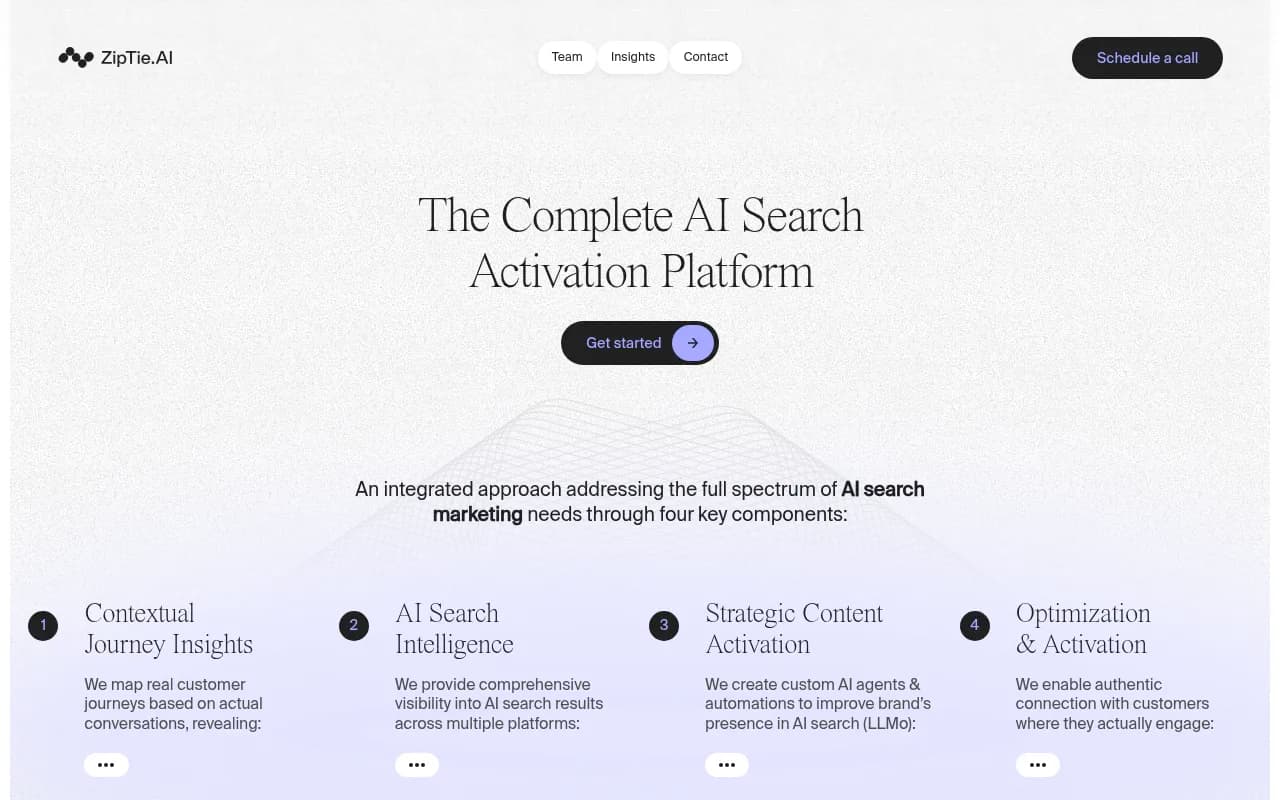
ZipTie
ZipTie positions itself around "deep analysis and reporting," which in practice means more granular breakdown of AI responses than most monitoring tools offer. It's one of the few platforms that goes beyond simple mention tracking to analyze the context and framing of how your brand or product is described.
For product-level work, the contextual analysis is useful -- you can understand not just whether you're mentioned, but whether you're mentioned as the recommended option, a runner-up, or with caveats. That distinction matters enormously for feature-level competitive intelligence.
Peec AI
Peec AI is a solid mid-market option that supports custom prompt tracking across ChatGPT, Gemini, Perplexity, and Claude. It's more affordable than Profound and more capable than basic monitoring tools like Otterly.AI. The smart suggestions feature helps surface prompt ideas you might not have thought to track -- useful when you're trying to map out the full space of feature-related queries.
It doesn't have the content generation capabilities of Promptwatch, so you'll need a separate workflow to act on what you find. But for teams that just need better tracking granularity without the full optimization stack, it's worth evaluating.

Scrunch AI
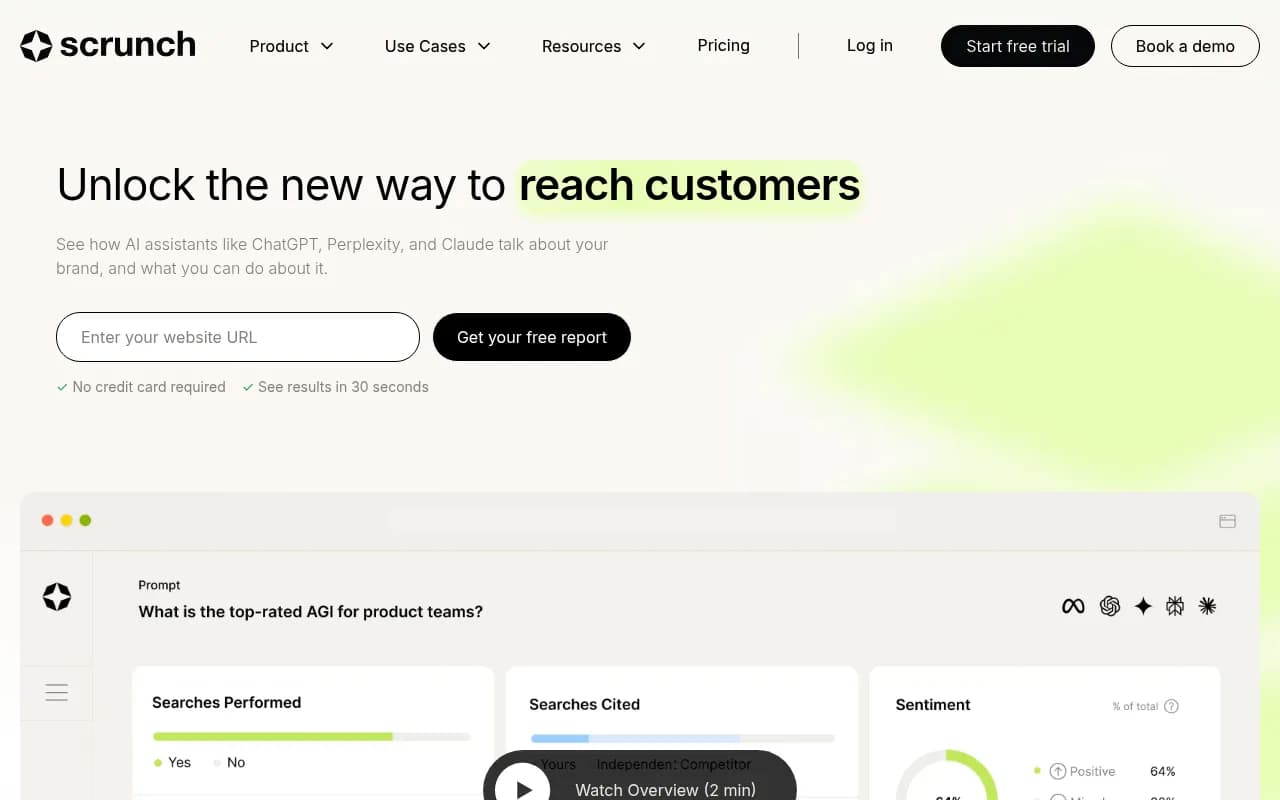
Scrunch AI tracks brand mentions across LLMs and offers competitive benchmarking. It's particularly strong on the reporting side, which makes it useful for teams that need to present AI visibility data to stakeholders. The feature-level tracking depends on how you set up your prompt library, which requires some upfront work.
Otterly.AI
Otterly.AI is frequently cited as the most accessible entry point for AI visibility monitoring. It's affordable, easy to set up, and covers the major AI platforms. But it's fundamentally a brand-level monitoring tool. There's no content gap analysis, no crawler logs, no page-level citation tracking. For teams that need product-feature-level intelligence, it's a starting point, not a destination.
Otterly.AI

Comparison: how the main platforms handle product-level tracking
| Platform | Custom prompts | Feature-level tracking | Content gap analysis | Page-level citations | Crawler logs | Starting price |
|---|---|---|---|---|---|---|
| Promptwatch | Yes | Yes | Yes | Yes | Yes | $99/mo |
| Profound | Yes | Yes | Partial | Partial | No | $499/mo |
| ZipTie | Yes | Yes (contextual) | No | No | No | Custom |
| Peec AI | Yes | Yes | No | No | No | €89/mo |
| Scrunch AI | Yes | Partial | No | No | No | Custom |
| Otterly.AI | Limited | No | No | No | No | $25/mo |
| Rankscale | Limited | No | No | No | No | $20/mo |
The pattern is clear: the more affordable tools handle brand-level monitoring well but don't support the prompt customization and citation analysis needed for feature-level work. The tools that go deeper either cost significantly more (Profound) or combine depth with optimization capabilities (Promptwatch).
How to set up product-feature-level prompt tracking
Regardless of which platform you use, the methodology for feature-level tracking follows the same logic.
Start with your product's core use cases
Map out every distinct job your product does. Not "project management" but "AI-assisted task prioritization for remote teams" or "automated sprint planning for engineering teams." The more specific, the better -- because that's how users actually prompt AI models.
Build comparison prompts
AI models get a lot of "X vs Y" and "best tool for Z" queries. Build prompts that mirror these:
- "What's the best [category] tool for [specific use case]?"
- "How does [your feature] compare to [competitor feature]?"
- "What are the pros and cons of [your product] for [specific persona]?"
Track at the persona level
Different buyers ask different questions. A developer asking about your API capabilities prompts differently than a marketing manager asking about your reporting. Good GEO platforms let you set personas -- Promptwatch's persona targeting, for example, lets you see how visibility differs by buyer type.
Monitor the citation sources, not just the mentions
When an AI model recommends your product for a specific feature, what source is it citing? Is it your feature page, a comparison article, a Reddit thread? This tells you where to invest content effort. If your feature page isn't being cited but a competitor's blog post about your feature is, that's a specific, fixable problem.
The content gap problem: why tracking alone isn't enough
Here's the uncomfortable truth about most GEO monitoring tools: they show you where you're losing without helping you fix it.
You can spend $499/month on Profound and get a detailed breakdown of every prompt where competitors outrank you. But then what? You still need to figure out what content to create, brief a writer, publish it, and wait to see if it moves the needle.
The platforms that close this loop -- where tracking feeds directly into content creation -- are the ones that deliver compounding returns. Promptwatch's Answer Gap Analysis identifies the specific prompts where you're invisible, and the built-in AI writing agent generates content engineered to get cited for those exact prompts. The content isn't generic SEO filler; it's built around the citation patterns from 880M+ analyzed citations.
That cycle -- find the gap, create the content, track the improvement -- is what separates an optimization platform from a monitoring dashboard.
What to look for if you're evaluating platforms now
If your goal is product-feature-level AI visibility, here's the shortlist of capabilities that actually matter:
Custom prompt libraries: You need to define the prompts, not just use a preset library. Feature-level tracking requires prompts that match your specific product positioning.
Page-level citation tracking: Knowing your brand is mentioned is less useful than knowing which specific pages are being cited. This tells you whether your feature content is working.
Competitive prompt analysis: See which prompts your competitors are winning that you're not. This is the core of feature-level competitive intelligence.
Content gap analysis: Identify the specific topics and angles that AI models want to answer but can't find on your site.
AI crawler logs: Understanding which pages AI crawlers are actually reading (and which they're skipping or erroring on) is essential for diagnosing why certain features aren't getting cited.
Multi-model coverage: Feature visibility can vary significantly across ChatGPT, Perplexity, Claude, and Gemini. A tool that only monitors one or two models gives you an incomplete picture.
The bottom line
Brand-level AI visibility monitoring made sense in 2024 when most teams were just trying to establish a baseline. In 2026, it's not enough. If you're running a product with multiple features, use cases, or buyer personas, you need to track at the level where purchase decisions actually happen -- which is the feature and use-case level.
The platforms that support this kind of depth are a small subset of the broader GEO market. Promptwatch covers the full stack from tracking to optimization. Profound goes deep on enterprise monitoring. ZipTie adds contextual analysis. Peec AI hits a reasonable mid-market balance.
What most of the market offers -- basic brand mention tracking with a nice dashboard -- isn't going to tell you why your most important product feature is invisible to ChatGPT while a competitor's inferior version gets recommended every time.
That's the question worth paying to answer.