Key takeaways
- Profound's pricing page now lists only a free 7-day trial and a custom-priced Enterprise plan, according to Alhena's July 2026 write-up. A "cheaper alternative" mostly means a tool with a published price.
- Healthcare AI answers lean on government and research sources. In Promptwatch Data's Sep 9 to Oct 8, 2026 report, NIH was the top cited healthcare source at 5.46% of citations, ahead of the FDA (1.76%) and the NHS (1.1%).
- Almost half of ChatGPT responses cite 10 or more domains, so a tool that only reports "mentioned or not" will miss most of what matters.
- None of the vendor listicles we reviewed address HIPAA, BAA, SOC 2 or MLR review. Ask every vendor directly, and do not take their blog rankings at face value.
- Pick by job: monitoring only, monitoring plus content work, or an SEO suite add-on.
Why healthcare and life sciences need a different evaluation
Most "Profound alternatives" articles are written by vendors who rank themselves first. Frase, Maintouch, Omnia, Answer Socrates and Alhena all do this. That is fine as a source of tool names, but not as evidence. And none of them talk about health.
Health is a YMYL category. AI engines behave differently here, and your compliance team will care about different things than an e-commerce marketer would. A few examples:
- A pharma brand needs to know what AI says about off-label use, side effects and dosing, not just whether the brand name appears.
- A hospital system needs local answers. "Cardiologist near me" is a very different prompt from "best cardiology hospital in the US."
- A medtech or biotech company is often competing with PubMed and the FDA for the citation slot, not with another vendor.
So the first job is to understand how AI actually sources health answers. Then you pick the tool.
What the data says about healthcare citations
Promptwatch Data analysed organic healthcare prompts in ChatGPT from Sep 9 to Oct 8, 2026. Some of the findings are surprising if you come from a normal marketing background.
- NIH is the most cited source at 5.46% of all healthcare citations, spread across six nih.gov subdomains. PubMed Central is 2.38% and PubMed is 2.33%. NIH earns more than the FDA, NHS, CMS and SAMHSA combined.
- The FDA is second at 1.76%, including its drug database at accessdata.fda.gov. The NHS is third at 1.1%.
- The most cited non-government sites are the American Society of Plastic Surgeons (0.64%) and the American Academy of Dermatology (0.54%).
- Mayo Clinic (0.49%) and Cleveland Clinic (0.4%) are the only hospitals in the top 20.
- The top 20 domains together earn only 15.54% of citations. The long tail is huge.
| Source type | Share of healthcare citations |
|---|---|
| Government and public health | 7.06% |
| NIH and medical research databases | 5.46% |
| Medical associations | 1.39% |
| Hospitals and clinics | 0.89% |
| Reviews and directories | 0.46% |
| Pharmacies (Boots only) | 0.28% |
Two takeaways. First, brand sites are not the main event. If your tool only tells you whether your domain is cited, it is missing the sources that shape the answer. You need citation-level reporting that shows which third-party pages feed the response. Second, the practical playbook is different: publish claims that trace back to peer-reviewed studies on PubMed or PubMed Central, keep pages consistent with FDA, CDC, NHS and NICE guidance, work with specialty associations, and keep Doctify and WebMD profiles complete.
Why single-prompt checks mislead
In Promptwatch's unique-domains data (Sep 28 to Oct 4, 2026), 47.6% of ChatGPT responses cited 10 or more domains, and 66.1% cited at least eight. For organic prompts the 10+ figure was 52.5%. Brand-specific prompts were tighter, with five domains the most common count.
When you evaluate tools, that means you want:
- Position and description tracking, not just a yes/no mention.
- Many prompts per topic, not one.
- Visibility into which review and listicle sites feed brand-specific answers, since they shape how the model describes you.
The compliance questions nobody answers publicly
The vendor posts we reviewed say nothing about these. Put them in your RFP, and expect some uncomfortable silence.
- Does the vendor sign a BAA? Most monitoring tools never touch PHI, so you may not need one, but legal will ask.
- What security certifications do they hold? SOC 2 and ISO/IEC 27001 are the usual asks.
- Can the tool track prompts in a locked topic set, so only approved health prompts are run?
- Does generated content go through an approval step before anything is published? Most pharma teams need MLR review, and "fully hands-off publishing" is a non-starter for regulated claims.
- Can you monitor for inaccurate or off-label statements about your product, and export the evidence?
- Does it track the real user interface of each AI engine, or only API output? The two can differ.
The point on approval workflows matters most. An agentic tool that publishes health content automatically is risky unless it has a review inbox you can force on.
Profound alternatives worth shortlisting
This is not a ranking by a vendor trying to sell you something. It is a sorted list by job. Verify current pricing and compliance on each vendor's site before you commit.
| Tool | Type | Good for | Watch out for |
|---|---|---|---|
| Promptwatch | Monitoring plus optimization | Teams that need to fix gaps, not only see them | Content Agent publishing needs a review step for regulated claims |
| AthenaHQ | Monitoring plus action center | Content recommendations | Verify compliance posture |
| Scrunch | Monitoring and agent-readiness audits | Brand presence and site readability | Page optimizations metered by plan |
| Peec AI | Prompt tracking | Agencies with many clients | Tracking-focused |
| Otterly.AI | Budget tracking | Small teams and pilots | Basic feature set |
| Semrush | SEO suite add-on | Teams already on Semrush | Less AI-specific depth |
| Ahrefs Brand Radar | SEO suite add-on | Mentions plus backlink data | Priced as an add-on to a base plan |
| Conductor | Enterprise SEO and AI | Large organisations | Enterprise sales cycle |
Promptwatch
Promptwatch is the one I would put first for a team that wants to change outcomes instead of only watching them. It tracks the real interfaces of ChatGPT, Google AI Overviews, Google AI Mode, Gemini, Perplexity, Copilot and others, by country and language, which matters for health queries that vary by region. Its citation analytics show which pages, Reddit threads, YouTube videos and LinkedIn posts feed the answer, and IP-verified crawler logs show whether AI bots can even read your pages. For a hospital with many locations, local targeting can pin a monitor to exact coordinates on the Business plan.
It is also ISO/IEC 27001 certified and GDPR compliant, which helps in a security review. The Content Agent can plan and publish to WordPress, Webflow or Framer, with a review inbox where you approve, edit or decline each piece. For regulated content, use that inbox and do not run it hands-off. Pricing starts at $95 a month for Essential, with Business at $579 a month. Confirm on the pricing page.

If you want a quick baseline first, the free AI Visibility Report scans how ChatGPT, Gemini and Perplexity describe your brand without a login.
Profound
To be fair to the incumbent: Alhena's July 2026 write-up notes Profound raised a $180M Series D in September 2026 and says it serves more than 1,000 enterprise brands. If you are a large pharma with a budget and want a custom contract, it remains a legitimate option. You simply cannot price it without talking to sales.
Profound

AthenaHQ
Frase ranks AthenaHQ third and describes an action center that returns recommendations, plus a content agent and a Shopify publishing path. Shopify is irrelevant for most health brands, so the content agent is the part to test.

Scrunch
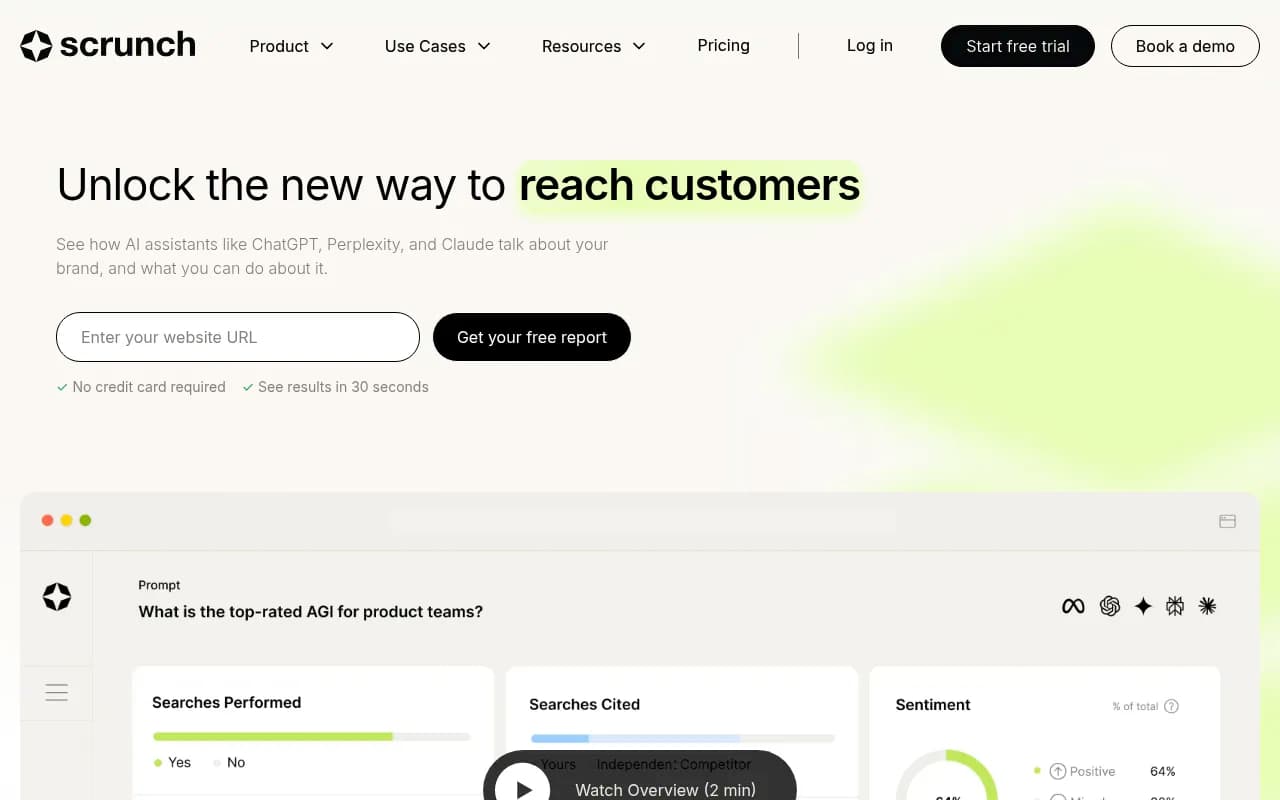
Scrunch watches brand presence and audits how AI agents read a site. The agent-readiness angle is useful for healthcare sites with heavy JavaScript patient portals or gated content.
Peec AI and Otterly.AI
These are the budget and agency picks. Alhena lists Peec AI from about 85 euros a month with unlimited seats, and Otterly.ai from $29 a month. Both are tracking-first. For a pilot on a handful of condition-related prompts they are fine. Neither will tell you why a page is not being cited.

Otterly.AI

Semrush and Ahrefs Brand Radar
If your team already lives in one of these, the AI add-ons are the cheapest way in. Alhena puts the Semrush AI toolkit at $99 a month per domain and Ahrefs Brand Radar at $199 a month on top of a base plan. The tradeoff is depth. Suite add-ons tend to use fixed prompt sets.

Conductor
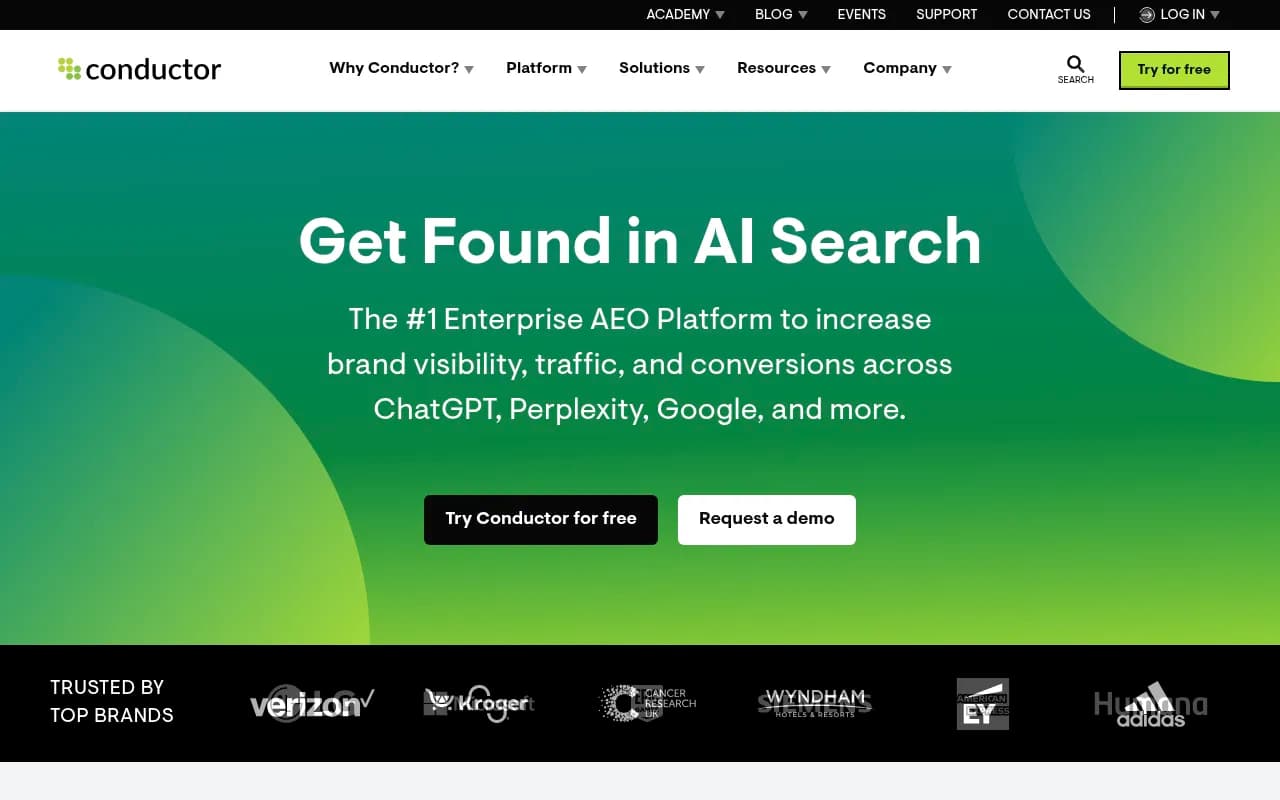
Conductor sits at the enterprise end for organisations that want AI visibility inside a larger SEO platform. Demand-Genius lists it among its ten.
For a wider view, the GEO software directory at bestgeosoftware.com lists more options by category.
What the vendor comparison articles look like
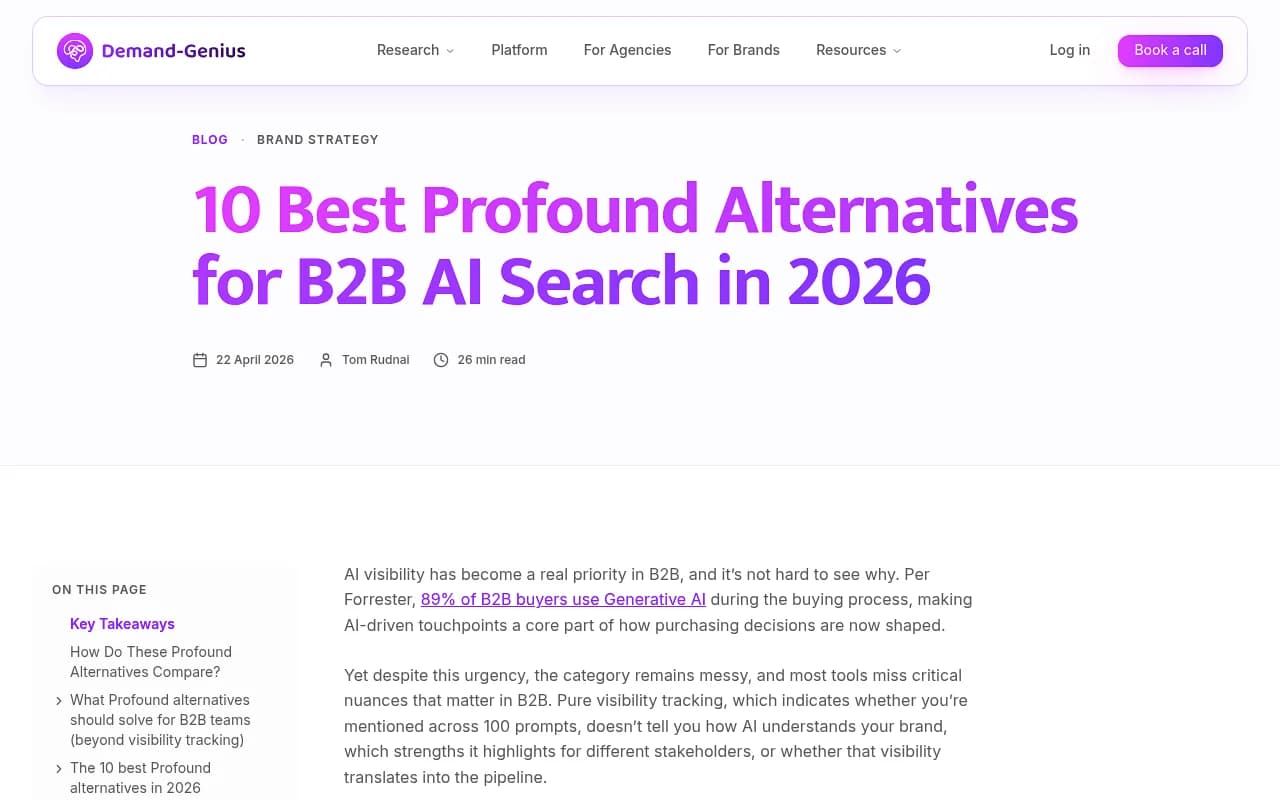
The Demand-Genius piece is useful for one reason: it frames tools across three jobs, tracking, executing and measuring. It also includes a 30-day migration playbook.
How to run a 30-day evaluation
Borrowing the structure from Demand-Genius and adapting it for a regulated brand:
Week 1: audit and scope
List 40 to 60 prompts across symptoms, treatments, comparisons, brand terms and "near me" queries. Split them into organic, brand-specific and competitor-comparison sets, since citation behaviour differs sharply between them. Get legal to sign off on the prompt list before you run anything.
Week 2: parallel testing
Run the same prompts in two or three tools. Check whether answers match what you see by hand in the real ChatGPT or Google interface. If a tool relies only on API output, expect gaps.
Week 3: test the work, not the dashboard
Pick one page that is not being cited. Ask each tool to tell you why, and what to change. A tool that can show crawler errors, missing PubMed references or a thin page is worth more than one with a prettier chart.
Week 4: security and workflow review
Send the compliance questions above. Confirm the approval workflow. Decide whether you need an agency to help interpret results.
Picking by situation
| Situation | Start with |
|---|---|
| Pharma or biotech brand with MLR review | A platform with an approval inbox and security certifications, such as Promptwatch, plus a legal-approved prompt list |
| Multi-location health system | A tool with local targeting and crawler logs |
| Small clinic or practice on a budget | Otterly.AI or Peec AI for a pilot |
| Team already on Semrush or Ahrefs | The add-on first, then reassess |
| Enterprise buyer comfortable with sales cycles | Profound or Conductor, compared against one action-oriented tool |
If you want outside help turning the data into a plan, an agency that covers technical SEO, content and GEO can run this for you. 1001 SEO Media is one such agency and uses Promptwatch as its AI visibility platform.
Bottom line
For healthcare and life sciences, the best Profound alternative is the one that shows you the government, research and association pages shaping answers, lets you act on gaps, and keeps a human reviewer in the loop. Run a 30-day parallel test, send the compliance questions in writing, and judge vendors on whether they can explain one uncited page, not on their own blog rankings.