Key takeaways
- Profound's meaningful functionality starts at $399/mo and scales to custom enterprise contracts -- most mid-market B2B teams are priced out before they even get started.
- Promptwatch is the only platform in this comparison that closes the full loop: find visibility gaps, generate content to fix them, and track the results -- all in one tool.
- Peec AI is the strongest pick for global brands where tracking accuracy matters most, using UI-scraping rather than API approximations.
- AthenaHQ is built for teams that need to tie AI visibility to pipeline and revenue, with GA4, Shopify, and Search Console integrations.
- AirOps is a content engineering platform first -- it's less about tracking and more about producing AI-optimized content at scale.
- Price alone doesn't tell the full story: what you can do with the data matters more than what you can see.
Profound is genuinely impressive. $155M raised, a $1B valuation, and clients like Target, Walmart, Figma, and MongoDB. It's the most credentialed AI search visibility platform on the market right now.
It's also built almost entirely for enterprise buyers.
The $99/mo Starter plan gives you ChatGPT monitoring with 50 prompts -- fine for a proof of concept, not a real program. Anything resembling full functionality starts at $399/mo (Growth), and if you want complete LLM coverage, you're looking at a custom Enterprise contract. For mid-market B2B brands -- growth-stage SaaS, lean content teams, agencies running multiple clients -- that structure either overshoots the budget or undershoots on the execution side.
This guide compares four of the strongest alternatives: Promptwatch, Peec AI, AthenaHQ, and AirOps. Each one takes a meaningfully different approach, and the right choice depends on what your team actually needs to accomplish.
Why mid-market teams are leaving Profound (or never signing up)
The core tension with Profound isn't the product quality -- it's the product fit. Enterprise platforms are built around enterprise workflows: dedicated CSMs, long onboarding cycles, quarterly business reviews, and pricing that assumes a six-figure marketing budget.
Mid-market B2B brands usually need something different. They want:
- Self-serve onboarding with data visible in minutes, not weeks
- Pricing that doesn't require a procurement process
- Tools that help them act on visibility data, not just report it upward
- Coverage across multiple AI models without paying enterprise rates for each one
The monitoring-only problem is real too. Knowing that you're invisible in ChatGPT is useful for exactly one meeting. After that, you need to know what to do about it. Most platforms -- including Profound at its lower tiers -- stop at the dashboard. They show you the gap. They don't help you close it.
The four alternatives compared
Promptwatch
Promptwatch takes a different structural approach than most tools in this space. Where Profound and many of its competitors are monitoring dashboards with analytics layered on top, Promptwatch is built around an action loop: find gaps, create content, track results.

The Answer Gap Analysis shows you exactly which prompts your competitors are appearing for that you're not -- not as a vague "you're missing coverage" warning, but as specific topics, questions, and angles that AI models want answered but can't find on your site. That's genuinely useful for a B2B content team because it tells you what to write, not just that you should write more.
The built-in AI writing agent then generates articles, listicles, and comparisons grounded in citation data from 880M+ sources analyzed. This isn't generic content -- it's engineered to get cited by ChatGPT, Claude, Perplexity, and other models. For mid-market teams without a dedicated GEO specialist, that's a meaningful capability gap closed.
On the tracking side, Promptwatch monitors 10 AI models (ChatGPT, Perplexity, Claude, Gemini, Google AI Overviews, Google AI Mode, Grok, DeepSeek, Copilot, and Mistral) from its $99/mo Essential plan. That's the broadest multi-model coverage at the lowest price among the tools in this comparison. Page-level tracking shows which specific pages are getting cited, how often, and by which models.
A few capabilities that stand out for B2B teams specifically:
- AI Crawler Logs show which AI bots are hitting your site, which pages they're reading, and any errors they encounter. Most competitors don't have this at all.
- Prompt Intelligence includes volume estimates and difficulty scores, so you can prioritize high-value, winnable prompts instead of guessing.
- Reddit and YouTube tracking surfaces discussions that directly influence AI recommendations -- a channel most platforms ignore entirely.
- Traffic attribution via code snippet, GSC integration, or server log analysis connects visibility to actual revenue.
Pricing: Essential $99/mo (1 site, 50 prompts, 5 articles), Professional $249/mo (2 sites, 150 prompts, 15 articles, crawler logs), Business $579/mo (5 sites, 350 prompts, 30 articles). Free trial available.
The honest trade-off: if you only need monitoring and you're happy to do all the content work yourself, Promptwatch has more capability than you'll use. But for teams that want to actually move their visibility scores, the full loop is hard to replicate by stitching together separate tools.
Peec AI
Peec AI's core differentiator is methodology. Most AI visibility tools query the API directly to get responses -- fast, scalable, but what you get back isn't always what a real user sees. Peec AI uses UI-scraping, which captures the actual rendered output: the full response, the citations shown, the formatting, everything a human would see if they typed that prompt themselves.

For global B2B brands where tracking accuracy is non-negotiable -- think enterprise software companies running multilingual campaigns, or brands where a single AI recommendation can influence a six-figure deal -- that methodological difference matters. You're not working from an approximation; you're working from ground truth.
Peec AI also handles multi-language and multi-region monitoring well, which is relevant for mid-market B2B companies with international sales motions. If your buyers in Germany and France are prompting AI models in their native languages, you need visibility data that reflects that.
Where Peec AI is weaker: it's primarily a monitoring and analytics tool. There's no built-in content generation, no answer gap analysis that tells you what to write, and no crawler log data. You get excellent visibility data and then you're on your own to act on it.
Pricing starts at $85/mo, which is competitive. The free trial lets you validate accuracy before committing.
Best for: B2B brands with international audiences where tracking fidelity across languages and regions is the primary requirement.
AthenaHQ
AthenaHQ is the strongest option in this comparison for teams that need to connect AI visibility to pipeline and revenue metrics. Its integrations with GA4, Shopify, and Google Search Console are the most developed attribution capabilities among mid-market-accessible GEO platforms.

For B2B marketing teams that report to revenue-focused leadership, that matters a lot. "Our AI visibility score went up 12 points" is a hard sell in a board meeting. "AI search drove 340 qualified sessions last month, and here's the pipeline it contributed to" is a different conversation entirely.
AthenaHQ also has solid enterprise-grade features: custom persona targeting, competitive benchmarking, and workflow integrations that fit into larger marketing operations stacks. It's designed for teams that have some operational maturity around analytics and attribution.
The trade-off is price and complexity. AthenaHQ starts at $295/mo, which is meaningfully higher than Promptwatch or Peec AI. And it's primarily a monitoring and attribution platform -- there's no content generation built in. You'll need a separate content workflow to act on what you learn.
Best for: Mid-market and lower-enterprise B2B teams with an existing content operation who need to prove AI visibility ROI to leadership.
AirOps
AirOps is a different kind of tool. It's less a GEO monitoring platform and more a content engineering system -- built to produce AI-optimized content at scale, with workflows that connect research, writing, and publishing into a repeatable process.
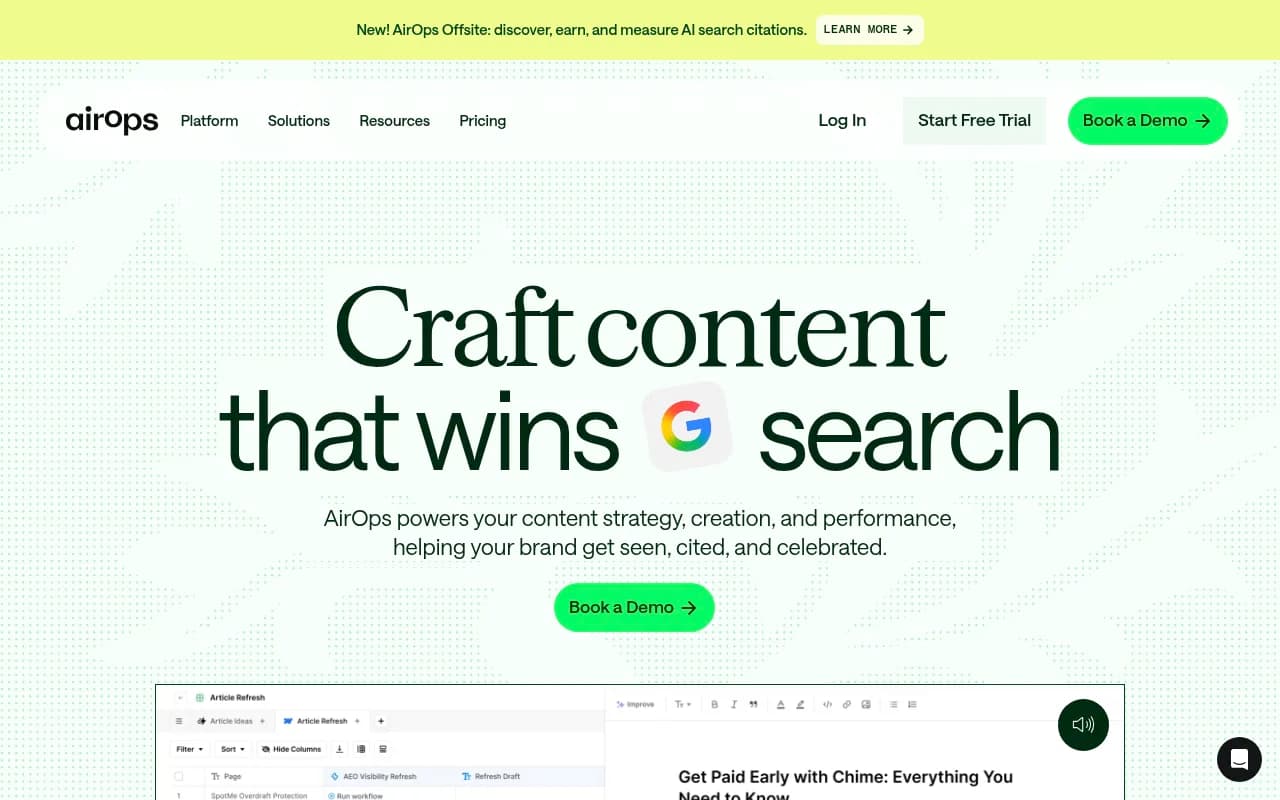
Where Promptwatch, Peec AI, and AthenaHQ all start from "what is your current AI visibility?" AirOps starts from "what content do you need to create, and how do you create it efficiently?" If your team's primary bottleneck is content production volume rather than visibility intelligence, AirOps addresses that directly.
For B2B brands with complex buying journeys -- multiple personas, long sales cycles, lots of comparison and evaluation content needed -- AirOps can help systematize content production in a way that manual workflows can't match. It's particularly useful for teams that already have a GEO strategy and need to execute against it faster.
The limitation is the flip side of that strength: AirOps doesn't give you the monitoring layer. You won't know which AI models are citing your content, which pages are performing, or where your competitors are beating you. You'd need to pair it with a monitoring tool to get the full picture.
Best for: B2B content teams with a defined GEO strategy that need to scale content production, not teams still figuring out where their visibility gaps are.
Head-to-head comparison
| Promptwatch | Peec AI | AthenaHQ | AirOps | Profound | |
|---|---|---|---|---|---|
| Starting price | $99/mo | $85/mo | $295/mo | Custom | $99/mo (limited) |
| AI models monitored | 10 | Multiple | Multiple | N/A | 9+ |
| Content generation | Yes (built-in) | No | No | Yes (core feature) | No |
| Answer gap analysis | Yes | No | Partial | No | Yes |
| AI crawler logs | Yes (Pro+) | No | No | No | No |
| Traffic attribution | Yes | No | Yes (GA4, GSC) | No | Limited |
| Reddit/YouTube tracking | Yes | No | No | No | No |
| Multi-language/region | Yes | Yes (strong) | Yes | N/A | Yes |
| ChatGPT Shopping | Yes | No | No | No | No |
| Free trial | Yes | Yes | Yes | Yes | Yes |
| Best for | Full GEO loop | Accuracy-first tracking | Revenue attribution | Content production | Enterprise |
How to choose
The honest answer is that these tools solve different problems, and the right choice depends on where your team is stuck.
If you're stuck at "we don't know where we're invisible or what to do about it," Promptwatch is the most complete answer. The monitoring, gap analysis, and content generation in one platform means you're not stitching together three tools to close one loop.
If you're stuck at "our tracking data doesn't feel reliable, especially for international markets," Peec AI's UI-scraping methodology is worth the trade-off of having no content tools.
If you're stuck at "leadership doesn't believe AI visibility is driving revenue," AthenaHQ's attribution integrations give you the data to make that case.
If you're stuck at "we know what to create but can't produce it fast enough," AirOps addresses the production bottleneck directly -- though you'll need a monitoring tool alongside it.
One thing worth saying plainly: if you're a mid-market B2B team evaluating Profound, the pricing structure will push you toward either the limited Starter plan or a Growth plan that may still not give you the full LLM coverage you need. The four tools above all offer more accessible entry points with meaningful functionality at those price points -- not just demos.
The monitoring-only trap
A pattern worth watching out for: most GEO platforms are monitoring dashboards. They show you data. They generate reports. They send you alerts when your visibility score changes.
That's useful for understanding your situation. It's not useful for changing it.
The teams that are actually moving their AI visibility scores in 2026 are the ones that have closed the loop between what they learn from monitoring and what they publish in response. That loop -- find the gap, create the content, track whether it worked -- is what separates optimization from observation.
Promptwatch is the only platform in this comparison that handles all three steps natively. AthenaHQ handles the first and third well. Peec AI handles the first with high fidelity. AirOps handles the second at scale. Knowing which part of the loop your team is missing is the most useful frame for making this decision.