Key takeaways
- Most AI visibility tools are built for marketing teams with dedicated budgets — but several work well for solo operators billing by the hour
- The biggest divide is between monitoring-only tools (they show you data) and optimization platforms (they help you act on it)
- Free and entry-level tiers exist, but they're often too limited to deliver real client value
- For freelancers managing multiple clients, tools with multi-site support and white-label reporting matter more than raw feature count
- Promptwatch is the only platform in this comparison that closes the full loop: find gaps, generate content, track results
If you're a freelancer or solo consultant doing SEO, content strategy, or digital marketing work, you've probably noticed that clients are starting to ask about AI search. "Why isn't our brand showing up in ChatGPT?" is becoming as common as "why aren't we ranking on page one?"
The problem is that most GEO platforms are priced and designed for in-house marketing teams at mid-size companies. You're billing by the hour. You can't justify a $500/month platform for a client paying you $2,000/month — the math doesn't work.
So this guide is specifically about which AI search visibility tools make sense when you're a solo operator. That means looking at: what the tool actually does, whether the entry-level pricing is usable, how much time it takes to get value out of it, and whether you can show clients something meaningful.
Let's get into it.
What "AI search visibility" actually means (and why it matters for your clients)
When someone asks ChatGPT "what's the best project management tool for small teams?" or asks Perplexity "who are the top HR consultants in Chicago?" — those answers come from somewhere. The AI models are pulling from training data, web crawls, and cited sources to construct a response.
If your client's brand isn't in that response, they're invisible to that user. They never even get the chance to compete.
This is what GEO (Generative Engine Optimization) addresses. It's the practice of making your content visible, credible, and citable within AI-generated answers — not just crawlable by Google. Gartner predicted traditional search volume would drop 25% by 2026 due to AI chatbots, and that shift is now clearly underway.
For freelancers, this creates an opportunity. Clients need help with this. Most agencies haven't figured it out yet. If you can show up with a clear process and the right tools, you can own this service line.
The tools below are the ones worth knowing.
The 10 best AI visibility tools for freelancers in 2026
1. Promptwatch — best overall for freelancers who want to actually fix things
Most AI visibility tools show you a dashboard and leave you to figure out what to do next. Promptwatch is different because it's built around a complete action loop: find the gaps, create content that addresses them, and track whether it worked.
For a freelancer, that's meaningful. You're not just delivering a report — you're delivering a result.
The Answer Gap Analysis shows you exactly which prompts your client's competitors appear in but they don't. The built-in AI writing agent then generates articles and content grounded in real citation data from over 880 million citations analyzed. And page-level tracking shows you which specific pages are getting cited by which AI models, so you can show clients a clear before/after.
It also monitors 10 AI models (ChatGPT, Perplexity, Claude, Gemini, Google AI Overviews, Grok, DeepSeek, Copilot, Meta AI, Mistral), has AI crawler logs so you can see when ChatGPT or Perplexity actually visits your client's site, and includes Reddit and YouTube tracking — two channels most competitors ignore entirely.
Pricing starts at $99/month for one site and 50 prompts. The Professional plan at $249/month covers two sites and 150 prompts, which is workable if you're running two active client accounts. A free trial is available.

2. Otterly.AI — good entry point for basic monitoring
Otterly.AI is one of the more accessible monitoring tools in this space. It tracks brand mentions across ChatGPT, Perplexity, and Google AI Overviews, and the interface is clean enough that you can get a client up and running quickly.
The limitation is that it stops at monitoring. You'll see where your client is and isn't mentioned, but the tool won't help you figure out what to do about it. For a freelancer who already has a content workflow and just needs visibility data, that might be fine. For a freelancer trying to deliver a full GEO service, you'll need to pair it with something else.
Otterly.AI

3. Rankshift — solid for ChatGPT and Gemini tracking
Rankshift focuses specifically on tracking visibility across ChatGPT and Gemini, with prompt-level data that shows you where your client appears and where they don't. It's a cleaner, more focused tool than some of the broader platforms.
The prompt-level granularity is useful for client reporting — you can show exactly which questions your client is visible for and which ones they're losing to competitors. That's a concrete deliverable.

4. Peec AI — straightforward monitoring for smaller budgets
Peec AI is a monitoring-focused platform that tracks brand mentions across AI search engines. It's relatively affordable and doesn't require a lot of setup time, which matters when you're billing hourly and can't spend three hours configuring a new tool for every client.
It won't give you content recommendations or gap analysis, but for clients who just want to know "are we showing up in AI answers?" it can answer that question without a lot of friction.

5. Semrush — familiar platform, limited AI depth
If you're already using Semrush for traditional SEO work, its AI Toolkit adds some AI search monitoring on top of what you already have. The advantage is that you're not paying for a separate tool — it's integrated into a platform you probably already know.
The downside is that Semrush's AI search features use fixed prompts, which limits how much you can customize tracking to a specific client's situation. And there's no AI traffic attribution, so you can't connect AI visibility to actual traffic or revenue. For clients who want to understand the business impact, that's a gap.
Still, if you're already paying for Semrush and want to add basic AI monitoring without adding another subscription, it's worth exploring.
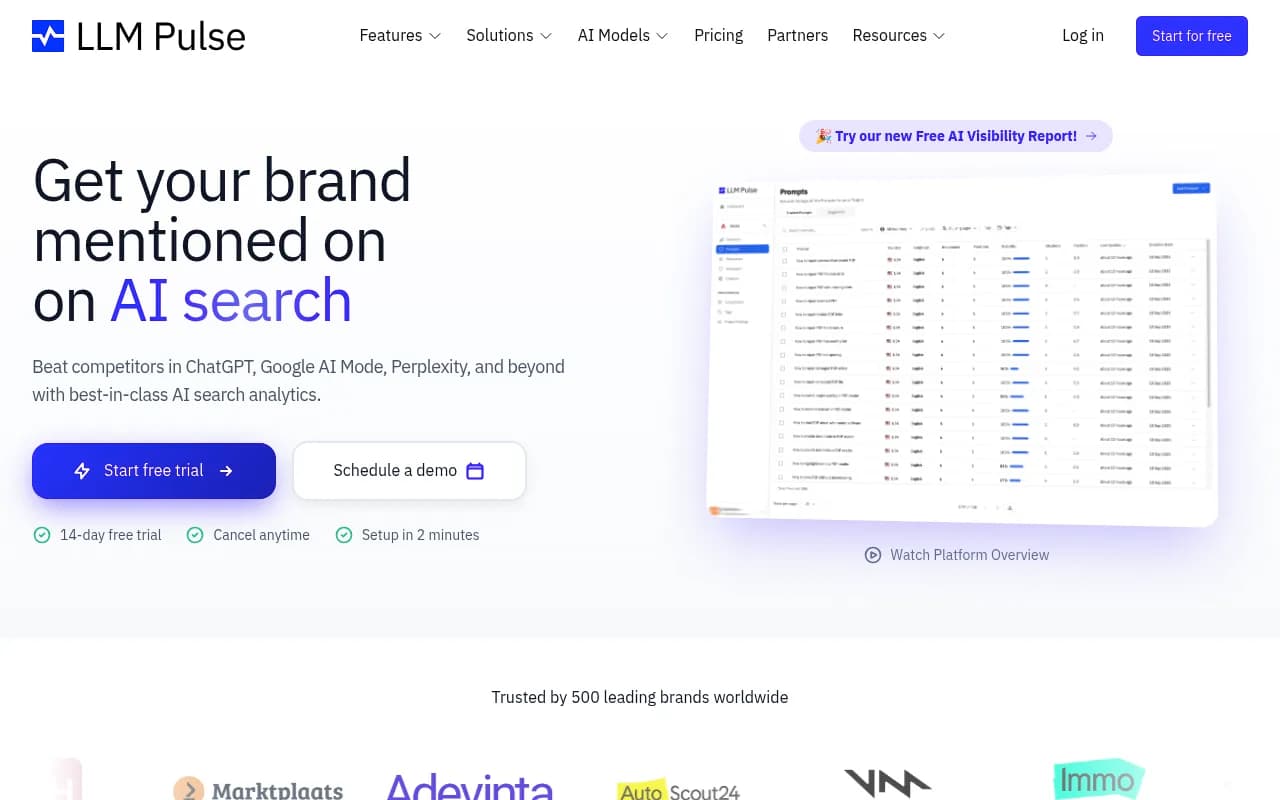
6. LLM Pulse — lightweight and accessible
LLM Pulse is a lighter-weight tool for tracking brand visibility across ChatGPT, Perplexity, and other AI engines. It's worth knowing about if you're looking for something with a lower barrier to entry — either for your own brand or for smaller clients who aren't ready to invest in a full platform.
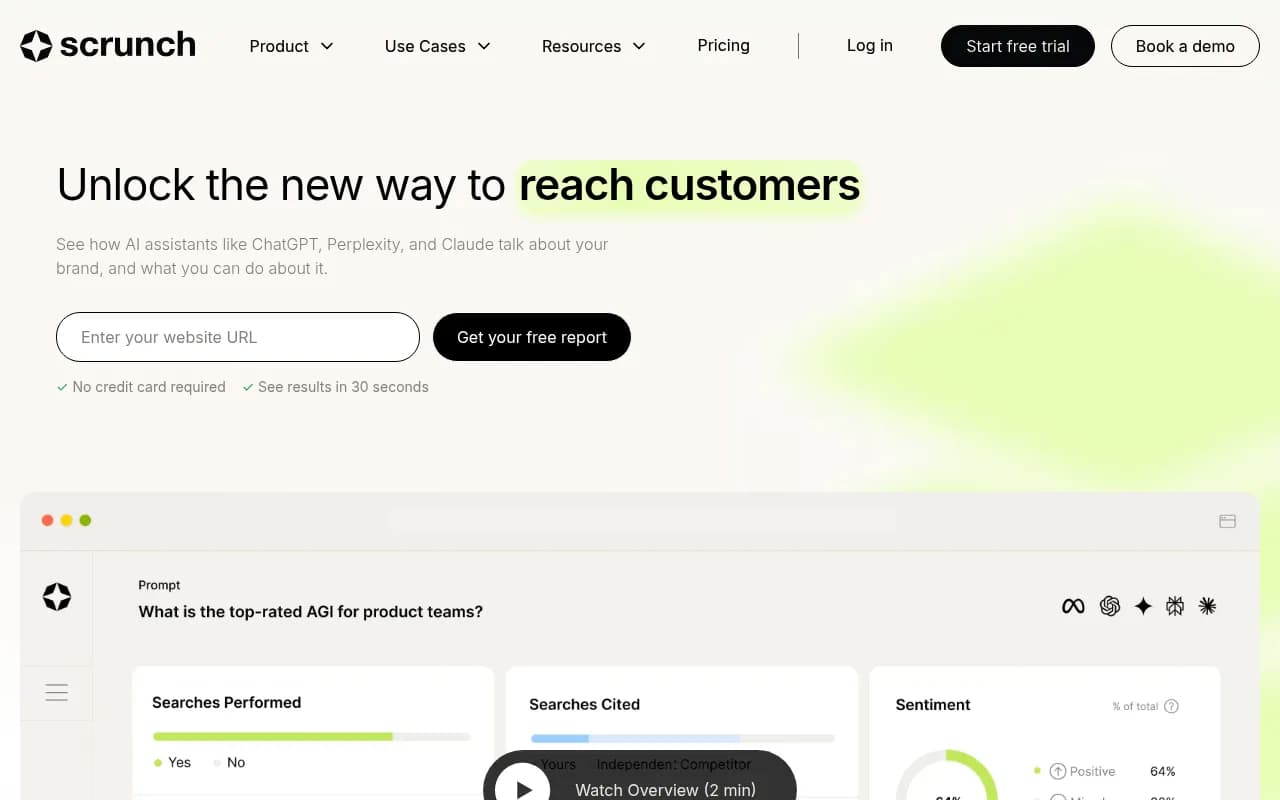
7. Scrunch AI — good for tracking and reporting
Scrunch AI tracks brand mentions across LLMs and provides reporting that's reasonably client-friendly. For freelancers who need to produce regular reports showing AI visibility trends, it's a practical option.
8. AthenaHQ — monitoring-focused with a clean interface
AthenaHQ is a monitoring platform with a well-designed interface that makes it easy to pull together visibility data across AI search engines. It's focused on tracking rather than optimization, so similar caveats apply as with Otterly — you'll need to bring your own content strategy to act on what you find.

9. Profound — enterprise-grade, but worth knowing
Profound is one of the more feature-rich platforms in this space, tracking brand mentions across ChatGPT, Perplexity, and nine other AI search engines. It's positioned more toward enterprise brands, so the pricing may be hard to justify for most freelance client engagements.
That said, if you land a larger client with a real budget for AI visibility, Profound is worth evaluating. The depth of data is genuinely impressive.
Profound

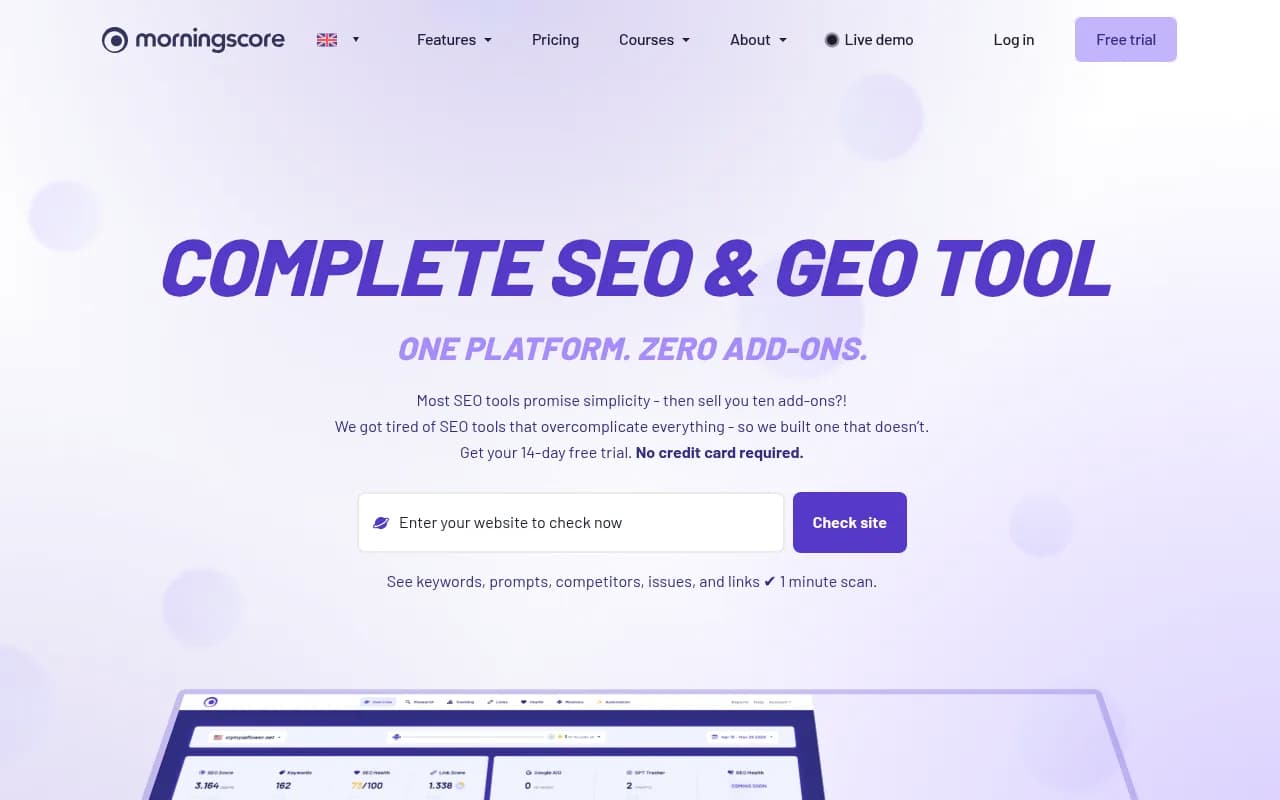
10. Morningscore — SEO plus AI visibility in one
Morningscore is an all-in-one SEO and AI visibility platform with a gamified approach to tracking missions and progress. For freelancers who are managing both traditional SEO and AI search for clients, having both in one place reduces context-switching.
It's not the deepest AI visibility tool on this list, but the combination of traditional and AI search tracking in a single interface has real practical value for solo operators.
How these tools compare
| Tool | AI models tracked | Content generation | Crawler logs | Entry price | Best for |
|---|---|---|---|---|---|
| Promptwatch | 10 | Yes (built-in AI writer) | Yes | $99/mo | Full GEO service delivery |
| Otterly.AI | ChatGPT, Perplexity, AI Overviews | No | No | Lower tier available | Basic monitoring |
| Rankshift | ChatGPT, Gemini | No | No | Mid-range | Prompt-level reporting |
| Peec AI | Multiple | No | No | Affordable | Budget monitoring |
| Semrush | Limited (fixed prompts) | No | No | Bundled with Semrush | Existing Semrush users |
| LLM Pulse | ChatGPT, Perplexity + | No | No | Low | Lightweight tracking |
| Scrunch AI | Multiple LLMs | No | No | Mid-range | Client reporting |
| AthenaHQ | Multiple | No | No | Mid-range | Clean monitoring UI |
| Profound | 9+ AI engines | No | No | Enterprise | Large client budgets |
| Morningscore | AI + Google | No | No | Mid-range | Combined SEO + AI |
What to actually look for as a freelancer
Time to value
You're billing by the hour. A tool that takes four hours to set up for a new client is a tool that costs you money. Look for platforms with clean onboarding, sensible defaults, and the ability to get meaningful data within a session or two.
Can you show clients something?
The best tools for freelancers produce outputs that clients can understand without a 30-minute explanation. Visibility scores, prompt-level tracking, before/after comparisons — these are things clients can react to. Raw data tables are not.
Monitoring vs. optimization
This is the biggest distinction in the market right now. Monitoring tools tell you where you stand. Optimization platforms help you improve. If you're selling a GEO service (not just a GEO audit), you need a tool that goes beyond the dashboard.
Most tools on this list are monitoring-only. Promptwatch is the clearest exception — the Answer Gap Analysis and built-in content generation mean you can go from "here's the problem" to "here's the solution" inside the same platform.
Multi-site support
If you're managing more than one client, check whether the pricing model supports multiple sites without requiring a separate subscription per client. Promptwatch's Professional plan covers two sites; Business covers five. That's a meaningful consideration when you're scaling a client roster.
Prompt customization
Fixed-prompt tools (like Semrush's AI Toolkit) track a predetermined set of questions. That's fine for general benchmarking but often misses the specific queries your client's customers are actually asking. Look for platforms that let you define custom prompts relevant to your client's industry and audience.
A practical workflow for freelancers using GEO tools
Here's how a reasonable GEO engagement might look for a solo consultant:
-
Run an initial visibility audit using your tool of choice. Show the client where they appear (and don't appear) across key AI engines for their most important prompts.
-
Use gap analysis to identify which competitor-owned prompts represent the biggest opportunity. Prioritize by prompt volume and relevance.
-
Create content targeting those gaps. If you're using Promptwatch, the built-in AI writer can generate first drafts grounded in citation data. Otherwise, you're writing from scratch based on what you found.
-
Publish and wait. AI models don't update in real time — there's typically a lag between publishing content and seeing it cited.
-
Track results over 4-8 weeks. Show the client which pages are now being cited, by which models, and how often. Connect it to traffic if you can.
-
Repeat. GEO is not a one-time project. The prompts that matter shift, new competitors enter the picture, and AI models update their training data.
This is a service you can sell on retainer, which is better economics than a one-time audit.
The honest reality about pricing
Most GEO platforms are not cheap. The entry-level tiers often limit you to a handful of prompts and one site, which can feel restrictive when you're trying to do meaningful work.
The math that works for freelancers usually looks like this: if you can charge a client $500-800/month for AI visibility management, a $99-249/month tool is a reasonable cost of goods. If you're charging less than that, the economics get tight.
Free tools exist (ProductRank, PromptReach, and a few others), but they're generally too limited for professional client work. They're fine for learning the space or doing a quick check on your own brand.
The tools that offer the most value per dollar for freelancers are the ones that replace multiple steps in your workflow — not just monitoring, but gap analysis and content creation too. That's where the time savings compound.
Bottom line
The AI search visibility space is moving fast, and most tools are still primarily monitoring dashboards. That's useful, but it's not a complete service.
For freelancers who want to deliver real results for clients — not just reports — the tools that matter most are the ones that help you act on what you find. Promptwatch is the clearest example of that right now, with the full loop from gap analysis to content generation to tracking built into one platform. The other tools on this list are worth knowing, but most of them stop at step one.
Pick the tool that fits your current client load and budget, build a repeatable process around it, and position yourself as someone who improves AI visibility rather than just measures it. That's the service clients will actually pay for.