Key takeaways
- AI search engines cite sources based on clarity, authority, and content structure -- not just traditional SEO signals
- The 90-day roadmap breaks into three phases: audit and baseline (days 1-30), content creation and optimization (days 31-60), and tracking and iteration (days 61-90)
- Answer gap analysis is the fastest way to find which prompts your competitors are winning but you're not
- Reddit discussions, structured data, and original research are disproportionately influential in what AI models recommend
- Tracking AI visibility requires dedicated tools -- Google Search Console alone won't show you what's happening inside ChatGPT or Perplexity
If you've noticed that your brand doesn't appear when someone asks ChatGPT to recommend tools in your category, you're not alone. Most companies built their SEO strategy for Google's blue links. AI search works differently, and the gap between brands that get cited and brands that don't is widening fast.
The good news: this isn't a black box. There's a repeatable process for getting from zero AI visibility to consistently appearing in responses from ChatGPT, Perplexity, Claude, Gemini, and Google AI Overviews. It takes about 90 days of focused work if you use the right tools and prioritize the right signals.
This roadmap breaks that process into three phases. Each phase has specific goals, tactics, and tools. Let's get into it.
Why AI search visibility is different from traditional SEO
Before jumping into tactics, it's worth being clear about what you're actually optimizing for.
Traditional SEO is about ranking in a list of links. AI search is about being cited in a generated answer. The model reads sources, synthesizes them, and either mentions your brand or it doesn't. There's no position 1 through 10 -- you're either in the answer or you're not.
What influences whether you get cited? A few things matter more than people expect:
- Clarity of positioning. AI models struggle with vague brands. If your website doesn't clearly explain what you do, who you serve, and how you're different, models default to competitors who are clearer.
- Answer-shaped content. Content that directly answers specific questions gets cited more than content that talks around a topic. FAQs, comparison pages, and "how to" articles outperform generic thought leadership.
- Off-site authority signals. Reddit threads, YouTube videos, review sites, and third-party mentions all influence what AI models recommend. A brand that only exists on its own website is easy to ignore.
- Entity consistency. Your brand name, description, and category should be consistent across your site, your social profiles, your Google Business Profile, and anywhere else you appear online.
- Structured data. Schema markup helps AI crawlers understand what your pages are about and how they relate to specific queries.
One useful framing from the research: AI systems are trying to reduce uncertainty before selecting a source. Schema, entity consistency, original research, and off-site authority all help them feel confident recommending you. Anything that creates ambiguity works against you.
Phase 1: Audit and baseline (days 1-30)
The first month is about understanding where you stand and what's actually happening when someone asks an AI about your category.
Step 1: Run your first AI visibility audit
Start by manually querying the major AI models with the prompts your customers actually use. Think "best [your category] tools for [use case]" or "what's the difference between [you] and [competitor]." Log every response. Note whether you appear, what's said about you, and who else is mentioned.
This is tedious to do manually at scale, which is why purpose-built tracking tools exist. Promptwatch monitors your brand across 10 AI models simultaneously -- ChatGPT, Perplexity, Google AI Overviews, Claude, Gemini, DeepSeek, Grok, Mistral, Meta AI, and Copilot -- and shows you your mention frequency, sentiment, and which competitors are appearing where you're not.

For teams that want additional monitoring options, tools like Otterly.AI and Profound also track brand mentions across AI engines, though they focus more on monitoring than on helping you act on what you find.
Otterly.AI

Profound

Step 2: Identify your target prompts
Not all prompts are equal. Some have high query volume and are highly competitive. Others are winnable with a few focused pieces of content. You need to know which is which before you start creating anything.
Map out the prompts relevant to your business. Think about:
- Category-level prompts ("best project management tools for agencies")
- Comparison prompts ("X vs Y")
- Problem-based prompts ("how do I [solve specific problem]")
- Use-case prompts ("best tool for [specific workflow]")
Promptwatch's Prompt Intelligence feature gives volume estimates and difficulty scores for each prompt, which takes a lot of the guesswork out of prioritization. If you're working without a dedicated GEO tool, you can approximate this by checking Google search volume for similar queries using a tool like Ahrefs or Semrush -- the correlation isn't perfect, but it's a reasonable starting point.
Step 3: Audit your content for answer-readiness
Go through your existing content with fresh eyes. For each key page, ask: if an AI model read only this page, would it be able to confidently answer a specific question and cite you?
Common problems to look for:
- Pages that describe what you do without answering specific questions
- No FAQ sections or structured Q&A content
- Missing comparison content (you vs. competitors)
- Thin "about" pages that don't clearly establish your category and differentiation
- No original data, research, or proprietary insights
Step 4: Check your technical foundation
AI crawlers need to be able to read your pages. A few things to verify:
- Your robots.txt isn't blocking AI crawlers (GPTBot, ClaudeBot, PerplexityBot, etc.)
- Your pages load fast enough that crawlers don't time out
- You have basic schema markup (Organization, Product, FAQ, Article as appropriate)
- Your site is indexed in Google (if Google can't crawl it, AI models probably can't either)
Screaming Frog is still one of the most reliable tools for a thorough technical crawl.
For ongoing monitoring of AI crawler activity specifically -- which pages they're hitting, how often, and what errors they encounter -- Promptwatch's AI Crawler Logs feature gives you real-time visibility into this. Most teams have no idea which of their pages AI models are actually reading.
Step 5: Set your baseline metrics
Before you do anything else, record your starting numbers. You can't measure improvement without a baseline. The key metrics to track for the first 90 days:
| Metric | What it measures | How to track |
|---|---|---|
| Mention frequency | How often your brand appears in AI responses | Promptwatch, Otterly.AI, Profound |
| Share of voice | Your mentions vs. competitors across target prompts | Promptwatch, AthenaHQ |
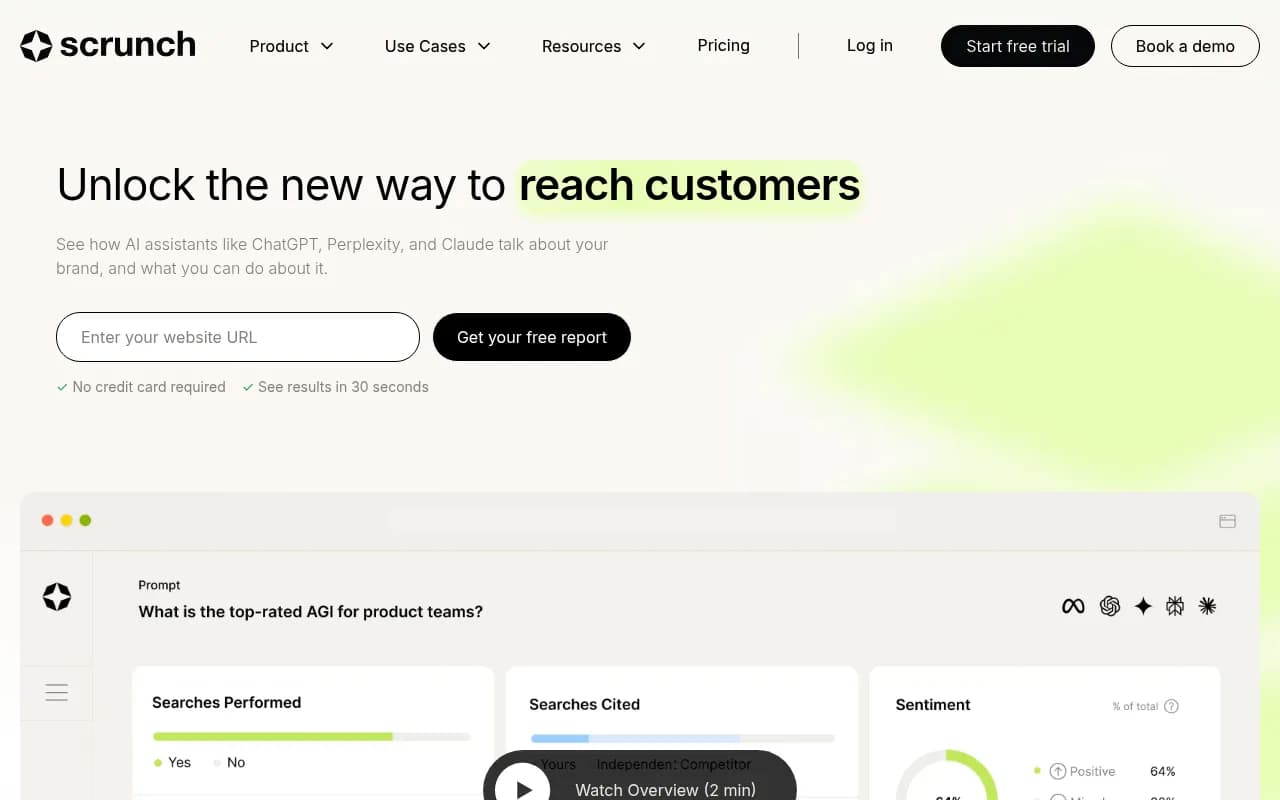
| Sentiment | Whether mentions are positive, neutral, or negative | Promptwatch, ScrunchAI |
| Citation rate | Which pages are being cited and how often | Promptwatch page-level tracking |
| AI-driven traffic | Visits from AI referrals (ChatGPT.com, Perplexity.ai, etc.) | Google Analytics + GSC |

Phase 2: Content creation and optimization (days 31-60)
Month two is where most of the real work happens. You now know where you're invisible and why. The goal is to create content that fills those gaps.
Step 6: Run an answer gap analysis
Answer gap analysis is the single most valuable exercise in GEO. It shows you the specific prompts where competitors are getting cited but you're not -- and by extension, the content your site is missing.
The manual version: take your target prompts, run them in each AI model, and catalog every competitor mention. Then look at what content those competitors have that you don't.
The faster version: Promptwatch's Answer Gap Analysis does this automatically, showing you the exact topics, angles, and questions AI models want answers to but can't find on your site. This is where most brands discover they're missing obvious content -- comparison pages, use-case guides, FAQ content for specific personas.
Step 7: Create answer-optimized content
With your gaps identified, start creating. The content formats that perform best in AI search are different from what worked in traditional SEO:
Comparison pages are disproportionately powerful. When someone asks "X vs Y" or "best alternatives to X," AI models need a source that directly addresses the comparison. If you don't have that page, a competitor or a review site will get cited instead.
FAQ content with direct, specific answers gets pulled into AI responses constantly. Structure your FAQs around the actual questions your customers ask, not the questions you wish they'd ask.
Original research and data is one of the fastest ways to become a citable source. AI models prefer citing primary sources. If you publish a survey, a dataset, or an industry benchmark, you become the source -- not someone else's summary of it.
How-to guides with clear step-by-step structure get cited when someone asks a process question. The key is being genuinely specific, not just covering the topic at a high level.
For content creation at scale, a few tools worth knowing:
If you're using Promptwatch, the built-in AI writing agent generates articles and comparisons grounded in citation data from 880M+ analyzed citations -- so the content is engineered around what AI models actually cite, not just what reads well.
Step 8: Build off-site authority
Your own website is only part of the picture. AI models pull from Reddit, YouTube, review sites, industry publications, and other third-party sources. If you're only optimizing your own content, you're missing a significant part of the equation.
Practical tactics:
- Participate genuinely in Reddit communities where your customers hang out. Answer questions. Don't just drop links.
- Get listed on relevant review platforms (G2, Capterra, Trustpilot, etc.) and actively collect reviews.
- Pitch original data or insights to industry publications. A single citation in a well-read article can drive AI mentions for months.
- Create YouTube content that answers the questions your customers ask. Perplexity in particular surfaces YouTube results frequently.
- Ensure your brand is consistently described the same way across all platforms.
Step 9: Implement structured data
If you haven't already, add schema markup to your key pages. The most useful schema types for AI visibility:
Organizationon your homepage (name, description, URL, logo, social profiles)FAQPageon any page with Q&A contentArticleorBlogPostingon content pagesProductorSoftwareApplicationif you're a product companyHowToon process guides
This isn't magic -- structured data doesn't guarantee citations -- but it reduces ambiguity about what your pages are about, which is exactly what AI models are trying to resolve before selecting a source.
WordLift is a solid tool for implementing structured data without getting deep into JSON-LD by hand.
Phase 3: Track, iterate, and compound (days 61-90)
By day 60, you should have a baseline, a set of new content published, and some initial data coming in. Month three is about closing the loop: seeing what's working, doubling down on it, and fixing what isn't.
Step 10: Measure what changed
Go back to your baseline metrics and compare. For each target prompt, are you appearing more often? Has your share of voice improved? Which new pages are getting cited?
This is where page-level tracking becomes important. Knowing your overall mention frequency went up is useful, but knowing that your "X vs Y" comparison page is now being cited by Perplexity 40 times a week is actionable. You can create more pages like it.
Promptwatch's page-level tracking shows exactly which pages are being cited, how often, and by which AI models. This closes the loop between content creation and results.
Step 11: Connect AI visibility to actual traffic and revenue
AI citations that don't drive traffic or revenue are interesting but not sufficient. You need to connect the dots.
The most reliable approach is a combination of:
- Direct referral traffic from AI platforms (ChatGPT.com, Perplexity.ai, etc.) in Google Analytics
- Google Search Console data showing AI Overview appearances
- A tracking snippet or server log analysis to catch traffic that doesn't show up as a referral
Some brands are surprised to find that AI-driven traffic converts at a higher rate than organic search traffic -- the intent is often more specific. But you won't know unless you measure it.
Step 12: Identify your next round of gaps
By day 90, you'll have a clearer picture of which prompts you're winning and which you're still missing. Run another answer gap analysis. The prompts you're now competitive on will have shifted -- new gaps will have emerged as competitors respond to what you've done.
This is the core loop: find gaps, create content, track results, repeat. The brands that compound their AI visibility over time are the ones that treat this as an ongoing process, not a one-time project.
Tools comparison: what to use at each phase
| Phase | Task | Recommended tools |
|---|---|---|
| Audit | AI visibility monitoring | Promptwatch, Otterly.AI, Profound |
| Audit | Technical SEO crawl | Screaming Frog, Sitebulb |
| Audit | Traditional keyword research | Ahrefs, Semrush |
| Content | Gap analysis | Promptwatch (Answer Gap Analysis) |
| Content | Content optimization | Surfer SEO, Frase, MarketMuse |
| Content | Structured data | WordLift |
| Content | Off-site reviews | Trustpilot |
| Tracking | Page-level citation tracking | Promptwatch |
| Tracking | Web analytics | Google Analytics, Google Search Console |
| Tracking | Competitor benchmarking | Promptwatch, AthenaHQ, ScrunchAI |

What most teams get wrong
A few patterns show up repeatedly in teams that struggle to make progress:
They monitor without acting. Knowing you're invisible in ChatGPT is only useful if you do something about it. A lot of teams set up a monitoring tool, watch their scores stay flat, and wonder why nothing changed. Monitoring is the starting point, not the strategy.
They create content without checking gaps first. Publishing more blog posts won't help if those posts don't address the specific prompts where you're missing. Content creation needs to be driven by gap analysis, not by editorial instinct.
They ignore off-site signals. Your website alone isn't enough. Reddit, YouTube, review platforms, and third-party publications all influence what AI models recommend. A brand that's only visible on its own site is easy to overlook.
They measure too early. AI models update their training data and retrieval indexes on their own schedules. New content often takes 4-8 weeks to show up in AI responses consistently. Don't panic if you don't see movement in week two.
They treat this as a one-time project. The brands winning in AI search in 2026 are the ones running this cycle continuously, not the ones who did a sprint six months ago and moved on.
The 90-day checkpoint
By the end of 90 days, you should be able to answer yes to each of these:
- Do you know your mention frequency across at least 3 major AI models?
- Have you published at least 5-10 pieces of content directly targeting prompt gaps?
- Do you have at least one comparison page for each major competitor?
- Is your structured data implemented on your key pages?
- Are you actively building off-site presence (reviews, Reddit, publications)?
- Can you connect AI visibility improvements to actual traffic changes?
If you can check all of these, you're not starting from zero anymore. You're in the game -- and the compounding starts from here.
The tools, the tactics, and the process all exist. The brands that will dominate AI search over the next 12 months are the ones that start this cycle now, not the ones waiting for the landscape to "settle." It won't settle. It'll just keep moving.