Key takeaways
- Jasper AI and Copy.ai are AI writing tools first — they help you produce content faster, but they don't track whether that content gets cited by ChatGPT, Perplexity, or any other AI engine.
- AirOps sits closer to the GEO space, with content engineering workflows built around AI search, but its visibility tracking is limited compared to dedicated platforms.
- Promptwatch is the only platform in this group that closes the full loop: it shows you where you're invisible in AI search, helps you create content to fix it, and then tracks whether that content actually gets cited.
- If your goal is purely writing productivity, Jasper or Copy.ai make sense. If your goal is ranking in AI search engines, you need something built for that.
Why this comparison matters in 2026
The term "GEO content platform" is getting slapped on a lot of tools right now, and it's creating real confusion for marketing teams trying to figure out what they actually need.
Jasper AI and Copy.ai have been around for years as AI writing assistants. AirOps emerged as a more structured content operations tool. And Promptwatch built itself specifically around the problem of AI search visibility — tracking where brands appear (or don't appear) in ChatGPT, Perplexity, Claude, Gemini, and the rest.
These are genuinely different products. The fact that they're being compared in the same breath says more about how fast the GEO category is moving than about how similar the tools actually are.
Let's break down what each one does, where it shines, and where it doesn't.
What each platform actually does
Jasper AI: marketing content at scale
Jasper is a mature AI writing platform aimed at marketing teams that need to produce a lot of content consistently. It has brand voice controls, team workflows, a document editor, and integrations with tools like Surfer SEO. In 2025, Jasper added "AI agents" to its pitch — the idea being that you can automate multi-step content workflows, not just generate individual pieces.
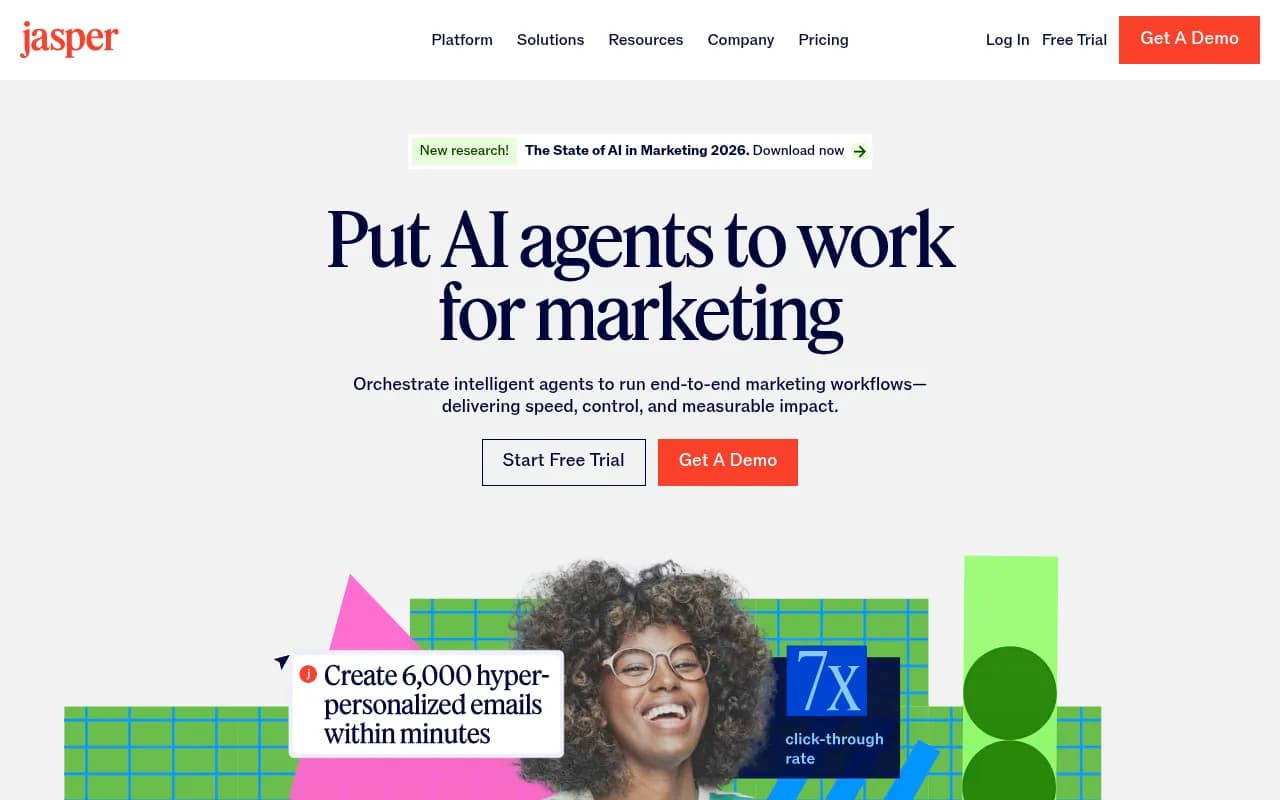
Where Jasper genuinely excels is brand consistency at scale. If you have a large marketing team producing blog posts, ad copy, and social content, Jasper's brand voice and style controls help keep everything coherent. The template library is extensive, and the editor is polished.
What Jasper doesn't do: it has no visibility into how AI models are actually responding to queries in your category. It can't tell you which prompts your competitors are winning, which pages on your site are being cited by ChatGPT, or whether the content it helps you write is actually getting picked up by AI engines. It's a production tool, not an optimization tool.
Copy.ai: GTM workflows and sales content
Copy.ai started as a copywriting tool and has since repositioned itself around go-to-market workflows. The pitch now is less "write faster" and more "automate your GTM content pipeline" — think sales sequences, outreach copy, product descriptions, and marketing automation content.

Copy.ai's workflow builder is genuinely useful for teams that need to connect content generation to CRM data or sales processes. If you're running outbound sequences or need to generate personalized content at scale for sales, it's a strong option.
But like Jasper, Copy.ai has no GEO capabilities. It doesn't monitor AI search engines, doesn't analyze citation patterns, and doesn't tell you anything about how your brand appears in AI-generated answers. It's a content production tool that happens to use AI — not an AI visibility platform.
AirOps: content engineering for AI search
AirOps is the most interesting of the three writing-adjacent tools in this comparison, because it's explicitly trying to bridge content production and AI search optimization. The platform lets teams build content workflows grounded in real data — competitor analysis, keyword research, and increasingly, AI search signals.
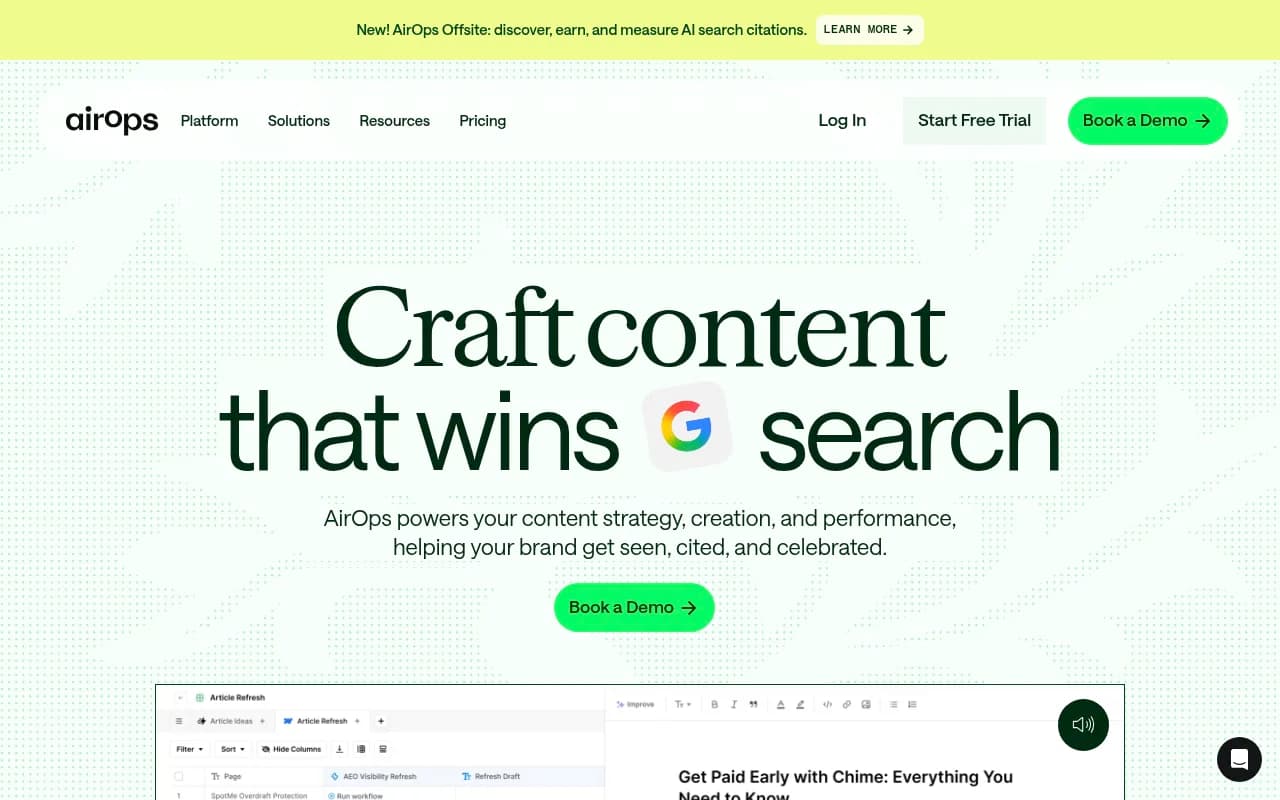
AirOps tracks up to four AI models (according to publicly available data as of early 2026), which is a meaningful step beyond pure writing tools. It has a free tier, which makes it accessible for smaller teams experimenting with GEO. The workflow-building approach is genuinely powerful for content operations teams that want to systematize how they produce AI-optimized content.
The limitation is depth. AirOps doesn't have the citation analysis, crawler logs, Reddit/YouTube tracking, or prompt intelligence that dedicated GEO platforms offer. It's a content engineering tool with some AI visibility features, not the other way around.
Promptwatch: end-to-end AI search visibility
Promptwatch is built around a different question than the other three tools. Not "how do I produce content?" but "why isn't my brand appearing in AI search results, and what do I do about it?"

The platform monitors 10 AI models — ChatGPT, Perplexity, Claude, Gemini, Google AI Overviews, Google AI Mode, Grok, DeepSeek, Meta/Llama, Copilot, and Mistral — and tracks brand mentions, citation rates, share of voice, and sentiment across all of them. That's more model coverage than any other tool in this comparison.
What makes Promptwatch different from monitoring-only tools is the action loop it's built around:
- Answer Gap Analysis surfaces the specific prompts where competitors are visible but you're not — with the exact content gaps causing it.
- The built-in AI writing agent generates articles, listicles, and comparisons grounded in 880M+ citations analyzed, prompt volumes, and competitor data. This isn't generic content — it's engineered to get cited.
- Page-level tracking shows which pages are being cited by which models, and traffic attribution (via code snippet, GSC integration, or server log analysis) connects AI visibility to actual revenue.
On top of that: AI crawler logs show which pages ChatGPT, Claude, and Perplexity are actually reading on your site, Reddit and YouTube tracking surfaces discussions that influence AI recommendations, and ChatGPT Shopping tracking monitors product recommendation appearances.
Feature comparison
| Feature | Jasper AI | Copy.ai | AirOps | Promptwatch |
|---|---|---|---|---|
| AI writing / content generation | Yes | Yes | Yes | Yes (built-in AI agent) |
| AI model monitoring | No | No | Up to 4 models | 10+ models |
| Brand mention tracking | No | No | Limited | Yes |
| Citation analysis | No | No | No | Yes (880M+ citations) |
| Answer gap analysis | No | No | No | Yes |
| AI crawler logs | No | No | No | Yes |
| Reddit / YouTube tracking | No | No | No | Yes |
| ChatGPT Shopping tracking | No | No | No | Yes |
| Traffic attribution from AI | No | No | No | Yes |
| Prompt volume / difficulty scoring | No | No | No | Yes |
| Competitor visibility heatmaps | No | No | No | Yes |
| Multi-language / multi-region | Limited | Limited | No | Yes |
| Free tier / trial | Trial | Trial | Free tier | Free trial |
| Starting price | ~$49/mo | ~$49/mo | Free | $99/mo |
The core question: what problem are you actually solving?
This is where a lot of teams go wrong. They buy a writing tool because it mentions "AI optimization" in the marketing copy, then wonder why their brand still doesn't appear when someone asks ChatGPT for a recommendation in their category.
Writing faster is not the same as ranking in AI search. These are different problems.
If you need to produce more content, more consistently, with better brand voice control, Jasper is a solid choice for larger marketing teams. Copy.ai makes more sense if your content needs are tied to sales and GTM workflows. AirOps is worth evaluating if you want to build structured content pipelines with some AI search awareness baked in.
But if your actual goal is understanding and improving how your brand appears in AI-generated answers — and then tracking whether your efforts are working — you need a platform built for that from the ground up.
Who should use what
Use Jasper if...
You have a marketing team of 5+ people producing high volumes of brand content across channels, and consistency of voice is a real operational problem. Jasper's brand controls and team workflows are genuinely useful here. Just don't expect it to tell you anything about AI search visibility.
Use Copy.ai if...
Your content needs are primarily tied to sales and GTM — outreach sequences, product copy, sales enablement content. The workflow automation is legitimately useful for connecting content generation to sales processes.
Use AirOps if...
You're a content operations team that wants to build systematic, data-informed content workflows and you're starting to think about AI search optimization. The free tier makes it low-risk to experiment.
Use Promptwatch if...
Your brand needs to appear in AI-generated answers and you want to know exactly why you're not showing up, what to create to fix it, and whether it's working. Promptwatch is the only platform in this comparison that gives you all three.
A note on pricing and value
Jasper and Copy.ai both start around $49/month for individual users, scaling up significantly for team plans with brand controls and advanced features. AirOps has a free tier, which is genuinely useful for getting started.
Promptwatch starts at $99/month (Essential: 1 site, 50 prompts, 5 articles), $249/month (Professional: 2 sites, 150 prompts, 15 articles, crawler logs, state/city tracking), and $579/month (Business: 5 sites, 350 prompts, 30 articles). There's a free trial available.
The pricing comparison isn't really apples-to-apples, because the tools are solving different problems. Spending $49/month on Jasper while your competitors dominate AI search results is a different kind of cost than it looks like on a spreadsheet.
The GEO platform landscape in 2026
It's worth zooming out for a moment. The GEO category has exploded in the past 18 months, and the tools range from basic monitoring dashboards to full optimization platforms.
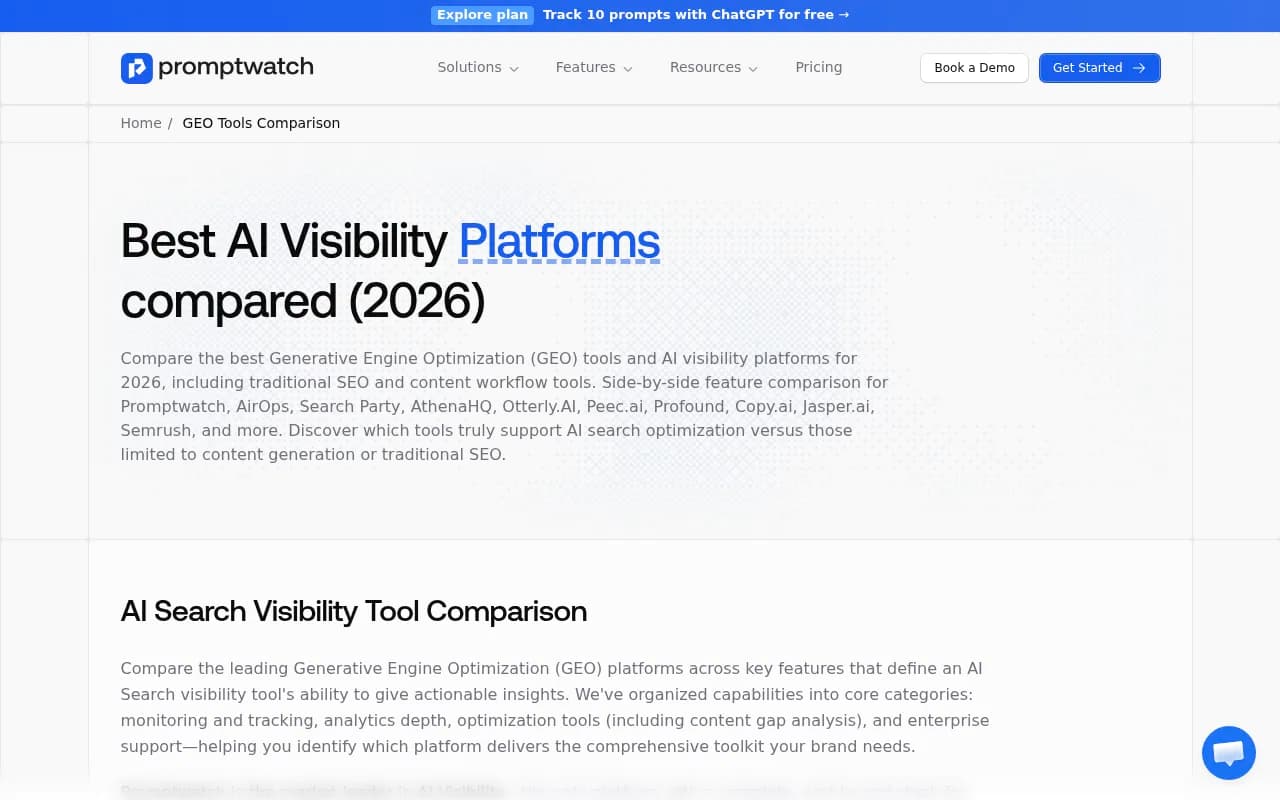
Most tools in the space — including many dedicated GEO platforms — stop at monitoring. They show you a visibility score and leave you to figure out what to do with it. The more useful question is: what content do I need to create, and how do I know if it's working?
That's the gap Promptwatch is built to close. The Answer Gap Analysis tells you exactly which prompts competitors are winning that you're not. The AI writing agent generates content designed to get cited. The tracking layer shows you whether it worked.
For Jasper and Copy.ai, GEO isn't really on the roadmap in any meaningful way — they're writing tools, and that's fine. AirOps is moving in the right direction but isn't there yet on visibility depth.
Bottom line
The "GEO content platform" label gets applied too loosely. Jasper and Copy.ai are excellent AI writing tools that have nothing to do with GEO. AirOps is a content operations platform with some AI search awareness. Promptwatch is the only one in this group built specifically to track and improve AI search visibility end-to-end.
If you're evaluating tools for your marketing stack in 2026, the honest answer is: you might need more than one. A writing tool for production, and a dedicated GEO platform for visibility. Or you use Promptwatch's built-in content generation and skip the separate writing tool entirely.
What you shouldn't do is assume that producing more content with an AI writing tool will automatically improve your AI search visibility. It won't, unless that content is engineered around the specific prompts and gaps that matter in your category.