Key takeaways
- All four platforms track brand visibility across AI search engines like ChatGPT, Perplexity, and Google AI Overviews -- but they stop at very different points.
- Otterly.AI is the cheapest entry point ($29/month) and works well for basic monitoring. Peec AI is a strong mid-market analytics platform with solid prompt intelligence. Scrunch adds content and partnership intelligence on top of tracking.
- Promptwatch is the only platform in this comparison that closes the full loop: find gaps, generate content, track results -- without switching tools.
- If you're only monitoring, you're only doing half the job. AI visibility without optimization is just a dashboard that makes you feel bad.
The AI visibility tool market has exploded. Between summer 2025 and spring 2026, the category attracted over $300M in funding, and now there are more than 28 platforms claiming to help you "rank in AI." Most of them do roughly the same thing: run your brand name through ChatGPT and Perplexity a few times a day, show you a percentage, and call it visibility.
But there's a real difference between knowing you're invisible and knowing how to fix it. This guide breaks down four of the most-discussed platforms -- Peec AI, Promptwatch, Otterly.AI, and Scrunch -- with a focus on that distinction.
What these platforms actually do (and what they don't)
Before the feature breakdown, it's worth being honest about what "AI visibility" means in practice. When someone asks ChatGPT "what's the best project management tool for remote teams," your brand either appears in that answer or it doesn't. AI visibility tools measure that. The good ones also tell you why you're not appearing and help you do something about it.
The four platforms here sit at different points on that spectrum.
Otterly.AI: the accessible starting point
Otterly.AI is consistently described as the most accessible entry point in the category. At $29/month, it's genuinely affordable, and it covers the basics: brand monitoring across ChatGPT, Perplexity, and Google AI Overviews, with multi-engine tracking and prompt scheduling.
Otterly.AI

For a small business or solo marketer who has never measured AI visibility before, Otterly is a reasonable first step. You can set up prompts, see where your brand appears, and get a rough sense of your competitive position.
The limitations show up quickly, though. Otterly doesn't have AI crawler logs, so you can't see which pages AI engines are actually reading. There's no content gap analysis, no built-in content generation, and no traffic attribution. You'll know you're invisible -- you just won't know what to do about it.
Best for: Teams that want to start measuring AI visibility without a big budget commitment. Not the right choice if you need to act on what you find.
Peec AI: strong analytics, growing fast
Peec AI has had a remarkable 2025-2026. According to Surmado's 2026 market overview, it hit $4M+ ARR in ten months and raised $29M -- making it the fastest-growing challenger in the mid-market segment.

The analytics depth is genuinely impressive. Peec AI tracks brand visibility across multiple AI engines, surfaces prompt-level data, and gives you a clearer picture of where you're winning and losing compared to competitors. It's particularly good at showing you which prompts your competitors appear in that you don't -- which is useful intelligence.
Where Peec AI falls short is on the "now what" side. The platform is analytics-first. It tells you what's happening with real sophistication, but it doesn't generate content, doesn't have AI crawler logs, and doesn't close the loop with traffic attribution. You'll need separate tools to act on the data.
Best for: Mid-market marketing teams that want serious analytics and are comfortable using separate tools for content creation and optimization.
Scrunch: tracking plus content intelligence
Scrunch takes a slightly different angle. Beyond standard AI visibility tracking, it layers in content intelligence and partnership insights -- helping you understand not just where your brand appears, but what content and sources are driving AI recommendations in your category.
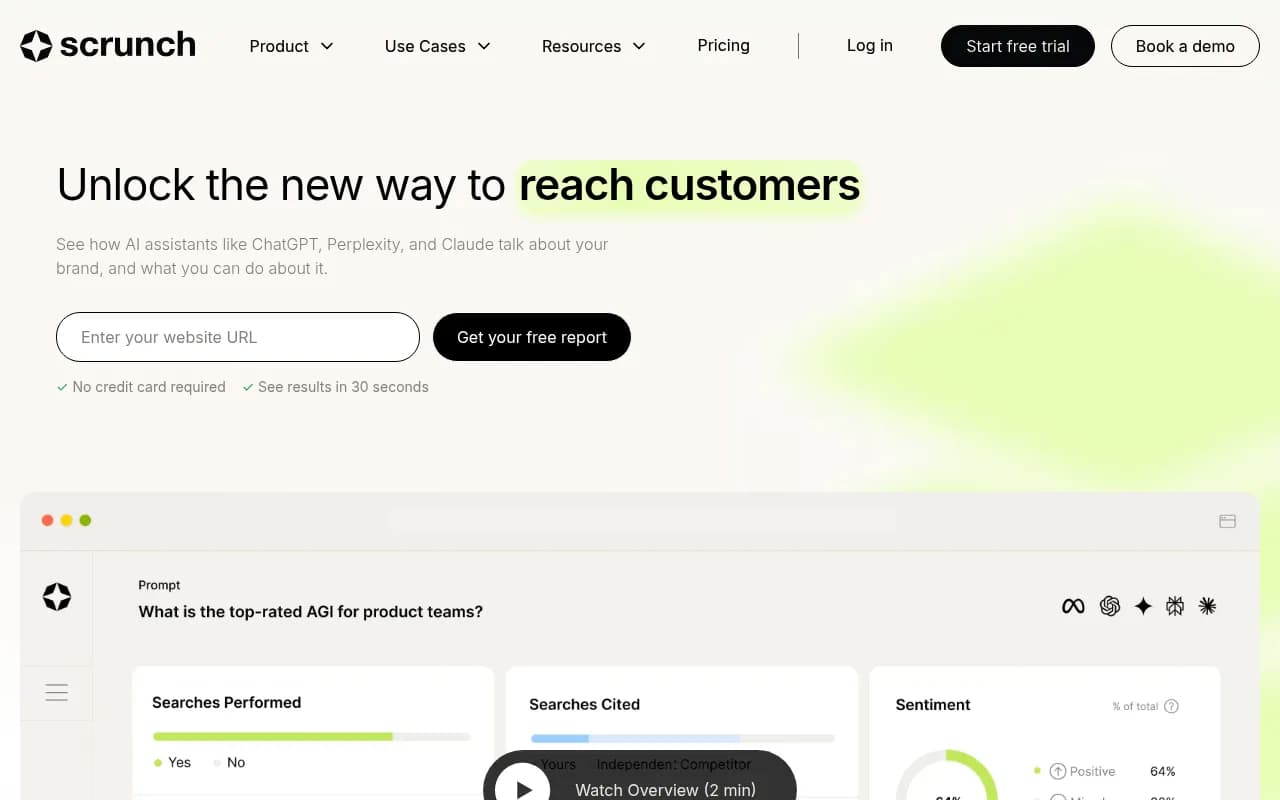
That's a meaningful differentiator. If you want to understand which third-party content (Reddit threads, review sites, industry publications) is influencing AI recommendations for your category, Scrunch surfaces that in a way most monitoring tools don't.
The trade-off: Scrunch is enterprise-oriented and priced accordingly. It's also primarily a research and intelligence tool rather than an optimization platform. You get better context for decisions, but you're still doing the actual optimization work elsewhere.
Best for: Enterprise teams that want deep content and source intelligence to inform their broader content strategy.
Promptwatch: the full loop
Promptwatch is built around a different premise than the other three. The core argument is that monitoring without optimization is incomplete -- and the platform is designed to close that gap.

The workflow goes like this: Answer Gap Analysis shows you exactly which prompts your competitors appear in that you don't. You see the specific topics and questions AI models are answering without citing your site. Then the built-in AI writing agent generates content -- articles, listicles, comparisons -- grounded in real citation data from over 880 million citations analyzed. Then page-level tracking shows you whether that new content is getting cited, by which models, and how often. Traffic attribution (via code snippet, Google Search Console integration, or server log analysis) connects visibility to actual revenue.
That cycle -- find gaps, create content, track results -- is what separates Promptwatch from the other platforms in this comparison. The others show you data. Promptwatch helps you change the data.
A few capabilities worth calling out specifically:
- AI Crawler Logs: Real-time logs of which pages ChatGPT, Claude, Perplexity, and other AI crawlers are visiting, how often, and what errors they're hitting. Most competitors don't have this at all.
- Prompt Intelligence: Volume estimates and difficulty scores for each prompt, plus query fan-outs that show how one prompt branches into related sub-queries. This helps you prioritize which gaps to close first.
- Reddit & YouTube Insights: Surfaces discussions that directly influence AI recommendations -- a channel most platforms ignore.
- ChatGPT Shopping Tracking: Monitors when your brand appears in ChatGPT's product recommendations and shopping carousels.
- Multi-language & multi-region: Monitor AI responses in any language, from any country, with customizable personas.
Promptwatch monitors 10 AI models: ChatGPT, Perplexity, Google AI Overviews, Google AI Mode, Claude, Gemini, Meta/Llama, DeepSeek, Grok, Mistral, and Copilot.
Pricing starts at $99/month (Essential: 1 site, 50 prompts, 5 articles), $249/month (Professional: 2 sites, 150 prompts, 15 articles, crawler logs), and $579/month (Business: 5 sites, 350 prompts, 30 articles). A free trial is available.
Best for: Marketing teams, SEO teams, and agencies that want to actually improve their AI visibility -- not just measure it.
Side-by-side comparison
| Feature | Otterly.AI | Peec AI | Scrunch | Promptwatch |
|---|---|---|---|---|
| Brand monitoring (ChatGPT, Perplexity, etc.) | Yes | Yes | Yes | Yes (10 models) |
| Competitor visibility tracking | Basic | Strong | Yes | Yes |
| Prompt-level analytics | Limited | Strong | Moderate | Yes (with volume + difficulty) |
| Answer gap analysis | No | Partial | No | Yes |
| AI content generation | No | No | No | Yes (built-in writing agent) |
| AI crawler logs | No | No | No | Yes |
| Reddit & YouTube insights | No | No | Partial | Yes |
| ChatGPT Shopping tracking | No | No | No | Yes |
| Traffic attribution | No | No | No | Yes (GSC, snippet, server logs) |
| Page-level citation tracking | No | No | No | Yes |
| Multi-language / multi-region | Limited | Yes | Yes | Yes |
| Starting price | $29/mo | Mid-market | Enterprise | $99/mo |
| Free trial | Yes | Yes | No | Yes |
The monitoring-only trap
Here's the honest problem with most AI visibility tools: they're built to show you a number going up or down. That's useful for reporting. It's not useful for actually improving your position.
If you spend $300/month on a monitoring platform and your AI visibility score stays flat for three months, you've learned that you're invisible. You haven't learned what to write, which topics to cover, or which AI models are actually crawling your site. You're stuck.
The platforms that are genuinely useful in 2026 are the ones that answer the next question: given that I'm invisible here, what do I do about it? That's a much harder problem to solve, and most platforms haven't tried.
Peec AI gets you closer to an answer with its analytics depth. Scrunch helps you understand the content ecosystem driving recommendations. But neither generates the content or closes the attribution loop.
Promptwatch is the only platform in this comparison that does all three: shows you the gap, helps you fill it, and proves whether it worked.
Which platform should you actually use?
The right answer depends on where you are and what you need:
- You've never measured AI visibility and want to start cheap: Otterly.AI at $29/month is a reasonable first step. Expect to outgrow it.
- You want serious analytics and have a team to act on them: Peec AI is worth evaluating. The prompt-level data is genuinely good.
- You're enterprise and want content ecosystem intelligence: Scrunch is worth a conversation.
- You want to actually improve your AI visibility, not just track it: Promptwatch is the clearest path. The Answer Gap Analysis alone tends to surface content opportunities that teams didn't know they were missing, and the built-in content generation means you can act on them the same day.
The market is still young enough that most brands have significant gaps -- prompts their competitors appear in that they don't, topics AI models want to answer that their site doesn't cover. The question is whether your platform helps you find and close those gaps, or just shows you how big they are.