Key takeaways
- Botify, Lumar, and seoClarity all started as technical SEO crawlers and have bolted on AI visibility features -- with varying degrees of success.
- Promptwatch is the only platform in this comparison built from the ground up for AI search visibility, with a full action loop: find gaps, generate content, track results.
- AI crawler log monitoring (seeing which bots -- GPTBot, ClaudeBot, PerplexityBot -- actually visit your pages) is a differentiating feature that most platforms still handle poorly.
- If you're an enterprise with a large technical SEO team, Botify or Lumar may already be in your stack. But for GEO-specific work, they're not purpose-built.
- Pricing varies dramatically: Promptwatch starts at $99/mo, while Botify and seoClarity are custom-quoted enterprise contracts.
The GEO platform space in 2026 is a mess of overlapping claims. Every tool seems to say it "tracks your brand in AI search" -- but what that actually means ranges from a basic mention counter to a full optimization engine. This comparison focuses on four platforms that sit in a specific, interesting overlap: they all have meaningful technical SEO roots, and they all claim some level of AI search or GEO capability.
The four are Botify, Lumar (formerly DeepCrawl), seoClarity, and Promptwatch. They're not direct competitors in the traditional sense -- they come from different starting points and serve somewhat different audiences. But if you're an SEO or marketing team trying to figure out where to invest in 2026, you'll likely encounter all four.
Let's get into what each actually does, where they're strong, and where they fall short.
What "technical GEO" actually means in 2026
Before comparing platforms, it's worth being clear about what we're evaluating. "Technical GEO" (Generative Engine Optimization) refers to the technical layer of making your website visible and crawlable by AI systems -- not just Google, but ChatGPT's GPTBot, Anthropic's ClaudeBot, Perplexity's PerplexityBot, and others.
This includes:
- Monitoring which AI crawlers are visiting your site and which pages they're reading
- Identifying crawl errors or blocked pages that prevent AI models from indexing your content
- Understanding which of your pages are actually being cited in AI-generated responses
- Closing the loop between AI crawler activity and actual AI search visibility
Most traditional SEO crawlers were built for Googlebot. The question in 2026 is whether they've meaningfully adapted for the new generation of AI crawlers -- or just added a dashboard widget and called it GEO.
Botify
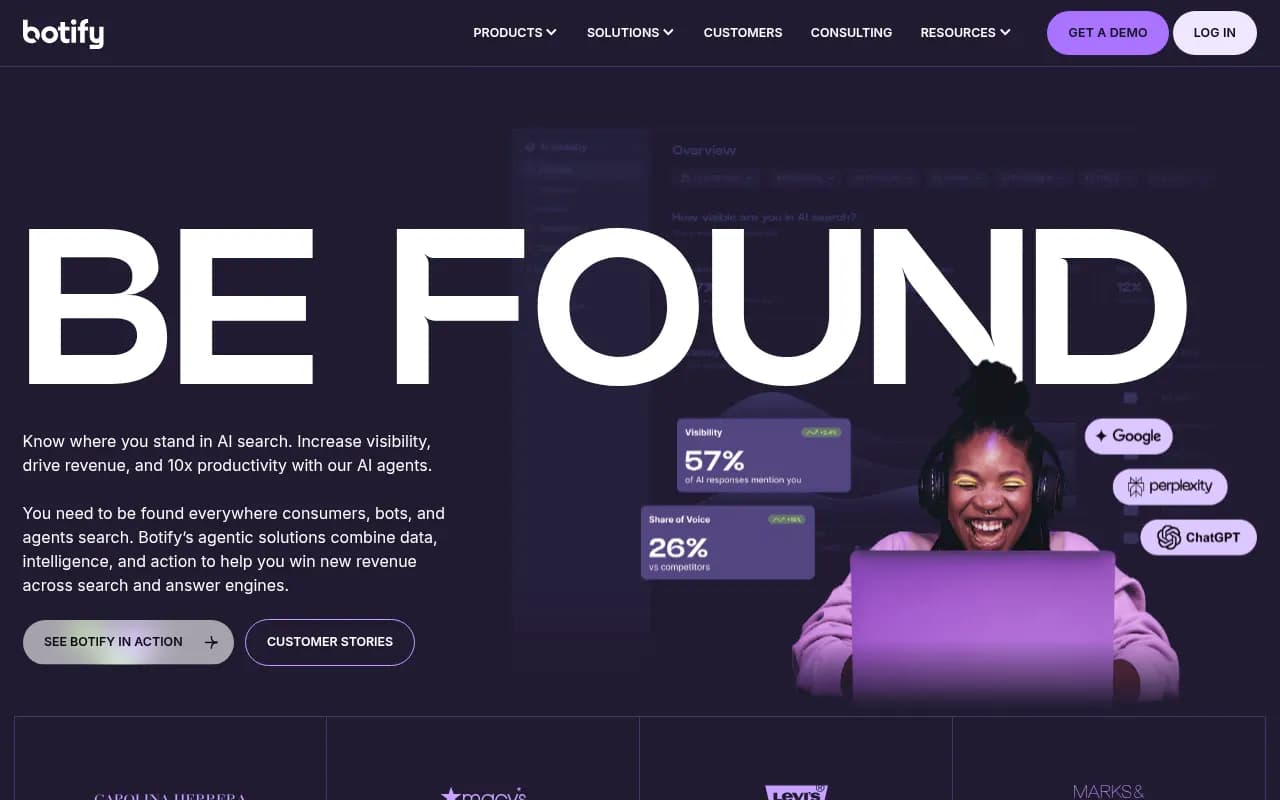
Botify is a well-established enterprise SEO platform that's been around since 2012. Its core product is a technical SEO suite built around large-scale website crawling, log file analysis, and content optimization. It's used by large enterprises -- retailers, publishers, travel companies -- with sites that have hundreds of thousands or millions of pages.
In 2025-2026, Botify added AI search monitoring features, including some visibility into AI crawler activity. The platform can ingest server log data and surface which bots are crawling your site, including AI crawlers like GPTBot.
Where Botify is genuinely strong: log file analysis at scale. If you have a 2-million-page e-commerce site and you want to understand crawl budget allocation across both Googlebot and GPTBot, Botify has the infrastructure to handle that. The RealKeywords integration and PageWorkers feature (which lets you modify pages without developer involvement) are legitimately useful for large technical teams.
Where it falls short for GEO work: Botify wasn't designed around the question "why isn't ChatGPT recommending us?" It can tell you that GPTBot visited 40% of your pages last month. It can't tell you which prompts your competitors are winning that you're not, or generate content designed to close those gaps. The GEO layer feels like an add-on to a technical SEO product, not a native capability.
Pricing is enterprise-only, custom-quoted. Expect five-figure annual contracts. There's no self-serve option.
Lumar
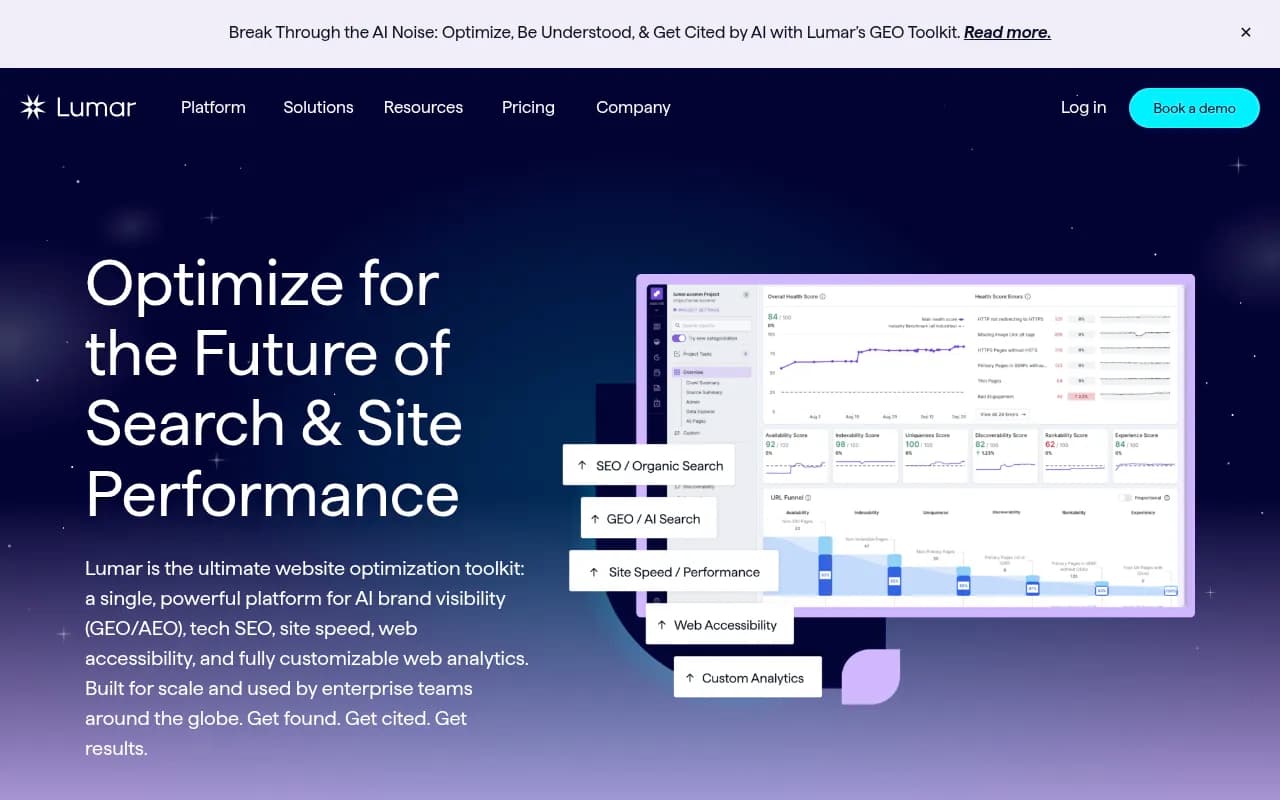
Lumar (rebranded from DeepCrawl in 2023) is another enterprise technical SEO platform with a long history. Its strengths are website crawling, technical auditing, and accessibility testing. Like Botify, it's built for large-scale sites and has a strong reputation in the technical SEO community.
Lumar has been expanding into what it calls "website intelligence" -- combining crawl data, analytics integrations, and now some AI search monitoring. The platform can surface AI crawler activity through log analysis, and it has added some GEO-adjacent reporting.
The honest assessment: Lumar is excellent at what it's always done. Technical audits, crawl visualization, Core Web Vitals monitoring, structured data validation -- these are areas where it competes well. But its AI visibility features are still relatively nascent. You can see that AI crawlers are hitting your site. You can't easily connect that to whether your brand is actually appearing in AI-generated responses, or understand what content you need to create to change that.
Lumar also sits at enterprise price points with custom contracts. It's not a tool you spin up to test GEO strategy -- it's infrastructure for large technical teams.
seoClarity
seoClarity is an enterprise SEO platform that has arguably gone further than Botify or Lumar in building out AI search features. It added an "AI Visibility" module that tracks brand mentions across AI search engines, and it has a content optimization layer called Clarity Grid that uses AI to analyze and improve content.
The platform monitors several AI models and provides share-of-voice metrics for brand mentions in AI-generated responses. For an enterprise SEO platform, this is a more complete GEO offering than most traditional tools have managed.
That said, seoClarity's AI visibility features are still built on top of a traditional SEO platform architecture. The prompt monitoring is less granular than purpose-built GEO tools -- you're working with a more limited set of tracked prompts, and the content generation capabilities are tied to the broader Clarity Grid workflow rather than being specifically engineered for AI citation optimization.
Like Botify and Lumar, seoClarity is enterprise-priced with custom contracts. It's a strong choice if you're already using it for traditional SEO and want to add some AI visibility without switching platforms.

Promptwatch
Promptwatch takes a fundamentally different approach. It wasn't built as a technical SEO crawler that added GEO features -- it was built specifically to help brands understand and improve their visibility in AI search engines.
The core difference is what Promptwatch calls the action loop: find gaps, create content, track results. Most platforms in this comparison can do step three (track results) reasonably well. Promptwatch is designed to do all three.
The AI Crawler Logs feature is worth calling out specifically in the context of this comparison. Promptwatch provides real-time logs of AI crawlers (ChatGPT, Claude, Perplexity, and others) hitting your website -- which pages they read, errors they encounter, how often they return. This is the same kind of log analysis that Botify and Lumar do for Googlebot, but applied natively to the AI crawler ecosystem and connected directly to visibility outcomes.
Where Promptwatch goes further: Answer Gap Analysis shows exactly which prompts competitors are visible for that you're not. The built-in AI writing agent then generates content specifically engineered to get cited by AI models -- grounded in 880M+ citations analyzed, not generic SEO templates. And page-level tracking shows which specific pages are being cited, by which models, how often.
On pricing, Promptwatch is significantly more accessible: Essential at $99/mo, Professional at $249/mo, Business at $579/mo. There's a free trial. You don't need to talk to a sales team to get started.

Feature comparison
| Feature | Botify | Lumar | seoClarity | Promptwatch |
|---|---|---|---|---|
| AI crawler log monitoring | Yes (via server logs) | Yes (via server logs) | Limited | Yes (real-time, native) |
| Brand mentions in AI responses | Limited | Limited | Yes | Yes |
| Prompt tracking | No | No | Basic | Yes (volume + difficulty scores) |
| Answer gap analysis | No | No | No | Yes |
| AI content generation | No | No | Partial (Clarity Grid) | Yes (purpose-built) |
| Citation analysis (which pages get cited) | No | No | Limited | Yes (page-level) |
| Reddit/YouTube influence tracking | No | No | No | Yes |
| ChatGPT Shopping tracking | No | No | No | Yes |
| Traditional technical SEO crawling | Yes (best-in-class) | Yes (best-in-class) | Yes | No |
| Competitor heatmaps (AI visibility) | No | No | Limited | Yes |
| AI models monitored | 1-2 | 1-2 | 4-5 | 10 |
| Traffic attribution (AI to revenue) | No | No | No | Yes |
| Starting price | Custom enterprise | Custom enterprise | Custom enterprise | $99/mo |
| Free trial | No | No | No | Yes |
Which platform is right for which team?
The honest answer is that these tools aren't really competing for the same buyer in most cases.
Botify and Lumar are infrastructure tools for large technical SEO teams. If you have a site with 500,000+ pages and a dedicated technical SEO function, one of these might already be in your stack. They're excellent at what they do. But if your primary question is "why isn't our brand appearing in ChatGPT responses?" -- they're not the right tool to answer it.
seoClarity is the most interesting competitor to Promptwatch in this group. It's made a genuine effort to build AI visibility into an enterprise SEO platform, and for teams that are already seoClarity customers, the AI module is worth exploring. The limitation is that it's still a traditional SEO platform at its core -- the GEO features are real but not the primary design intent.
Promptwatch is the right choice if AI search visibility is your primary concern. It's not a technical SEO crawler -- it won't replace Botify or Lumar for large-scale crawl analysis. But for understanding why competitors are winning in ChatGPT, Perplexity, and Google AI Overviews, and for actually doing something about it, it's the most complete platform available.
The $99/mo entry point also means you can test it without a procurement process. That's a meaningful difference when you're trying to build a business case for GEO investment.
The AI crawler monitoring question specifically
Since this comparison is framed around AI crawler monitoring, it's worth being direct about what each platform actually delivers here.
Botify and Lumar both offer log file analysis that can surface AI crawler activity. This is genuinely useful -- you can see that GPTBot visited your site 12,000 times last month, which pages it hit, and whether it encountered any errors. For large enterprise sites, this data is valuable for understanding crawl budget and ensuring AI models can access your content.
The limitation is that this data exists in isolation. Knowing that GPTBot crawled your /blog/category/pricing page 47 times doesn't tell you whether that page is being cited in ChatGPT responses, or whether it's helping your brand appear when users ask about pricing in your category.
Promptwatch's AI Crawler Logs connect crawler activity to visibility outcomes. You can see which pages AI crawlers are reading, then cross-reference that with which pages are actually generating citations in AI responses. That connection -- between crawl activity and citation outcomes -- is what makes the data actionable rather than just informational.
seoClarity has less developed crawler log analysis for AI bots specifically, though it compensates with stronger brand mention tracking.
A note on the broader GEO platform landscape
If you're evaluating these four platforms, you're probably also looking at other GEO-focused tools. The market has expanded significantly in 2026, with purpose-built platforms like Profound, AthenaHQ, Otterly.AI, and others competing for the AI visibility budget.
The key distinction to keep in mind: most GEO platforms are monitoring-only. They show you data. Promptwatch is one of the few that completes the loop by helping you act on that data -- through content gap analysis, AI-optimized content generation, and traffic attribution that connects AI visibility to actual revenue.
For teams coming from a technical SEO background (which is likely if you're evaluating Botify or Lumar), the crawler log feature in Promptwatch will feel familiar. But the surrounding context -- prompt intelligence, citation analysis, competitor heatmaps -- is what makes it a GEO platform rather than just another log analyzer.
Bottom line
If you need best-in-class technical SEO crawling for a large enterprise site, Botify or Lumar are hard to beat. They've added some AI crawler visibility, and it's useful data for technical teams.
If you're already on seoClarity and want to add AI visibility without changing platforms, the AI module is worth evaluating -- it's more developed than what Botify and Lumar offer on the GEO side.
If your primary goal is improving your brand's visibility in AI search engines -- understanding why competitors appear in ChatGPT responses and you don't, then fixing it -- Promptwatch is the most complete platform in this comparison. The action loop (find gaps, generate content, track results) is what separates it from tools that just show you a dashboard and leave you to figure out what to do next.
The free trial makes it easy to test. Start there, run your first Answer Gap Analysis, and see what you're missing.