Key takeaways
- Botify, seoClarity, and Lumar are all strong technical SEO platforms, but their AI search visibility features range from nascent to moderate -- none were built with GEO as a core use case.
- Promptwatch is the only platform in this comparison built specifically around AI search visibility, with content gap analysis, an AI writing agent, and crawler log monitoring for AI bots.
- If your primary concern is crawl budget, JavaScript rendering, and Core Web Vitals at scale, Botify or Lumar are the right fit. If AI visibility is the priority -- or you need both -- the answer is more nuanced.
- These four tools are not really direct competitors. They solve overlapping but distinct problems, and the best choice depends on where your biggest gap is right now.
The SEO tool landscape in 2026 has a weird split running through it. On one side you have the technical SEO platforms -- built for crawling, log file analysis, rendering, and site architecture -- that have been adding "AI visibility" features to their roadmaps. On the other side you have a new wave of GEO (Generative Engine Optimization) platforms that started with AI monitoring and are now expanding into content optimization.
Botify, seoClarity, and Lumar represent the first camp. Promptwatch represents the second.
The question most marketing and SEO teams are asking right now is: do I need both? And if I have to pick one, which gives me the most coverage?
This guide breaks down all four platforms honestly, without the usual vendor-speak.
What each platform actually does
Before comparing features, it helps to understand the design philosophy behind each tool, because that shapes everything from the UI to what metrics you can actually act on.
Botify
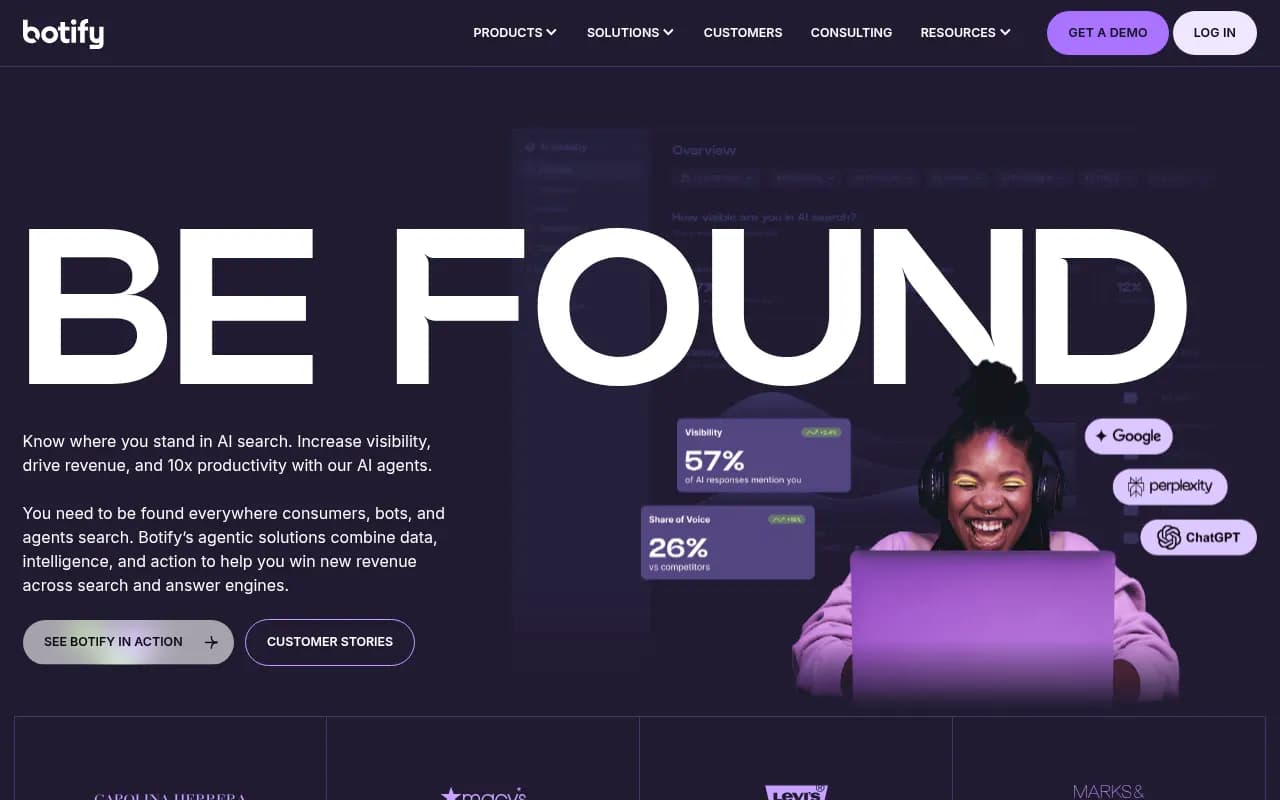
Botify started as a log file analyzer and enterprise crawler. Its core strength is understanding how search engines (and increasingly, AI crawlers) actually interact with your site at scale. For large e-commerce sites or publishers with millions of URLs, Botify's ability to correlate crawl data with organic performance is genuinely hard to replicate.
In 2026, Botify has expanded into what it calls "AI search optimization" -- tracking how your pages appear in AI-generated responses and flagging technical barriers that might prevent AI models from reading your content. The technical SEO foundation is excellent. The AI visibility layer is newer and thinner.
seoClarity
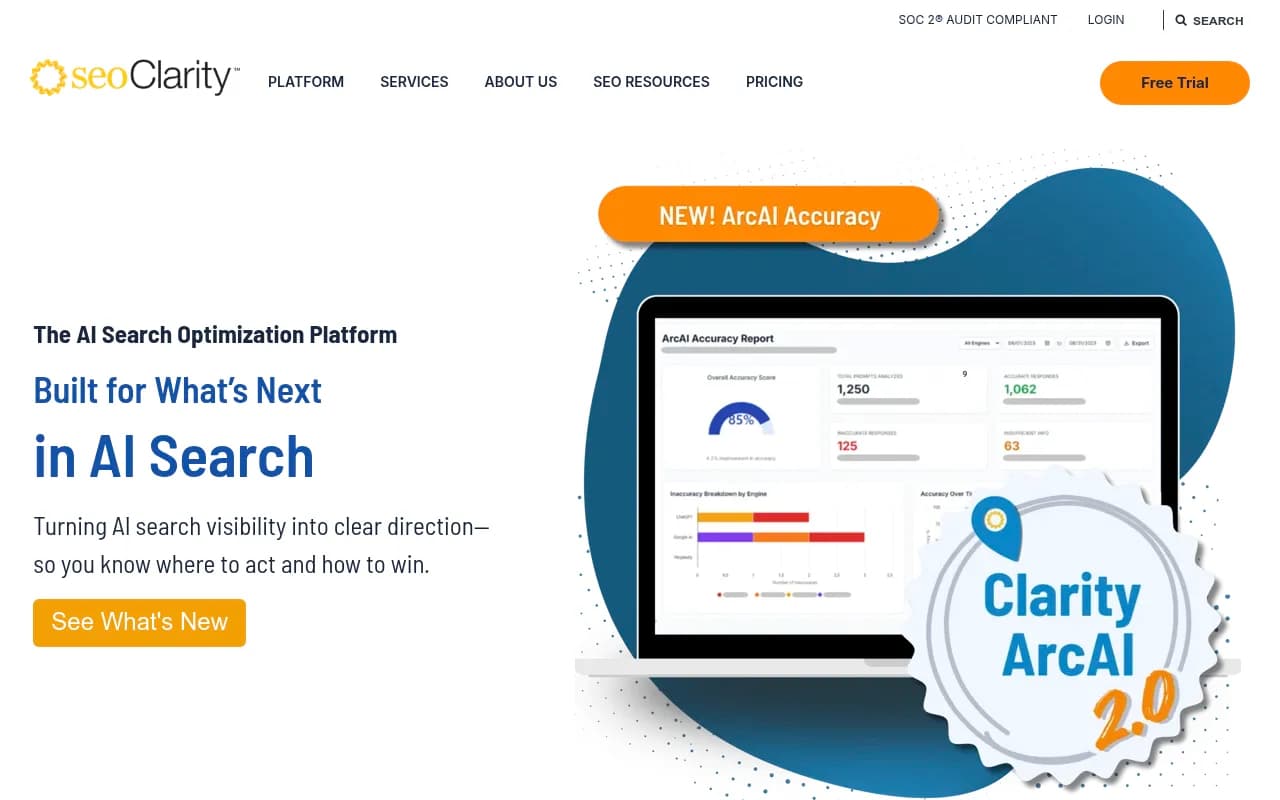
seoClarity is an enterprise SEO platform that has historically competed with BrightEdge for large in-house SEO teams. It covers rank tracking, content optimization, site auditing, and competitive intelligence. The platform added AI search tracking features in late 2024, and by 2026 it offers monitoring across several AI engines.
What seoClarity does well is consolidation -- it tries to be the single platform for an enterprise SEO team. The AI visibility features are there, but they sit alongside a lot of traditional SEO functionality, which means the interface can feel heavy if AI search is your primary concern.
Lumar
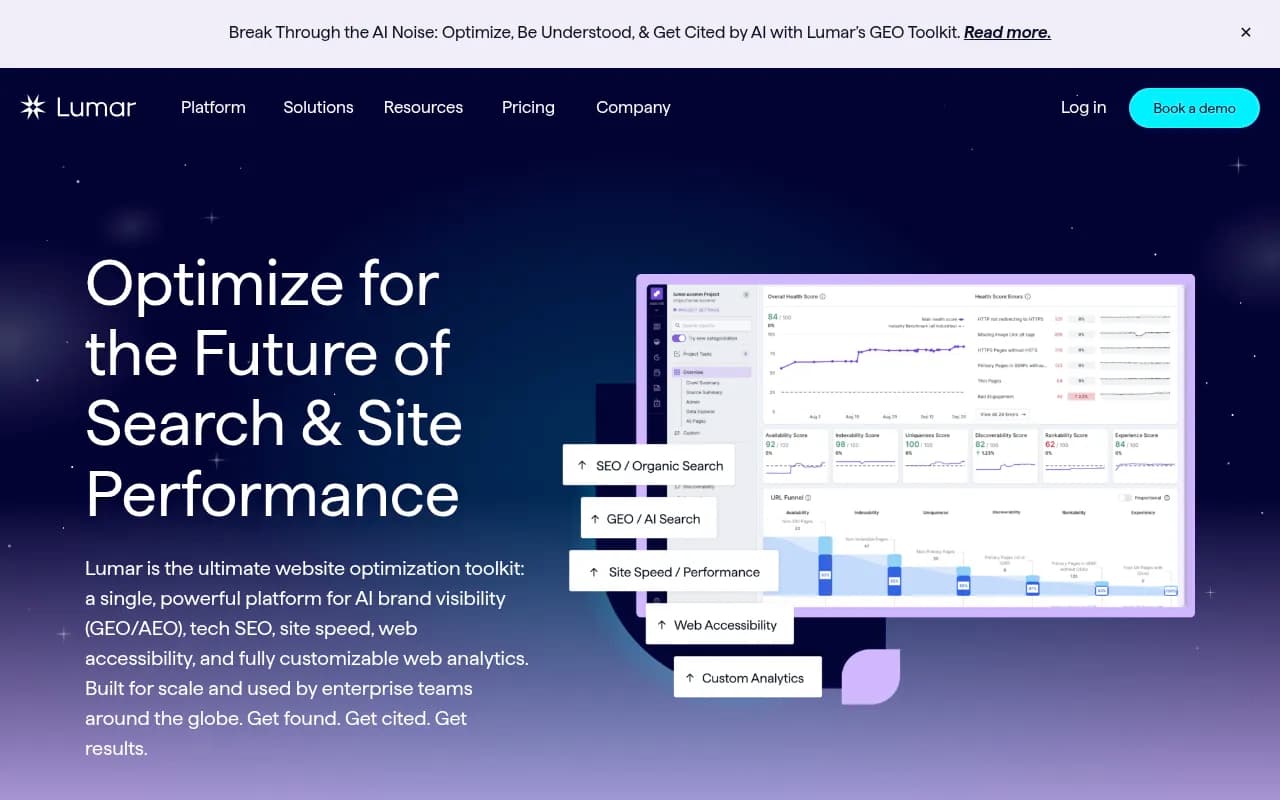
Lumar (formerly DeepCrawl) is a website intelligence platform focused on technical SEO, accessibility, and web performance. It's particularly strong on crawl analysis, schema validation, and Core Web Vitals monitoring. Like Botify, it has been adding AI-era features -- including some GEO-focused crawl insights -- but technical SEO remains its center of gravity.
Promptwatch
Promptwatch is built differently. It didn't start as an SEO tool and then add AI features -- it was designed from the ground up to track and improve how brands appear in AI-generated answers. The platform monitors 10 AI models (ChatGPT, Perplexity, Claude, Gemini, Google AI Overviews, Grok, DeepSeek, Copilot, Meta AI, and Mistral), and crucially, it goes beyond monitoring to help you actually fix visibility gaps.
The core workflow is: find prompts where competitors appear but you don't, generate content engineered to get cited by AI models, then track whether that content improves your visibility scores. There's also AI crawler log monitoring -- real-time logs of when GPTBot, ClaudeBot, and PerplexityBot visit your site, which pages they read, and what errors they hit.

Feature-by-feature comparison
| Feature | Botify | seoClarity | Lumar | Promptwatch |
|---|---|---|---|---|
| Technical site crawling | Excellent | Good | Excellent | Basic |
| Log file analysis | Excellent | Moderate | Good | AI crawlers only |
| AI crawler log monitoring | Partial | No | No | Yes (real-time) |
| AI search visibility tracking | Moderate | Moderate | Limited | Excellent |
| Number of AI models tracked | 3-4 | 4-5 | 2-3 | 10 |
| Prompt/query research | No | Limited | No | Yes (with volume + difficulty) |
| Answer gap analysis | No | No | No | Yes |
| AI content generation | No | Limited | No | Yes (built-in writing agent) |
| Citation & source analysis | No | No | No | Yes (880M+ citations) |
| Reddit/YouTube tracking | No | No | No | Yes |
| ChatGPT Shopping tracking | No | No | No | Yes |
| Competitor visibility heatmaps | Limited | Yes | Limited | Yes |
| Core Web Vitals monitoring | Yes | Yes | Yes | No |
| Schema/structured data auditing | Yes | Yes | Yes | No |
| Traffic attribution (AI traffic) | No | No | No | Yes |
| Multi-language/multi-region | Yes | Yes | Yes | Yes |
| Free trial | Yes | Yes | Yes | Yes |
| Starting price | Enterprise | Enterprise | Enterprise | $99/mo |
A few things stand out from this table. First, the technical SEO platforms are genuinely better at the technical SEO stuff -- crawling, rendering, structured data, Core Web Vitals. That's not a surprise; they've been building those capabilities for years.
Second, Promptwatch has a significant lead on anything related to AI search visibility. The gap is especially wide on actionable features: content gap analysis, AI writing, citation tracking, and traffic attribution. The other three platforms can tell you that your AI visibility is low. Promptwatch can tell you why and help you fix it.
Where each platform wins
Botify wins for: large-scale technical SEO with AI crawl insights
If you're running a site with 5+ million URLs and you need to understand why Googlebot (or GPTBot) isn't crawling 40% of your pages, Botify is the right tool. Its log file analysis is the best in class, and the correlation between crawl data and organic performance is genuinely useful for prioritizing technical fixes.
The AI visibility layer is improving, but it's still primarily a technical lens -- you'll see which pages AI crawlers are visiting, not which prompts you're winning or losing.
Best for: Enterprise e-commerce, large publishers, technical SEO teams who need crawl budget analysis at scale.
seoClarity wins for: enterprise teams that want one platform for everything
seoClarity's strength is breadth. If your SEO team needs rank tracking, content optimization, site auditing, and AI visibility monitoring all in one place -- and you have the budget for an enterprise contract -- seoClarity can cover a lot of ground. The AI visibility features aren't as deep as Promptwatch's, but they're integrated with the rest of your SEO workflow.
Best for: Large in-house SEO teams that want consolidated reporting and don't want to manage multiple platforms.
Lumar wins for: technical SEO auditing with a focus on quality and compliance
Lumar is particularly good for teams that care about accessibility, schema accuracy, and site health scoring. Its crawl reports are clean and actionable, and the platform has a reputation for being easier to use than Botify for mid-market teams. The AI/GEO features are limited, but the technical foundation is solid.
Best for: Mid-market to enterprise teams focused on site health, accessibility compliance, and technical SEO quality.
Promptwatch wins for: AI search visibility, GEO, and content optimization for AI engines
If your primary question is "why isn't my brand appearing in ChatGPT and Perplexity responses, and what do I do about it?" -- Promptwatch is the only platform in this comparison built to answer that question end-to-end. The Answer Gap Analysis shows you exactly which prompts competitors are visible for but you're not. The built-in AI writing agent generates content grounded in real citation data. And the traffic attribution connects AI visibility to actual revenue.
The platform is also the most accessible price-wise, starting at $99/month versus the enterprise-only pricing of the other three.
Best for: Marketing teams, SEO teams, and agencies that want to improve AI search visibility, track brand mentions across LLMs, and generate content that gets cited by AI models.
The technical SEO + AI visibility overlap
Here's the honest reality: technical SEO and AI search visibility are related but not the same problem.
Technical SEO is about making sure search engines can crawl, render, and index your content correctly. AI search visibility is about making sure AI models have the right content to cite when users ask relevant questions.
There's some overlap -- if GPTBot can't crawl your pages because of JavaScript rendering issues, that's both a technical SEO problem and an AI visibility problem. Botify and Lumar can help you find and fix that. Promptwatch's AI crawler logs can surface the same issue from the AI side (which pages are being visited, which are returning errors).
But the bigger driver of AI visibility isn't usually technical. It's content. AI models cite sources that have clear, authoritative answers to specific questions. If your site doesn't have content that addresses the prompts your customers are using, no amount of technical optimization will help. That's where Promptwatch's Answer Gap Analysis and content generation capabilities matter.
The practical implication: most teams with serious AI visibility ambitions will end up using Promptwatch alongside (not instead of) their existing technical SEO platform. The two tools solve different parts of the problem.
Pricing reality check
Botify, seoClarity, and Lumar all use enterprise pricing models -- which means you're looking at custom quotes, annual contracts, and typically $1,000-$5,000+ per month depending on site size and feature set. That's appropriate for the enterprise teams these platforms are built for, but it puts them out of reach for smaller teams and agencies.
Promptwatch has transparent, tiered pricing:
- Essential: $99/month (1 site, 50 prompts, 5 articles)
- Professional: $249/month (2 sites, 150 prompts, 15 articles, crawler logs, local tracking)
- Business: $579/month (5 sites, 350 prompts, 30 articles)
- Agency/Enterprise: custom pricing
This makes Promptwatch accessible to teams that can't justify an enterprise contract but still need serious AI visibility capabilities. It also means you can run a proof of concept before committing to a larger investment.
Which should you choose?
The honest answer depends on where your biggest gap is.
If your site has serious technical problems -- crawl budget waste, JavaScript rendering failures, Core Web Vitals issues at scale -- fix those first with Botify or Lumar. Broken technical foundations will limit everything else you do.
If you're an enterprise team that needs consolidated SEO reporting and wants AI visibility monitoring integrated into your existing workflow, seoClarity is worth evaluating.
If AI search visibility is your primary concern -- you want to know why competitors appear in ChatGPT responses and you don't, and you want tools to fix that -- Promptwatch is the right starting point. It's the only platform here that closes the loop from gap identification to content creation to traffic attribution.
For most teams in 2026, the realistic answer is Promptwatch for AI visibility plus whatever technical SEO tool you're already using. They complement each other rather than compete.
A note on the broader market
The tools in this comparison represent different generations of SEO thinking. Botify, seoClarity, and Lumar were built for a world where Google was the only search engine that mattered. They're adapting to a world where ChatGPT, Perplexity, and Google AI Mode are increasingly where users get their answers -- but adaptation takes time.
Promptwatch was built for that new world from day one. That's not a criticism of the older platforms -- their technical SEO capabilities are genuinely excellent -- but it does mean the depth of AI visibility features isn't comparable.
If you want to see how the broader GEO platform landscape looks beyond these four tools, the comparison of 28 AI visibility platforms from Omnia is worth a read:
The market is moving fast. Tools that were monitoring-only dashboards 18 months ago are adding content features. Technical SEO platforms are adding AI tracking. The platforms that started with a clear answer to "how do I actually improve my AI visibility?" have a head start -- and right now, Promptwatch is the clearest example of that approach.