Key takeaways
- ChatGPT and Perplexity pull citations from different source types -- what works on one often doesn't transfer to the other
- ChatGPT relies more heavily on entity recognition, training data signals, and structured content; Perplexity behaves more like a real-time search engine that actively indexes and cites web pages
- Brands winning AI visibility in 2026 run separate content architectures for each platform, not just more content for both
- Perplexity is generally easier to get traction on first; ChatGPT requires deeper entity authority and broader third-party coverage
- Tracking both platforms separately is essential -- their citation patterns are almost opposite in many categories
If you've been treating ChatGPT and Perplexity as interchangeable channels for brand visibility, you're probably getting mediocre results on both. These two platforms look similar on the surface -- you type a question, you get an answer -- but underneath, they work in completely different ways. Their citation logic, content preferences, and ranking signals are distinct enough that a strategy tuned for one can actively underperform on the other.
This guide breaks down exactly how each platform decides which brands to surface, where the strategies diverge, and how to build a practical approach for both in 2026.
How ChatGPT and Perplexity actually decide which brands to mention
The most important thing to understand is that these platforms are not search engines in the traditional sense. They don't rank pages -- they construct answers. But they construct those answers in different ways.
ChatGPT (specifically when using web search) performs tool calls to retrieve current information, but it also draws heavily on its training data. This means brand visibility in ChatGPT has two layers: what the model already "knows" from training, and what it retrieves in real time. For brands, this creates a situation where entity authority -- how well-established and consistently described your brand is across the web -- matters enormously. If ChatGPT has seen your brand mentioned authoritatively in many places during training, it's more likely to surface you even without a live web search.
Perplexity, by contrast, is built around real-time retrieval. It actively indexes the web and constructs answers from current sources, showing citations as part of the response. This makes it behave more like a search engine with a generative layer on top. Pages that are crawlable, well-structured, and directly answer the query at the sentence level tend to get cited. Perplexity is also more transparent about its sources than ChatGPT, which makes it somewhat easier to audit and influence.
One practitioner on Reddit's r/aeo community put it plainly: "ChatGPT and Perplexity have citation sources that are almost opposite. ChatGPT pulls from entity-heavy, authority-driven sources. Perplexity pulls from whatever it can crawl and index right now."
That asymmetry is the core reason you need different strategies.
The ChatGPT brand visibility playbook
Build entity authority first
ChatGPT's training-data layer means that entity clarity is non-negotiable. Before anything else, your brand needs to exist as a coherent, consistent entity across the web. That means:
- A single canonical name used consistently across your site, social profiles, press mentions, and third-party listings
- Organization schema markup on your homepage and key pages
- A Wikipedia or Wikidata entry if you can justify one (this is a strong signal)
- Consistent NAP data (name, address, phone) across directories
- Clear, structured "About" and "What we do" content that AI can parse without ambiguity
Brands with inconsistent messaging or sparse third-party coverage appear ambiguous to ChatGPT's entity resolution. They're not penalized -- they're simply not selected.
Target training-data-adjacent sources
Because ChatGPT's base knowledge comes from training data, getting mentioned in sources that are likely to be included in future training runs matters. This means:
- Major industry publications and news sites
- Wikipedia and Wikidata
- Well-established review platforms (G2, Capterra, Trustpilot)
- Academic or research contexts where relevant
- High-authority listicles and comparison articles
This is where digital PR intersects with GEO. A mention in a credible trade publication does double duty: it builds entity authority for ChatGPT's training layer and creates a citable source for real-time retrieval.
Structure content for answer extraction
ChatGPT's web search mode looks for content it can extract and synthesize. Pages that answer specific questions directly -- with clear headings, concise definitions, and structured paragraphs -- are more likely to be cited than pages that bury answers in narrative prose.
Practically, this means:
- FAQ sections with direct Q&A formatting
- Comparison tables that clearly position your brand
- Definition-style content ("What is [your category]?")
- Pages that answer high-intent buyer questions at the sentence level
Invest in Reddit and YouTube
This is one of the more counterintuitive findings from 2026 research: ChatGPT cites Reddit and YouTube at a surprisingly high rate. Discussions in relevant subreddits, YouTube reviews, and tutorial content featuring your brand all feed into ChatGPT's citation pool. If your brand is being discussed positively in these channels, that signal carries weight.
Promptwatch tracks Reddit and YouTube discussions that directly influence AI recommendations -- one of the few platforms that surfaces this channel explicitly.

The Perplexity brand visibility playbook
Optimize for real-time crawlability
Since Perplexity is retrieval-first, technical SEO fundamentals matter more directly here than on ChatGPT. If Perplexity can't crawl your pages efficiently, it can't cite them. Key priorities:
- Fast page load times (Core Web Vitals still matter)
- Clean URL structures and proper internal linking
- No JavaScript rendering issues that block content from bots
- Sitemap accuracy and robots.txt hygiene
- Regular content freshness -- Perplexity favors recently updated pages
Write answer-ready content at the paragraph level
Perplexity constructs its answers by pulling specific paragraphs and sentences from source pages. This means your content needs to be answer-ready at a granular level, not just topically relevant. Each section of a page should be able to stand alone as a citation.
Concrete tactics:
- Lead paragraphs that directly state the answer before elaborating
- Short, declarative sentences that can be extracted without losing meaning
- Headers that match the exact phrasing of common queries
- Avoid long preambles before getting to the actual answer
Publish on high-citation-rate domains
Perplexity has citation preferences. It tends to favor certain domain types: news sites, established blogs, industry publications, and authoritative reference pages. Getting your brand mentioned on these domains -- through guest posts, PR, or partnerships -- creates citation pathways that Perplexity can follow.
This is different from the ChatGPT strategy in one key way: for Perplexity, recency matters. A fresh mention on a mid-tier publication this week can outperform an older mention on a major site from two years ago.
Use structured data to signal relevance
While Perplexity doesn't rely on schema the way Google does, structured data still helps by making your content machine-readable and easier to parse. Organization, Article, FAQ, and HowTo schema all give Perplexity clearer signals about what your content is about and who it's from.
Monitor your citation footprint
Because Perplexity is transparent about its sources, you can actually audit which pages it's citing for your target queries. This creates a feedback loop: run your key prompts, see what gets cited, identify the gaps, and create content that fills them.
Tools like Promptwatch, Otterly.AI, and Profound all track Perplexity citations, though they differ significantly in what you can do with that data.
Otterly.AI

Profound

Where the strategies overlap (and where they diverge)
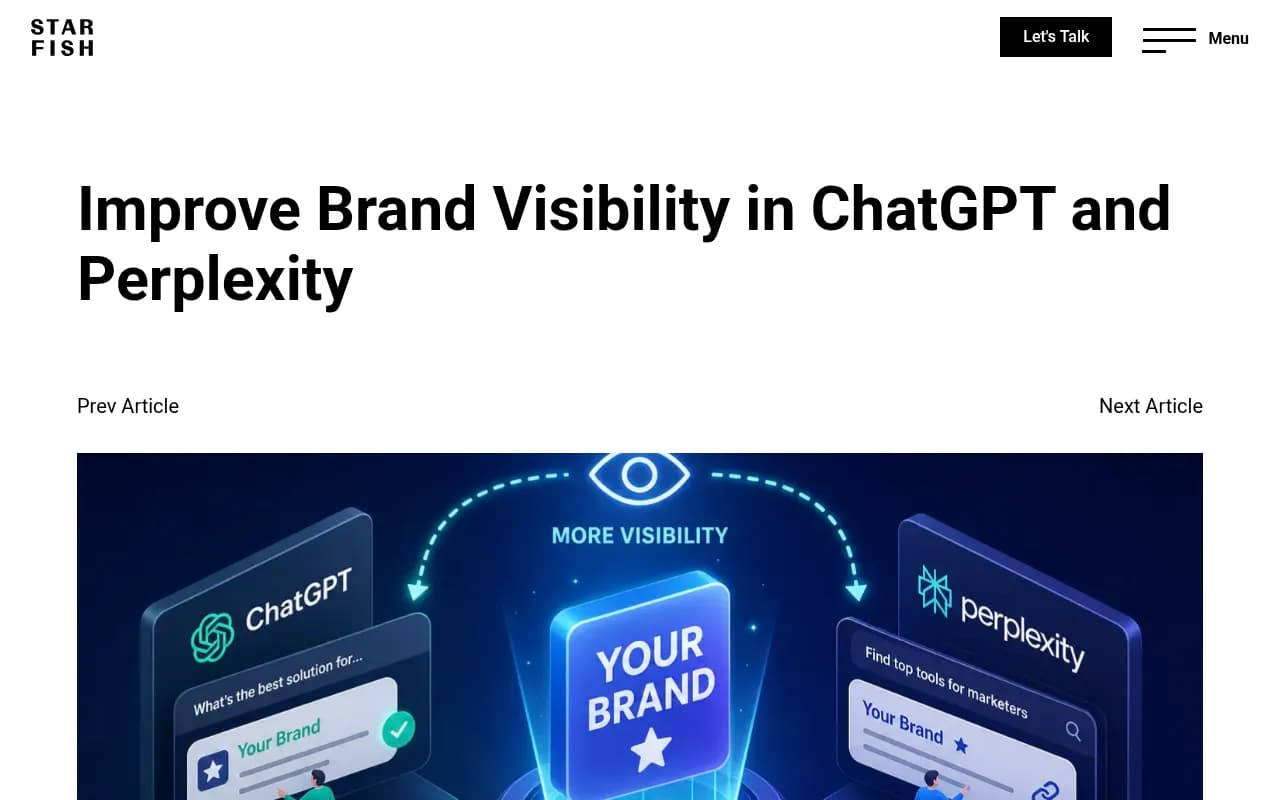
Some fundamentals apply to both platforms. Entity clarity, structured content, and third-party authority all help on ChatGPT and Perplexity. But the weighting is different, and some tactics are platform-specific.
| Strategy | ChatGPT impact | Perplexity impact | Notes |
|---|---|---|---|
| Entity schema (Organization markup) | High | Medium | Critical for ChatGPT's entity resolution |
| Technical crawlability | Medium | High | Perplexity is retrieval-first |
| Wikipedia / Wikidata presence | High | Medium | Strong training-data signal for ChatGPT |
| Content freshness | Low-Medium | High | Perplexity favors recent pages |
| FAQ / Q&A formatting | High | High | Works on both |
| Reddit / YouTube mentions | High | Low-Medium | ChatGPT cites these heavily |
| High-authority press mentions | High | Medium | More durable on ChatGPT |
| Recent mid-tier publications | Low | High | Recency matters more on Perplexity |
| Structured data (FAQ, HowTo) | Medium | Medium | Helps both, not a silver bullet |
| Internal linking | Medium | High | Helps Perplexity discover more pages |
The divergence is sharpest in two areas: recency (Perplexity cares, ChatGPT's training layer doesn't) and entity authority (ChatGPT cares deeply, Perplexity is more page-level).
Which platform should you prioritize first?
The honest answer: start with Perplexity if you're new to GEO. The feedback loop is faster. You can run a prompt, see what gets cited, identify what's missing, and publish content to fill the gap -- sometimes within days. Perplexity's citation behavior is more transparent and more directly influenced by on-page content.
ChatGPT requires a longer investment. Building entity authority, getting into training-adjacent sources, and accumulating third-party coverage takes months. But the reach is larger. ChatGPT has significantly more users than Perplexity, and visibility there compounds over time as the model's knowledge base updates.
For most brands, the right approach is to use Perplexity as a testing ground -- validate your content strategy, see what gets cited, refine your answer-ready writing -- then apply those learnings to the broader entity-building work that pays off on ChatGPT.
Tracking both platforms separately
One of the most common mistakes is measuring ChatGPT and Perplexity visibility with the same metrics. Their citation patterns are different enough that a single aggregate score obscures what's actually happening.
You want to track:
- Which prompts trigger citations on each platform separately
- Which pages are being cited (and which aren't)
- How your citation rate compares to competitors for the same prompts
- How visibility changes over time as you publish new content
Several tools now support this kind of platform-level tracking. Promptwatch goes furthest here -- it tracks real user-facing responses (not just API outputs), includes AI crawler logs that show when your pages are being read and cited, and connects visibility data to actual traffic attribution. That last piece matters because a citation that doesn't drive traffic isn't worth much.
For teams that want simpler monitoring without the optimization layer, Peec AI and Otterly.AI offer basic tracking across both platforms.

Building a content architecture for both platforms
The brands getting the best results in 2026 aren't publishing more content -- they're publishing smarter content. The key insight from AuthorityTech's 2026 B2B playbook: "The brands winning AI visibility run separate content architectures for each platform's citation behavior."
What does that look like in practice?
For ChatGPT, your content architecture should emphasize:
- Evergreen, authoritative pages that establish your brand's position in a category
- Comparison and "best of" pages that position you against competitors
- Thought leadership content that gets cited in industry publications
- Entity-rich pages that clearly define what your brand does and for whom
For Perplexity, your content architecture should emphasize:
- Frequently updated pages that stay current
- Highly specific, query-matched content (think: "how to do X with Y" at a granular level)
- Pages that answer the exact questions your buyers are asking right now
- Content published on or linked from domains Perplexity already trusts
The answer gap -- prompts where competitors appear but you don't -- is different on each platform. Mapping those gaps separately, then creating content to fill them, is the core of a platform-specific GEO strategy.
Practical starting points for 2026
If you're building or refining your AI visibility strategy right now, here's a sequenced starting point:
- Run your 20 most important buyer prompts on both ChatGPT and Perplexity. Record who gets cited and who doesn't.
- Audit your entity clarity: is your brand described consistently across your site, social profiles, and third-party sources?
- Check your technical crawlability: can Perplexity's bots access your key pages without errors?
- Identify your answer gaps: which prompts are competitors winning that you're not? What content would need to exist to change that?
- Publish answer-ready content targeting your highest-priority gaps, formatted for extraction (direct answers, clear headers, FAQ sections).
- Build third-party coverage: press mentions, review platform presence, Reddit discussions, and YouTube content all feed into ChatGPT's citation pool.
- Track results separately for each platform and iterate.
The brands that treat this as a one-time project will fall behind. The ones that build a repeatable cycle -- find gaps, create content, track results -- will compound their visibility over time.
AI search isn't replacing traditional search. It's adding a layer where brand authority is tested in a completely different way. The good news is that the rules are knowable, the gaps are measurable, and the content that wins is genuinely useful content. That's a solvable problem.