Key takeaways
- 44% of ChatGPT citations come from the first 30% of your content—front-load answers and structure pages for quick extraction
- ChatGPT pulls from pretrained data for evergreen topics and live search results for current queries—optimize for both
- Strong technical SEO (crawlability, site speed, structured data) increases your chances of being indexed and retrieved by AI models
- Citation-ready content uses tight question-answer formatting, clear claims with evidence, and consistent messaging across pages
- Tools like Promptwatch help you track which pages get cited, identify content gaps, and generate articles grounded in real citation data

How ChatGPT actually picks content to cite
ChatGPT doesn't rank content the same way Google does. It uses two main pathways: pretrained knowledge for common, evergreen topics (think "What is a VPN?") and live search results for current events or queries requiring fresh data. When you ask ChatGPT a question in 2026, it decides whether to pull from its training data or query Bing's index in real time.
For pretrained queries, your content had to be crawled and indexed before the model's training cutoff. For live queries, ChatGPT retrieves pages from Bing, then extracts the most relevant information to synthesize an answer. Either way, the model prioritizes content it can easily parse, verify, and attribute.
A 2024 analysis of AI citation patterns found that inconsistent messaging across pages hurts your chances. If one page says "Feature X costs $50/month" and another says "$60/month," the model may skip both and cite a competitor with clearer, consistent information.

The 44% rule: why the first 30% of your content matters most
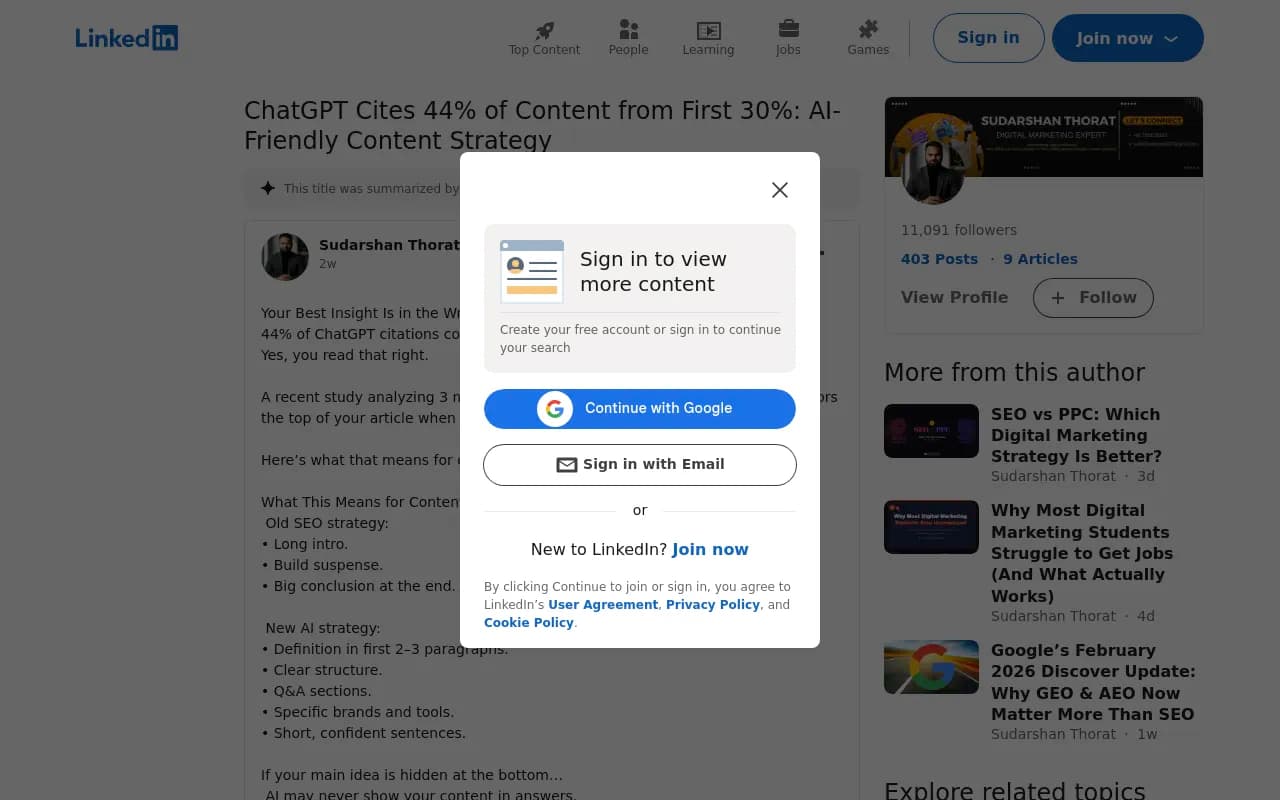
Recent data shows that 44% of ChatGPT citations come from the first 30% of a page's content. This isn't a coincidence—AI models scan pages quickly and prioritize information that appears early. If your answer to a query is buried in paragraph seven, ChatGPT will likely cite a competitor who puts it in paragraph two.
Front-load your content. State the core answer in the first few paragraphs, then elaborate. Use headings that mirror common questions. If someone asks "How much does X cost?" and your pricing section is halfway down the page, you're losing citations.
This also means your page structure matters. Use H2 and H3 headings to break content into scannable sections. AI models parse HTML structure to understand hierarchy—a well-structured page with clear headings is easier to extract from than a wall of text.
Technical factors that make or break AI citations
Crawlability and indexing
If ChatGPT can't access your page, it can't cite it. OpenAI's GPTBot crawler needs to read your content. Check your robots.txt file—blocking GPTBot means you're invisible to ChatGPT's live search results. Same goes for pages behind logins, paywalls, or JavaScript that doesn't render properly.
Site speed matters too. Slow pages get crawled less frequently and may time out during retrieval. Core Web Vitals aren't just for Google anymore—AI models favor fast, accessible pages.
Structured data and schema markup
Structured data helps AI models understand what your content is about. Use schema markup for FAQs, how-tos, products, and reviews. ChatGPT can pull structured data directly into its responses, especially for queries like "What are the top-rated X?" or "How do I do Y?"
FAQPage schema is particularly effective. It signals to AI models that your page contains direct question-answer pairs, which are easy to extract and cite.
Clean HTML and semantic markup
AI models parse HTML to understand content hierarchy. Use semantic tags (<article>, <section>, <aside>) to signal what's main content vs. navigation or ads. Avoid excessive DOM depth—deeply nested divs make extraction harder.
Keep your HTML clean. Remove unnecessary scripts, inline styles, and bloated code. The easier it is for a model to parse your page, the more likely it is to cite you.
Content patterns that win citations
Tight question-answer formatting
ChatGPT loves content that directly answers a question. Use the question as a heading, then provide a concise answer in the first sentence or two. Expand with details, examples, and evidence afterward.
Example:
What is the best time to post on LinkedIn?
The best time to post on LinkedIn is Tuesday through Thursday between 8-10 AM and 12-2 PM, based on engagement data from 500M+ posts. These windows align with when professionals check LinkedIn during work hours.
This format is citation-ready. The model can extract the answer, attribute it to your page, and move on.
Clear claims backed by evidence
Vague statements don't get cited. "Our tool is fast" means nothing. "Our tool processes 10,000 records in under 2 seconds" is specific and verifiable. AI models prioritize claims that include numbers, sources, or concrete details.
Cite your sources. If you reference a study, link to it. If you quote a statistic, name the source. This builds trust and makes your content more citation-worthy.
Consistent messaging across pages
If your pricing page says one thing and your FAQ says another, ChatGPT may skip both. Audit your site for inconsistencies—pricing, feature descriptions, timelines, anything that could contradict itself. AI models cross-reference pages and penalize sites with conflicting information.
Topical authority and domain trust signals
ChatGPT doesn't have a "domain authority" score like Moz, but it does favor content from sites that demonstrate expertise. If your site consistently publishes high-quality content on a specific topic, you're more likely to get cited for related queries.
Backlinks still matter. Not because AI models crawl backlinks directly, but because backlinks influence what gets indexed and retrieved by search engines like Bing, which ChatGPT queries for live results. Strong backlink profiles signal trust and relevance.
Brand mentions also play a role. If your brand is frequently mentioned across the web—news articles, Reddit threads, YouTube videos—AI models are more likely to recognize and cite you. This is where tools like Promptwatch help: they show you where your brand is (or isn't) being mentioned across AI engines and help you identify gaps.
Comparison: ChatGPT vs. Perplexity vs. Gemini citation behavior
| Factor | ChatGPT | Perplexity | Gemini |
|---|---|---|---|
| Primary data source | Pretrained + Bing live search | Live search (multiple engines) | Pretrained + Google Search |
| Citation frequency | Moderate (cites 2-5 sources per answer) | High (cites 5-10+ sources) | Low (often no citations) |
| Prefers structured data | Yes (FAQ, How-To schema) | Yes (all schema types) | Yes (Google-native schema) |
| Favors recent content | For live queries only | Always | For live queries only |
| Crawlability requirements | GPTBot access required | Multiple bots (varies by engine) | Googlebot access required |
Perplexity is the most citation-heavy—it pulls from multiple search engines and lists sources prominently. ChatGPT cites selectively, usually 2-5 sources per response. Gemini often synthesizes answers without explicit citations, making it harder to track visibility.
Tools for tracking and optimizing AI citations
You can't optimize what you don't measure. Several platforms now track how often your brand gets cited across AI engines:
- Promptwatch ([tool:promptwatch]) tracks citations across ChatGPT, Perplexity, Gemini, and 10+ other AI models. It shows which pages are being cited, identifies content gaps (queries where competitors are visible but you're not), and includes an AI writing agent that generates citation-ready articles based on real prompt data.
- Ahrefs ([tool:ahrefs]) recently added AI search tracking to its platform, though it's more limited than dedicated GEO tools.
- Semrush ([tool:semrush]) offers basic AI visibility tracking but uses fixed prompts and lacks the depth of specialized platforms.
For most teams, a dedicated GEO platform like Promptwatch is the best bet. It closes the loop: find gaps, generate content, track results. Most competitors (Otterly.AI, Peec.ai, AthenaHQ) stop at monitoring—they show you data but don't help you fix it.
Common mistakes that kill your citation chances
Burying the lede
If your answer is in paragraph five, you're invisible. AI models scan quickly and prioritize early content. Front-load answers.
Inconsistent information
One page says "$50/month," another says "$60/month." ChatGPT skips both and cites a competitor. Audit your site for contradictions.
Blocking AI crawlers
Check your robots.txt. If you're blocking GPTBot, Perplexity's crawler, or other AI bots, you're invisible to live search results.
Generic, vague content
"Our tool is great" doesn't get cited. "Our tool processes 10,000 records in under 2 seconds" does. Be specific.
Ignoring structured data
FAQPage, HowTo, and Product schema make your content easier to extract. If you're not using schema markup, you're leaving citations on the table.
What to do next
Start by auditing your current AI visibility. Use a tool like Promptwatch to see which queries you're being cited for (and which ones you're missing). Look for patterns—are competitors getting cited for queries where you have content? That's a content gap.
Next, optimize your highest-value pages. Front-load answers, add structured data, clean up inconsistencies. Focus on pages that target high-volume, high-intent queries.
Finally, create new content to fill gaps. Use tools like Promptwatch's AI writing agent to generate citation-ready articles based on real prompt data. Don't guess—write content that AI models are actively looking for.
Getting cited by ChatGPT isn't magic. It's about making your content easy to find, easy to parse, and easy to verify. Do that, and the citations follow.