Key takeaways
- ChatGPT and Claude use different training data, citation behaviors, and recommendation patterns -- so your brand can appear in one and be completely invisible in the other
- Most AI visibility tools query both models but treat the results as equivalent, which masks real gaps in your coverage
- Effective monitoring requires model-specific prompt testing, not just aggregate "AI visibility" scores
- The tools that work best in 2026 are the ones that show you per-model data AND help you act on it -- not just dashboards that tell you what you already suspect
- Building content that gets cited by both models requires understanding what each one actually values in a source
There's a scenario that keeps coming up in marketing forums and Reddit threads in 2026: someone runs an "AI visibility" audit, sees a decent score, feels reassured -- then manually asks ChatGPT and Claude the same question and gets completely different answers. One model mentions their brand. The other doesn't.
This isn't a fluke. It's a structural problem with how most monitoring tools work, and it points to something more fundamental: ChatGPT and Claude are not the same engine wearing different clothes. They have different training data, different tendencies around citing sources, and different ways of framing recommendations. Treating them as interchangeable in your monitoring setup is like tracking your Google rankings and your Bing rankings as a single number. Technically possible. Practically useless.
This guide breaks down why the two models diverge, what that means for brand monitoring, and how to actually track both well.
Why ChatGPT and Claude recommend brands differently
The short version: they were trained differently, by different companies, with different philosophies about what a "good" response looks like.
ChatGPT (particularly GPT-4o and the newer GPT-5 family) tends to produce more confident, list-heavy recommendations. Ask it for the best project management tools and you'll usually get a clean numbered list with brief explanations. It draws heavily on web content it was trained on, and its recommendations often reflect what's most discussed and linked across the broader internet -- which tends to favor well-established brands with high content volume.
Claude (Anthropic's model, currently in the Opus 4.x range) takes a more conversational, nuanced approach. It's more likely to qualify its recommendations, acknowledge tradeoffs, and frame things as "it depends on your situation." That's not just a stylistic difference -- it changes which brands get mentioned and in what context. A brand that gets recommended by Claude might be framed as "good for teams that prioritize X" rather than appearing in a flat top-5 list. If your brand has a specific positioning or serves a niche use case well, Claude might actually surface you more readily than ChatGPT -- or vice versa.
There's also a real difference in how each model handles recency and web access. ChatGPT with browsing enabled can pull in current information. Claude's web access behavior varies by context. When a monitoring tool queries both models, the version it's querying, the system prompt it uses, and whether web access is enabled all affect what comes back. Most tools don't tell you any of this.
One Reddit thread from early 2026 captured this well: a marketer asked both models to recommend brands in the same product category and found that framing the query slightly differently -- specifically, how the category was defined -- caused one brand to appear consistently in Claude's responses but rarely in ChatGPT's. The inverse was true for a competitor. Same category, same intent, different models, different winners.
The monitoring tool problem: aggregate scores hide model-level gaps
Here's where it gets frustrating. Most AI visibility tools in 2026 query multiple models and roll the results into a single "visibility score" or "mention rate." That number feels reassuring. It's also misleading.
If you're mentioned in 8 out of 10 ChatGPT responses but 2 out of 10 Claude responses, an aggregate score of 50% tells you almost nothing actionable. You don't know which model to focus on. You don't know whether your Claude problem is a content gap, a framing issue, or a citation problem. You just know the number is lower than you'd like.
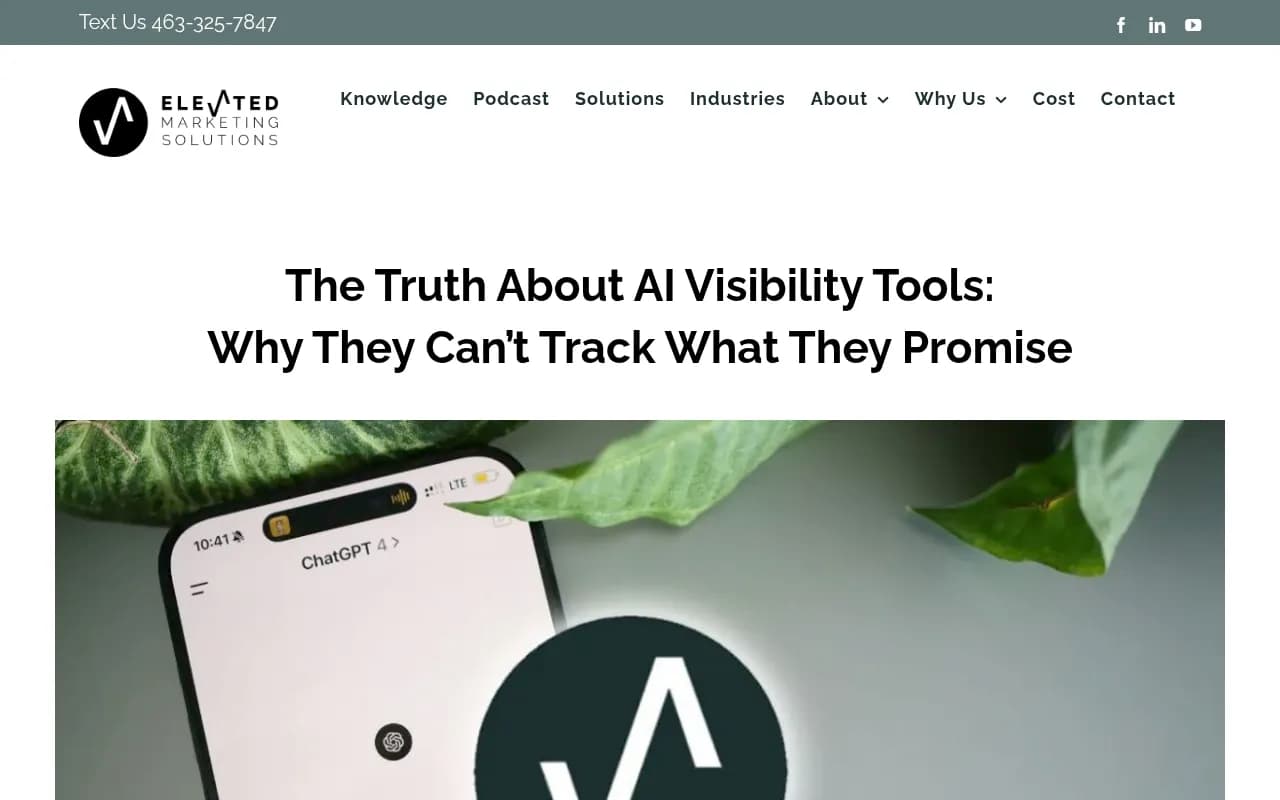
The deeper issue, as Elevated Marketing Solutions pointed out in a piece that got a lot of traction in early 2026, is that many tools can't actually track what they claim. When a tool says it "uses the ChatGPT API," that means it's querying the API -- but the API response can differ significantly from what a real user sees in the ChatGPT interface, especially with browsing, memory, or custom GPT configurations in play. The same caveat applies to Claude. Tools that don't disclose exactly how they're querying each model are selling you a number that may not reflect your real-world visibility at all.
This doesn't mean monitoring tools are useless -- it means you need to pick ones that are transparent about methodology and show you per-model breakdowns, not just aggregates.
What good per-model monitoring actually looks like
The tools worth using in 2026 share a few characteristics:
They show you model-level data. Not just "you appeared in 60% of responses" but "you appeared in 70% of ChatGPT responses and 40% of Claude responses for this prompt set." That split is where the real insight lives.
They let you test specific prompts, not just brand name queries. Searching for your brand name directly is the least useful test -- of course you'll appear when someone asks "tell me about [Brand]." What matters is whether you appear when someone asks a category question, a comparison question, or a problem-solving question. Good tools let you define those prompts yourself.
They track prompt-level results over time. A single snapshot is almost meaningless because AI responses vary. You need to see trends: is your Claude visibility improving after you published that new comparison page? Did your ChatGPT mentions drop after a competitor launched a major PR campaign?
They're honest about methodology. The best tools tell you which model version they're querying, whether web access is enabled, and what system prompt (if any) they're using. If a tool won't tell you this, treat its numbers with skepticism.
Promptwatch is one of the few platforms that breaks visibility down by individual AI model -- so you can see exactly where you're winning and where you're not, rather than getting a blended number that obscures the real picture.

A practical comparison of tools for cross-model monitoring
Not every tool handles ChatGPT and Claude equally well. Here's how the main options stack up on the dimensions that matter most for this specific use case:
| Tool | Per-model breakdown | Custom prompts | Trend tracking | Content gap analysis | Claude-specific data |
|---|---|---|---|---|---|
| Promptwatch | Yes | Yes | Yes | Yes (Answer Gap Analysis) | Yes |
| Otterly.AI | Partial | Limited | Yes | No | Partial |
| Peec AI | Partial | Yes | Yes | No | Partial |
| Profound | Yes | Yes | Yes | Limited | Yes |
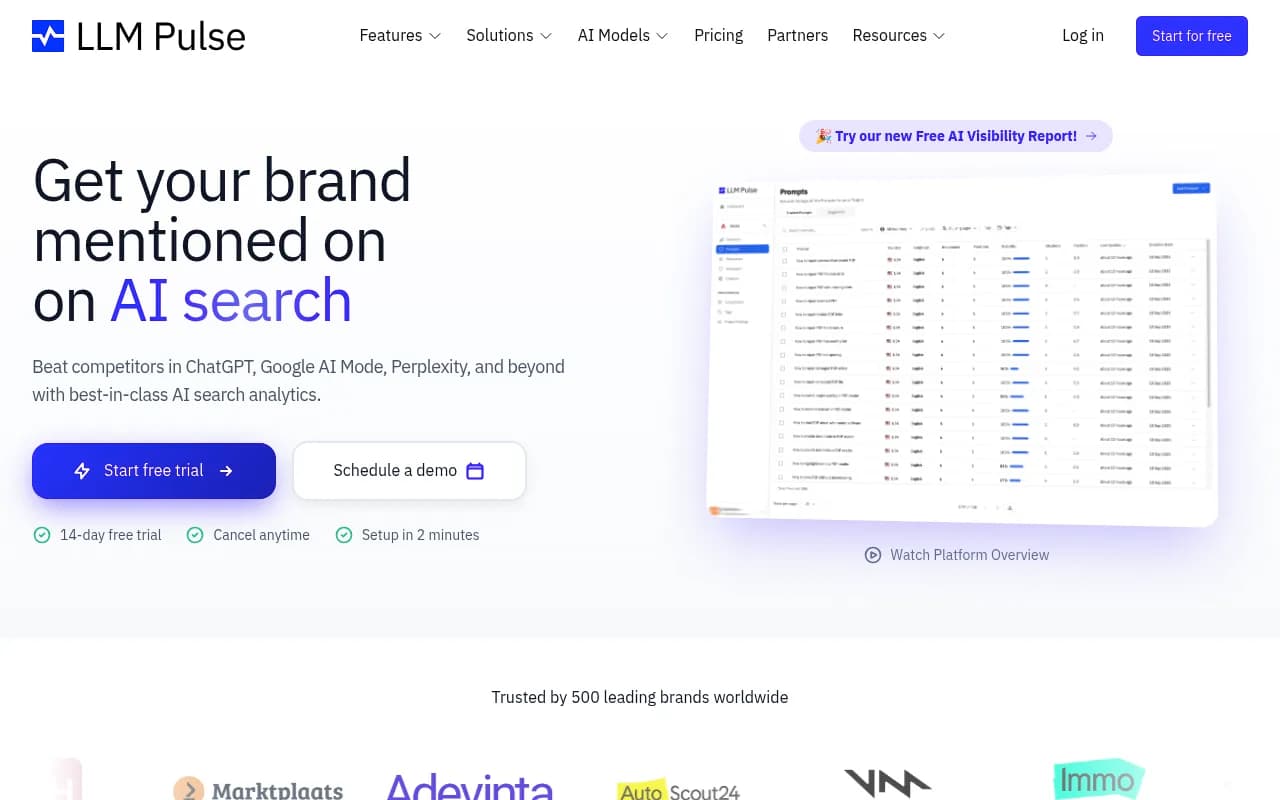
| LLM Pulse | Basic | Limited | Yes | No | Basic |
| Rankshift | Basic | Yes | Yes | No | Basic |
| Cognizo | Partial | Limited | Partial | No | Partial |
Otterly.AI


Profound


The pattern here is consistent: most tools can tell you something about your visibility across models, but very few help you understand why there's a gap or what to do about it. Promptwatch's Answer Gap Analysis is the most direct attempt to bridge that -- it shows you which prompts competitors are visible for that you're not, then connects that to content you can actually create.
Why your Claude visibility might be lower than your ChatGPT visibility (and what to do about it)
If you're seeing a consistent gap where ChatGPT mentions you more than Claude does, a few things are usually going on.
Claude tends to favor sources that demonstrate genuine expertise and nuance. If your content is mostly listicles and product pages optimized for traditional SEO, ChatGPT might still surface you (because you have volume and backlinks), but Claude may not find your content authoritative enough to recommend. Claude seems to weight depth and specificity more heavily -- detailed guides, comparison content, and content that acknowledges tradeoffs tend to perform better.
Claude also appears to be more sensitive to how a brand is framed across the web. If most of the third-party content about your brand is neutral or transactional (review sites, directory listings), you may struggle to appear in Claude's more contextual recommendations. Getting mentioned in editorial content -- real articles where writers actually discuss your product in context -- seems to help.
The reverse gap (good Claude visibility, weak ChatGPT) is less common but happens. It usually means your content is strong but your overall web presence is thin. ChatGPT's recommendations correlate more strongly with raw content volume and domain authority signals.
Building a monitoring setup that covers both models properly
Here's a practical approach that works regardless of which tool you use.
Start by building a prompt library that reflects how real users in your category actually search. This means category questions ("what's the best tool for X"), problem questions ("how do I solve Y"), and comparison questions ("X vs Y"). Aim for 20-30 prompts that cover your main use cases. Don't just test your brand name.
Run those prompts in both ChatGPT and Claude manually, at least once a month. Yes, manually. Automated tools are useful for trend tracking, but there's no substitute for actually reading the responses and understanding the context in which your brand does or doesn't appear. You'll notice things an aggregate score will never surface -- like the fact that Claude mentions you but frames you as "expensive" or "better for enterprise teams," which might explain why you're getting visibility but not conversions.
Track the results in a spreadsheet by model. Two columns: ChatGPT mentions, Claude mentions. Over time, you'll see which prompts are consistent performers and which are volatile. Volatile prompts (where you appear sometimes but not others) are worth investigating -- they often indicate that your content is borderline, and a targeted improvement could tip you into consistent visibility.
When you find a gap, look at what's being cited instead of you. If Claude is consistently recommending a competitor for a specific use case, read what that competitor has published on the topic. You're not looking to copy it -- you're trying to understand what depth or angle is missing from your own content.
Tools like Promptwatch can automate much of this tracking and surface the gaps faster, but the underlying logic is the same whether you're doing it manually or with a platform.
The content implications: writing for two different models
This is where the rubber meets the road. Once you understand that ChatGPT and Claude weight content differently, you can start making deliberate choices about what to publish.
Content that tends to perform well in both models shares a few characteristics: it answers a specific question completely, it acknowledges real tradeoffs (not just "here's why we're great"), it's structured clearly enough that a language model can extract a recommendation from it, and it's published on a domain with some authority.
Where the models diverge: ChatGPT seems more responsive to content volume and SEO fundamentals -- if you publish consistently and have solid backlinks, you'll tend to appear. Claude seems more responsive to content quality signals -- a single genuinely excellent piece on a topic can outperform a dozen thin articles.
The practical implication is that you probably need both. A content strategy that only optimizes for traditional SEO signals will likely do better in ChatGPT than Claude. A strategy that only produces long-form, nuanced content without distribution may do better in Claude but struggle in ChatGPT. The brands that are winning in both in 2026 are doing both: building topical authority with depth, and maintaining the content volume and backlink profile that signals relevance at scale.
Choosing the right tool for your situation
If you're just getting started and want to understand where you stand across both models, a tool that shows per-model breakdowns is the minimum requirement. Promptwatch, Profound, and Peec AI all offer this to varying degrees.
If you're at the stage where you understand your gaps and need to act on them -- creating content that will actually get cited -- you need something that goes beyond monitoring. Promptwatch's built-in content generation, grounded in citation data and competitor analysis, is the most direct path from "I know I'm invisible in Claude" to "I've published something that changes that."
If you're an agency managing multiple brands, the per-client reporting and multi-site support matters as much as the monitoring quality. Promptwatch's agency tier and Profound both handle this reasonably well.
What you want to avoid is any tool that only gives you an aggregate score across all models. That number will make you feel informed while hiding the specific, actionable gaps that actually matter.
The honest reality about AI monitoring in 2026
It's worth being direct about something: AI visibility monitoring is still a young discipline, and the tools are imperfect. Response variability is real -- the same prompt can produce different results on different days, and no tool has fully solved for this. The best tools acknowledge this and show you trends over time rather than pretending a single data point is definitive.
What's gotten significantly better in 2026 is the ability to connect visibility data to actual traffic and revenue. Tools that integrate with Google Search Console or analyze server logs can now tell you whether your AI visibility improvements are actually driving clicks -- which is the only metric that ultimately matters.
The brands that are ahead right now aren't the ones with the most sophisticated monitoring setup. They're the ones that have closed the loop: they know where they're invisible, they've created content to address those gaps, and they're tracking whether it's working. That cycle -- find the gap, fix it, verify the result -- is what separates the brands that are growing their AI visibility from the ones that are just watching their dashboards.