Key takeaways
- Conductor, BrightEdge, and seoClarity are mature enterprise SEO platforms that have bolted on AI search features -- they're strong for traditional SEO at scale but weren't built around AI visibility from the ground up.
- Promptwatch is purpose-built for AI search visibility and is the only platform in this comparison that closes the full loop: find content gaps, generate content, track results.
- BrightEdge has the most credible AI research story (its own data shows AI agents now drive 88% of search activity), but its AI tracking features are still largely enterprise-add-on territory.
- seoClarity scores highest on review platforms (4.8/5 on Capterra vs BrightEdge's 4.2 and Conductor's 4.4) and has the most complete traditional SEO feature set.
- If AI search visibility is your primary concern in 2026, the traditional platforms will leave you with data but no clear path to action.
The search landscape shifted faster than most enterprise teams expected. A year ago, AI Overviews were a novelty. Now BrightEdge's own research puts AI agents at 88% of search activity -- a number that, if accurate, means the majority of discovery is happening in environments where traditional rank tracking tells you almost nothing.
So where does that leave the platforms that enterprise marketing teams have relied on for years? Conductor, BrightEdge, and seoClarity are all serious tools with real customer bases and genuine capabilities. But they were built for a world where Google's blue links were the finish line. The question worth asking in 2026 is whether their AI search additions are core features or afterthoughts.
This comparison looks at all four platforms honestly: what they're good at, where they fall short, and which type of team should actually be using each one.
What we're comparing
Before getting into the platforms, it helps to be clear about what "AI search tracking" actually means in 2026, because the term gets used loosely.
At minimum, it means monitoring whether your brand appears in responses from ChatGPT, Perplexity, Google AI Overviews, Gemini, and similar engines. That's the baseline.
More useful is tracking which prompts trigger your brand, how often you're cited versus competitors, which pages AI models actually reference, and whether your visibility is improving or declining over time.
Most useful -- and where platforms diverge sharply -- is being able to act on that data: identifying content gaps, generating content that's likely to get cited, and connecting AI visibility to actual traffic and revenue.
With that framework in mind, here's how the four platforms stack up.
Conductor
Conductor has positioned itself as an enterprise content intelligence platform, and it's genuinely good at that. The platform combines traditional SEO (rank tracking, site audits, technical health) with content performance analytics and workflow tools that help large teams coordinate across sites with thousands of pages.
Its AI visibility offering, branded as AI Visibility Optimization, centralizes AI and SEO reporting for large brands. The pitch is that you can see your traditional search performance and your AI search presence in one place, which is useful if you're managing both channels and don't want to toggle between tools.
Where Conductor is strong:
- Workflow and collaboration features for large in-house teams
- Content performance tracking tied to business goals
- Integration with existing enterprise tech stacks
- Solid technical SEO capabilities
Where it's weaker on AI search specifically:
- The AI tracking layer feels like it was added to an existing SEO product rather than built from scratch
- Limited prompt intelligence -- you can see some AI visibility data but the depth of prompt-level analysis is thin compared to dedicated GEO platforms
- No content generation tied to AI citation data
- Pricing is enterprise-only (no transparent pricing, custom contracts), which makes it hard to evaluate without a sales conversation
Conductor is a reasonable choice if you're already a customer and want to consolidate reporting. It's harder to justify as a first choice if AI search visibility is your primary concern.
BrightEdge
BrightEdge is one of the oldest names in enterprise SEO, and it's been more vocal than most about the AI search shift. The company's own research -- showing AI agents driving 88% of search activity -- has been widely cited and gives BrightEdge some credibility as a platform that takes this transition seriously.
Its AI Catalyst product integrates AI metrics with traditional SEO data, which is the right instinct. The challenge is that "integrating AI metrics" in practice often means showing you share-of-voice data and citation counts without giving you a clear path to improving them.
BrightEdge's strengths:
- Deep traditional SEO feature set built for large, complex sites
- Strong data infrastructure and historical benchmarking
- AI research and thought leadership that's actually useful for understanding the landscape
- Enterprise-grade support and SLA commitments
BrightEdge's weaknesses:
- Capterra score of 4.2/5 is the lowest of the three traditional platforms in this comparison -- users frequently cite the interface as dated and the learning curve as steep
- AI tracking features are available but not the core product experience
- Like Conductor, no content generation tied to AI citation data
- Custom enterprise pricing only, with contracts that can run into six figures annually
BrightEdge is the right tool for a large enterprise that needs deep traditional SEO capabilities and wants some AI visibility data layered on top. It's not the right tool if you need to move fast on AI search optimization.
seoClarity
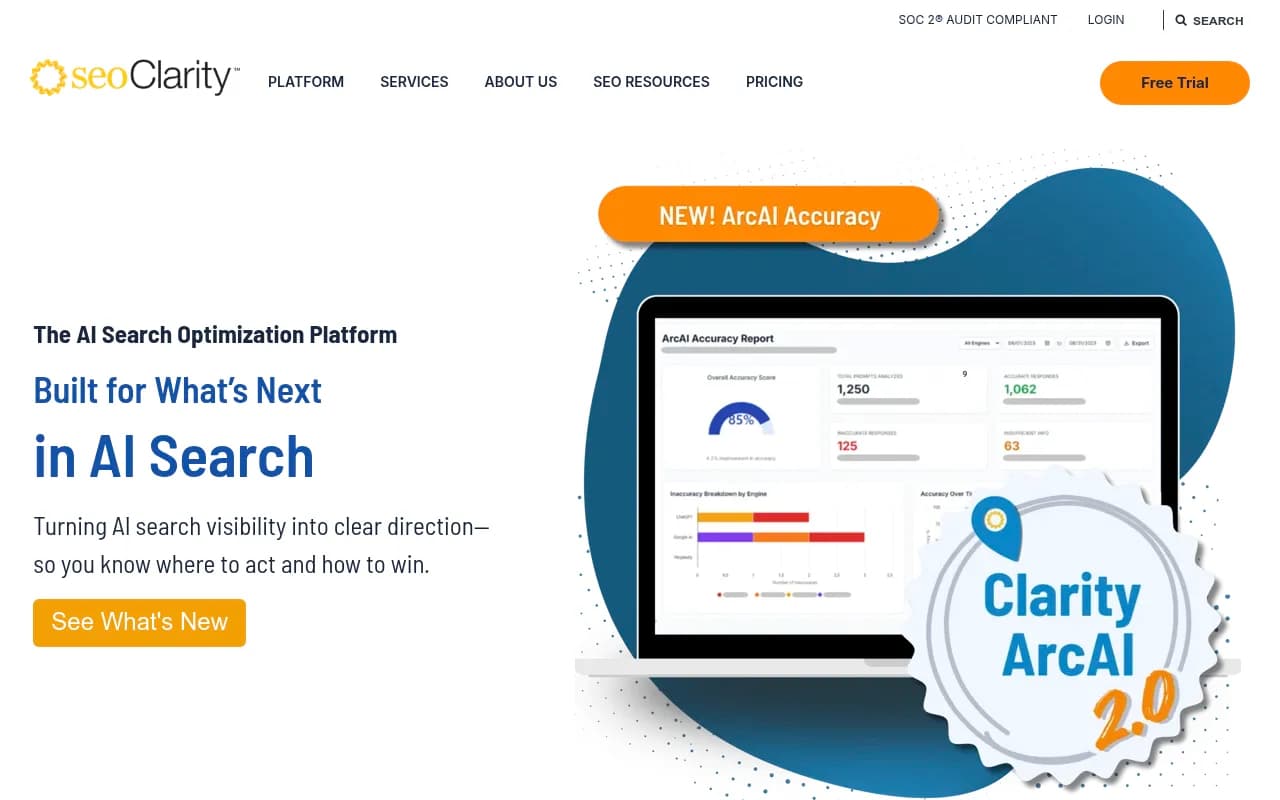
seoClarity is the most complete traditional SEO platform in this comparison, and its Capterra score of 4.8/5 reflects that. It covers keyword research, rank tracking, content gaps, technical SEO, log file analysis, and content briefs -- essentially the full stack of what an enterprise SEO team needs for traditional search.
It also has an AI content writer and content gap analysis, which puts it closer to the action loop than Conductor or BrightEdge. The content gap feature identifies topics you're missing, and the AI writer can help produce content to fill them.
The limitation is that seoClarity's content gap analysis is built around traditional search data -- keyword volumes, SERP features, competitor rankings. It's not analyzing which prompts AI models respond to, which citations those models pull, or what content structure tends to get referenced by ChatGPT versus Perplexity. That's a meaningful gap in 2026.
seoClarity's strengths:
- Best-in-class traditional SEO feature set
- Highest user satisfaction of the three traditional platforms
- Content gap analysis and AI writing tools (though not AI-search-native)
- Research Grid for large-scale keyword analysis
- Log file analysis for understanding crawler behavior
seoClarity's weaknesses:
- AI search tracking is limited compared to dedicated GEO platforms
- Content generation is tied to traditional SEO signals, not AI citation data
- No monitoring of AI crawler behavior (which pages ChatGPT or Perplexity are actually reading)
- Enterprise pricing, though more accessible than BrightEdge
If your team is primarily focused on Google organic search and wants the most capable traditional SEO platform, seoClarity is probably the strongest choice here. If AI search is a priority, you'll need to supplement it.
Promptwatch
Promptwatch is built differently from the other three. It wasn't a traditional SEO platform that added AI tracking -- it was designed from the start around the question of how brands get cited in AI-generated responses.

The core difference is what Promptwatch calls the action loop: find gaps, create content, track results. Most monitoring tools stop at step one. Promptwatch is built to complete all three.
Here's what that looks like in practice:
Finding gaps: The Answer Gap Analysis shows you which prompts your competitors appear in that you don't. Not just "you're missing from Perplexity" -- but the specific questions and topics where AI models are recommending competitors instead of you. That's actionable in a way that share-of-voice dashboards aren't.
Creating content: The built-in AI writing agent generates articles, listicles, and comparisons grounded in citation data from 880M+ analyzed citations. It's not generating generic SEO content -- it's producing content structured around what AI models actually cite, which is a different optimization target than what ranks in Google's blue links.
Tracking results: Page-level tracking shows which specific pages are being cited, by which AI models, and how often. The traffic attribution layer (via code snippet, GSC integration, or server log analysis) connects AI visibility to actual sessions and revenue.
Additional capabilities that matter for enterprise teams:
- AI Crawler Logs: real-time logs of ChatGPT, Claude, Perplexity, and other crawlers hitting your site -- which pages they read, errors they encounter, how often they return
- Prompt Intelligence: volume estimates and difficulty scores for each prompt, plus query fan-outs showing how one prompt branches into sub-queries
- Reddit and YouTube tracking: surfaces discussions that directly influence AI recommendations, a channel the other platforms in this comparison ignore entirely
- ChatGPT Shopping tracking: monitors when your brand appears in product recommendations and shopping carousels
- Competitor heatmaps: shows who's winning for each prompt across different AI models
Promptwatch monitors 10 AI models: ChatGPT, Perplexity, Google AI Overviews, Google AI Mode, Claude, Gemini, Meta/Llama, DeepSeek, Grok, Mistral, and Copilot.
Pricing is transparent: Essential at $99/month (1 site, 50 prompts, 5 articles), Professional at $249/month (2 sites, 150 prompts, 15 articles, crawler logs), Business at $579/month (5 sites, 350 prompts, 30 articles). Agency and enterprise plans available. Free trial included.
The honest limitation: Promptwatch doesn't replace a full enterprise SEO platform. If you need deep technical SEO auditing, historical backlink data, or traditional rank tracking at scale, you'll still want something like seoClarity or Conductor alongside it. Promptwatch is the right primary tool for AI search visibility -- it's not trying to be everything else.
Head-to-head comparison
| Feature | Conductor | BrightEdge | seoClarity | Promptwatch |
|---|---|---|---|---|
| Traditional SEO (rank tracking, audits) | Strong | Strong | Very strong | Not the focus |
| AI search monitoring | Basic | Moderate | Basic | Core feature |
| Prompt-level tracking | Limited | Limited | Limited | Yes (with volume + difficulty) |
| Content gap analysis (AI-native) | No | No | No (traditional only) | Yes |
| AI content generation (citation-based) | No | No | Partial (traditional SEO) | Yes |
| AI crawler logs | No | No | Log file analysis (traditional) | Yes |
| Reddit/YouTube tracking | No | No | No | Yes |
| ChatGPT Shopping tracking | No | No | No | Yes |
| Traffic attribution from AI | No | No | No | Yes |
| Number of AI models monitored | Limited | Limited | Limited | 10 |
| Transparent pricing | No | No | No | Yes ($99-$579/mo) |
| Capterra score | 4.4 | 4.2 | 4.8 | N/A |
| Best for | Large in-house teams | Enterprise SEO + AI data | Enterprise SEO depth | AI search visibility |
Which platform is right for you?
The answer depends on what problem you're actually trying to solve.
Choose Conductor if you're a large in-house marketing team that needs workflow coordination, content performance tracking, and traditional SEO in one place, and AI search visibility is a secondary concern you want included in your existing reporting.
Choose BrightEdge if you're at a large enterprise that needs deep traditional SEO infrastructure and wants AI search data layered on top, and you're comfortable with enterprise contracts and a steeper learning curve.
Choose seoClarity if traditional SEO is your primary focus and you want the most complete feature set for keyword research, rank tracking, and technical auditing. Its 4.8 Capterra score reflects genuine product quality. Supplement with a dedicated GEO tool for AI search.
Choose Promptwatch if AI search visibility is a primary concern -- if you need to know why competitors appear in ChatGPT responses that you don't, what content to create to change that, and whether your efforts are working. It's also the right choice for teams that want to move fast without enterprise contract negotiations.
For many teams in 2026, the honest answer is a combination: seoClarity or Conductor for traditional SEO at scale, and Promptwatch for AI search visibility and optimization. The two categories of tool are complementary, not competing.
The broader context: why this comparison matters now
BrightEdge's claim that AI agents now drive 88% of search activity is a striking number. Even if the real figure is half that, it represents a channel that most enterprise SEO platforms weren't designed to optimize for.
The traditional platforms in this comparison are adapting, and they'll continue to improve their AI search features. But there's a structural difference between a platform built around traditional search that's adding AI tracking, and a platform built around AI search from the start.
That difference shows up in the depth of prompt intelligence, the quality of content generation tied to citation data, the presence of AI crawler logs, and the ability to actually close the loop from visibility gap to published content to tracked results.
The traditional platforms are good at what they were built for. The question for 2026 is whether what they were built for is still the whole game.