Key takeaways
- A GEO tool tells you where you stand in AI answers. An agency does the work of changing it. Most buyers confuse the two, then wonder why the dashboard didn't move anything.
- Published agency retainers cluster at $2,000 to $10,000 a month for B2B companies. Tools run roughly $50 to $1,000 a month. Verify both on vendor pages, because prices are shifting fast.
- If you have writers and a developer, buy a tool that also helps you act. If you have neither, an agency (or a managed offering) is the honest answer.
- Citations decay. Promptwatch Data found ChatGPT-cited news pages lost half their citations within 36 days, so a one-off project is not enough.
- I found no independent data on agency effectiveness or ROI. Nearly all pricing and ranking content comes from vendors who sell something.
The question behind the question
"Agency or tool?" sounds like a budget question. It is mostly a capacity question. GEO work is a loop: find the prompts that matter, see who gets cited, change your pages and your off-site presence, then check whether it worked. A tool covers the measuring parts. Somebody still has to do the changing.
So the real question is: who will write, fix, publish and chase citations every week for the next year? If the answer is "we have people for that," you need a tool. If it's "nobody," you need people, whether that's an agency, a freelancer, or a hire.
One caveat before going further. Almost everything written on this topic, including pricing guides and "best agency" lists, is published by agencies or tool vendors. I'll label the bias where I can. And I'll say it plainly: I couldn't find independent research showing what share of agency engagements pay off. Anyone quoting you a clean ROI figure is working from their own client list.
What each option actually gives you
What a GEO tool does
A GEO tool tracks how your brand appears in answers from ChatGPT, Google AI Overviews, Gemini, Perplexity and others. The basic version runs a fixed set of prompts and reports mentions, share of voice, sentiment and cited sources. The better ones add crawler logs, traffic attribution, content gap analysis and some way to produce or publish content.
That split matters more than any individual feature. A monitoring-only tool is a scoreboard. It's useful, and without it GEO spending is guesswork, but it doesn't change the score. The OGTool guide puts it bluntly: unactioned reports are the most expensive kind of cheap.
What a GEO agency does
Per the agency-side sources I read, a retainer typically covers five jobs: quotable content, entity and schema work, citation building, community presence (Reddit, Quora) and monitoring. Citation building is the costliest because it scales with headcount. OutreachBloom, which sells this work, says any quote under $2,000 a month either leaves it out or fakes it. That's one agency's opinion, but it matches how the labor works.
A good agency also brings judgment: which prompts are worth chasing, which pages to rewrite first, what to ignore. That is hard to buy as software.
What the data says about where the work is
Promptwatch Data helps sort tasks by who should own them. In ChatGPT's citation share by content type (Sep 28 to Oct 4, 2026), product pages were 22.4% of classified citations and landing pages 16.8%. Together that's 39% of citations going to pages that describe what a company sells. Listicles were 13.6%, how-tos 8.7%, documentation 7.5%, comparisons 5.9% and news 5.7%.
For commercial prompts the skew is stronger: product pages 26.0%, landing pages 20.6%, listicles 15.0% and comparisons 7.9%, almost 70% of commercial citations combined.
What this means for the decision:
- A big chunk of the work is on your own site: product pages, landing pages, docs, FAQs. Your team or a tool with content features can own that.
- Another chunk is off-site: getting into listicles, collecting reviews, earning mentions on pages AI already cites. That is outreach labor, and it's where agencies earn their fee.
Then there's decay. In Promptwatch's content half-life study of pages ChatGPT cited on July 6, 2026 and tracked for 90 days, 78% of landing pages and 76% of docs were still cited after 30 days, and 69% and 67% after 60. Product pages, reviews and how-tos sat around 55% at day 60, with half-lives of 74 to 77 days. News lost half its pages in 36 days. Citations fade, so GEO is a subscription-shaped problem. Whatever you buy has to run continuously.
One more detail that affects tool choice. Promptwatch's query fanout data shows average searches per response moving around (2.15 in December 2025, about 1.84 in early March 2026, 1.0 in April). ChatGPT's behavior changes under you, so re-audit after updates. Someone has to be watching.
What it costs
Treat every number below as a starting point. Most come from sellers.
Agency pricing
| Source | Range | Bias note |
|---|---|---|
| OutreachBloom | $2,000 to $10,000/mo for most B2B; audits $1,000 to $4,000; enterprise $25,000+ | Agency selling GEO; own plans are $3,400 to $4,900/mo |
| WebFX | $1,500 to $50,000+/mo | Discloses no sample, per OutreachBloom |
| First Page Sage (Oct 2026) | Starter $1,800 to $4,200; growth $4,500 to $11,000; advanced $11,000 to $22,000; enterprise $22,000 to $60,000+ | Based on 1,146 quotes from 214 agencies, but it is itself an agency |
| Hourly consultants | $50 to $400/hr | Cited via Stackmatix |
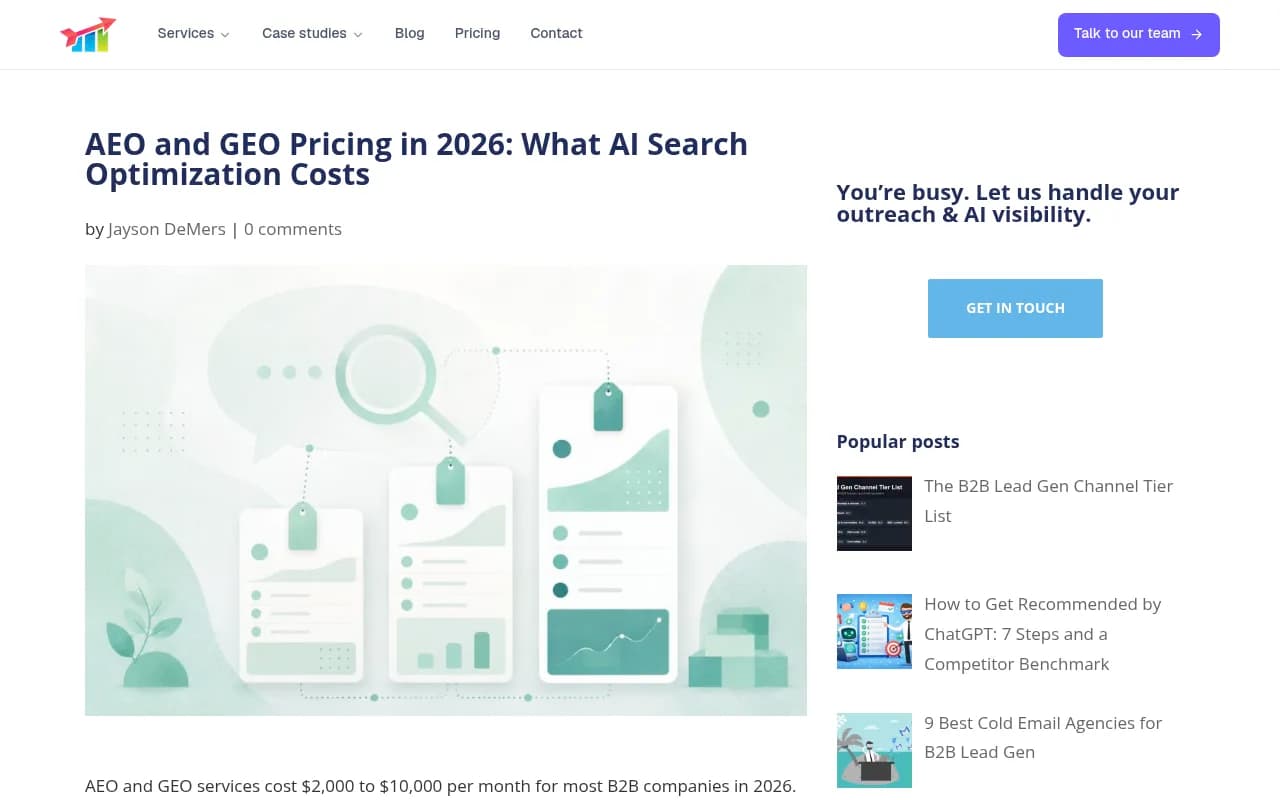
OutreachBloom's price checks were done in July 2026, so re-verify before budgeting. A tip that holds regardless of source: ask for deliverable counts (content pieces, citations earned, community engagements). A price with no counts can't be compared to another quote.
Tool pricing
Figures below come from the IndustryLens aggregator as of October 2026. Confirm on vendor pages.
| Tool | Entry price | Notes |
|---|---|---|
| Rankscale | $20/mo (annual only) | Pro is $99 |
| Otterly.AI | $29/mo | Lite, 15 prompts |
| Peec AI | about EUR 85/mo | 50 prompts, 3 models; other sources quote different numbers |
| Semrush AI Toolkit | $199/mo | 50 tracked prompts |
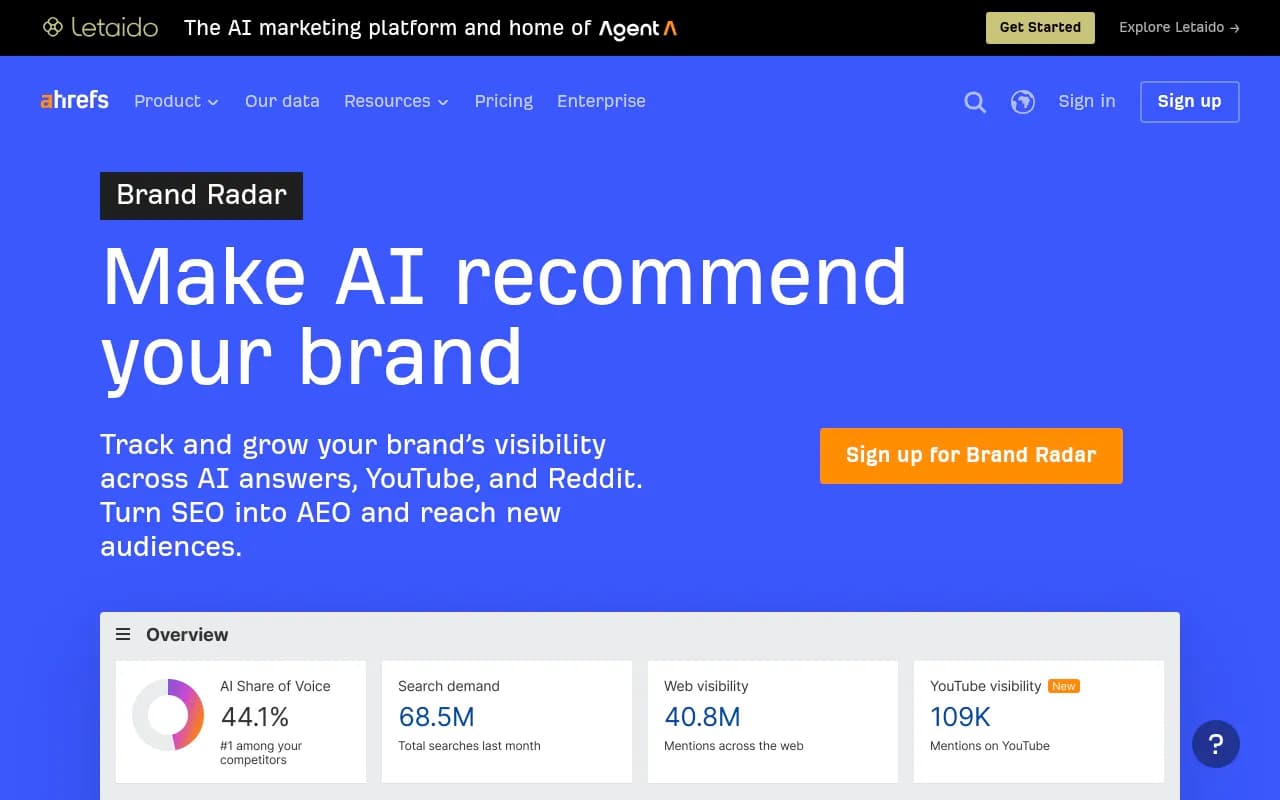
| Ahrefs Brand Radar | from $199/mo | Prompt packages from about $50 |
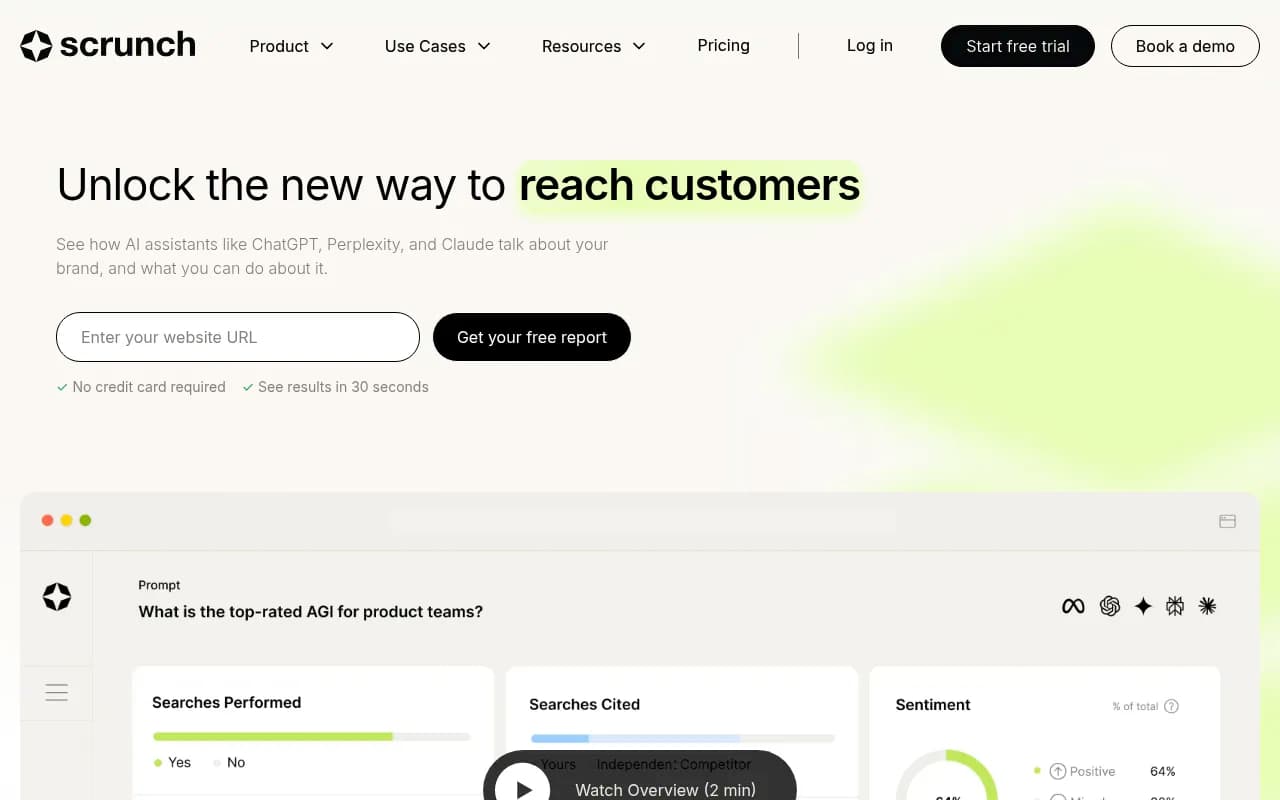
| Scrunch | $250/mo | 125 prompts |
| AthenaHQ | $295/mo | Starter |
| Evertune | $800/mo | Pro |
| Profound | Custom | Removed its $99 Starter tier from public pricing in October 2026 |
Vendor-run comparisons disagree with each other. Otterly's page quotes Peec at $95 and Scrunch at $300. AthenaHQ's own test shows AthenaHQ at $595, Peec at $199 and Profound at $499, and reports its own answer-share gains. Both are self-interested, so don't treat either as a benchmark.
Tool tiers: monitoring versus action
Per Surmado's comparison, Profound, Scrunch, Evertune and AthenaHQ have some kind of action layer, while Otterly, Semrush and Ahrefs are monitoring-only. That's a useful dividing line, because it decides whether your tool purchase replaces any labor or just reports on it.
Otterly.AI and Peec AI are the cheap, simple end. Good if you want a baseline and have the team to act on it.
Otterly.AI


Semrush and Ahrefs Brand Radar make sense if you already live in those suites and want AI tracking next to classic SEO data. Expect fixed prompt sets and shallower AI-specific data.
Profound and Scrunch are the stronger monitoring platforms with higher price points.
Profound

Promptwatch sits at the other end of the spectrum, closer to doing the work than reporting on it. It combines real-UI prompt tracking, IP-verified AI crawler logs, visitor analytics and a Content Agent that plans, writes and publishes to Webflow, Framer or WordPress, then tracks whether each page gets crawled and cited. Plans start at $95 a month (Essential), with an automated Content Agent on Business at $579. Confirm on promptwatch.com/pricing.

For more options, the GEO software directory at bestgeosoftware.com lists far more tools than fit here.
The decision framework
Four questions settle most cases.
1. Do you have people who can ship content and technical fixes weekly?
If yes, a tool with an action layer is probably enough. If you have a writer and nobody who can touch templates, schema or robots rules, you'll stall on the first technical recommendation.
2. Is your gap on-site or off-site?
Run a baseline first. If AI cites your competitors' product pages and docs while yours are thin, that's on-site work you can do yourself. If you're missing from the listicles and review pages AI keeps citing, that's outreach and relationship work, which is where agencies are strongest.
3. How much does an AI-driven lead mean to you?
Forrester data cited by Linkedist says B2B buyers adopt AI search at three times the consumer rate and 94% of business buyers use AI tools in purchasing. That's an agency's blog post, so weigh it accordingly, but the direction matches what sales teams report. If one closed deal pays for a year of retainer, an agency is easier to justify than for a low-ticket product.
3b. Can you measure it?
If you can't tie AI traffic to conversions, you can't judge either option. Check that your tool or analytics shows visits from AI platforms, not just mentions.
4. What's your tolerance for a long contract?
GEO results compound slowly and citations decay. Short commitments and clear deliverables are safer than a 12-month lock-in with vague reporting.
Quick decision table
| Your situation | Best fit | Rough budget |
|---|---|---|
| Small team, no baseline yet, a few hundred dollars to spend | A monitoring tool plus a one-off audit | $29 to $300/mo for the tool; $1,000 to $4,000 for the audit |
| In-house writers and a developer, want to move fast | A tool with action features, run in-house | $95 to $600/mo |
| No capacity, high deal value, gap is mostly off-site | Agency retainer | $2,000 to $10,000/mo |
| Agency serving clients | White-label tool plan | Varies by plan |
| Enterprise, many brands and regions | Enterprise platform plus agency or managed service | $10,000+/mo |
The hybrid model most teams end up with
The cleanest setup I've seen described is boring: you own the measurement and the agency owns the heavy lifting. You pay for the tool because you want first-party data on your own visibility, not a PDF from a vendor who has an incentive to show progress. The agency (or freelancer) works inside that data, and you can verify what they claim.
This also fixes the biggest buying risk. Menra's buyer guide says it directly: in 2026 there is no dominant GEO agency brand, so buy on verifiable methodology, not marketing. If you hold the tracking, you can check the methodology against results.
If you want an agency in that role, 1001 SEO Media runs GEO alongside technical SEO, content and digital PR, with no long-term contracts and monthly reporting. It also publishes this directory, so weigh that disclosure the way you would any other vendor's.
How to vet an agency
- Ask for deliverable counts per month, not just a price.
- Ask which prompts they would track for you and why. A vague answer means a templated engagement.
- Ask how they measure citations and AI traffic, and whether you get raw access to that data.
- Ask what happens when ChatGPT changes behavior. Fanout and citation patterns shift often, as the Reddit citation drop (reddit.com fell from about 4% to 0.5% of ChatGPT citations on August 14, 2026) shows. A tactic built on one platform quirk can vanish overnight.
- Ask for client references in your category, and treat any case study as self-reported.
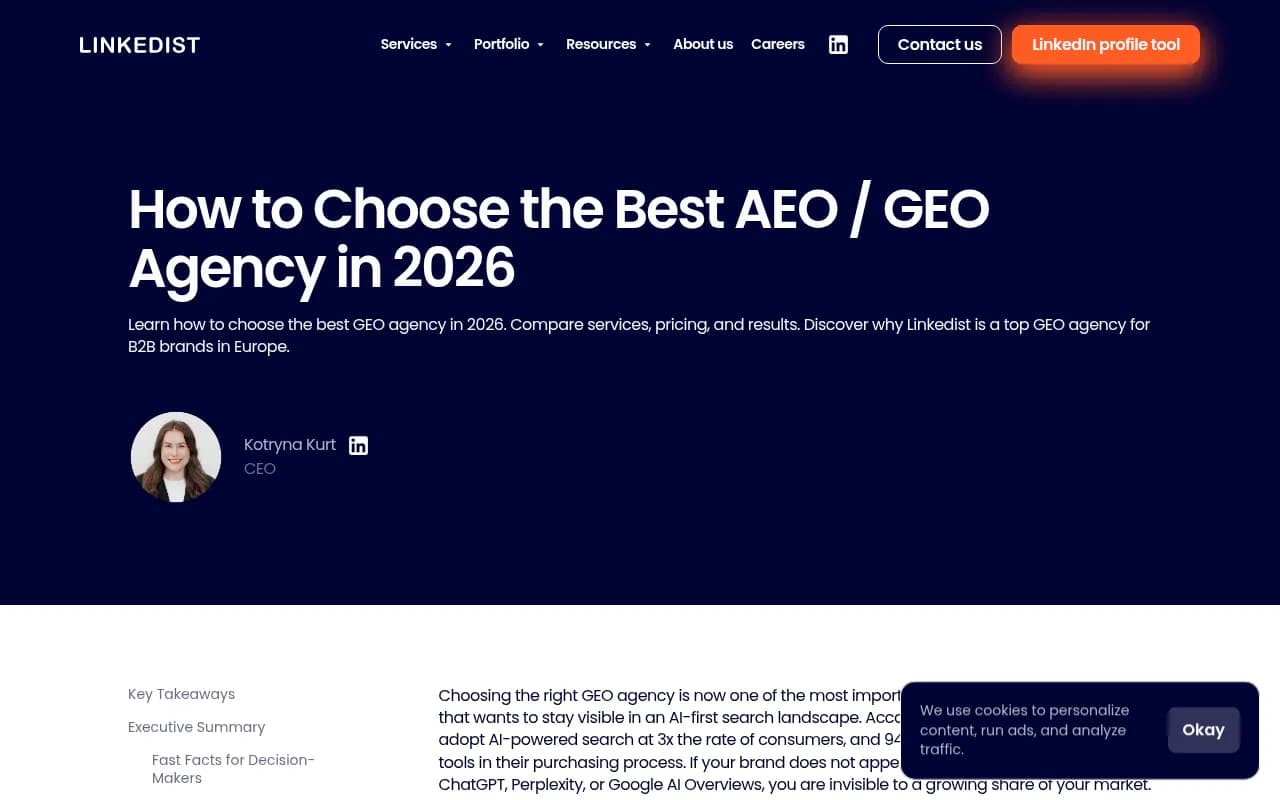
The Linkedist guide above is a reasonable example of the checklist agencies publish for themselves. Read it for the service list, and keep in mind it ends by recommending Linkedist.
A sensible starting sequence
- Spend a week on a free baseline. Several tools offer free scans, and Promptwatch has a no-login AI visibility report.
- Track your top 25 commercial prompts. The Sitefinity guide makes the same point: without that data, GEO investment is guessing.
- Fix what is cheap: crawler access, thin product pages, missing FAQs.
- Review after 60 days. If you shipped the fixes and still can't get into off-site sources, that's the moment to price an agency.
For AI rank trackers specifically, ai-rank-tools.com is another directory worth scanning.
Bottom line
Buy a tool if the problem is knowing. Buy an agency if the problem is doing. Most teams have both problems, which is why the tool-plus-help combination keeps showing up. Start with the measurement, because it makes every later decision cheaper, and treat any claim of guaranteed AI rankings as a sign to walk away.