Key takeaways
- Peec.ai queries live AI engines (ChatGPT, Perplexity, Gemini) directly, so its visibility data reflects real model outputs -- not cached or simulated responses.
- Its Crawl Insights feature adds server log integration to track GPTBot, ClaudeBot, and other AI crawlers hitting your site, which is a meaningful step beyond pure query-based monitoring.
- The platform still lacks content generation, answer gap analysis, and traffic attribution -- so you can see what's happening but have limited tools to fix it.
- Platforms with deeper crawl infrastructure (like Promptwatch) combine live query data with crawler logs, page-level citation tracking, and content optimization in one loop.
- For teams that need monitoring plus action, Peec.ai is a solid starting point but not a complete solution.
There's a question that comes up constantly in GEO discussions: when a tool says your brand appeared in 47% of AI responses, what does that number actually mean? Was the AI queried live? Was it a cached response? Was it an API call that differs from what real users see in ChatGPT's interface?
These aren't pedantic questions. The answer changes whether the data is useful or just decorative.
This guide looks specifically at Peec.ai's data collection approach, what "real AI search data" means in this context, and how Peec.ai compares to platforms that have invested more heavily in live crawling infrastructure.
What "real AI search data" actually means
Before getting into Peec.ai specifically, it's worth being precise about what we're talking about.
There are three main ways AI visibility platforms collect data:
Direct API queries: The platform sends prompts to AI model APIs (OpenAI, Google, Anthropic, etc.) and records the responses. Fast, scalable, and consistent -- but API responses can differ from what users see in actual chat interfaces, especially for shopping recommendations, citations, and featured sources.
User-interface simulation: The platform queries AI engines through their actual web interfaces, mimicking real user behavior. Slower and more resource-intensive, but captures what real users actually see -- including UI-specific features like ChatGPT's source carousels or Perplexity's citation panels.
Server log / crawler log analysis: The platform analyzes your own web server logs to see which AI crawlers (GPTBot, ClaudeBot, PerplexityBot, etc.) are visiting your pages, how often, which pages they read, and whether they return. This is passive data -- it tells you about AI engines' indexing behavior, not what they say about you.
Most platforms use some combination of the first two. The third is rarer and more technically involved.
How Peec.ai collects its data
Peec.ai's core approach is direct querying of AI engines. You set up prompts relevant to your brand and category, and Peec.ai runs those prompts against ChatGPT, Perplexity, Gemini, and a growing list of models (the June 2026 changelog added Gemini 3 Flash and Qwen 3.7). It records visibility scores, sentiment, position, and which sources each model cites.
This is real data in the meaningful sense: Peec.ai is actually asking the AI engines questions and recording what they say. It's not simulating responses or pulling from a static database.
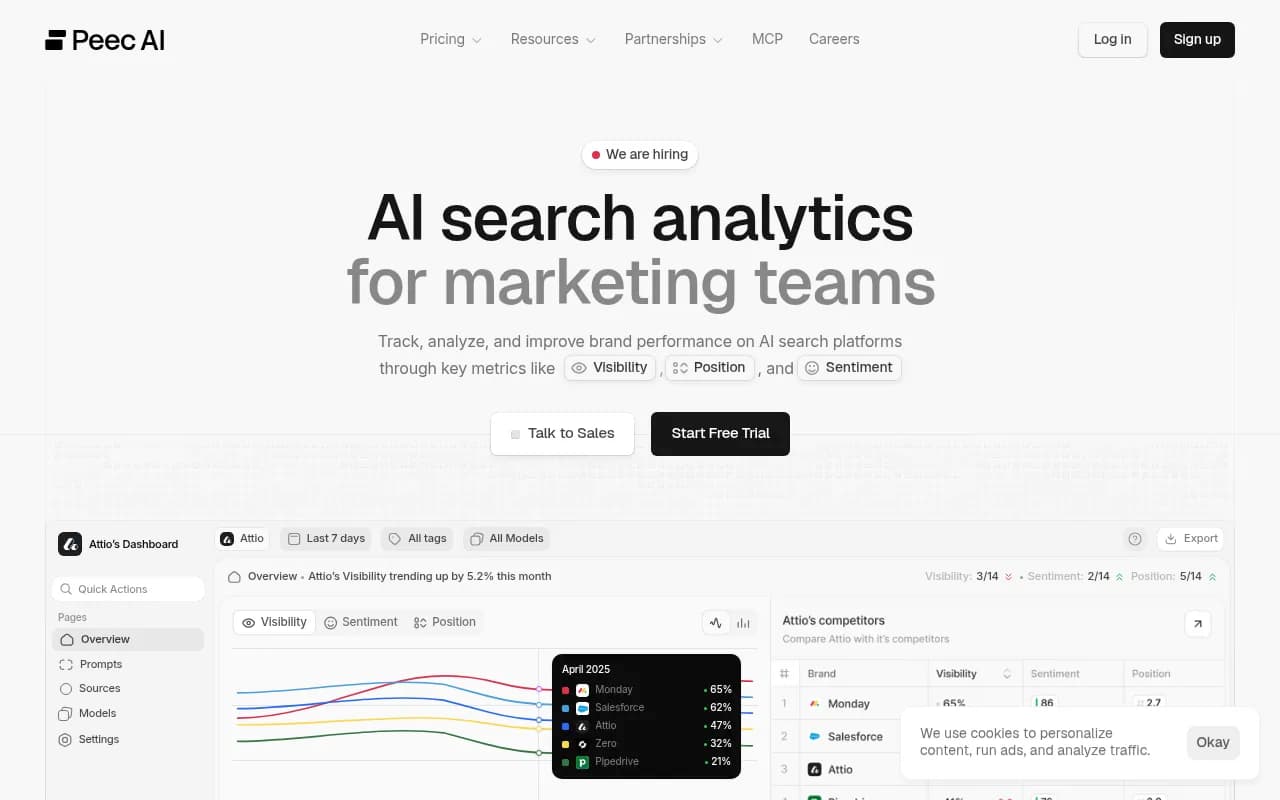
Where it gets more interesting is Crawl Insights, which Peec.ai has been building out through 2025 and 2026. This feature connects to your server logs to track how AI crawlers move through your site. The June 2026 changelog added WordPress plugin, AWS CloudFront, and Google Cloud integrations -- on top of existing Vercel, Akamai, and webhook options. The changelog describes it directly: "Built on your own server log data, it gives a direct and objective view of how AI bots interact with your content. That helps you catch technical access issues."
So Peec.ai now covers both sides: what AI engines say about you (query-based) and how AI crawlers interact with your site (log-based). That's a more complete picture than most monitoring-only tools offer.

What the Crawl Insights feature actually tells you
The Crawl Insights data is genuinely useful for diagnosing technical problems. If GPTBot is hitting your homepage but never reaching your product pages, that's a crawl depth issue. If ClaudeBot keeps returning to a page but you're not appearing in Claude's responses, there might be a content relevance problem. If a bot is encountering 404s or redirect chains, you'll see that in the logs.
This is the kind of data that used to require digging through raw server logs manually. Having it surfaced in a dashboard, filtered by bot type, is a real improvement.
The limitation is that crawl log data tells you about indexing behavior, not citation behavior. A page being crawled doesn't mean it gets cited. The gap between "AI bot visited this page" and "AI model cited this page in a response" is where most of the interesting optimization work happens -- and that gap isn't fully bridged by log data alone.
How Peec.ai's data compares to platforms with deeper live crawling
Here's where the comparison gets honest. Peec.ai has made meaningful progress on data collection, but there are real differences between its approach and platforms that have built more comprehensive crawling infrastructure.
| Capability | Peec.ai | Promptwatch | Otterly.AI | Profound |
|---|---|---|---|---|
| Live AI engine queries | Yes | Yes | Yes | Yes |
| UI-level query simulation | Partial | Yes | No | Partial |
| Server log / crawler integration | Yes (multiple options) | Yes (Cloudflare, Vercel, Fastly, GSC) | No | No |
| Page-level citation tracking | Limited | Yes | No | Yes |
| Answer gap analysis | No | Yes | No | Limited |
| Content generation from gaps | No | Yes | No | No |
| Traffic attribution | No | Yes | No | No |
| Reddit / YouTube citation tracking | No | Yes | No | No |
| ChatGPT Shopping tracking | No | Yes | No | No |
| Prompt volume / difficulty scoring | No | Yes | No | No |
The core difference isn't really about whether the data is "real" -- Peec.ai's query data is real. The difference is about what you can do with it.
Peec.ai shows you visibility scores, sentiment, position, and which sources are being cited. That's useful diagnostic information. But if your visibility score is low, the platform doesn't help you understand why at a content level, doesn't generate content to address the gaps, and doesn't connect visibility changes to actual traffic or revenue.

Promptwatch is built around what happens after you see the data. Its Answer Gap Analysis identifies which prompts competitors rank for that you don't, and its Content Agents generate articles, listicles, and briefs specifically designed to close those gaps. The crawler log integration (through Cloudflare, Fastly, Vercel, or a tracking snippet) feeds into page-level tracking that shows which specific pages are being cited, by which models, and how often -- and then connects that to actual traffic attribution.
That's a different category of tool. Not just "what does AI say about me" but "here's what's missing, here's how to fix it, here's whether it worked."
Where Peec.ai's data is genuinely strong
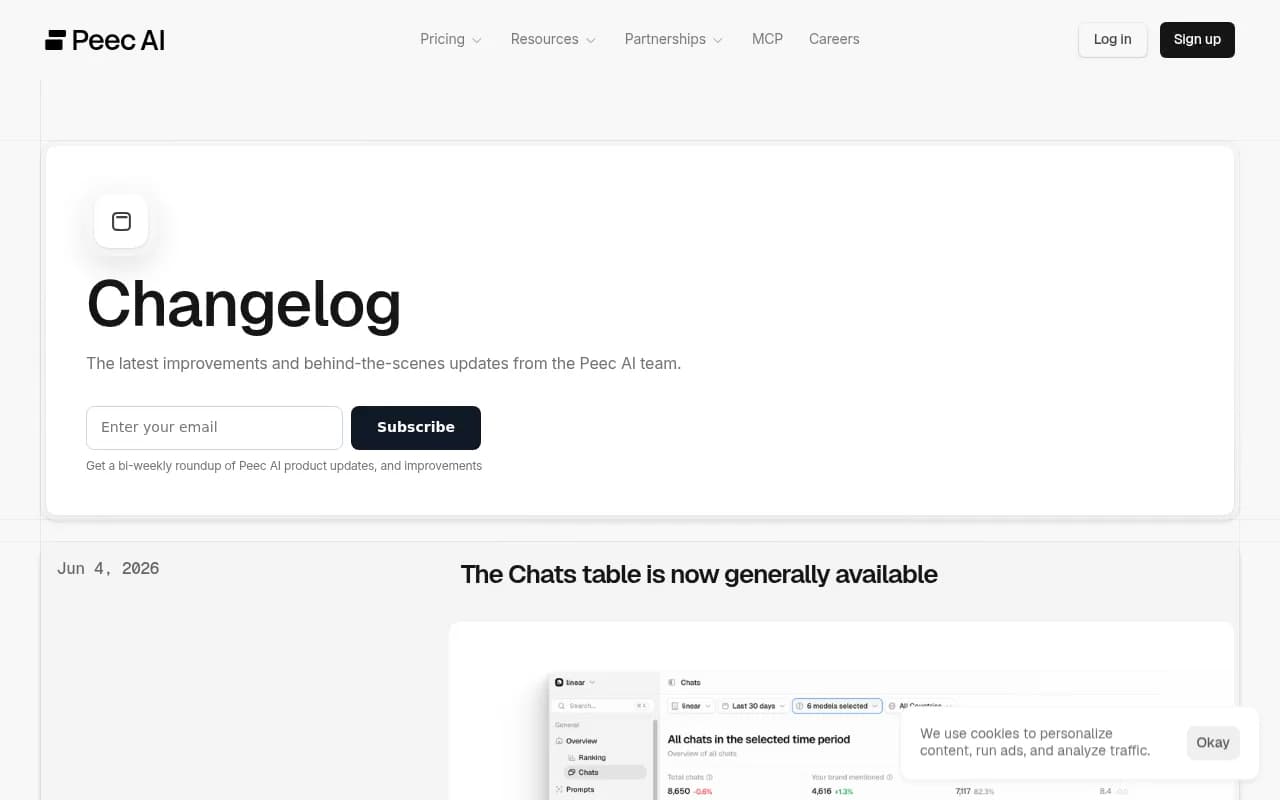
To be fair about this: Peec.ai's prompt-level data is solid. The Chats table (now generally available as of June 2026) shows the raw AI responses for each tracked prompt, filterable by brand, sortable by mention count or source count. That's useful for qualitative analysis -- reading actual AI responses to understand how models frame your brand, what language they use, which competitors they mention alongside you.
The source citation tracking is also genuinely valuable. Seeing which pages, Reddit threads, or third-party sites AI models cite when answering your prompts tells you where to focus optimization efforts -- whether that's improving your own pages or getting mentioned on high-authority external sources.
The multi-model coverage is expanding. Adding Gemini 3 Flash and Qwen 3.7 in June 2026 means Peec.ai now covers a broader slice of the AI engine landscape, which matters as users spread across more platforms.
For teams that primarily need monitoring and reporting -- tracking visibility trends, benchmarking against competitors, understanding sentiment -- Peec.ai delivers real data and a clean interface. The 2,000+ marketing teams using it aren't wrong to find it useful.
The accuracy question: API vs. real user interface
One thing worth flagging: there's an ongoing debate in the GEO community about whether API-based queries accurately reflect what real users see. The concern is that AI engines sometimes behave differently in their consumer interfaces than through their APIs -- particularly for citation panels, shopping recommendations, and featured sources.
Peec.ai queries AI engines directly, but it's not entirely clear from public documentation whether all queries go through APIs or through UI simulation. This matters more for some use cases than others. If you're tracking whether your brand name appears in a response, API vs. UI probably doesn't change the answer much. If you're tracking ChatGPT Shopping recommendations or Perplexity's source carousel, the difference can be significant.
Platforms that specifically invest in UI-level simulation (querying the actual chat interface rather than the API) capture a more accurate picture of what real users experience. This is one area where the technical infrastructure choices made by different platforms lead to meaningfully different data quality.
Alternatives worth considering
If Peec.ai's monitoring-focused approach fits your needs, it's a reasonable choice. But if you're looking for more, here are platforms worth comparing:
Promptwatch is the most complete option if you need the full loop: gap analysis, content generation, crawler logs, page-level citation tracking, and traffic attribution. It covers 10 AI models and has processed over 4.5 billion citations and prompts. The Professional plan ($249/mo) adds crawler logs and state/city tracking on top of the Essential tier.
Otterly.AI

Otterly.AI is a cleaner, simpler monitoring tool. Good for teams that want basic visibility tracking across ChatGPT, Perplexity, and Google AI Overviews without a lot of complexity. No crawler logs, no content generation, but the interface is straightforward.
Profound

Profound has a strong feature set for enterprise teams, with solid monitoring across multiple AI engines and some content gap functionality. Higher price point than Peec.ai, and no Reddit tracking or ChatGPT Shopping.
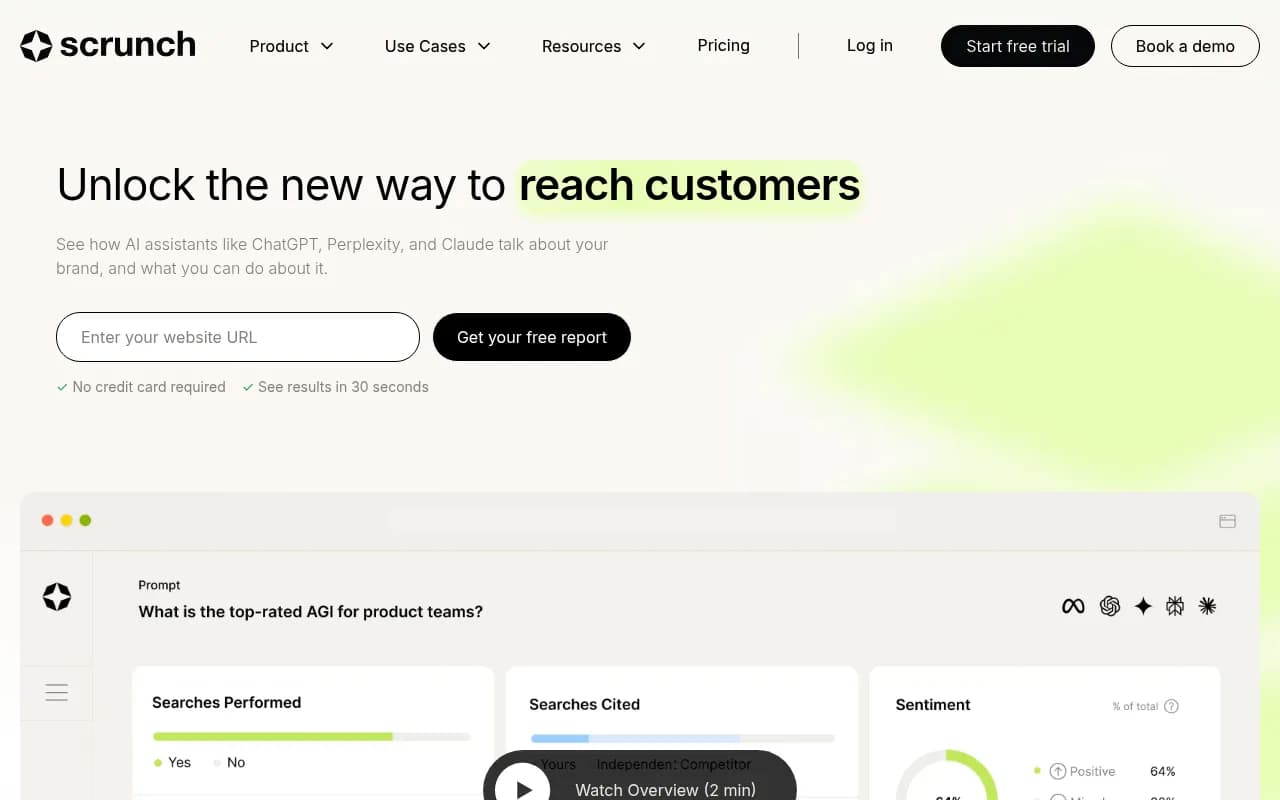
Scrunch AI has been noted for real-time bot crawling diagnostics and AI-readiness insights -- similar territory to Peec.ai's Crawl Insights but with a different emphasis on technical readiness.

AthenaHQ is monitoring-focused with a clean interface, but like most competitors, stops at showing you data rather than helping you act on it.
Comparing the main options
| Tool | Best for | Crawler logs | Content generation | Pricing starts at |
|---|---|---|---|---|
| Peec.ai | Monitoring + basic crawl insights | Yes | No | ~$49/mo |
| Promptwatch | Full optimization loop | Yes | Yes | $99/mo |
| Otterly.AI | Simple monitoring | No | No | ~$29/mo |
| Profound | Enterprise monitoring | No | Limited | ~$200/mo |
| AthenaHQ | Mid-market monitoring | No | No | ~$149/mo |
The bottom line
Peec.ai uses real AI search data. Its query-based approach queries live AI engines, and its Crawl Insights feature adds genuine server log integration that most competitors don't offer. For a monitoring tool, it's more technically complete than many alternatives.
The honest limitation is that monitoring is where it stops. The data is real, but the platform doesn't help you close the gaps it identifies. If your visibility is low, you'll know -- but you'll need other tools to figure out why and fix it.
For teams that need to go from "we see the problem" to "we fixed it," the comparison shifts toward platforms built around the full optimization cycle rather than just the reporting layer.