Key takeaways
- Peec AI is a legitimate AI search visibility monitoring platform — not a scam — but it has real limitations worth knowing before you pay.
- It tracks brand mentions, position, and sentiment across ChatGPT, Perplexity, Google AI Overviews, and other AI engines.
- The platform scores around 7.3/10 in independent reviews, with strong analytics but weak prescriptive guidance.
- It's best suited for established brands with existing SEO traction, not early-stage startups or teams without a content strategy.
- If you need to go beyond monitoring and actually fix your AI visibility gaps, you'll likely need a more complete platform.
Let's get the obvious question out of the way: no, Peec AI is not a scam. It's a real product that does what it says on the tin. But "not a scam" and "worth your money" are two very different things, and that's what this guide is actually about.
The AI visibility tracking space has exploded in the last 18 months. Dozens of tools have appeared promising to tell you how your brand shows up in ChatGPT, Perplexity, Claude, and Google AI Overviews. Some of them are genuinely useful. Some are glorified dashboards with a $300/month price tag. Peec AI sits somewhere in between, and the answer to whether it's right for you depends a lot on what you're trying to accomplish.
Here's an honest look at what you actually get.

What Peec AI actually does
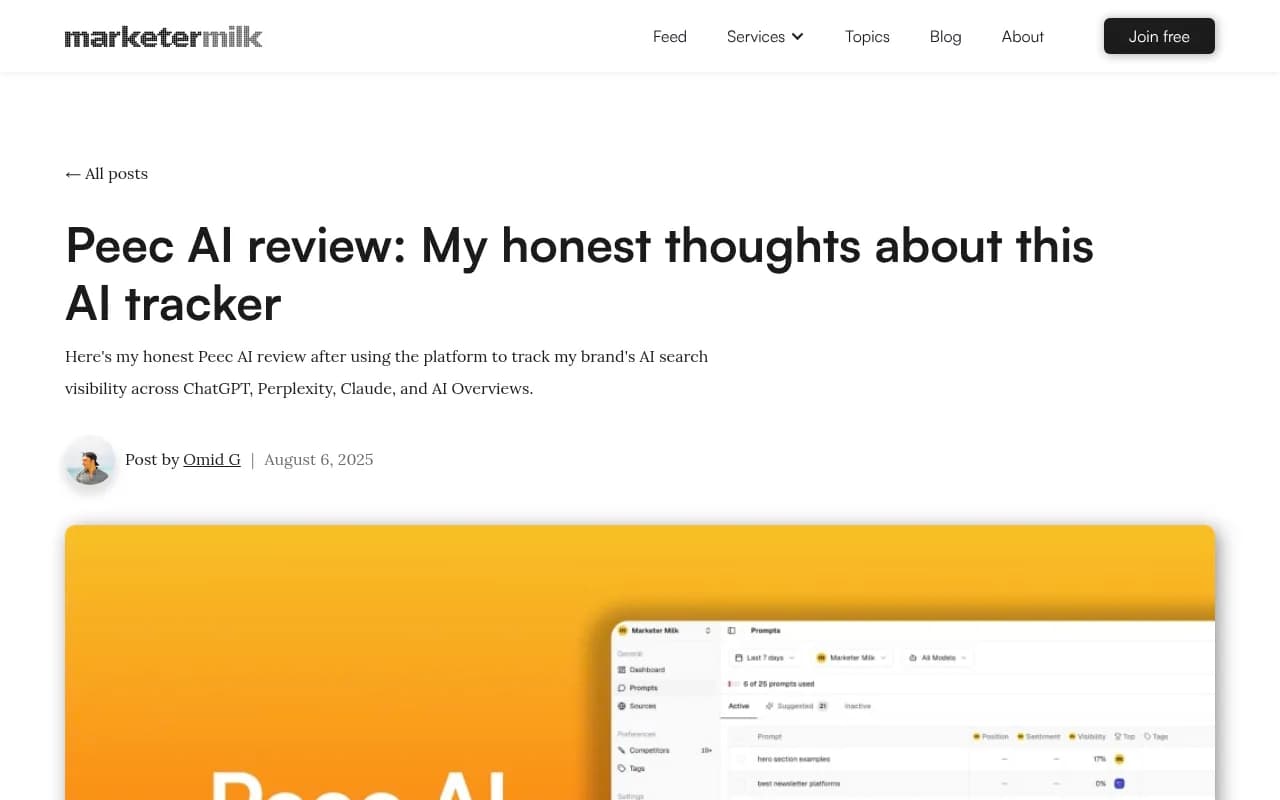
Peec AI is an AI search analytics platform built for marketing and SEO teams. The core idea: instead of tracking keyword rankings in Google, you track how AI models describe, mention, and cite your brand when users ask questions.
You set up prompts that mirror real user queries — things like "what's the best project management tool for remote teams?" or "which CRM should a B2B startup use?" — and Peec AI runs those prompts across multiple AI engines on a daily basis. It then shows you three things:
- Visibility: how often your brand appears in the answers
- Position: where in the answer you appear (first mention vs. buried in a list)
- Sentiment: whether the AI is describing you positively, neutrally, or negatively
That's the core loop. It also does competitor benchmarking, so you can see how your visibility stacks up against specific rivals for the same set of prompts.
The UI is clean. The data refreshes daily. Setup is reasonably straightforward if you already know what prompts matter to your business. Independent reviewers on LinkedIn have rated its AI visibility and analytics capabilities at 9/10, and prompt-level insights at the same score. Those aren't inflated numbers — the monitoring side of Peec AI is genuinely well-built.
Where the "scam" perception comes from
The frustration people express about Peec AI — and why some users feel burned — usually comes down to one thing: the gap between what they expected and what they got.
If you sign up expecting a tool that will tell you what to do to improve your AI visibility, you're going to be disappointed. Peec AI tells you what's happening. It doesn't tell you why, and it doesn't tell you how to fix it.
From a review on radarkit.ai: "Peec AI shows you what's happening (visibility, position, sentiment), but it doesn't always tell you exactly what to do next."
That's not a scam. That's a monitoring tool. But if you're a marketer who expected an optimization platform, the distinction matters a lot.
A few other friction points that come up consistently in reviews:
- Prompt and answer limits on lower plans push growing teams toward upgrades faster than expected. The pricing can feel aggressive once you start tracking more than a handful of prompts across multiple AI engines.
- Not beginner-friendly. The interface and metrics can feel complex if you're new to GEO or AI search. One reviewer rated beginner-friendliness at 6/10.
- Limited value for new sites. Multiple reviewers note that Peec AI is best for established brands with existing SEO traction and branded search volume. If you're a startup with low brand recognition, the data you get back will be thin and hard to act on.
None of this makes it a scam. It makes it a tool with a specific use case that doesn't fit everyone.
Who it's actually built for
Peec AI works well for:
- In-house SEO or marketing teams at established companies who want a dedicated layer of AI search monitoring on top of their existing SEO stack
- Agencies that need to report AI visibility metrics to clients and want clean, exportable data
- Brands that already have content and want to understand how AI models are perceiving them
It's a poor fit for:
- Early-stage startups with low brand awareness (the data will be sparse)
- Teams that don't already have a content strategy and need guidance on what to create
- Anyone who needs to go from "monitoring" to "fixing" without switching tools
One reviewer on Marketer Milk put it plainly: "This tool is best for established sites that already get decent SEO traffic (and solid branded searches)."
That's a fair characterization. If your brand isn't already being mentioned somewhere in the AI training data or cited in web sources that AI models pull from, tracking your AI visibility is a bit like checking your bank balance when you haven't deposited anything yet.
The monitoring-only problem
This is the bigger issue with Peec AI, and it's worth spending a moment on it because it affects the entire category of monitoring-only tools.
Knowing that your brand appears in 12% of relevant AI responses while a competitor appears in 34% is useful information. But what do you do with it? Peec AI doesn't answer that question. It doesn't show you which content gaps are causing the disparity. It doesn't generate content to close those gaps. It doesn't track AI crawler activity on your site or show you which pages are being cited.
For teams that already have a strong content operation and just need visibility data to inform their strategy, that's fine. They can take the monitoring data and act on it themselves.
For teams that need the full loop — find gaps, create content, track results — a monitoring-only tool leaves a lot of work on the table.
How it compares to other options
Here's a straightforward comparison of Peec AI against a few alternatives in the AI visibility space:
| Tool | Core focus | Content generation | Crawler logs | Prompt volume data | Best for |
|---|---|---|---|---|---|
| Peec AI | Monitoring | No | No | Limited | Established brands, reporting |
| Otterly.AI | Monitoring | No | No | No | Basic tracking |
| AthenaHQ | Monitoring | No | No | Limited | Mid-market monitoring |
| Profound | Monitoring + analytics | No | No | Yes | Enterprise monitoring |
| Promptwatch | Monitoring + optimization | Yes | Yes | Yes | Teams that need to act, not just track |

The table above isn't meant to dismiss Peec AI — its monitoring capabilities are genuinely strong. But if you're evaluating tools and wondering why some cost more or less, this is the core difference: most tools in this space, including Peec AI, stop at step one. They show you the data. The question of what to do with it is left to you.
Tools like Promptwatch are built around the full cycle: identifying which prompts competitors rank for that you don't, generating content specifically designed to close those gaps, and then tracking whether that content starts getting cited. That's a different product category, even if it looks similar on the surface.
Otterly.AI


Profound

What independent reviewers actually say
The consensus across multiple independent reviews in 2026 is pretty consistent:
- Overall rating: around 7.3/10 (LinkedIn review by Sanjay Singh)
- Strong on analytics and competitor benchmarking (8-9/10 across those categories)
- Weak on actionable recommendations and beginner-friendliness (6/10)
- Pricing can escalate quickly as you add prompts and AI engines
One reviewer on generatemore.ai summarized it well: "Peec AI is a visibility tracker, not a strategy tool. Good for understanding 'what's happening' but not 'what to do about it.'"
That's not a condemnation. Strategy tools and monitoring tools serve different needs. The problem is when people buy a monitoring tool expecting a strategy tool.

Is it worth the money?
It depends on what you're paying and what you need.
If you're an established brand with a content team, an existing SEO strategy, and you just need clean AI visibility data to add to your reporting stack — Peec AI is a reasonable choice. The monitoring is solid, the UI is clean, and the daily data refresh is genuinely useful.
If you're a startup, a small team without a content operation, or someone who needs the tool to tell you what to do next — it's probably not the right fit. You'll end up with a dashboard full of data and no clear path forward.
And if you need the full picture — monitoring, gap analysis, content generation, crawler logs, and traffic attribution all in one place — you'll likely outgrow Peec AI quickly, or find yourself stitching it together with other tools to fill the gaps.
A few alternatives worth considering
If Peec AI doesn't fit your situation, here are some other tools in the space worth evaluating:
For basic monitoring on a budget:
Otterly.AI
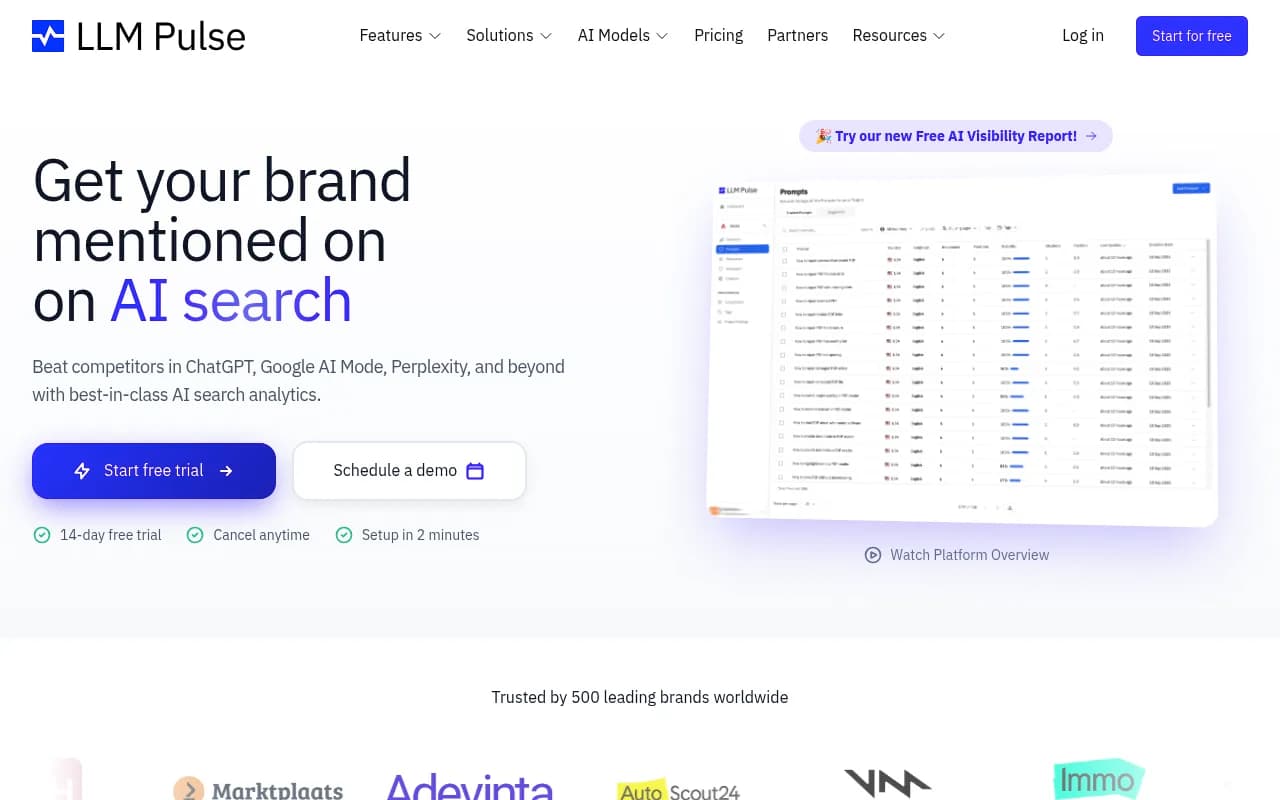
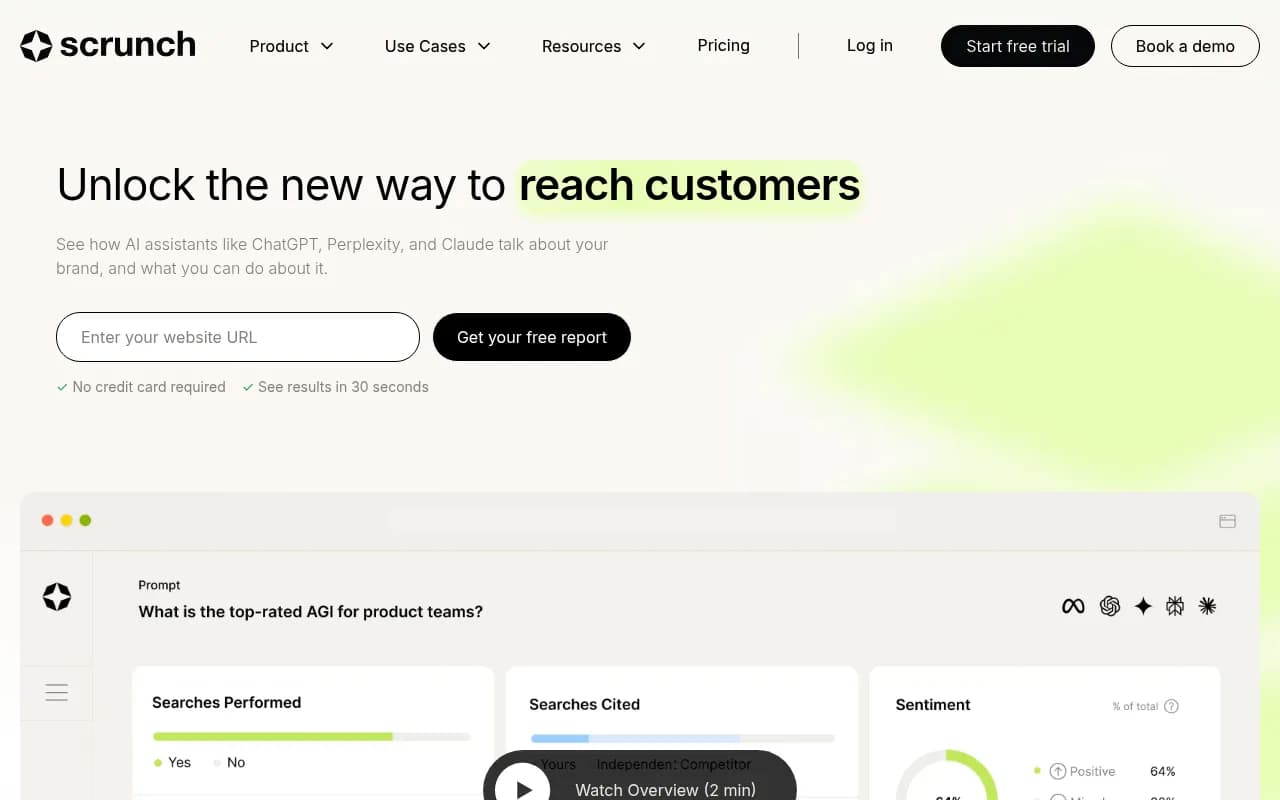
For deeper analytics with more AI engines:
For monitoring plus content optimization:

For enterprise-scale visibility:
Profound
The bottom line
Peec AI is a legitimate, well-built monitoring platform. The people calling it a scam are usually people who bought it expecting something it was never designed to be.
If you go in with clear expectations — this is a monitoring tool, not a strategy tool, and it works best for brands that already have some AI search presence to track — it can deliver real value. The 7.3/10 rating from independent reviewers is honest: it's good at what it does, but what it does has limits.
The more important question isn't whether Peec AI is a scam. It's whether monitoring alone is enough for where your brand is right now. For a lot of teams in 2026, the answer is no — they need to find the gaps, create content to fill them, and track whether that content actually gets cited. That's a different kind of tool.