Key takeaways
- Google AI Overviews only trigger when Google's systems determine the summary adds value beyond standard results -- roughly 60% of queries as of late 2025, but that number varies heavily by topic and intent.
- Your visibility in AI Overviews is not just about ranking -- it depends on content format, E-E-A-T signals, query type, and whether Google trusts your page enough to synthesize from it.
- The same query can show an AI Overview one day and not the next. This is normal, not a bug.
- Sensitive topics (health, finance, legal) face much stricter quality thresholds -- Google pulled AI Overviews from certain health queries in January 2026 after a Guardian investigation found dangerous inaccuracies.
- You can diagnose gaps systematically by mapping which query types trigger overviews, auditing your content structure, and tracking citation patterns over time.
If you've been paying attention to your Google Search Console data lately, you've probably noticed something confusing: you appear in AI Overviews for some searches but are completely absent from others, even when you rank well organically for both. It feels arbitrary. It isn't -- but the logic takes some unpacking.
This guide walks through the actual mechanics of how Google decides when to show AI Overviews and when to source from your site, so you can stop guessing and start diagnosing.
How Google decides when to show an AI Overview at all
The first thing to understand is that AI Overviews don't appear for every query. Google is explicit about this in its Search Central documentation: AI Overviews only show up "when our systems determine that it is additive to classic Search." That phrase does a lot of work.
In practice, Google's systems are asking: does a synthesized AI summary actually help the user more than a list of blue links? For navigational queries ("Gmail login"), the answer is almost always no. For transactional queries ("buy running shoes"), it's usually no. For informational queries ("how does compound interest work"), it's often yes.
As of December 2025, roughly 60% of Google search queries trigger AI Overviews -- a significant jump from where things stood in 2023. But that aggregate number hides a lot of variation. Healthcare queries, for example, saw AI Overview presence on pain-related searches rise from 58% in 2023 to 98% by 2025, according to BrightEdge research. Meanwhile, some query categories have actually seen AI Overviews pulled back after quality concerns.
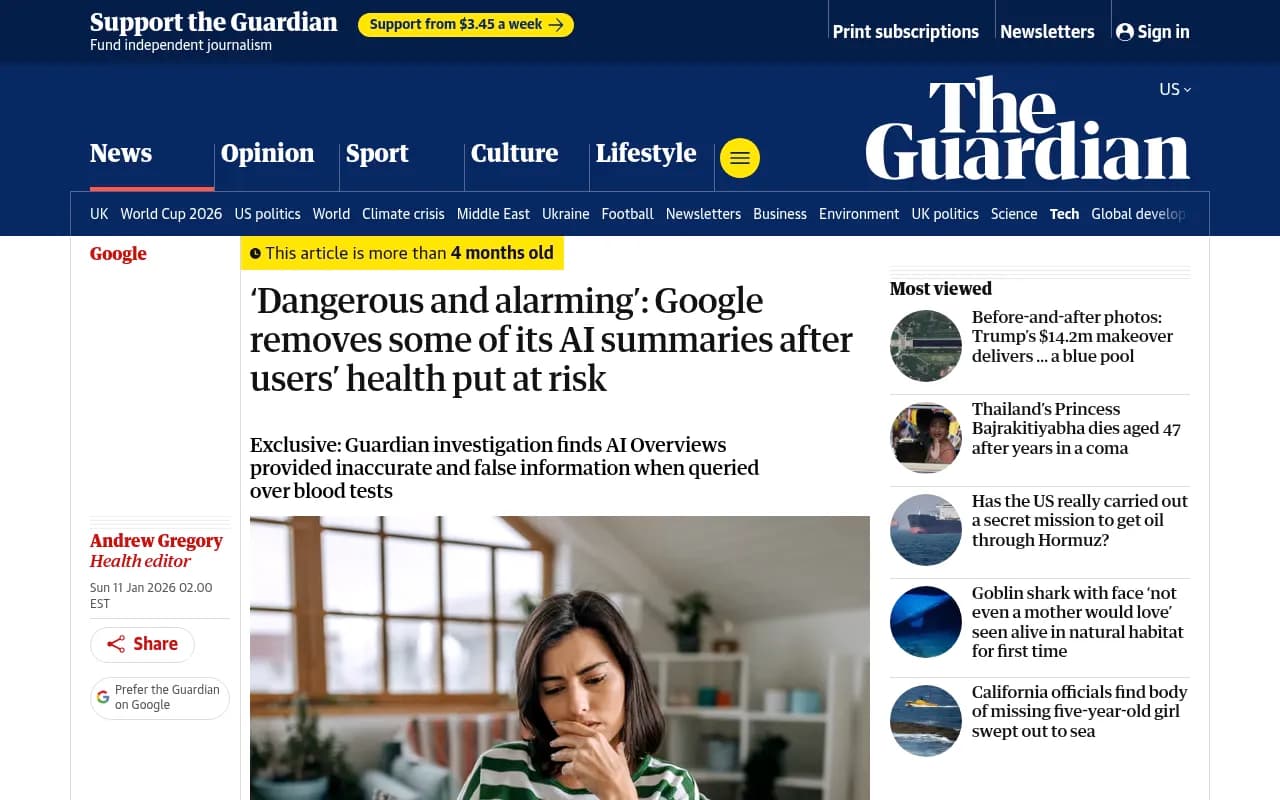
That last point matters. In January 2026, a Guardian investigation found that Google's AI Overviews were serving dangerous health information -- specifically, inaccurate liver function test ranges that could lead patients to miss serious diagnoses. Google removed some of those summaries. The incident is a useful window into how Google thinks about this: confidence in response quality is the gating factor, not just topical coverage.
Why the same query can appear differently on different days
This trips people up constantly. A user in Portugal documented exactly this in a Google Search Community thread in May 2026 -- the same query showed an AI Overview one day and a featured snippet the next, with no apparent change in search behavior.
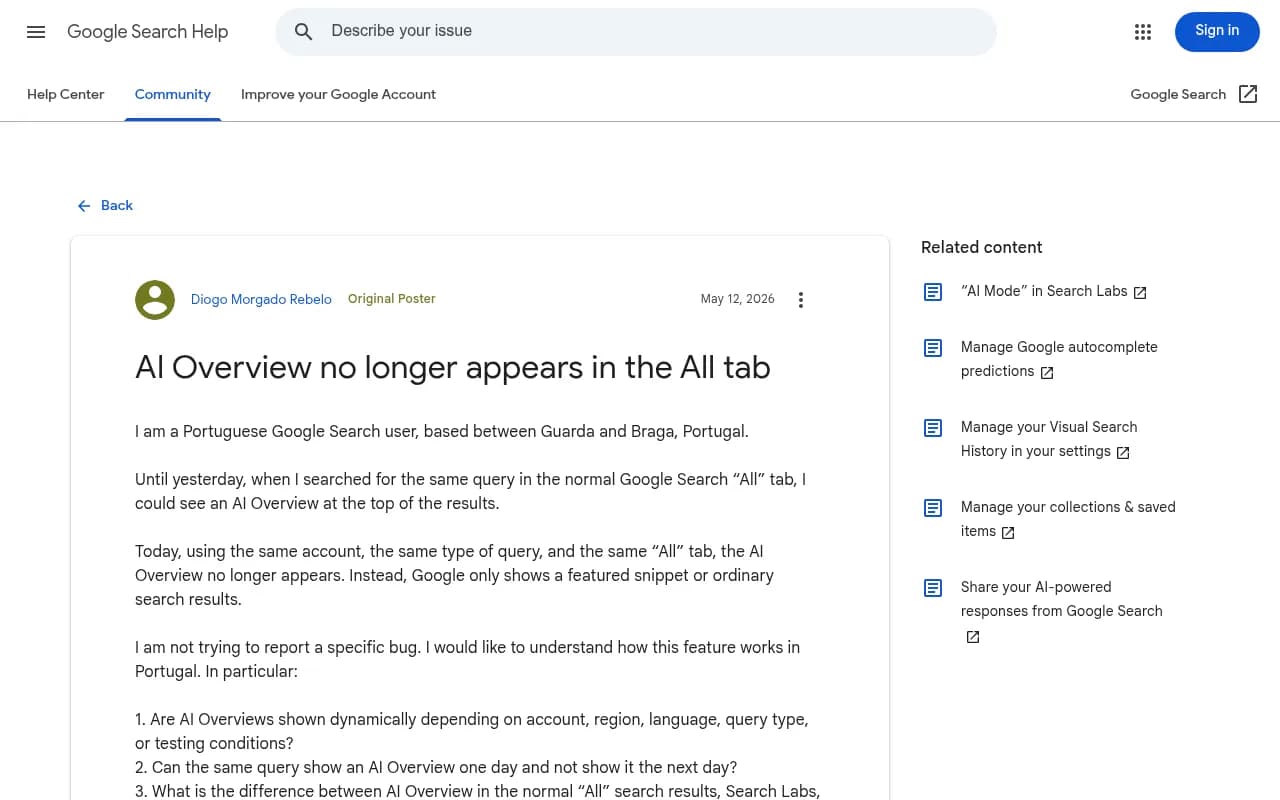
The answer from Google's community experts confirmed what many SEOs have suspected: AI Overview display is dynamic. It varies by account, region, language, query phrasing, and ongoing A/B testing. Google is continuously running experiments on which queries benefit from AI summaries, and your experience on any given day reflects the current state of those experiments in your region.
So if you're seeing inconsistency, that's not a sign something is broken. It's Google still figuring out where AI Overviews add value.
The five reasons you're visible for some queries but not others
1. Query intent mismatch
The single biggest factor. AI Overviews are almost exclusively triggered by informational and research-oriented queries. If you're tracking queries that are navigational (people looking for a specific site), transactional (people ready to buy), or local ("pizza near me"), you'll rarely see AI Overviews fire at all -- so your absence isn't a content problem, it's a category problem.
Run through your target queries and categorize them honestly. If you're chasing AI Overview visibility for bottom-of-funnel commercial terms, you're optimizing for something that rarely exists.
2. Content format doesn't match what AI systems want to synthesize
Google's AI systems are looking for content they can confidently extract and synthesize. That means:
- Clear, direct answers near the top of the page (not buried after three paragraphs of preamble)
- Structured content with logical headings that signal what each section covers
- Factual claims that can be verified or cross-referenced against other sources
- Appropriate depth -- not so thin that there's nothing to synthesize, not so dense that the key point is hard to extract
If your content is written primarily for conversion (lots of CTAs, brand voice, minimal factual density), it's less likely to be sourced in an AI Overview even if it ranks well organically. Google's synthesis engine is looking for informational utility, not persuasive writing.
3. E-E-A-T signals are inconsistent across your site
Google's quality thresholds for AI Overviews are higher than for standard ranking. Experience, Expertise, Authoritativeness, and Trustworthiness signals matter more here -- especially for YMYL (Your Money or Your Life) topics.
A page on a medical site that lacks author credentials, has no citations, and doesn't clearly identify who wrote it is less likely to be sourced in an AI Overview than a well-attributed page on a smaller site. This is particularly true after the January 2026 health summary controversy, which prompted Google to tighten its quality filters on health-related queries.
Check whether your pages that are missing from AI Overviews have:
- Named authors with visible credentials
- Publication and update dates
- Citations or references to primary sources
- Clear organizational affiliation
4. Technical issues blocking AI crawlers
This one is underdiagnosed. AI systems need to be able to crawl and index your content before they can cite it. Common blockers include:
robots.txtrules that inadvertently block Googlebot-Extended or AI-specific crawlers- JavaScript-rendered content that isn't being properly indexed
- Noindex tags on pages you actually want cited
- Slow page load times that cause crawlers to time out or deprioritize the page
- Thin or duplicate content signals that reduce crawl budget allocation
A technical SEO audit focused specifically on crawlability -- not just rankings -- is worth running if you're seeing gaps you can't explain through content quality alone.
5. Competitor content is simply better for that specific query
Sometimes the honest answer is that another site has a more comprehensive, better-structured, more authoritative page on that specific topic. AI Overviews tend to synthesize from a small number of highly trusted sources per query. If three authoritative pages already cover the topic well, your page may not add enough incremental value to be sourced.
This is where gap analysis becomes useful. Look at which pages are actually being cited in the AI Overviews you're missing from, and assess what they're doing that your content isn't.
How to run a systematic diagnostic
Step 1: Categorize your target queries by intent
Before anything else, sort your queries into: informational, navigational, transactional, local. Focus your AI Overview optimization efforts on informational queries -- that's where the opportunity actually exists.
Step 2: Check which queries are triggering AI Overviews at all
Search each target query manually (in an incognito window, from the relevant region) and note whether an AI Overview appears. If it doesn't appear for a query, the issue may not be your content -- it may be that Google hasn't decided to show AI Overviews for that query type yet.
Step 3: Audit the pages that are missing from AI Overviews
For queries where an AI Overview does appear but you're not cited, pull up the pages that are cited and compare them to yours. Look at:
- How quickly they answer the core question
- How they use headings and structure
- What factual depth they provide
- What E-E-A-T signals they display
This comparison usually reveals the gap faster than any tool will.
Step 4: Fix content structure before anything else
The most common fixable issue is that the answer to the query is buried. If someone searches "how does X work" and your page spends 300 words on background before getting to the actual explanation, Google's synthesis engine may skip it in favor of a page that leads with the answer.
Restructure key pages so the core answer appears in the first 100-150 words, supported by a clear H2 structure that signals the page's informational architecture.
Step 5: Track your citation patterns over time
Manual checking doesn't scale. Tools like Promptwatch track which of your pages are being cited in AI Overviews (and other AI search engines), how often, and what's changed over time. This turns a guessing game into a measurable process -- you can see exactly which pages moved from "crawled but not cited" to "actively cited" after content changes.

For tracking specifically within Google's ecosystem, Google Search Console now surfaces some AI Overview impression data, though it's still limited compared to what third-party tools provide.
Query types and their AI Overview likelihood
| Query type | AI Overview likelihood | Example | What this means for you |
|---|---|---|---|
| Informational / how-to | High | "how does HIIT work" | Primary optimization target |
| Research / comparison | High | "difference between LLC and S-corp" | Strong opportunity if you have depth |
| Health / medical | High but strict | "symptoms of vitamin D deficiency" | Requires strong E-E-A-T signals |
| Financial / legal | Medium-high | "how to file a tax extension" | Quality thresholds are elevated |
| Transactional | Low | "buy running shoes" | Rarely triggers AI Overviews |
| Navigational | Very low | "Spotify login" | Don't optimize for this |
| Local | Very low | "coffee shops near me" | Different feature set entirely |
The health and YMYL exception
It's worth spending a moment on this because it affects a significant portion of sites. After the January 2026 controversy around dangerous health summaries, Google tightened its confidence thresholds for medical, financial, and legal queries considerably.
If you operate in one of these spaces and you're seeing AI Overview visibility decline or inconsistency, it may reflect Google pulling back on lower-confidence sources in your category -- not anything specific you've done wrong. The path forward is the same: stronger author credentials, clearer sourcing, more precise factual claims, and content that a domain expert would recognize as accurate.
The BrightEdge data showing 98% AI Overview presence on pain-related queries is real, but that presence is concentrated among a smaller set of highly trusted sources than it was two years ago. The pie got bigger; the slices got fewer.
What not to do
A few common mistakes that don't help and sometimes hurt:
Don't stuff FAQ schema everywhere. Structured data can help signal content structure, but it's not a shortcut to AI Overview inclusion. Google's synthesis engine reads the actual content, not just the markup.
Don't write for AI Overviews at the expense of your actual users. Pages that are optimized purely for extraction -- short, flat, no depth -- tend to perform worse over time because they don't satisfy users who click through.
Don't assume ranking position determines AI Overview sourcing. Google regularly cites pages that rank in positions 5-15 in AI Overviews while ignoring the #1 result. Ranking and citation are related but separate signals.
Don't ignore technical crawlability. It's the least glamorous part of this, but a page that AI crawlers can't properly read will never be cited regardless of content quality.
Tools that help with diagnosis and tracking
Beyond Google Search Console, a few tools are worth knowing about for this specific problem:
Promptwatch is the most comprehensive option for tracking AI Overview citations alongside other AI search engines, with page-level citation tracking and content gap analysis that shows which queries competitors are visible for but you're not.
Semrush has added AI Overview tracking to its rank tracking suite, which is useful if you're already in that ecosystem.
Ahrefs has its Brand Radar feature for tracking AI mentions, though it uses fixed prompts rather than dynamic query tracking.
For content optimization -- making sure your pages are structured to be synthesizable -- tools like Clearscope and Surfer SEO help with topical depth and semantic coverage.

The bottom line
AI Overview visibility is not random, but it is dynamic. The queries where you're missing are almost always explainable by one of five factors: wrong query intent, poor content structure, weak E-E-A-T signals, technical crawlability issues, or stronger competing content. The diagnostic process is straightforward once you stop treating AI Overviews as a black box and start treating them as a content quality signal.
The sites that are consistently cited across a wide range of queries share one characteristic: they have pages that answer specific questions directly, credibly, and completely. That's not a new insight -- it's what good content has always looked like. AI Overviews just make the gap between good and mediocre content more visible than it used to be.