Key takeaways
- ChatGPT shopping recommendations are driven by data quality, not ad spend. Incomplete product data, missing structured markup, and inconsistent pricing make your products invisible.
- Syncing to ChatGPT (via Shopify, for example) is not the same as being recommended. The sync just makes you eligible.
- AI models cite products that match specific buyer intent, have strong review signals, and appear consistently across trusted third-party sources.
- You can audit your current visibility in about 20 minutes using nothing but ChatGPT itself.
- Tracking your ChatGPT Shopping presence over time requires dedicated tooling -- manual checks don't scale.
The shift that caught most brands off guard
Not long ago, the buying journey was predictable. Someone searched Google, opened several tabs, skimmed a few reviews, and eventually bought from whichever tab they hadn't closed yet.
That script is being rewritten. US shoppers now ask ChatGPT over 84 million shopping-related questions every week, according to data from Stackline. And AI-referred shoppers convert 31% better than those from traditional search, per Adobe's commerce data. That's not a rounding error -- that's a meaningful chunk of high-intent traffic that never touches your Google rankings.
The uncomfortable truth for most ecommerce brands: being absent from ChatGPT Shopping isn't a visibility problem you can solve with more ad spend. It's a data and content problem. And the brands that figure this out first will have a real head start.
How ChatGPT Shopping actually works
Before fixing anything, it helps to understand what's actually happening under the hood.
When someone asks ChatGPT "what's the best standing desk under $800 for a home office," the model doesn't search your product catalog. It draws on:
- Crawled web content (your product pages, category pages, blog posts)
- Third-party sources (review sites, Reddit threads, YouTube videos, comparison articles)
- Structured data signals (product schema, pricing, availability)
- Review and trust signals (star ratings, review volume, recency)
- Merchant integrations (Shopify's native ChatGPT sync, Walmart's in-chat app)
The model then assembles a recommendation that matches the buyer's specific intent. "Best standing desk" and "best standing desk under $800 for a home office" are very different prompts, and they can produce very different results.
This is why "show up in AI" is incomplete advice. You need to show up for the right prompts, with the right data, in the right context.
The most common reasons products don't appear
1. Incomplete or inconsistent product data
This is the single biggest issue. If your product title, description, price, and availability aren't consistent across your own site, Google Merchant Center, and any marketplace listings, AI models get confused signals and often skip you entirely.
Specifically, watch for:
- Product titles that are too generic ("Blue Shirt") or stuffed with irrelevant keywords
- Descriptions that describe features but never address use cases or buyer questions
- Prices that differ between your site and third-party listings
- Out-of-stock products that still appear in feeds
2. Missing or broken product schema
Structured data (JSON-LD Product schema) is how you explicitly tell crawlers -- including AI crawlers -- what your product is, what it costs, whether it's in stock, and what people think of it. Without it, AI models have to guess from your page content, and they often get it wrong or skip the page.
A basic Product schema block looks like this:
{
  "@context": "https://schema.org/",
  "@type": "Product",
  "name": "Ergonomic Standing Desk - 60 inch",
  "description": "Height-adjustable standing desk with memory presets, ideal for home offices.",
  "brand": {
    "@type": "Brand",
    "name": "YourBrandName"
  },
  "offers": {
    "@type": "Offer",
    "priceCurrency": "USD",
    "price": "749.00",
    "availability": "https://schema.org/InStock"
  },
  "aggregateRating": {
    "@type": "AggregateRating",
    "ratingValue": "4.7",
    "reviewCount": "312"
  }
}
Every product page needs this. Not just your top sellers.
3. Content that doesn't match buyer intent
Your product page was built to convert someone who already found you. ChatGPT is trying to answer someone who hasn't decided yet. Those are different jobs.
A product page that says "Premium ergonomic desk with dual motor lift system" doesn't answer "what's the best standing desk for someone with lower back pain who works from home." The page needs to speak to specific use cases, personas, and contexts -- not just the product category.
This is the gap most brands miss. You need content that answers the questions buyers are actually asking, not just content that describes what you sell.
4. Weak or absent review signals
Reviews are one of the strongest trust signals AI models use when evaluating products. A product with 12 reviews and a 3.8 average is going to lose to a competitor with 400 reviews and a 4.6 average, almost every time.
This isn't just about volume. Recency matters. A product with 200 reviews, all from 2022, looks stale. AI models pick up on this.
5. No presence on third-party sources
ChatGPT doesn't just read your website. It reads the whole web. If your product isn't mentioned in any review articles, comparison guides, Reddit threads, or YouTube videos, you're essentially invisible to the model for anyone who isn't already searching for your brand by name.
The brands that show up consistently in AI shopping recommendations tend to have strong offsite presence: they're in "best of" lists, they're discussed in niche communities, they have YouTube reviews. This isn't accidental.
6. The sync/recommendation confusion (Shopify users especially)
If you're on Shopify, your products do sync to ChatGPT automatically through the Shopify-OpenAI integration. But syncing just means you're in the pool. Whether ChatGPT actually recommends you depends entirely on data quality, reviews, and content relevance. A lot of Shopify merchants assume the sync means they're visible. It doesn't.
The exact steps to fix it
Step 1: Audit your current visibility
Before changing anything, find out where you actually stand. Open ChatGPT and ask it the questions your customers ask. Be specific:
- "What's the best [your product category] for [specific use case]?"
- "Which [product type] would you recommend for someone who [buyer persona]?"
- "Compare [your brand] vs [competitor]"
Note whether you appear, where you appear in the list, and what ChatGPT says about you. This is your baseline.
If you want to do this systematically across multiple prompts and track changes over time, manual checks won't cut it. Tools like Promptwatch track your ChatGPT Shopping appearances across hundreds of prompts automatically, including which pages are being cited and how your visibility shifts after you make changes.

Step 2: Fix your product schema
Run every product page through Google's Rich Results Test (search.google.com/test/rich-results). Any page that fails or shows warnings needs to be fixed.
Prioritize:
- Adding
aggregateRatingif you have reviews - Ensuring
priceandavailabilityare accurate and current - Adding
brandmarkup - Including
descriptionthat addresses use cases, not just features
For Shopify stores, most themes generate basic Product schema automatically, but it's often incomplete. Check that your reviews app is injecting rating data into the schema, not just displaying it visually.
For WooCommerce, the Yoast SEO or Rank Math plugins handle schema generation, but you'll want to verify the output.
Step 3: Rewrite product descriptions for buyer intent
This is the most time-consuming fix, but it moves the needle the most. For each product, think about:
- Who specifically buys this? (Not "adults" -- "remote workers with back pain who sit 8+ hours a day")
- What problem does it solve?
- What questions do buyers ask before purchasing?
- What objections do they have?
Then rewrite your product descriptions to answer those questions directly. Don't abandon the feature list -- just lead with the use case and the buyer context.
A good structure: open with the problem or use case, explain how the product addresses it specifically, then list features. Keep it scannable.
Step 4: Build review infrastructure
If your review count is low, fix the collection process first:
- Send post-purchase review request emails at 14 and 30 days (not 3 days -- give people time to use the product)
- Make the review process frictionless: one click to the form, no account required
- Respond to existing reviews, especially negative ones -- this signals active management to both customers and AI models
For platforms like Trustpilot or Google, the key is consistency. A steady stream of new reviews matters more than a burst followed by silence.
Step 5: Get onto third-party sources
This is where most brands underinvest. A few high-value moves:
- Reach out to niche review bloggers and comparison sites in your category. Offer a product sample for an honest review.
- Answer relevant questions on Reddit in your product category. Don't pitch -- just be genuinely helpful. Your brand gets mentioned naturally.
- Create YouTube content (or get YouTubers to review your product). ChatGPT cites YouTube videos in shopping recommendations more than most brands realize.
- Submit to relevant "best of" listicles. A lot of these are maintained by content teams who update them regularly -- getting on one list can compound over time.
Step 6: Create intent-specific landing pages
Your main product page can't do everything. Consider creating dedicated pages for specific use cases:
- "Best standing desk for home office" (different from "best standing desk for gaming")
- "Standing desk for people with back pain"
- "Standing desk under $800"
These pages can be thin on product detail but rich on context, comparison, and buyer guidance. They're exactly what AI models are looking for when someone asks a specific question.
[tool:conver tmate]
How to track whether it's working
This is where a lot of brands get stuck. You make changes, then... what? You can't just check ChatGPT manually every week for 50 different prompts.
A few approaches:
Manual spot checks (free, limited)
Pick 5-10 high-priority prompts and check them weekly. Note your position, what ChatGPT says, and which competitors appear. It's slow but it gives you a feel for the direction.
Dedicated AI visibility tools
For anything beyond basic spot checks, you need tooling. The table below covers the main options for tracking ChatGPT Shopping visibility:
| Tool | ChatGPT Shopping tracking | Competitor comparison | Content recommendations | Price |
|---|---|---|---|---|
| Promptwatch | Yes (page-level) | Yes (heatmaps) | Yes (content agents) | From $99/mo |
| Otterly.AI | Basic | Limited | No | From $49/mo |
| Profound | Yes | Yes | No | Higher tier |
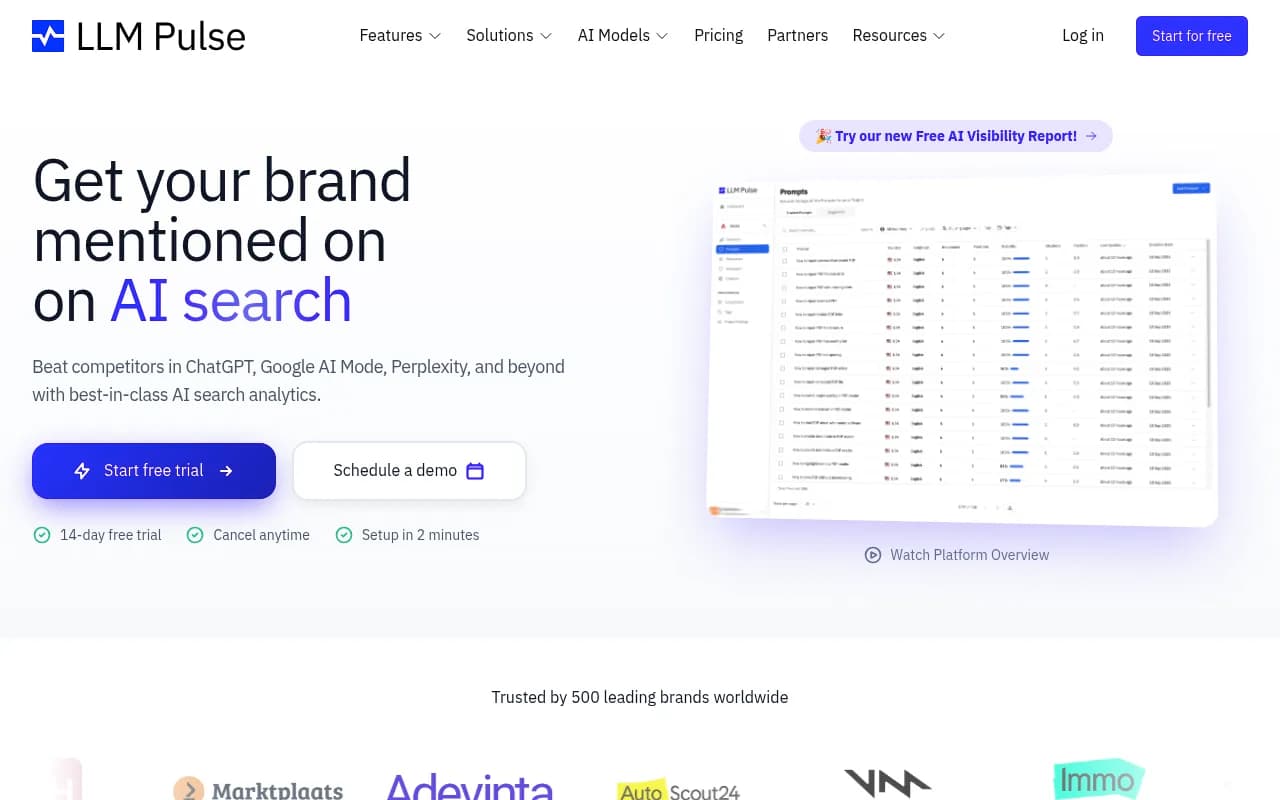
| LLM Pulse | Basic | Limited | No | Freemium |
| ProductRank | Basic | No | No | Free |
Otterly.AI

Profound

The meaningful difference between these tools is what happens after you see the data. Most monitoring tools show you that you're not appearing -- then leave you to figure out why and what to do. Promptwatch goes further: it shows you which specific prompts competitors are winning that you're not, then helps you create the content to close those gaps.
Watch your traffic sources
Once you start appearing in ChatGPT Shopping, you'll see traffic from chatgpt.com in your analytics. Set up a segment in Google Analytics or your analytics platform to track this specifically. AI-referred traffic tends to behave differently from organic search traffic -- higher intent, often landing on product pages directly.
A note on the Shopify + ChatGPT integration
OpenAI announced native checkout capabilities powered by Shopify in early 2026, and Walmart launched a deeper in-chat shopping app around the same time. These integrations mean the gap between "ChatGPT recommends your product" and "customer buys your product" is shrinking fast.
But the integrations don't change the fundamental equation. ChatGPT still decides what to recommend based on data quality and content relevance. The checkout integration just removes friction for buyers who've already been recommended your product. If you're not being recommended, the checkout integration doesn't help you.
Fix the data. Fix the content. The infrastructure is already there.
The brands that will win
The marketplaces and brands cleaning up their product data, building review infrastructure, and creating intent-specific content right now will have a meaningful advantage in 12 months. The ones waiting to see if ChatGPT Shopping "really takes off" will be playing catch-up.
84 million shopping questions a week, converting at 31% better than search traffic. That's not a trend to watch. That's a channel to be in.
Start with the audit. Ask ChatGPT the questions your customers ask. See what comes back. Then work backwards from the gaps.