Key takeaways
- Finseo starts at €84/month (Starter) and scales to €479/month (Growth), with transparent self-serve pricing and up to 11 AI models trackable on Enterprise. It's bootstrapped, German-based, and EU data-resident.
- Profound's public pricing page now shows only a free Trial and custom Enterprise, after raising a $180M Series D at a $1.8B valuation in September 2026. It serves over 1,000 enterprise brands, including a third of the Fortune 100.
- Profound has 1,130 G2 reviews; Finseo has 3. That gap matters if you're relying on peer validation before buying.
- Finseo includes bot traffic analytics, CRM attribution, and 40+ integrations starting at its Business tier (€210/month) - features Profound only ships to Enterprise accounts at custom pricing.
- Neither tool is the only option. If you want a platform built around fixing visibility rather than just reporting it, it's worth putting Promptwatch next to both before you sign anything.
Two products, two very different starting points
I'll say the obvious thing first: comparing Finseo and Profound head-to-head is a little like comparing a well-equipped hatchback to a custom-built truck. They both drive, they both track AI visibility across ChatGPT, Gemini, Claude, and Perplexity, but they were built for buyers with very different budgets, team sizes, and patience for sales calls.
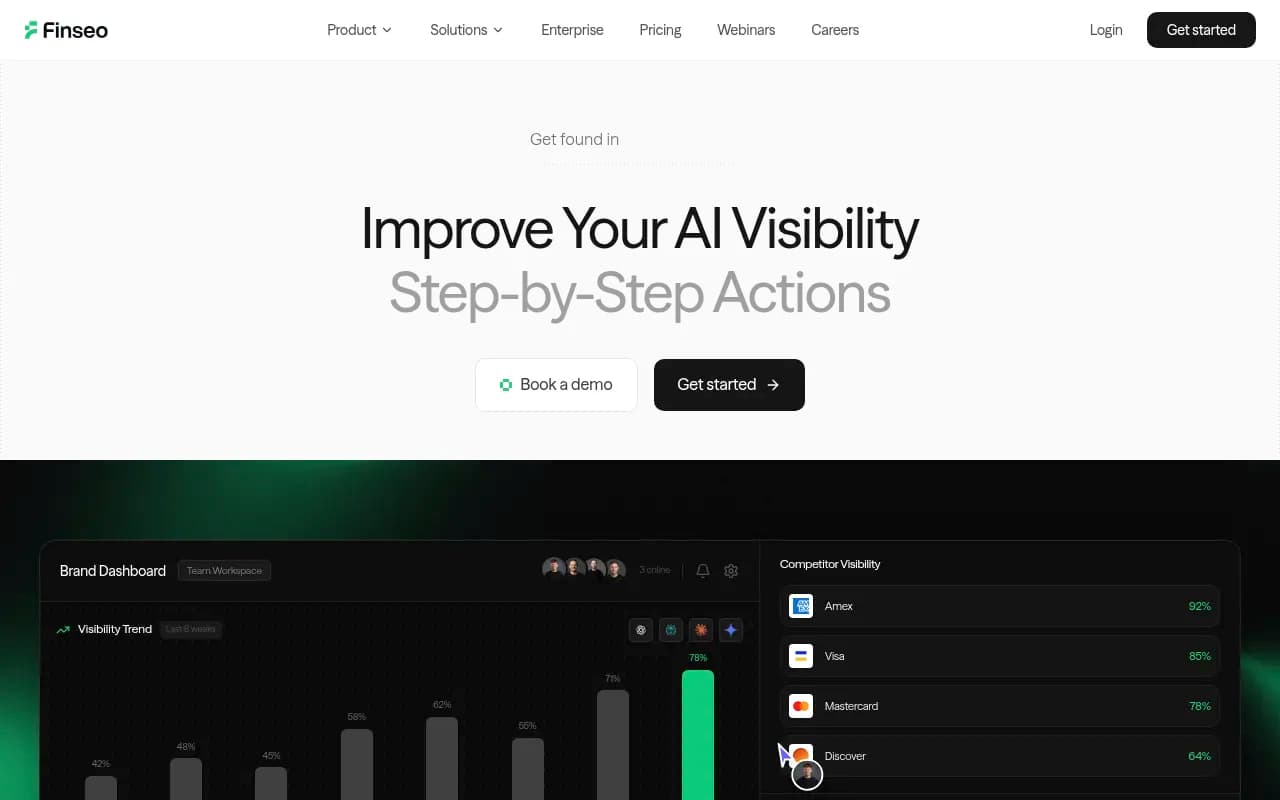
Finseo is a bootstrapped German company (Finseo GmbH, based in Gaildorf, Baden-Württemberg) that publishes real pricing on its website and lets you sign up with a credit card. Profound raised $180 million in September 2026 at a $1.8 billion valuation and, as of this writing, its public pricing page shows exactly two options: a 7-day free trial and "custom Enterprise pricing." That's not a knock on either approach. It's just a fundamentally different go-to-market, and it should shape how you think about which one fits your team.

What Finseo actually gives you
Finseo's pricing is refreshingly boring in the best sense. You can see exactly what you get at each tier before talking to anyone.
- Starter (€84/month): 50 prompts, 3 AI models, 1 project, 4,500 AI answers tracked monthly, 300 Agent credits. No bot traffic analytics or attribution here.
- Business (€210/month): 150 prompts, 13,500 AI answers, and this is where it gets interesting - bot traffic analytics, CRM/attribution integrations, and an AI content agent with 15 articles included per month.
- Growth (€479/month): 350 prompts across 5 projects, 31,500 AI answers, 25,000 Agent credits (50 articles), API access, priority support.
- Enterprise (custom): up to 11 LLMs tracked concurrently, unlimited projects, SSO/SAML, a custom strategy paper, and a dedicated Slack channel.
What's notable is the breadth of models Finseo tracks beyond the usual four. It covers ChatGPT, Gemini, Google AI Overviews, AI Mode, Claude, Perplexity, Copilot, Grok, DeepSeek, and Mistral, plus regional add-ons for Naver, Qwen, Kimi, Meta AI, and several other models mostly relevant to APAC and Latin American markets. If you sell into those regions, that's a real differentiator most Western-focused tools skip entirely.
Finseo also ships 40+ integrations grouped into analytics (GA4, Search Console, Looker Studio), CMS (Shopify, WordPress, Webflow, Framer), bot traffic (Cloudflare, Fastly, Akamai, Vercel), project management (ClickUp, Asana, Jira), and CRM/attribution (HubSpot, Salesforce, Stripe, Zapier). Most of those integrations only unlock starting at Business, which is worth knowing before you budget for the cheaper Starter tier and then discover you need the next one up anyway.
One honest caveat: Finseo's G2 page has only 3 reviews (all 5-star), which is too small a sample to mean much either way. An earlier AppSumo listing for the product criticized an early version's cluttered UI, but that review predates the more polished product Finseo ships today. Treat both data points as thin.
What Profound actually gives you
Profound's story in 2026 is mostly a funding story. The $180 million Series D, co-led by Sequoia Capital and Kleiner Perkins with Lightspeed, Khosla Ventures, and others participating, values the company at $1.8 billion and funds an "applied AI lab" in New York and San Francisco. Profound now claims over 1,000 enterprise brand customers, including a third of the Fortune 100, and has integrated its AEO data directly into G2's seller dashboards.
Profound tracks up to 9 answer engines on its top tier, including ChatGPT, Perplexity, Google AI Mode, Gemini, Copilot, DeepSeek, Claude, AI Overviews, and Exa Search. The platform has shifted its positioning from pure monitoring toward what it calls "AI Marketer": an agentic system for research, content writing, reporting, and team collaboration, not just a dashboard that tells you where you got mentioned.
Profound

The catch is access. Profound's free trial covers just 3 surfaces (ChatGPT, Gemini, AI Overviews) for 7 days, with 50 prompts run daily, no history, no exports, and no API. Past that, you're talking to sales. Third-party estimates (not confirmed on Profound's own site) put a real-world starting price somewhere around $399/month for a multi-engine plan, and Enterprise is fully custom. If your procurement team is comfortable with a sales cycle and your budget has room for enterprise software, that's fine. If you're a five-person marketing team trying to get a fast read on AI visibility before your next board update, it's a much bigger commitment than Finseo's card-and-go signup.
A competing vendor, Conductor, has published claims that Profound's AI-engine data is scraping-based rather than API-direct and that it lacks technical AEO monitoring like schema or crawl-directive checks. Those are self-serving claims from a rival SEO platform, so take them with the appropriate grain of salt, but they're worth raising with Profound's sales team directly if technical crawl monitoring matters to your use case.
Side-by-side comparison
| Factor | Finseo | Profound |
|---|---|---|
| Starting price | €84/month, self-serve | Free trial; paid plans effectively custom/sales-led |
| Published pricing | Full tiers listed on site | Only Trial and Enterprise shown publicly |
| Model coverage | Up to 11 models, including regional (Qwen, Kimi, Naver) | Up to 9 engines, strong on major Western/global models |
| Funding | Bootstrapped, profitable, no VC | $180M Series D, $1.8B valuation (Sept 2026) |
| G2 reviews | 3 | 1,130 |
| Best fit | SMBs, agencies, EU-based teams wanting fast self-serve setup | Large enterprises, Fortune 500-scale programs, sales-led buying |
| Data residency | Frankfurt (EU), GDPR-friendly | Not publicly specified; US-headquartered |
| Content generation | Agent credits for articles from Business tier up | "AI Marketer" agent credits, scales with complexity |
Where the 'budget vs enterprise' framing breaks down
Here's where I'll push back a little on the premise of the question. "Budget" makes Finseo sound like it's cutting corners, and it isn't, really. Its Business tier at €210/month includes bot traffic analytics and CRM attribution that Profound only unlocks at custom Enterprise pricing. If you're a mid-sized SaaS company in Europe that needs GDPR-friendly data residency and a fast setup, Finseo's feature set at that price point is genuinely competitive, not a stripped-down version of something better.
On the other side, "enterprise-grade" doesn't automatically mean "better data." Profound's scale and funding buy it depth in agentic content workflows and a much larger customer base to learn from, but a five-person marketing team doesn't need 1,000 Fortune 100 case studies. It needs a tool it can turn on this week.
The more useful question isn't "which is better" but "which matches how my team actually buys software." If you want to see pricing, sign up, and start tracking prompts by lunchtime, Finseo fits. If you're running AEO across a dozen regional brand teams and need dedicated Slack support with a 24-hour SLA, Profound's Enterprise tier is built for exactly that.
Why visibility-only tracking isn't the whole job anymore
Both tools, at their core, answer the question "was my brand mentioned?" That's useful, but it's not the same as answering "why wasn't I mentioned, and what do I fix first?" Understanding scarcity matters here too: Promptwatch's data on average sources per response shows ChatGPT typically cites only around 5 sources per web-search answer, versus roughly 10 for Perplexity and Google AI Overviews, which means winning one of those ChatGPT slots is a much higher-stakes fight than it looks on paper.
That's the gap that tools like Promptwatch are built to close. Rather than stopping at a visibility score, it layers in AI crawler logs showing exactly when GPTBot, ClaudeBot, or PerplexityBot hit your pages, citation analytics that trace which pages actually get cited (including on Reddit and YouTube, channels most monitoring tools skip entirely), and visitor analytics that tie AI traffic to actual conversions. Then its Content Agents write and publish GEO-optimized content straight to your CMS, and Unified Actions turns all of that into a prioritized to-do list instead of a dashboard you have to interpret yourself.

For context on how mid-authority sites compete for citations, Promptwatch's domain-rank data from August 2026 found that mid-authority domains (DR 46-75) earned nearly half of all ChatGPT Search citations that month, while the very top domain-rank tier actually lost share. If you're evaluating any AI visibility tool, whether it's Finseo, Profound, or something else, ask how it helps you act on findings like that, not just report them.
Which one should you actually pick
If you're an SMB, a solo marketer, or an agency managing a handful of client accounts and want something you can start using today without a sales call, Finseo's published pricing and broader model coverage (especially for non-English markets) make it the more practical starting point. Its Business tier covers most of what a growing team needs.
If you're running AEO for a large enterprise with multiple brands, need SSO, custom prompt sets at scale, and a dedicated account team with an SLA, Profound's Enterprise tier and its funding-backed roadmap make more sense, assuming your procurement process can handle a custom quote rather than a published price.
Either way, before you commit budget to a 12-month contract, it's worth running a free trial of both and checking how each performs against your actual prompts, not the vendor's demo prompts. And if the deciding factor for your team is turning visibility data into published content and fixed crawl issues rather than just another dashboard, put Promptwatch on the shortlist too. For a broader look at the category, the GEO software directory at bestgeosoftware.com is a good place to keep comparing options as pricing and features shift through the rest of 2026.