Key takeaways
- Gauge's Growth plan is $599/month and covers three platforms (ChatGPT, Google AI Mode, Microsoft Copilot). Gemini, Perplexity and AI Overviews need Enterprise.
- Entry prices across the category run from about $29/month to $599/month, but prompt counts, engines and refresh rates differ so much that sticker price is a poor comparison.
- Most alternatives stop at monitoring. If you want to fix visibility and not just watch it, look for crawler logs, traffic attribution and content workflows.
- Pricing in this guide comes from vendor pages and third-party roundups. Confirm every number on the vendor's own pricing page before you buy.
What Gauge does, and why people look elsewhere
Gauge is a Y Combinator-backed platform that tracks brand presence in AI answers. It separates citation rate (your URLs appear as sources) from mention rate (your brand name appears in the text). That distinction is useful, because a brand can be cited as a source while its name gets stripped from the answer.
On Gauge's own pricing page, the Growth plan is $599/month. You get 600 prompts run daily across 3 platforms, which Gauge counts as 54,000 AI answers a month. It also includes 18 publish-ready articles per month, 3 seats, unlimited domains and competitors, one location, and integrations with GA4, Search Console, DataForSEO, Webflow, Framer, Sanity, GitHub and Slack. Enterprise is custom and adds Gemini, Perplexity, AI Overviews, sentiment and exports. Claude and Grok are optional, but you bring your own API key.
Gauge's argument is that it costs about a penny per answer, and that cheaper-looking tools cost more once you count prompts, models and run frequency. That is a fair point. It is also worth knowing why people leave:
- $599/month is a steep jump for a team still proving that AI search matters.
- Growth covers only three engines. Third-party lists saying "up to 6 platforms" are describing Enterprise.
- Some teams want deeper data (crawler logs, AI traffic, query fan-outs) than a monitoring-first tool gives.
- Others just need a cheap tracker and will never use 18 articles a month.
One warning on research: a couple of roundups quote Gauge at $50 to $200 a month. That does not match the official pricing page, so ignore it.
How I compared these tools
Three questions matter more than the feature checklist.
- Which engines are tracked, and is the data from the real interface or an API? Answers and citations in the consumer UI can differ from API output.
- How deep does tracking go? Mentions only, or also citations, sentiment, query fan-outs, crawler activity and traffic?
- What does it cost per useful answer, not per month?
The fan-out point is worth a moment. Promptwatch Data's ChatGPT query fanouts report found averages well below the "3 to 8 searches per prompt" folklore: about 2.15 fanouts per response in early December 2025, about 1.84 by early March 2026, and 1.0 when fanouts returned in April 2026. The sub-queries the model generates are what actually decide which pages get cited, so tools that surface them show you more than tools that only report mentions.
Engine behavior also varies. According to Promptwatch Data's average sources per response report, ChatGPT cites about 5 sources per web-search answer, Google AI Overviews about 10, and Perplexity almost exactly 10 every day. Copilot swung from under 2 to nearly 17 within a few weeks. Practical upshot: measure AI Overviews and ChatGPT separately, judge Copilot on monthly trends, and use Perplexity as a stable test bench.
Comparison table
Prices come from third-party roundups (mostly BrandAxis, October 2026, and Profound's buyer's guide) unless noted. Treat them as starting points and verify.
| Tool | Entry price (reported) | Tracking depth | Best for |
|---|---|---|---|
| Gauge | $599/mo (Growth) | 3 engines, citation + mention rate, articles | Teams that want monitoring plus drafts |
| Promptwatch | Free tier; paid from $95/mo | All major engines via real UI, crawler logs, traffic, content agents | Teams that want to fix visibility, not only watch it |
| Peec AI | About $95/mo (or EUR 89 per Profound's guide) | 3 engines, extras cost more | Small teams starting out |
| Otterly.AI | $29/mo (Lite, 15 prompts) | Basic prompt tracking | Solo marketers |
| Profound | $99/mo Starter (ChatGPT only) | Deep reporting, agents, prompt volumes | Enterprise |
| AthenaHQ | $295/mo | 8 engines, agent that acts on findings | Small agencies |
| Scrunch AI | $100/mo Explorer (ChatGPT only); $250/mo annual per BrandAxis | Persona and buyer-journey testing | B2B and technical fixes |
| Semrush AI Toolkit | $99/mo | AI visibility inside a full SEO suite | Existing Semrush users |
| ZipTie | About $42.75/mo | ChatGPT, AI Overviews, Perplexity | Flexible, usage-based tracking |
The two Peec figures conflict across sources. Check Peec's pricing page.
1. Promptwatch
Promptwatch is the one I would look at first if the complaint about Gauge is "it tells me what's wrong but my team has to do everything." It tracks the actual interfaces of ChatGPT, Google AI Overviews, Google AI Mode, Gemini, Perplexity, Copilot, Meta AI and Alexa, in each country and language. Alongside monitoring it has IP-verified AI crawler logs, visitor analytics for AI-referred traffic, weekly site audits, content gap analysis, and a Content Agent that plans, writes and publishes to WordPress, Webflow or Framer, then tracks whether those pages get crawled and cited.

Pricing starts with a free Explore plan (10 prompts, ChatGPT only), then Essential at $95/month for 50 prompts and all models, Professional at $245/month, and Business at $579/month with the automated Content Agent, local targeting and more. Agency plans start at $199/month. A 7-day trial applies to monthly plans. Confirm at promptwatch.com/pricing.
The tradeoff: the feature surface is large, so a solo marketer who only wants a weekly mention count may find it more than they need.
2. Peec AI
Peec AI is widely praised for a clean dashboard and for benchmarking. BrandAxis cites 2,500+ teams and a 4.9 G2 rating. The catch is that additional models beyond the included three are paid add-ons, and the cost climbs quickly: about $95 to start and $245 for a serious prompt set, according to BrandAxis. Profound's guide says it is a good pick if you only need basic data, and a poor one if you want recommendations to improve visibility.

3. Otterly.AI
Otterly.AI is the cheapest credible way in. The Lite plan is $29/month for 15 prompts. BrandAxis puts the Standard tier at $189. It is a prompt tracker, not an optimization platform, so expect no crawler logs and no content generation. For a solo marketer testing whether AI visibility is worth caring about, it is fine.
Otterly.AI

4. Profound
Profound is the enterprise heavyweight. Its Starter plan is $99/month but tracks ChatGPT only, so real use sits well above that. Strengths are deep reporting, prompt volumes and autonomous agents, including recent Google Search and OpenAI Ads nodes. If you are comparing it to Gauge, you are comparing two different budgets.
Profound

5. AthenaHQ
AthenaHQ starts at $295/month, with free credits to try it. Profound's guide lists coverage of ChatGPT, Perplexity, AI Overviews, AI Mode, Gemini, Claude, Copilot and Grok, which is broader than Gauge Growth. It pitches an agent that acts on findings. Profound's own comparison says it suits small agencies chasing lead gen, and that it lacks prompt volume data. That is a competitor's view, so test it yourself.

6. Scrunch AI
Scrunch AI is built around persona-based buyer-journey testing and technical fixes for AI readability. The Explorer plan is $100/month but ChatGPT only; BrandAxis lists $250/month on annual billing for a broader tier. Good fit for B2B teams who want to simulate how different buyers ask questions.
7. Semrush AI Toolkit
If you already pay for Semrush, the AI Toolkit at about $99/month adds AI visibility inside the same login. The depth is shallower than purpose-built platforms, but one contract and one dashboard has real value for agencies already living in Semrush.
8. ZipTie
ZipTie is usage-based, with plans from roughly $42.75/month and a seven-day trial that includes 25 daily prompts across ChatGPT, Google AI Overviews and Perplexity, according to Straight North. It is a good middle path if Otterly feels too thin and Gauge too costly.
9. SE Visible and SE Ranking
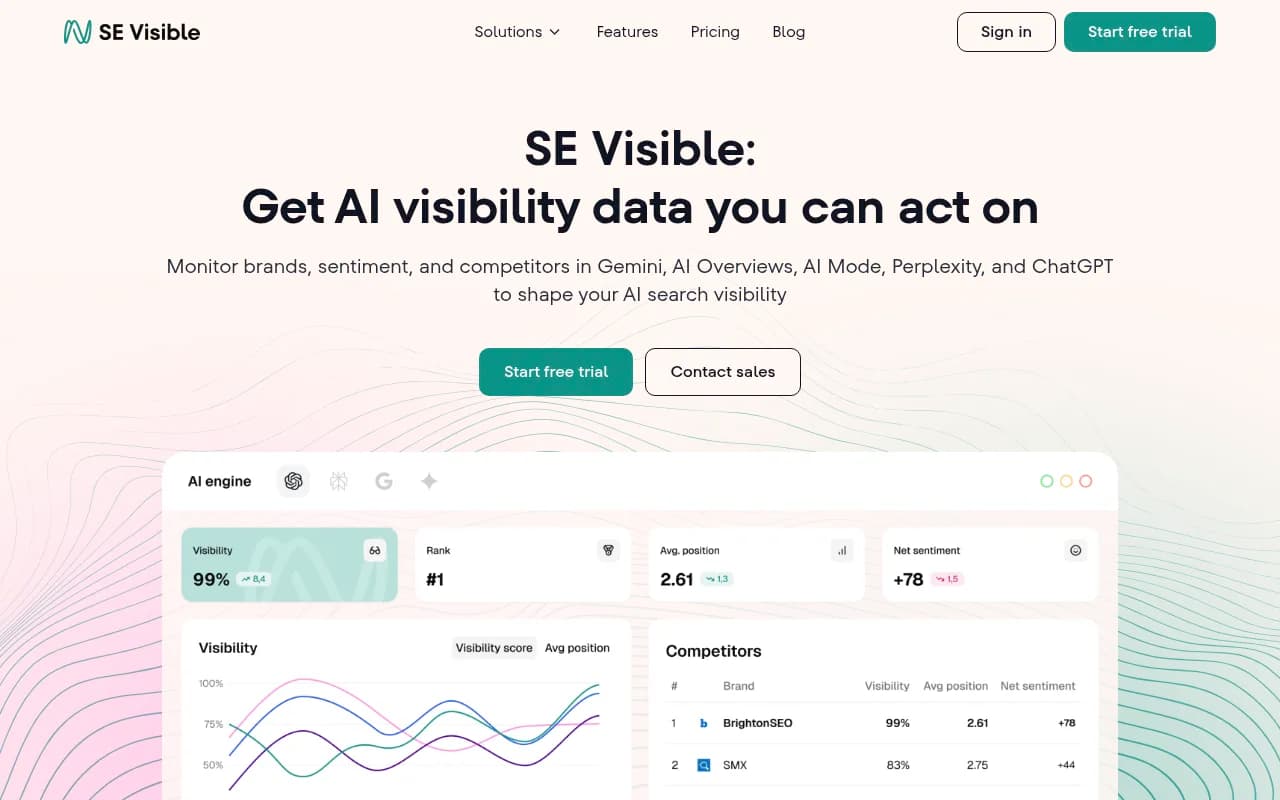
SE Visible, from SE Ranking, charges $99/month (Basic), $189 (Core) and $355 (Plus) per Profound's guide. BrandAxis notes SE Ranking's bundle gives 200 weekly prompts for $99, which beats daily-refresh rivals on volume if weekly cadence is acceptable. Its blind spot is the same as most trackers: it shows mentions without the tools to fix them.
Which one should you pick?
Start from what you will do with the data.
- You need cheap proof that AI visibility matters: Otterly.AI or ZipTie, then upgrade.
- You already live in an SEO suite: Semrush AI Toolkit or SE Visible.
- You want to act on the data, not only read it: Promptwatch, or Gauge if its article drafting fits your workflow and you can afford $599.
- You are enterprise and need reporting depth: Profound.
- You sell to B2B buyers and care about persona testing: Scrunch AI.
A fair gut check on price: Gauge's cost-per-answer argument holds up if you truly run 600 daily prompts. If you would only run 50, you are paying for capacity you will not use, and a smaller plan elsewhere is the better deal.
Before you buy
- Ask whether data comes from the real UI or from APIs.
- Count the engines you actually need. Gauge Growth omits Gemini, Perplexity and AI Overviews.
- Check refresh rate. Daily and weekly runs are priced very differently.
- Check what is gated: sentiment, exports and extra models are often add-ons.
- Run a trial with the same 20 prompts in two tools and compare the results.
For more options, the GEO software directory lists dozens of platforms beyond these nine, and Promptwatch Data publishes free research on how the engines cite sources so you can sanity-check what any tool tells you.
One gap in the research behind this guide: I did not independently verify competitor pricing, and the sources disagree on a few entries (Peec especially). Treat the table as a shortlist, then confirm on each vendor's pricing page.