Key takeaways
- Being named in an AI answer and being cited as a source are two different results. Track both, engine by engine.
- Pages that describe what you sell (product and landing pages) earn about 39% of ChatGPT citations, so compliance-approved product copy is your strongest GEO asset.
- Compliance is rarely the real blocker. Vague pages, blocked crawlers and missing third-party coverage usually are.
- Build a pre-approved answer library, so compliance reviews each claim once and marketing reuses it.
- Run a 90-day baseline-and-retest cycle on 25 to 50 buyer questions in Dutch and English.
Why Dutch financial brands should care about GEO now
A Dutch customer comparing mortgage providers, travel insurance or a business current account increasingly asks ChatGPT, Gemini or Perplexity first. Google AI Overviews sit above the organic results for many financial queries. You can rank on page one and still be absent from the answer the person actually reads.
Finance is also a category where AI engines are cautious. They lean on regulators, comparison sites, established publishers and clear product documentation. That is good news for regulated brands that publish accurate, well-structured pages, and bad news for anyone whose key facts live inside PDFs, login walls or vague marketing copy.
A word on scope. This guide covers GEO mechanics, backed by Promptwatch Data and published fintech studies. It does not cover the details of Dutch regulation. I did not verify AFM, DNB, Reclame Code Commissie, DORA, EU AI Act or GDPR specifics for this piece, so take those to your compliance and legal teams. Nothing here is legal advice.
What the evidence says about citations in finance
Appearing and being cited are separate
A 5WPR measurement of 2,034 AI answers on September 14, 2026, reported by Everything PR, found that appearance and citation diverge. Stripe appeared in 36.6% of combined fintech answers, while Shopify had the highest owned-domain citation rate at 12.3%. The four engines in the study also painted four different pictures of the same brands.
The practical lesson: a brand can be mentioned constantly and never have its own page used as a source. Mentions without self-citations usually point to content or crawlability problems, not reputation.
Third-party publishers fill the gaps
In the same research, Forbes was cited in 36.1% of 1,158 evidence-backed answers in the combined roll-up, more than any single brand's own domain. In the BNPL sub-study, CNBC appeared in 53.1% of 288 evidence-backed answers. When your own page does not state a fact clearly, AI engines borrow it from someone else. For Dutch brands the equivalents are the national financial press, comparison sites and consumer organisations. I have no Dutch-language citation data, so check which outlets show up for your own prompts rather than assuming.
Which page types get cited
Promptwatch Data for Sep 28 to Oct 4, 2026 shows product pages are the most cited content type in ChatGPT at 22.4%, with landing pages at 16.8%. Listicles take 13.6%, documentation 7.5%, comparisons 5.9% and FAQ pages 3.3%.
The split by prompt type matters for financial services:
| Prompt type | Top cited formats | What it means for you |
|---|---|---|
| Commercial (comparing options) | Product pages 26.0%, landing pages 20.6%, listicles 15.0%, comparisons 7.9% | Your product pages and "best of" roundup presence decide shortlists |
| Informational (how it works) | Product pages 19.1%, landing pages 13.9%, listicles 13.6%, how-tos 10.7%, docs 8.5% | Explainers and documentation earn real share |
| Branded (naming your company) | Product pages 23.3%, landing pages 22.8%, reviews 5.6%, FAQ 4.8% | Reviews and FAQs shape what AI says about you by name |
Reviews are worth a second look. At 5.6% of branded citations they have more than three times their share across all prompts. For a bank or insurer, what Trustpilot-type sites say about you is part of your GEO surface.
Longevity differs by format
Promptwatch's content half-life data tracked pages ChatGPT cited on July 6, 2026 for 90 days. Landing pages and docs stayed cited longest, while news lost half its pages within 36 days. Evergreen, approved product and policy pages are a better compliance investment than a stream of news posts that each need review and then fade.
Compliance is usually not the real blocker
A LinkedIn post making the rounds among fintech marketers argues that compliance gets blamed for missing ChatGPT and Perplexity citations when the cause is something else. I agree, with a caveat. Compliance review slows publishing, but the pages that matter most for citation (product facts, fees, eligibility, definitions) are exactly the pages compliance already wants to be accurate and consistent.
The usual real causes:
- Key facts sit in PDFs or behind JavaScript that AI crawlers do not read well.
- Pages hedge so heavily that no clear answer exists to quote.
- Robots.txt or a CDN rule blocks AI crawlers by accident.
- No third-party coverage, so engines have nothing independent to cite.
- Outdated pages that contradict each other.
The U.S. fintech sources I read frame the regulatory angle around SEC and FINRA rules. Those do not apply to you, but the principle transfers: a retrievable page that promotes a financial product is still marketing and gets the same review as any other marketing. Treat every GEO page as regulated copy from the start, using the Dutch and EU rules your compliance team already applies.
A compliance-friendly GEO workflow
Build a pre-approved answer library
Instead of sending every new page to compliance, get a core set of statements approved once: what the product is, who is eligible, what it costs, what the main risks and exclusions are, how complaints work. Marketing then assembles pages from approved blocks. Review time drops, and consistency across pages improves, which also helps AI engines settle on a single version of the facts.
Put the answer first, the qualifier right behind it
AI engines extract the opening of a section. Lead with a direct, accurate answer, then state conditions immediately after. One fintech agency described this as keeping both the answer and the qualifier and only changing the order. Compliance gets its caveat; the model gets a quotable sentence.
Write in Dutch and English deliberately
Dutch buyers prompt in both languages. Publish approved Dutch pages as primary content, not machine translations of English ones, and keep facts identical across versions. Then track prompts in both languages, because answers and cited sources can differ.
Prioritise page types
- Product and landing pages with complete, factual specs, fees and eligibility.
- Definition and category pages ("what is a hypotheekadvies", "what does a reisverzekering cover").
- Public documentation and FAQ pages that are crawlable.
- Honest comparison pages against named competitors, where your compliance team allows them.
- A review and listing strategy on trusted third-party sites.
One fintech agency reports comparison and evaluation pages drive shortlist-style answers more than anything else. Promptwatch's numbers are more modest (comparisons at 5.9% of citations overall, 7.9% in commercial prompts), so treat comparison pages as one lever, not the whole plan.
Do not forget crawl access
Check robots.txt, your CDN and bot protection rules. Financial sites often run aggressive security that blocks legitimate AI crawlers. Server logs that show which AI bots actually fetch your pages tell you whether the problem is access or content. Promptwatch's AI crawler traffic report is a useful benchmark for what normal bot activity looks like.
Where to invest beyond your own site
Social platforms matter far less than many teams assume, and the answer depends on the engine. Promptwatch's social citations data for Sep 28 to Oct 4, 2026 shows ChatGPT drew just 0.46% of its citations from social platforms, while Google AI Overviews drew 12.2%. For Perplexity it was 2.7%, with LinkedIn tying Reddit at 0.86%.
For a Dutch bank or insurer that translates to:
- Google audiences: YouTube explainers (4.28% of AI Overviews citations) are the first social bet.
- Perplexity: LinkedIn is worth maintaining, especially for B2B fintech.
- ChatGPT: do not count on Reddit. Its share collapsed in August 2026.
- X is not worth the effort for citations.
Earned coverage in respected publications and presence in roundups matters more. That is a PR and partnerships job, and it needs the same compliance eye as your own pages.
Measuring it: the 90-day plan
| Days | Actions | Output |
|---|---|---|
| 1 to 30 | Write 25 to 50 buyer questions per product line, in Dutch and English. Run them on ChatGPT, Gemini, Perplexity, Claude and Google AI Overviews. Record appearance and citation separately per engine. List every cited domain. | Baseline table and a list of outlets that supply your facts |
| 31 to 60 | Fix crawl access, consolidate contradictory pages, publish approved product, definition and FAQ pages. Start outreach to cited publications and roundups. | Updated pages and an outreach list |
| 61 to 90 | Re-run the same questions. Compare each engine with the baseline. Drop tactics that produced nothing. | Before-and-after report by engine |
Run each question more than once and record the date. AI answers change between runs, so a single run is only a sample.
Tools for tracking
You can do the first baseline by hand, but it gets tedious fast. A dedicated platform runs prompts daily and records mention rate, position, sentiment and cited URLs. Promptwatch is the one I would start with here, since it tracks the real interfaces of ChatGPT, AI Overviews, Gemini and Perplexity by country and language, and it adds IP-verified crawler logs that show whether AI bots can read your product pages at all. It is also ISO/IEC 27001 certified and GDPR compliant, which tends to matter when a bank's procurement team reviews a vendor.

Its Action Board and Content Agent can turn gaps into drafts, but for a regulated brand I would keep the review inbox on, so nothing publishes without sign-off.
Other tools worth a look:
| Tool | Angle | Notes |
|---|---|---|
| Promptwatch | Tracking, crawler logs, content workflow | Broadest stack, includes AI traffic attribution |
| Briljant | Dutch GEO platform | Tracks ChatGPT and Perplexity, local focus |
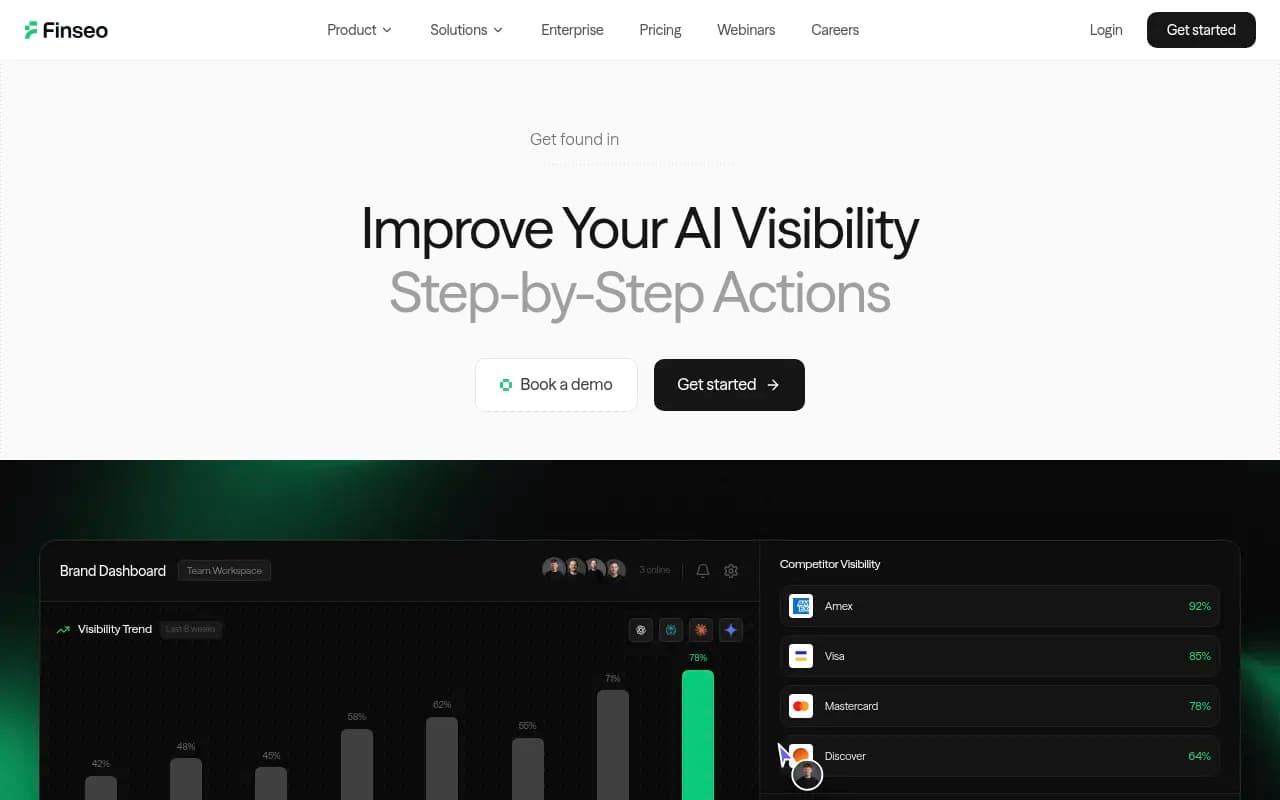
| Finseo.ai | AI visibility for financial brands | Sector-specific positioning |
| Otterly.AI | Prompt monitoring | Monitoring only |
| Profound | Enterprise visibility tracking | Higher price tier |
Otterly.AI

Profound

I have not compared pricing or features across these for the Dutch market, so check current plans before committing. For a wider list, the GEO software directory covers more options.
Governance that keeps compliance comfortable
A few habits keep this from turning into a monthly argument:
- Log every AI answer that gets your facts wrong, save the wording, and inspect the cited sources. An outdated page or ambiguous description is often the cause, and fixing it is a compliance win, not just a marketing one.
- Keep an owner for each approved fact (rates, fees, eligibility) and a review date, so pages do not go stale.
- Never publish performance figures, testimonials or comparisons on retrievable pages without sign-off.
- Document what your AI-assisted drafting does and who approves it. If you use a content agent, keep human approval in the loop.
- Check with legal on how AI-generated or AI-assisted content interacts with your obligations. I have not researched that area.
If you want outside help building the programme, an agency like 1001 SEO Media works on GEO, technical SEO and digital PR together, which fits the mix of on-site and third-party work described above.
A realistic starting point
Do not begin with a content blitz. Begin with the baseline, a crawl access check and one product line. Get ten approved answer blocks, publish clean Dutch and English product pages, and see which engines respond. After 90 days you will know whether your gap is coverage, prominence, crawlability or reputation, and you will have a compliance process that already works when you scale it.