Key takeaways
- AI Overviews now appear on roughly 48% of tracked Google queries, up 58% year-over-year, but organic CTR for queries with an AIO present has dropped as much as 61% (from 1.76% to 0.61%)
- SERP position #1 still earns a 33.07% AI Overview citation probability, versus 13.04% at position #10 — so traditional ranking still matters for getting cited
- Brands cited in AI Overviews earn 35% higher organic CTR and 91% higher paid CTR compared to uncited brands on the same queries, but citation slots perform at roughly position 6 click levels
- The top 3 traditional blue links still outperform the strongest AI Overview citation slot for driving raw traffic volume
- The winning strategy in 2026 isn't choosing between AIO citations and #1 rankings — it's pursuing both, with different content for different query types
The question sounds simple: would you rather rank #1 in traditional organic results, or get cited in Google's AI Overview? In 2026, it's one of the most practically important questions in SEO. And the honest answer is: it depends on what you're trying to accomplish, what query type you're targeting, and whether you can realistically achieve both.
Let's dig into what the data actually says.
What's happening to organic CTR in 2026
The headline number that's been circulating is striking. A large 2026 study from Seer Interactive, analyzing 53 brands, 5.47 million tracked queries, and 2.43 billion organic impressions, found that organic CTR for queries with AI Overviews present dropped 61% — from 1.76% to 0.61%.
That's not a rounding error. That's a structural shift in how the search results page works.
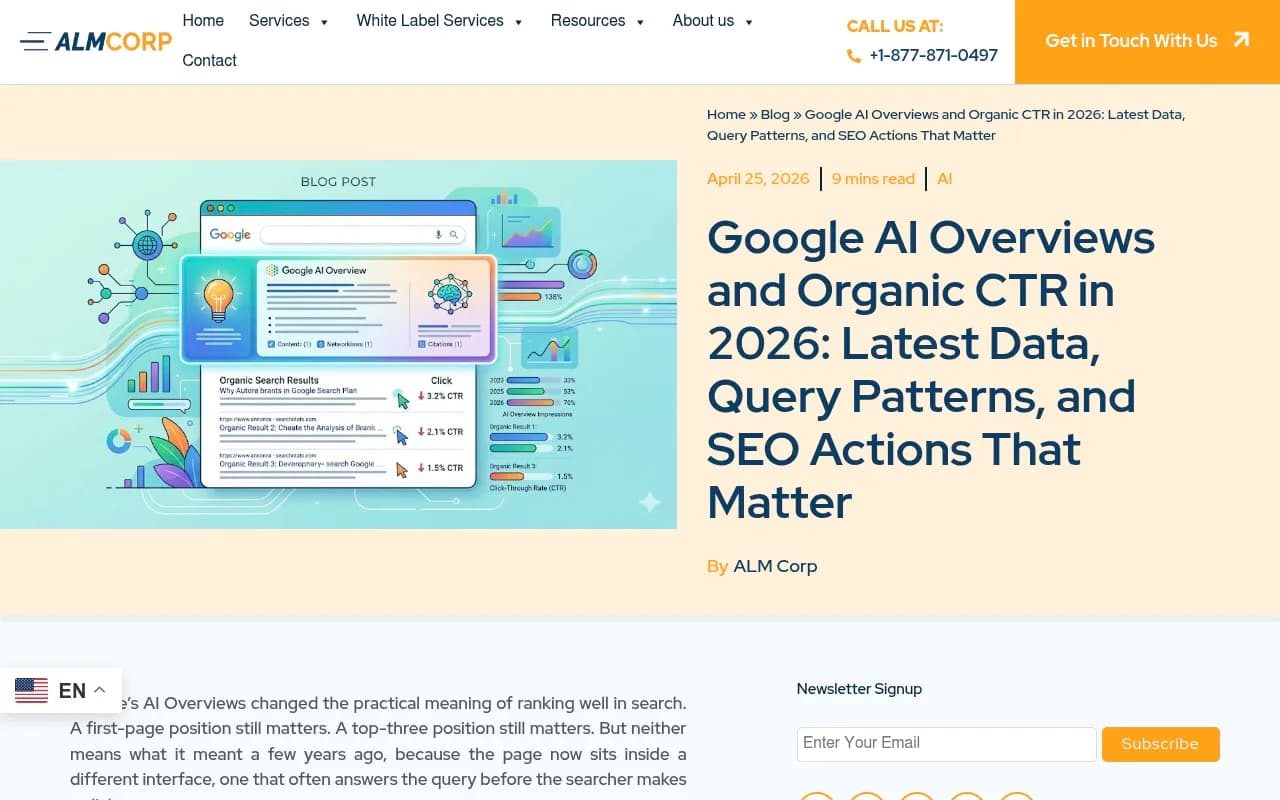
AI Overviews now appear on roughly 48% of tracked queries, up 58% year-over-year according to BrightEdge data from February 2026. The coverage is still accelerating. And when an AI Overview appears, it sits above the traditional blue links, answers the query in paragraph form, and gives many users exactly what they came for without requiring a click.
But here's where it gets more nuanced. The CTR decline isn't uniform across all query types. Informational queries — "how does X work," "what is Y," "explain Z" — are the hardest hit. Transactional and commercial queries, where users are closer to making a purchase decision, show more resilience. The AI Overview tends to summarize information rather than complete a transaction, so users still click through when they need to buy something, compare options, or take an action.
The citation probability math
Here's something that often gets lost in the "AI Overviews are killing SEO" narrative: your traditional SERP position still determines your probability of being cited in the AI Overview itself.
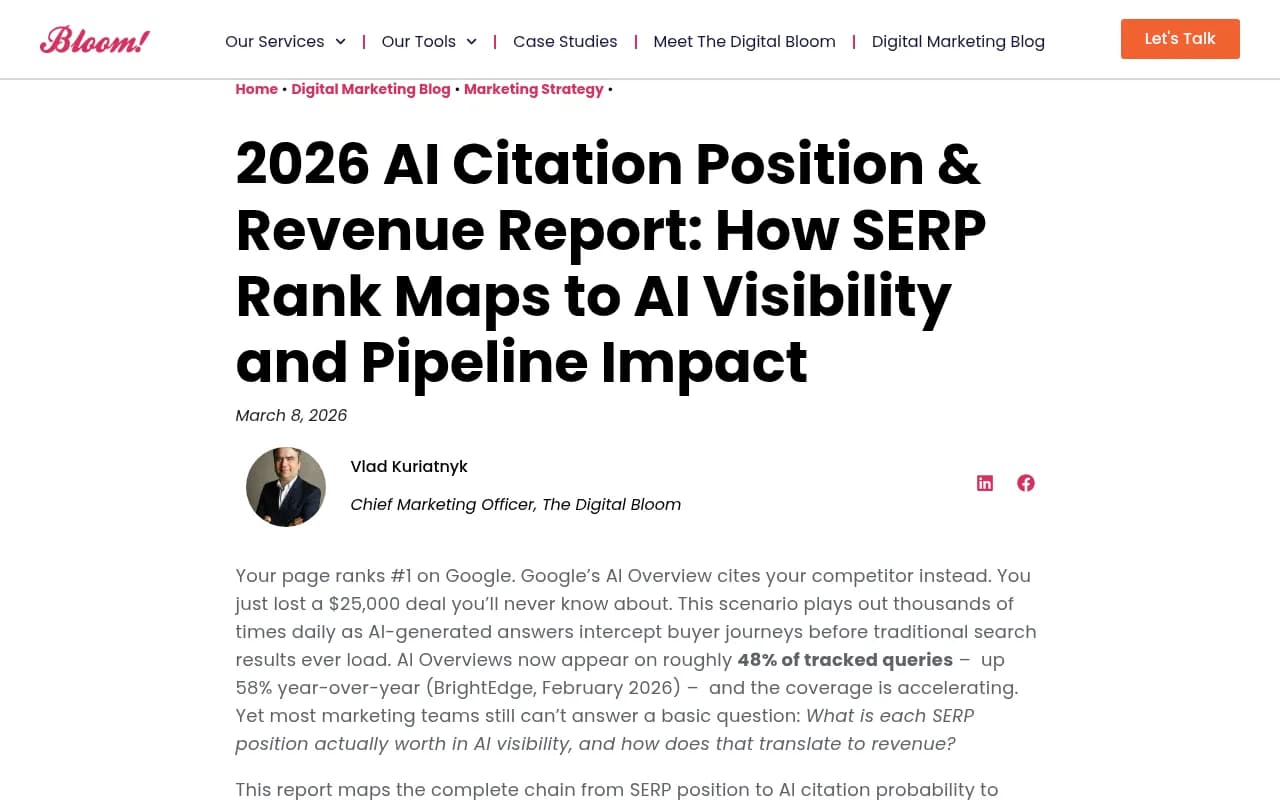
According to GetPassionFruit 2025 data cited in The Digital Bloom's 2026 AI Citation Position & Revenue Report:
- Position #1: 33.07% citation probability
- Position #3: roughly 25%
- Position #5: roughly 18%
- Position #10: 13.04%
That's a 60% decline in citation probability from position 1 to position 10. So if you want to appear in the AI Overview, ranking well in traditional results is still the primary lever. The two aren't separate games — they're deeply connected.
So which actually drives more traffic?
The Digital Bloom's 2026 report makes a claim that cuts against the prevailing panic: "The top 3 traditional blue links still outperform the strongest AI Overview citation slot for driving actual traffic."
This is important. Being cited in an AI Overview is not the same as ranking #1. Citation slots in AI Overviews perform at roughly position 6 click levels in terms of raw CTR. That's meaningful visibility — but it's not the traffic volume you'd get from a genuine #1 organic ranking on a query without an AI Overview present.
The nuance is in what kind of traffic you get. Brands cited in AI Overviews earn 35% higher organic CTR and 91% higher paid CTR compared to uncited brands on the same queries (Seer Interactive, November 2025). The visitors who do click through after seeing an AI Overview citation are more qualified — they've already read a summary and still chose to click. Ahrefs data shows that 0.5% of traffic drove 12.1% of signups for one tracked brand, suggesting AI-referred visitors convert at dramatically higher rates.
So the comparison isn't just about volume. It's about:
| Metric | Traditional #1 ranking (no AIO) | AI Overview citation |
|---|---|---|
| Raw CTR | High (typically 15-30% for #1) | Lower (roughly position 6 equivalent) |
| Visitor quality / intent | Mixed | Higher — pre-qualified by the summary |
| Conversion rate | Baseline | Up to 23x higher per Ahrefs data |
| Visibility to non-clickers | Limited | High — brand seen even without click |
| Dependency on query type | Works across all intents | Strongest on informational queries |
| Citation probability | N/A | 33% if you're already at #1 |
The honest summary: a #1 ranking on a query without an AI Overview will drive more raw clicks than an AIO citation. But if an AI Overview is present anyway (which it is on nearly half of all tracked queries), being cited is far better than not being cited — and your #1 ranking is still the most reliable path to getting cited.
The concentration problem
One data point that deserves more attention: nearly 30% of all Google AI Overview mentions go to the top 50 domains on the search engine, and 43% of AI Overview citations point back to Google's own properties.
That's a significant concentration effect. If you're not already in the top tier of domain authority for your niche, earning AI Overview citations is harder than it sounds. The AI Overview isn't a great equalizer — it tends to amplify existing authority signals.
This is part of why the "just optimize for AI Overviews" advice can be misleading for smaller brands. The path to citation still runs through traditional authority-building: earning backlinks, publishing original research, building topical depth, and maintaining technical health.
Which query types should you prioritize?
Not all queries behave the same way. Here's a practical breakdown:
Informational queries ("what is," "how to," "explain"): AI Overviews appear most frequently here. CTR to traditional results drops most sharply. Strategy: optimize for citation inclusion, not just ranking. Structure content to directly answer the question, use clear headings, and include original data or perspective that AI models can cite.
Commercial investigation queries ("best X for Y," "X vs Y," "X alternatives"): Mixed picture. AI Overviews appear but users often still click through to compare options in detail. Both citation and traditional ranking matter. This is where being cited AND ranking in the top 3 blue links gives you a real advantage.
Transactional queries ("buy X," "X price," "X near me"): AI Overviews are less dominant here. Traditional ranking and Google Shopping placements still drive most of the traffic. Focus on traditional SEO signals, structured data, and conversion optimization.
Navigational queries: Users know where they're going. AI Overviews rarely appear. Traditional ranking matters most.
The freshness factor
One finding from Seer Interactive's October 2025 data that most guides skip over: 65% of AI bot hits target content published in the past year, and 89% hit content updated within three years. AI crawlers are strongly biased toward fresh content.
This has practical implications. A page that ranked #1 three years ago and hasn't been touched since is increasingly at risk — not just of losing its traditional ranking, but of being passed over by AI crawlers in favor of fresher sources. Regular content updates aren't just a nice-to-have anymore; they're part of the citation strategy.
What this means for your SEO strategy
The framing of "AI Overview citations vs. traditional #1" is a bit of a false choice. Here's what the data actually suggests you should do:
Keep pursuing traditional rankings. They're still the primary driver of AI citation probability. A #1 ranking gives you a 33% chance of being cited in the AI Overview. Position #10 gives you 13%. The traditional ranking game still matters — it just has a new downstream benefit.
Audit your query portfolio by intent. Identify which of your target queries now have AI Overviews present. For those queries, measure whether you're being cited. If you're ranking #1 but not being cited, your content structure may need work — more direct answers, clearer formatting, original data.
Don't abandon informational content. Yes, informational queries see the biggest CTR drops. But they're also where AI Overview citations are most valuable for brand visibility. A user who sees your brand cited in an AI Overview summary is more likely to recognize you when they later search with transactional intent.
Invest in original research and data. The 65% freshness bias from AI crawlers, combined with the tendency of AI models to cite primary sources, means that original studies, surveys, and proprietary data are disproportionately valuable. Generic content that summarizes what's already out there is the most vulnerable to being replaced by the AI Overview itself.
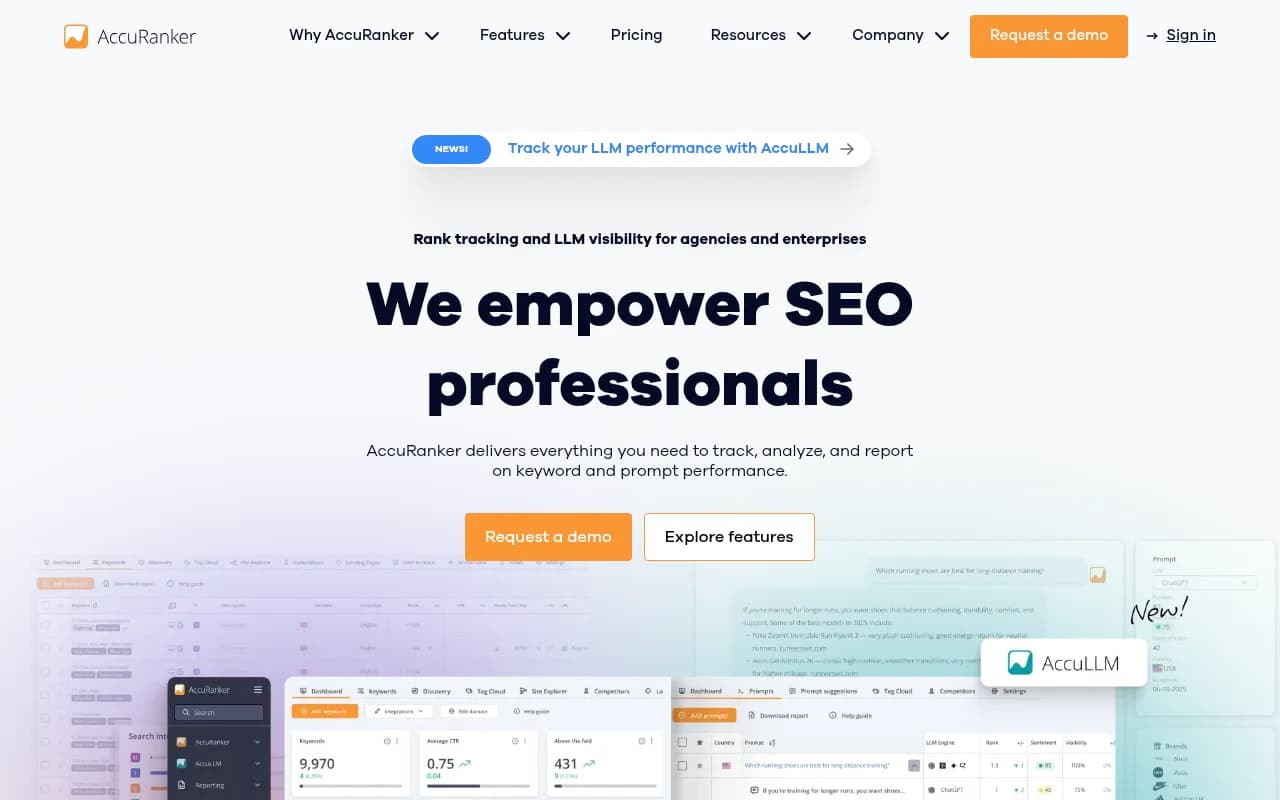
Track both signals. Traditional rank tracking tools like AccuRanker give you position data, but they don't tell you whether you're being cited in AI Overviews or how your brand appears in AI search engines like ChatGPT, Perplexity, and Gemini.
For the AI visibility side, Promptwatch tracks your brand's citation presence across 10 AI models including Google AI Overviews, ChatGPT, and Perplexity — and goes further by showing you which content gaps are costing you citations and helping you create content engineered to get cited.

Tools like Semrush can help you understand traditional ranking performance and identify which of your queries now have AI Overviews present, so you can prioritize accordingly.
The measurement gap
One of the biggest practical problems in 2026 is that most analytics setups weren't built to measure any of this. Google Search Console shows impressions and clicks for traditional results, but AI Overview citation visibility is a separate signal that requires separate tracking.
If you're seeing organic traffic decline but your rankings haven't moved, AI Overviews are the likely culprit — and you need to know whether you're being cited or not. That distinction matters enormously for diagnosis and response.
Tools like Google Search Console remain essential for baseline measurement.
But for a complete picture — one that connects AI visibility to actual traffic and revenue — you need attribution that spans both traditional organic and AI-referred visits. Server log analysis, GSC integration, and AI crawler monitoring are all part of that picture now.
The bottom line
Traditional position #1 still drives more raw traffic than an AI Overview citation, but that gap is narrowing fast as AI Overviews appear on more queries. The more important insight is that the two aren't in competition — your traditional ranking is the primary input to your citation probability.
The brands that will win in 2026 aren't the ones who pivot entirely to "AI SEO" and abandon traditional ranking signals. They're the ones who understand that ranking well is still the foundation, that content structure and freshness determine whether that ranking translates to a citation, and that the visitors who arrive via AI citations convert at dramatically higher rates than average organic traffic.
Measure both. Optimize for both. And stop treating them as separate games.