Key takeaways
- AI Overviews and AI Mode are two separate Google products with different triggers, different citation behaviors, and different traffic implications.
- AI Overviews have cut click-through rates for top organic positions by 58% since 2023, but citations inside the Overview box still drive high-intent traffic.
- AI Mode replaces the entire search results page with a conversational Gemini interface — no blue links, no ads, no organic rankings in the traditional sense.
- Ranking in AI Overviews requires structured, authoritative content that answers specific questions clearly. Ranking in AI Mode requires depth, topical authority, and content that handles complex, multi-part queries.
- These two surfaces need different content strategies, different measurement approaches, and different tools.
If you have been watching your Google Search Console data lately and wondering why impressions are holding steady while clicks keep dropping, you are not imagining things. Something structural has changed. And it is not one feature — it is two, both of which Google has rolled out to over 180 countries, both of which are eating into organic traffic in ways that traditional SEO metrics are only just beginning to capture.
AI Overviews and AI Mode. Two products, two completely different behaviors, two different problems for your brand, and most marketing teams are treating them as the same thing. They are not.
What AI Overviews actually are
AI Overviews have been live since 2024. You have seen them even if you did not know the name: that boxed AI-generated summary sitting above the first organic result, answering your question before you have even looked at a single link.
They were designed for straightforward informational queries — definitions, quick comparisons, factual lookups. Type in something like "best time to post on Instagram" or "what does a performance marketing agency do," and an AI Overview answers it right there, cites three or four sources with small links, and pushes the rest of the results page below the fold.
The traffic impact has been severe. By December 2025, AI Overviews were reducing click-through rates for the top organic position by 58% compared to two years earlier. Not 5%. Not 15%. Fifty-eight percent. A page that once reliably drove 1,000 monthly visitors from a single top ranking now delivers around 400. The ranking has not changed. The visibility has not changed. The clicks have collapsed.
Where AI Overviews still leave room for brands is in the citations. Those small linked sources inside the Overview box are real traffic opportunities. Users who click through from an AI Overview are already pre-informed, already interested, and far closer to a decision than someone casually browsing results. The click is harder to earn, but when it happens, it means something.
One important distinction worth making: AI Overviews are not just "featured snippets 2.0." Featured snippets pull from one source. AI Overviews synthesize multiple sources into a single answer. That changes the game entirely — Google is now rewarding breadth of coverage and topical authority, not just the single best-optimized page for a keyword.
What AI Mode actually is
AI Mode is not an enhancement of the search results page. It replaces it.
Launched in May 2025 in the US and expanded globally by October, AI Mode is accessed through a dedicated tab in Google Search powered by Gemini 2.5. When a user opts into AI Mode, there are no ten blue links. No organic rankings. No ads at the top. Just a fully conversational AI interface that takes a question, runs up to sixteen separate searches simultaneously behind the scenes, synthesizes the results, and responds in plain language with cited sources.
This is what Google built for the complex stuff. Research. Comparisons. Multi-step planning. "What's the best CRM for a 50-person B2B SaaS company that already uses HubSpot for marketing?" is an AI Mode query. "What is a CRM?" is an AI Overviews query. The distinction matters because the ranking signals are completely different.
In AI Mode, Gemini is doing the heavy lifting. It fans out your query into sub-questions, retrieves information from multiple sources, reconciles conflicting information, and builds a structured answer. The sources it cites are not necessarily the highest-domain-authority pages — they are the pages that best answer specific sub-questions within the broader query.
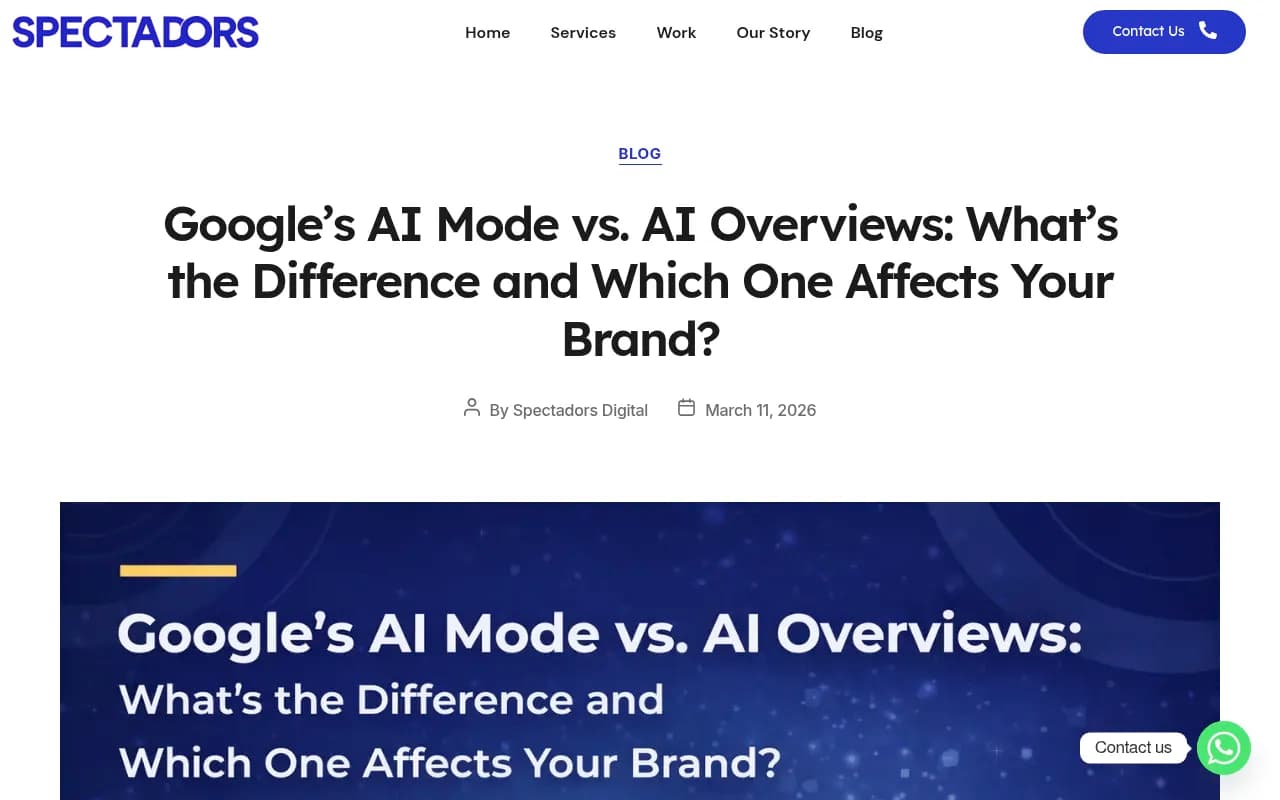
The core differences, side by side
| Dimension | AI Overviews | AI Mode |
|---|---|---|
| Where it appears | Top of standard search results page | Separate "AI Mode" tab in Google Search |
| Query type | Simple informational, definitional | Complex, multi-part, research-oriented |
| Underlying model | Gemini (lightweight) | Gemini 2.5 (full) |
| Number of sources cited | 3-5 typically | Often 10+ across sub-queries |
| Organic results visible? | Yes, below the fold | No — AI response replaces them |
| Ads visible? | Yes | No (as of 2026) |
| Traffic impact | Significant CTR reduction for top positions | Near-zero traditional organic traffic |
| User intent | Quick answer, low commitment | Deep research, high commitment |
| Opt-in required? | No — appears automatically | Yes — user must click "AI Mode" tab |
| Citation click quality | High intent | Very high intent |
The opt-in point is worth pausing on. AI Mode is not forced on users — they have to choose it. That means the audience using AI Mode is self-selected: people who specifically want a conversational, research-grade answer. They are not casual browsers. When your brand gets cited in AI Mode, the user reading that citation is genuinely interested.
Why your current SEO strategy handles neither well
Traditional SEO was built around ranking for keywords and earning clicks. Both AI Overviews and AI Mode break that model in different ways.
For AI Overviews, the problem is that ranking #1 no longer guarantees traffic. You can hold the top position and still lose 58% of your clicks because the AI Overview answers the question before the user scrolls. The only way to win is to get cited inside the Overview itself — which requires a different kind of content optimization than traditional on-page SEO.
For AI Mode, the problem is more fundamental. There are no "positions" to rank for. Gemini decides which sources to pull from based on how well they answer specific sub-questions within a complex query. A page that ranks well for a broad keyword might never appear in AI Mode responses if it does not contain the specific, detailed information Gemini needs to answer one of its sixteen sub-queries.
Most SEO teams are measuring impressions and clicks in Search Console, which captures neither of these surfaces accurately. AI Mode responses do not consistently appear in Search Console data. AI Overview citations are tracked inconsistently. You can be winning in both surfaces and have no idea, or losing badly and think everything is fine.
Ranking in AI Overviews: what actually works
The content that gets cited in AI Overviews tends to share a few characteristics.
First, it answers the question directly and early. AI Overviews pull from content that gets to the point fast. If your article buries the answer in paragraph six after three paragraphs of preamble, it is less likely to be cited than a page that leads with a clear, direct answer.
Second, it covers the topic with enough depth that Google trusts it. This is where domain authority still matters, but it is not the whole story. A newer site with genuinely comprehensive, well-structured content on a specific topic can get cited over a high-authority site with thin coverage.
Third, it uses structured formatting. Headers, bullet points, numbered lists, and clear definitions all make it easier for Google's systems to extract and synthesize information. This is not about gaming the algorithm — it is about writing content that is genuinely easy to parse.
Fourth, it earns external validation. Reviews, mentions, backlinks from relevant sources, and presence in third-party resources all signal to Google that your content is trustworthy enough to cite in a response it is putting its own name on.
Tools like Promptwatch can help you track exactly which of your pages are being cited in AI Overviews and which prompts are triggering those citations — useful for understanding what is working and where the gaps are.

Ranking in AI Mode: a completely different playbook
AI Mode requires depth in a way that AI Overviews do not. Because Gemini is handling complex, multi-part queries and running multiple sub-searches, it needs content that goes beyond surface-level coverage.
A few things that matter specifically for AI Mode visibility:
Topical authority over individual pages. AI Mode favors sources that have demonstrated expertise across a topic area, not just a single well-optimized page. If your site has one strong article about a topic but nothing else, you are less likely to be pulled into AI Mode responses than a site with ten interconnected, well-developed pieces on the same subject.
Specificity and detail. AI Mode queries are complex. "What's the best project management tool for a remote engineering team using Jira?" is not answered by a generic "best project management tools" roundup. The content that gets cited is specific enough to address the actual sub-question Gemini is trying to answer.
Freshness. AI Mode is used for research and planning, which means users expect current information. Content that has not been updated in two years is at a disadvantage, especially in fast-moving categories like software, finance, and technology.
Structured data and entity clarity. Gemini needs to understand what your content is about at a semantic level. Schema markup, clear entity relationships, and consistent naming conventions all help.
Conversational format. Because AI Mode is itself conversational, content written in a Q&A or FAQ format tends to map well to how Gemini constructs its responses. This does not mean writing awkward FAQ sections — it means anticipating the specific questions a user might have and answering them directly within your content.
Measuring visibility across both surfaces
This is where most teams fall down. Standard rank tracking tools were not built for this. Checking your position for a keyword tells you nothing about whether you are being cited in AI Overviews or AI Mode responses.
What you actually need to measure:
- Which prompts and queries trigger AI Overviews in your category
- Which of your pages are being cited in those Overviews
- Which complex queries in your space are being handled by AI Mode
- Whether your brand appears in AI Mode responses for those queries
- How citation frequency changes over time as you publish new content
For traditional rank tracking alongside AI visibility, tools like Semrush and Ahrefs give you a solid baseline.
For AI-specific visibility tracking across both surfaces, you need something built for the new environment. Platforms like Otterly.AI and Profound track brand mentions across AI engines.
Otterly.AI

Profound

Promptwatch goes further — it not only tracks which prompts your brand appears in across Google AI Overviews and AI Mode, but also identifies the specific content gaps causing you to miss citations, and has a built-in content generation tool to help you close those gaps. The answer gap analysis is particularly useful here: it shows you exactly which prompts your competitors are appearing in that you are not.
Content strategy implications
Given the differences between these two surfaces, the practical implication is that you need content designed for different jobs.
For AI Overviews, you want clear, direct, well-structured content that answers specific questions. Think definitional content, comparison guides, and how-to articles with clean formatting and direct answers near the top of the page.
For AI Mode, you want depth. Long-form guides that cover a topic comprehensively, content that addresses the nuanced follow-up questions a researcher would have, and a body of work across your site that signals genuine expertise in your space.
The good news is that these strategies are not in conflict. Content that is both deep and well-structured tends to perform well in both surfaces. The mistake is optimizing only for traditional keyword rankings and ignoring both.
A few tools worth knowing for the content side:

These help with content optimization and topical coverage — useful for making sure your content is comprehensive enough to get pulled into AI Mode responses and structured enough to get cited in AI Overviews.
The technical side: making sure AI can actually read your content
One thing that does not get enough attention: if AI crawlers cannot properly read your content, none of the above matters. JavaScript-heavy pages, slow load times, and crawl errors can all prevent Gemini from indexing your content for use in AI responses.
AI Mode and AI Overviews both rely on Google's ability to crawl and understand your content. Screaming Frog and similar technical SEO tools help you find crawl issues.
For specifically monitoring how AI crawlers interact with your site — which pages they visit, how often, and what errors they encounter — Promptwatch's AI Crawler Logs feature gives you a real-time view that most tools simply do not have.
Putting it together
AI Overviews and AI Mode are not the same problem. They require different content, different measurement, and different optimization approaches.
AI Overviews are about winning citations in a zero-click environment. The traffic you get is smaller in volume but higher in intent. You win by being the clearest, most direct, most trustworthy answer to a specific question.
AI Mode is about being the source Gemini trusts for complex research. The users are fewer but more committed. You win by having genuine depth and topical authority across a subject area, not just a single optimized page.
Most brands are not tracking either surface properly, let alone optimizing for both. That gap is an opportunity — but only if you start measuring what is actually happening in AI search, not just what your traditional rank tracker tells you.