Key takeaways
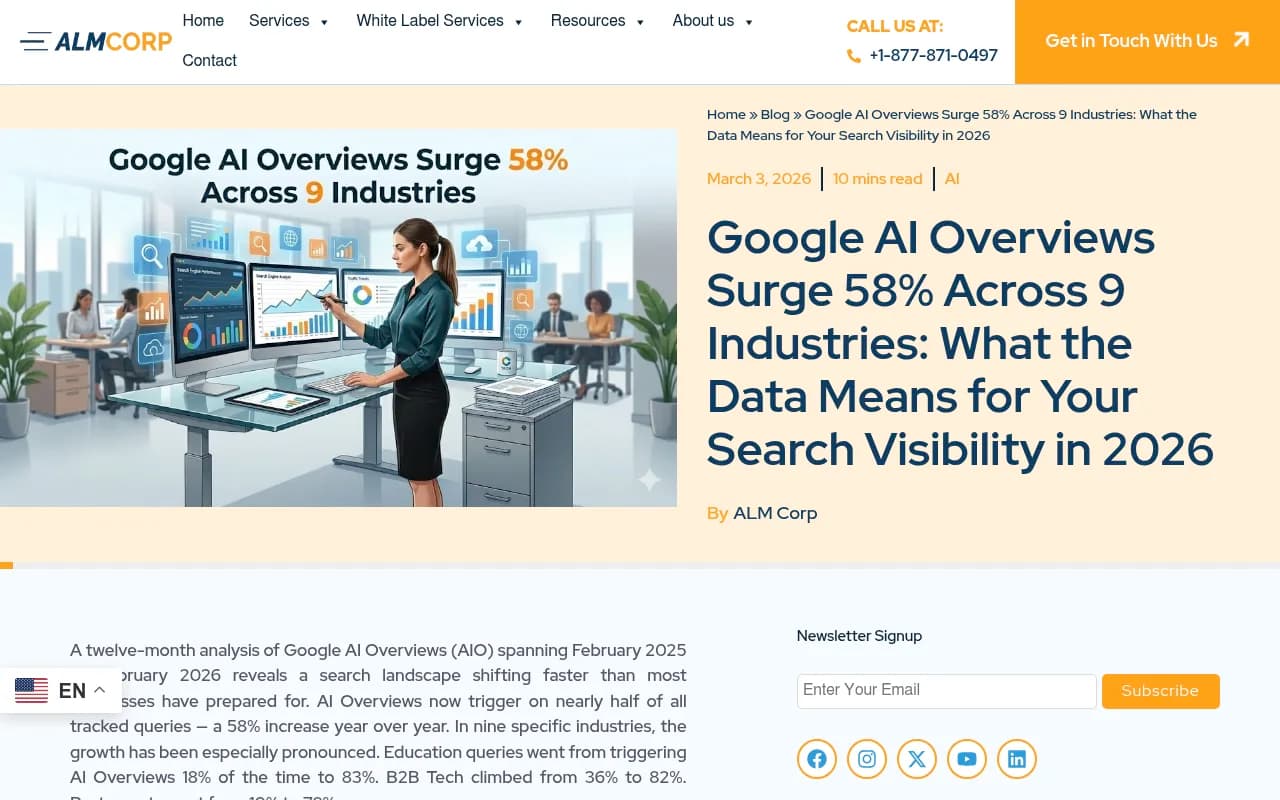
- Google AI Overviews now appear on roughly 48% of all tracked queries, up 58% year-over-year (BrightEdge, February 2026).
- Science (43.6%), Health (43.0%), and Pets & Animals (36.8%) lead in AI Overview share by industry, while Education and B2B Tech saw the most dramatic growth over the past year.
- SERP position still matters: a #1 ranking earns a 33% AI citation probability, but that drops to 13% by position #10.
- AI-referred visitors convert at 23x the rate of traditional organic visitors, but organic CTR on AI Overview queries has dropped 61%.
- Traditional SEO signals (E-E-A-T, freshness, topical authority) remain the foundation — 65% of AI bot hits target content published in the past year.
There's a scenario that plays out constantly right now: your page ranks #1 on Google. A competitor gets cited in the AI Overview instead. You lose a deal you'll never know about.
This isn't hypothetical. AI Overviews now appear on roughly 48% of all tracked queries, up 58% from a year ago according to BrightEdge data covering February 2025 through February 2026. The feature has moved from experiment to default behavior for nearly half of all searches. And the citation logic doesn't perfectly mirror organic rankings.
So which industries are most affected? Who gets cited and why? And what can you actually do about it? Here's what the data shows.
How big the shift actually is
The 58% growth figure is real, but context matters. In February 2025, AI Overviews appeared on roughly 31% of tracked queries. By February 2026, that reached 48%. Growth wasn't linear — it accelerated through mid-2025, crossed 40% in June, and pushed toward 50% by year-end.
The equally important flip side: about 52% of queries still return no AI Overview at all. Traditional blue-link results remain the majority experience. This means most businesses are operating in a split environment where some queries trigger AI summaries and others don't. Understanding which is which has become a real strategic task.
One more number worth sitting with: 43% of Google AI Overview citations point back to Google's own properties. Nearly 30% of all AI Overview mentions go to the top 50 domains on the web. If you're not already a high-authority domain, the deck is somewhat stacked against you — but not impossibly so.
Industry-by-industry breakdown: who's getting cited
The growth hasn't been uniform. Some industries have seen AI Overviews go from rare to near-ubiquitous in twelve months.
The leaders by AI Overview share
According to The Digital Bloom's 2026 AI Citation Position & Revenue Report, which aggregates data from 30+ studies:
- Science: 43.6% AI Overview share
- Health: 43.0%
- Pets & Animals: 36.8%
- People & Society: 35.3%
Health's position makes intuitive sense. Medical queries are exactly the kind of informational, multi-source questions that AI Overviews were designed for. Google has strong incentives to synthesize health information carefully (hence the heavy E-E-A-T requirements), but also strong incentives to answer these queries directly.
Science queries follow a similar pattern: factual, informational, often requiring synthesis across multiple sources. The AI Overview format is genuinely useful here.
Pets & Animals is the mild surprise. But think about the query types: "why is my dog limping," "can cats eat grapes," "how often should I bathe a rabbit." These are high-volume, informational, and often urgent. AI Overviews handle them well.
The fastest-growing industries
BrightEdge's year-over-year data tells a different story — one about velocity rather than absolute share:
| Industry | AI Overview rate (Feb 2025) | AI Overview rate (Feb 2026) | Growth |
|---|---|---|---|
| Education | 18% | 83% | +361% |
| B2B Tech | 36% | 82% | +128% |
| Restaurants | 10% | 78% | +680% |
| Healthcare | ~30% | ~75% | ~+150% |
| Finance | ~25% | ~65% | ~+160% |
| Retail/eCommerce | ~20% | ~55% | ~+175% |
Education's jump from 18% to 83% is the most dramatic. "How does photosynthesis work," "what caused World War I," "explain supply and demand" — these are textbook AI Overview queries. The format is perfectly suited to educational content, and Google has clearly leaned into it.
Restaurants at 78% is counterintuitive given that AI Overviews appear in only about 7% of local searches overall. The explanation is query type: restaurant-related queries that trigger AI Overviews tend to be informational ("best Italian restaurants in [city]," "what is omakase") rather than pure local navigational queries.
B2B Tech at 82% should concern every SaaS marketer. Queries like "what is a CDP," "how does zero-trust security work," and "best CRM for enterprise" now almost always return AI Overviews. If you're not getting cited, a competitor is.
Finance: high volatility, high stakes
Finance deserves special mention. The Digital Bloom report flags Finance as having the highest citation volatility of any industry — meaning AI Overview citations change frequently, and the same query can return different cited sources week to week. This makes Finance both an opportunity and a challenge. You can gain ground quickly, but you can also lose it.
The YMYL (Your Money or Your Life) classification means Google applies stricter E-E-A-T standards to financial content. Author credentials, institutional affiliation, and clear sourcing matter more here than in most other verticals.
The citation gap: ranking #1 doesn't guarantee anything
This is the part that surprises most people. According to GetPassionFruit's 2025 research cited in The Digital Bloom report:
- SERP position #1: 33.07% AI citation probability
- SERP position #5: ~20%
- SERP position #10: 13.04%
So ranking first gives you roughly a one-in-three chance of being cited in the AI Overview. That's significant — and it confirms that traditional SEO still matters — but it's far from guaranteed. Two-thirds of #1 rankings don't get cited.
The implication: you can rank #1 and still be invisible in AI search. The inverse is also true — pages ranking #5 or #6 sometimes get cited over the top result, because the AI is optimizing for the best answer, not the best-ranked page.
What actually drives citation probability beyond SERP position? The research points to several factors:
- Freshness: 65% of AI bot hits target content published in the past year; 89% hit content updated within three years. Stale content gets deprioritized.
- Content structure: Clear headers, direct answers, and structured data all help. AI models need to extract information efficiently.
- E-E-A-T signals: Author credentials, first-hand experience, institutional affiliation. Google says this matters most, and the data backs it up.
- Query length: Searches with eight or more words are 7x more likely to trigger an AI Overview. Long-tail, specific queries are where AI Overviews dominate.
- Topical authority: Covering a topic comprehensively across multiple pages signals expertise to both traditional and AI ranking systems.
The revenue math: why this matters beyond visibility
The Digital Bloom report makes the financial stakes concrete. A few numbers that reframe the whole conversation:
AI-referred visitors convert at 23x the rate of traditional organic visitors. Ahrefs data shows that 0.5% of traffic drove 12.1% of signups in one tracked dataset. The traffic volume is lower, but the intent quality is dramatically higher.
Brands cited in AI Overviews earn 35% higher organic CTR and 91% higher paid CTR compared to uncited brands on the same queries (Seer Interactive, November 2025).
But here's the counterweight: organic CTR on queries with AI Overviews present has dropped 61% — from 1.76% to 0.61% (Seer Interactive, September 2025). The AI Overview absorbs clicks that used to go to organic results.
The net effect: if you're cited, you win big. If you're not cited, you lose traffic you used to have. The middle ground is shrinking.
What actually gets you cited
Write for the query, not the keyword
AI Overviews are disproportionately triggered by long, specific, informational queries. "What is the best CRM for a 50-person B2B SaaS company" is far more likely to trigger an AI Overview than "best CRM." Content that directly and comprehensively answers specific questions performs better than content optimized for short-tail keywords.
Tools like Promptwatch can show you exactly which prompts are triggering AI Overviews in your industry, and which ones your competitors are being cited for but you're not — which is genuinely useful for prioritizing what to write next.

Freshness is non-negotiable
65% of AI bot crawls target content from the past year. If your best content is three years old and hasn't been updated, it's at a structural disadvantage. A regular content refresh cadence — updating statistics, adding new examples, revising outdated recommendations — isn't just good SEO hygiene anymore. It's a citation prerequisite.
Structured content wins
AI models need to extract information quickly. Content with clear H2/H3 structure, direct answers near the top of sections, and specific data points (not vague claims) is easier to cite. FAQ sections, comparison tables, and step-by-step guides all tend to perform well in AI Overview citations.
Build topical authority, not just individual pages
Google's AI systems reward sites that demonstrate comprehensive expertise on a topic. A single well-optimized page is less effective than a cluster of related content that covers a topic from multiple angles. This is especially true in high-E-E-A-T verticals like Health and Finance.
Don't ignore traditional SEO
This is worth saying plainly: 52% of queries still return no AI Overview. Traditional organic rankings still drive the majority of search traffic. The answer isn't to abandon conventional SEO for AI optimization — it's to do both, because the signals overlap significantly. Good E-E-A-T, fresh content, strong technical health, and topical authority help you rank in both systems.
For tracking both traditional rankings and AI visibility in one place, platforms like Semrush cover the traditional side well, while AI-specific tools fill the gap on the AI Overview tracking side.
Tools for tracking AI Overview visibility
If you're trying to understand where you stand in AI Overviews specifically, a few tools are worth knowing about:
For enterprise SEO teams that want deep AI Overview data alongside traditional rank tracking, BrightEdge is the source of much of the industry data cited in this guide.
For AI visibility tracking across multiple LLMs (not just Google), Promptwatch monitors 10 AI models including Google AI Overviews, ChatGPT, Perplexity, and Claude — and goes beyond monitoring to help you identify content gaps and generate content designed to get cited.
For content optimization aimed at AI citation, Surfer SEO and Clearscope both help structure content in ways that align with how AI models extract and cite information.

For tracking AI search visibility specifically, tools like Ahrefs have added AI Overview tracking to their traditional rank tracking features, making them a reasonable starting point if you're already in their ecosystem.
A quick comparison: high-citation vs. low-citation industries
| Industry | AI Overview share | Key query types | Primary citation driver |
|---|---|---|---|
| Science | 43.6% | Factual/explanatory | Authoritative sources, structured content |
| Health | 43.0% | Informational/advisory | E-E-A-T, medical credentials |
| Pets & Animals | 36.8% | How-to, advisory | Freshness, direct answers |
| People & Society | 35.3% | Informational | Breadth of coverage |
| B2B Tech | ~82% trigger rate | Definitional, comparative | Topical authority, freshness |
| Education | ~83% trigger rate | Explanatory | Structured content, authority |
| Finance | High volatility | Advisory, comparative | E-E-A-T, credentials |
| Local/Restaurants | ~7% (local queries) | Navigational | Limited AI Overview presence |
| eCommerce | ~55% trigger rate | Comparative, how-to | Product authority, reviews |
The practical takeaway
The data tells a fairly clear story. AI Overviews are now a permanent part of Google search for nearly half of all queries. Citation rates vary enormously by industry, with Education, B2B Tech, and Health seeing the most aggressive AI Overview penetration. Ranking #1 helps — a lot — but it's not sufficient. Freshness, structure, E-E-A-T, and topical authority all independently influence whether you get cited.
The businesses that will do well here are the ones treating AI citation as a distinct optimization target, not just a byproduct of traditional SEO. That means auditing which queries in your space trigger AI Overviews, understanding which competitors are being cited and why, and systematically building content that answers the specific questions AI models are trying to answer.
The 61% drop in organic CTR on AI Overview queries is real. So is the 23x conversion premium for AI-referred traffic. The math strongly favors being cited over not being cited — and the gap between those two outcomes is only going to widen.