Key takeaways
- Google AI Overviews don't work like traditional rankings -- you need tools that detect citation presence, not just keyword position
- Semrush and Ahrefs offer AI Overview tracking, but both use fixed prompt sets and lack traffic attribution from AI sources
- SE Ranking has solid AI Overview detection at a mid-range price, though its optimization features are limited
- Promptwatch is the only tool in this comparison that closes the loop: it finds gaps, generates content to fill them, and tracks whether that content earns citations
- If you're serious about improving your AI visibility (not just measuring it), the tool you pick matters a lot
Google AI Overviews have been live long enough now that most SEO teams have moved past the "wait and see" phase. The question isn't whether they affect your traffic -- they do. The question is: which tool actually helps you do something about it?
This guide focuses on four tools that come up most often in this conversation: Semrush, SE Ranking, Ahrefs, and Promptwatch. They're not all playing the same game, and the differences matter more than most comparison posts admit.
Why tracking AI Overviews is different from rank tracking
Traditional rank tracking is straightforward: you pick a keyword, the tool checks where your page appears in the SERP, you get a position number. Position 1, position 7, not ranking -- simple.
AI Overviews don't work that way. Google synthesizes a response from multiple sources and cites some of them. Your page might be cited. It might not. The AI Overview might appear for a given query on Monday and disappear by Thursday. The cited sources can change without any change to your underlying rankings.
What you actually need to track:
- Whether an AI Overview appears for a given query at all
- Whether your domain is cited in that overview
- Which specific pages are being cited
- How this changes over time
- Whether your content changes lead to more citations
Most traditional rank trackers were built for position numbers. Retrofitting them for citation tracking is harder than it sounds, and the quality of implementation varies a lot across tools.
The four tools compared
Semrush
Semrush added AI Overview tracking to its Position Tracking module, and it's genuinely useful if you're already a Semrush customer. You can see which of your tracked keywords trigger AI Overviews and whether your domain appears in them.
The main limitations: Semrush uses fixed prompt sets rather than letting you define your own queries. That matters because the prompts customers actually use to find your product often don't match the keyword lists SEO tools are built around. You're tracking visibility for the queries Semrush has decided to monitor, not necessarily the ones driving your business.
There's also no traffic attribution from AI sources. You can see that you're cited, but you can't connect that citation to actual visits or conversions. And there's no content gap analysis -- Semrush won't tell you which queries your competitors are cited for that you're not.
Best for: Teams already on Semrush who want basic AI Overview presence data alongside their traditional SEO metrics.
SE Ranking
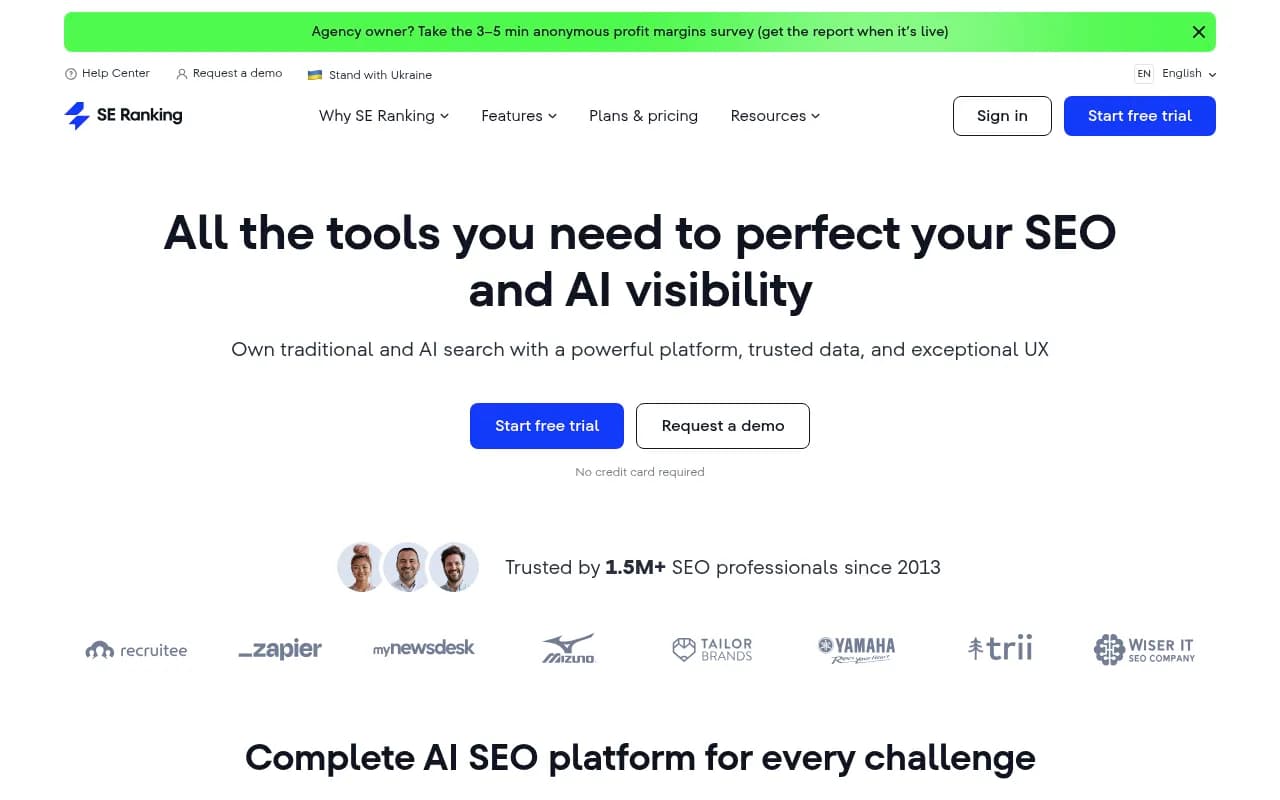
SE Ranking has built out solid AI Overview detection at a price point that's more accessible than Semrush. Its AI Overview tracking shows you which keywords trigger overviews, whether you're cited, and historical trends.
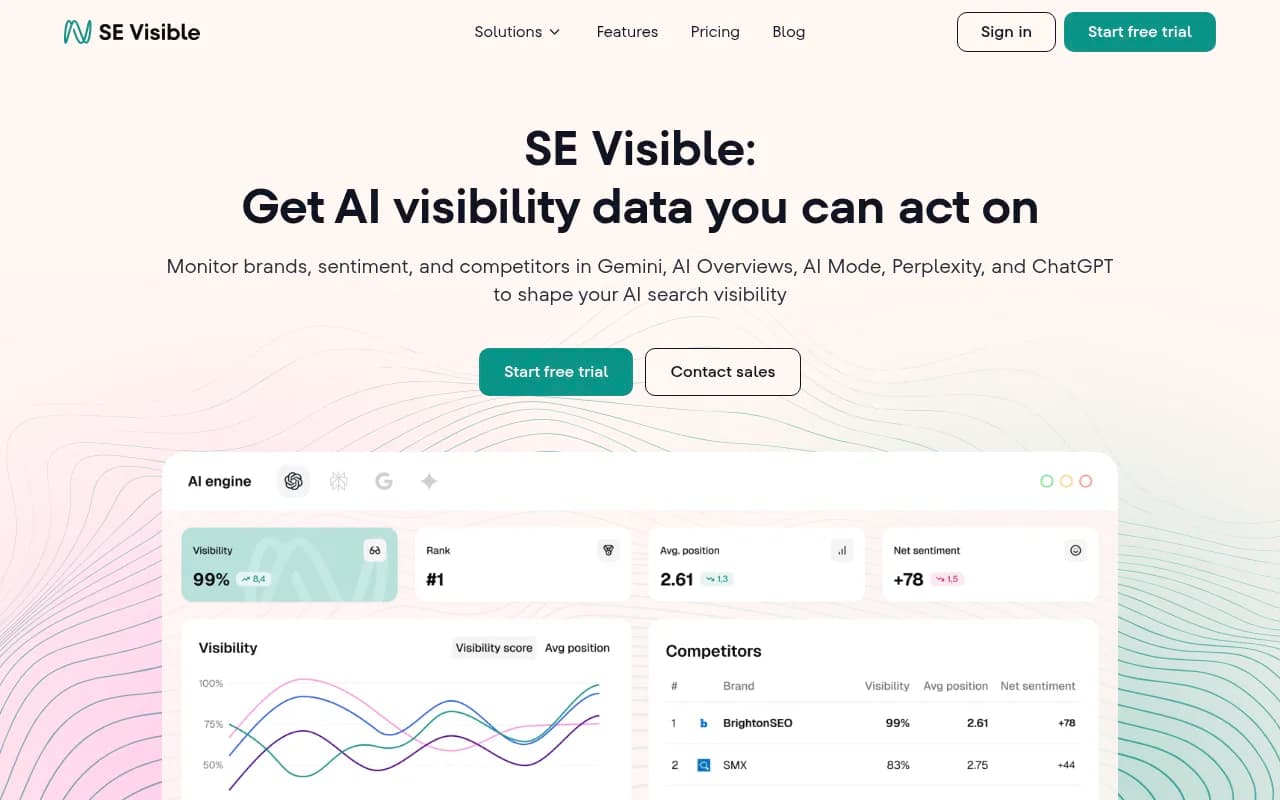
The platform also has an "AI Visibility" section (branded as SE Visible) that tracks brand mentions across some LLMs, though it's more limited than dedicated AI visibility platforms.
Where SE Ranking falls short: like Semrush, it's primarily a monitoring tool. It shows you the data but doesn't help you act on it. There's no content generation, no gap analysis showing competitor citations you're missing, and no crawler log analysis to understand how AI bots are actually reading your site.
Best for: Budget-conscious SEO teams who want AI Overview tracking without paying Semrush prices, and who are comfortable doing their own optimization work.
Ahrefs
Ahrefs launched its Brand Radar feature to track AI search visibility, and it covers Google AI Overviews alongside ChatGPT, Perplexity, and others. The data quality is good -- Ahrefs has always been strong on data.
The problems are similar to Semrush: fixed prompts (you can't customize the query set), and no AI traffic attribution. Ahrefs Brand Radar tells you where you appear but doesn't connect that to revenue. There's also no built-in content optimization workflow for improving your AI citations.
For traditional SEO, Ahrefs remains one of the best tools available. For AI Overview optimization specifically, it's a monitoring layer, not an action layer.
Best for: Teams who rely on Ahrefs for their SEO stack and want AI visibility data in the same interface, accepting that they'll need other tools for optimization.
Promptwatch
Promptwatch takes a different approach. Rather than adding AI tracking as a feature inside a traditional SEO platform, it's built specifically around the AI visibility problem -- and specifically around fixing it, not just measuring it.

The core difference is what happens after you see the data. Promptwatch's Answer Gap Analysis shows you exactly which prompts your competitors are cited for that you're not. Not just "you're missing from AI Overviews" -- but the specific questions and topics where AI models want an answer and can't find one on your site.
From there, the built-in AI writing agent generates content designed to earn citations: articles, listicles, and comparisons grounded in real citation data from 880M+ citations analyzed. This isn't generic content -- it's built around the specific gaps identified in your analysis.
Then you track whether it works. Page-level tracking shows which pages are being cited, how often, and by which AI models. Traffic attribution (via code snippet, Google Search Console integration, or server log analysis) connects citations to actual visits and revenue.
A few other things worth noting: Promptwatch includes AI crawler logs showing when ChatGPT, Claude, Perplexity, and others actually crawl your pages -- useful for diagnosing indexing issues. It also tracks Reddit and YouTube content that influences AI recommendations, which most tools ignore entirely. And it supports custom prompts, so you're tracking the queries that actually matter to your business.
Best for: Marketing and SEO teams who want to improve their AI visibility, not just measure it. Agencies managing multiple clients. Any brand where AI search is becoming a meaningful traffic source.
Feature comparison
| Feature | Semrush | SE Ranking | Ahrefs | Promptwatch |
|---|---|---|---|---|
| Google AI Overview tracking | Yes | Yes | Yes | Yes |
| Custom prompts | No (fixed) | Limited | No (fixed) | Yes |
| Competitor citation gaps | No | No | No | Yes |
| AI content generation | No | No | No | Yes |
| AI crawler logs | No | No | No | Yes |
| Traffic attribution from AI | No | No | No | Yes |
| Reddit/YouTube tracking | No | No | No | Yes |
| ChatGPT Shopping tracking | No | No | No | Yes |
| Multi-LLM tracking | Limited | Limited | Yes | Yes (10 models) |
| Page-level citation tracking | No | No | No | Yes |
| Pricing (entry) | ~$139/mo | ~$65/mo | ~$129/mo | $99/mo |
The pattern is clear: Semrush, SE Ranking, and Ahrefs all stop at monitoring. They show you where you stand. Promptwatch is built around the next step.
What "tracking" actually means in practice
Here's a workflow that illustrates the difference.
Say you're a B2B SaaS company and you want to know why your competitor keeps showing up in AI Overviews for "project management for remote teams" while you don't.
With Semrush, SE Ranking, or Ahrefs: you can confirm that your competitor is cited and you're not. That's it. You're left to figure out why and what to do about it.
With Promptwatch: the Answer Gap Analysis surfaces this specific prompt (and dozens like it) as a gap. You can see what content your competitor has that's earning the citation. The AI writing agent generates a piece specifically targeting that gap, grounded in citation data. You publish it, and page-level tracking shows you when AI models start citing it.
That's not a minor workflow difference. For teams trying to actually move the needle on AI visibility, it's the difference between a dashboard and a system.
Who should use which tool
The honest answer depends on what you're trying to accomplish.
If you're already paying for Semrush or Ahrefs and just want to add AI Overview data to your existing workflow, both tools do the job for basic monitoring. You won't be flying blind. But you will hit a ceiling quickly when you want to do something about what you see.
SE Ranking is worth considering if budget is a constraint and you primarily care about Google AI Overviews rather than the broader AI search landscape. It's a reasonable mid-tier option.
If AI search visibility is a priority -- not just a metric to report, but something you're actively trying to improve -- Promptwatch is the more complete tool. The action loop (find gaps, create content, track results) is what separates it from the rest of the field.
For agencies managing multiple clients, Promptwatch's multi-site plans and Looker Studio integration make it practical at scale. The $249/month Professional plan covers 2 sites with 150 prompts and 15 AI-generated articles per month, which is enough for most active optimization programs.
A note on prompt customization
This deserves more attention than it usually gets. Fixed prompt sets are a real limitation.
When Semrush or Ahrefs tracks your AI visibility, they're checking a set of queries they've predetermined. Those queries may or may not match how your actual customers search. A B2B software company's customers ask very different questions than a consumer brand's customers -- and neither of those maps neatly onto a generic keyword database.
Custom prompts let you track the queries that actually drive your business. That means tracking things like "what's the best [your category] tool for [specific use case]" rather than just broad category terms. The visibility data becomes much more actionable when it's tied to real buyer intent.
The bottom line
Google AI Overviews are here, they affect traffic, and the tools you use to track them matter. Semrush, SE Ranking, and Ahrefs all give you monitoring capabilities -- solid ones, in some cases. But monitoring is just the starting point.
The teams seeing real improvements in AI citation rates are the ones using tools that help them understand what content to create, create it efficiently, and verify that it's working. That's a different category of tool, and right now Promptwatch is the clearest example of it.
If you're evaluating options, the free trial is worth running. The gap analysis alone tends to surface things that are hard to find any other way.