Key takeaways
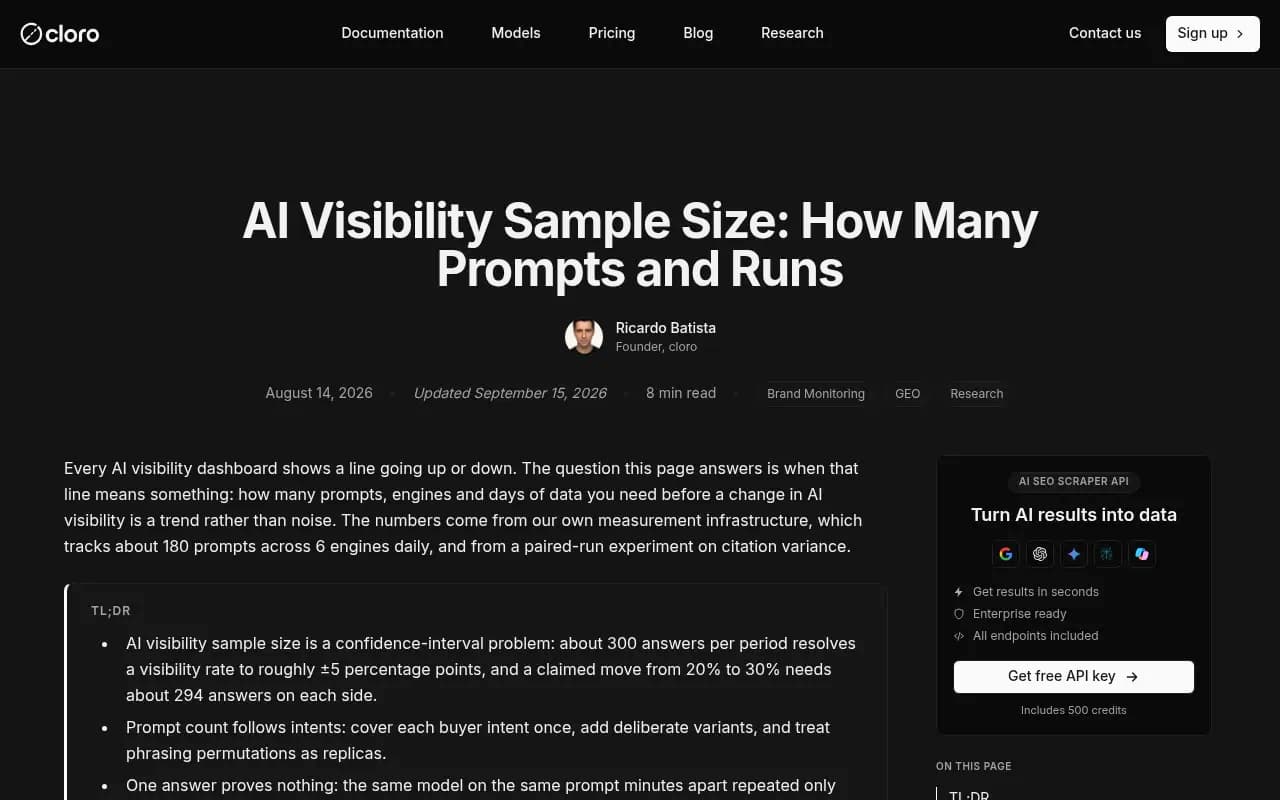
- One prompt checked once a day gives you 7 answers a week. That resolves nothing. A single prompt needs roughly 97 runs for ±10 points and 385 runs for ±5 points (95% confidence, worst-case assumptions).
- Count answers, not prompts. Answers = prompts x models x days. 50 prompts on 6 engines checked daily is 2,100 answers a week.
- Group prompts into topics of 15 to 20 and read topic-level scores weekly. Distinct buyer intents matter more than raw prompt count.
- Most teams land between 20 and a few hundred prompts. Start at 20 to 40, scale to 50 to 350 once you know which intents make money.
- ChatGPT changes its retrieval behaviour in steps, so annotate platform changes before you blame your content for a dip.
Why the question is harder than it looks
Every team that starts tracking ChatGPT visibility asks the same thing: how many prompts is enough? The honest answer is that prompts are the wrong unit. What matters is how many answers you collect per comparison period, and how those answers are grouped.
ChatGPT is probabilistic. Ask the same question twice and you can get a different set of brands. cloro ran the same 20 prompts through the same model twice, minutes apart, and the cited domains overlapped by only 40% on average. Per-prompt overlap ranged from 0.06 to 1.00. So one run of one prompt is a coin flip with extra steps.
There is a second problem on top. Promptwatch's average sources per response data shows ChatGPT cites about 5 sources per web-search answer. Each answer exposes only a handful of citation slots, so your brand is either in a given answer or it isn't. That binary signal is noisy per answer, and the fix is to pool lots of answers.
The sample-size math, with the assumptions spelled out
You will see different numbers in different articles. That is not because someone made an error. It is because they chose different assumptions.
| Source | Assumptions | Single-prompt runs for ±10 pts | For ±5 pts |
|---|---|---|---|
| Gumshoe / cloro | p = 0.5 (worst case), 95% confidence | 97 | 385 |
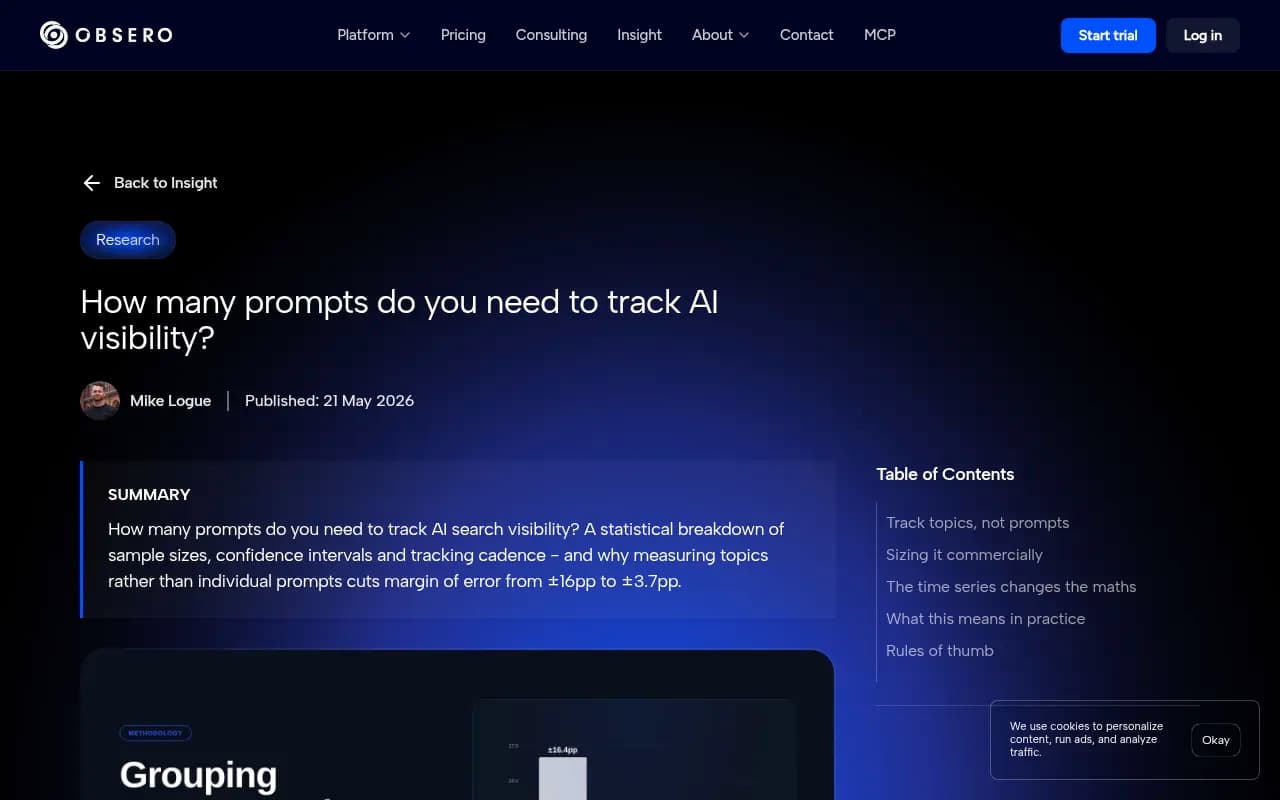
| Obsero | p = 0.3, 90% confidence, topic-level | 57 prompts | 228 prompts |
| Obsero, strict | same | 5,682 prompts for ±1 pt |
The worst-case p of 0.5 maximizes the required sample. That is right for a clinical trial. For a marketing dashboard where you are asking whether a topic is trending up or down, a more realistic visibility rate and 90% confidence are defensible. Just state your assumptions when you report a number, because a colleague with different defaults will get a different answer.
The quantity that matters most is how big a change you want to claim:
- A visibility rate near 25% over 72 answers carries about ±10 points at 95% confidence.
- Over roughly 300 answers it tightens to about ±5.
- To say visibility moved from 20% to 30% with standard statistical power, you need about 294 answers in each period.
- A 2-point move needs several times more data than a 10-point move.
Evertune's repetition study makes the same point from the other side. For one SUV prompt where a brand showed up around 10% of the time, five repetitions gave a margin of error of 27 points, 12 repetitions gave about 12 points, and 100 repetitions gave about 6. Evertune sees tight margins around 100 repetitions and diminishing returns beyond that.
Answers multiply faster than you think
Here is the good news. Sample size is not prompts alone. It is prompts x models x days.
| Setup | Answers per day | Answers per week | Rough weekly read |
|---|---|---|---|
| 1 prompt, 1 model, daily | 1 | 7 | Meaningless |
| 1 prompt, 3 models, daily | 3 | 21 | About ±16 pts (Obsero) |
| 20 prompts, 3 models, daily | 60 | 420 | About ±3.7 pts at p = 0.3, 90% (Obsero) |
| 50 prompts, 6 engines, daily | 300 | 2,100 | Sound week over week (cloro) |
A single day of the 50 x 6 setup is still only 300 answers spread across engines that behave differently. That is why weekly aggregates are the smallest sound unit for a mid-sized prompt set, and why a day-over-day wiggle is noise.
Obsero's worked example: 100 prompts in five topics of 20, across three models, refreshed daily. Each topic produces 420 readings a week and about 1,800 a month, which gives roughly ±3.7 points weekly and ±1.8 points monthly. Same prompts, grouped into a topic, instead of the ±16 points you get from one prompt alone.
Topics, not prompts
I think this is the single most useful reframing in the whole debate. Nobody should care whether "best trainers for a first marathon" mentions them on Tuesday. They should care how visible they are when people ask AI about running trainers.
A topic is a set of 15 to 20 related prompts. You score the topic, not the prompt. This mirrors how AI search works: there is no position one to capture, and visibility comes from breadth across many phrasings. Helen Pollitt's version, quoted by SE Ranking, is to treat the topic keyword as a variable that plugs into any prompt structure.
A warning from Evertune's side of the argument, though. Adding lots of unique prompts while sampling each once makes you a mile wide and an inch deep. You cannot drill into any topic, and sloppy extra prompts muddy what you set out to measure. Pruning the set is part of the job.
Prompt count: what the market and the experts say
The recommendations are not identical, but they overlap more than the arguments suggest.
| Source | Recommendation |
|---|---|
| Omnia | 10 to 20 high-intent prompts as a manual baseline |
| SE Ranking | Start with 20 to 40 prompts, 2 to 3 models, at least 30 days |
| Kevin Indig (via SE Ranking) | About 15 prompts per persona, around 5 consecutive runs once a week |
| Reddit GEO thread | 20 to 30 can be enough if they cover different intent types |
| cloro | 50 to a few hundred prompts, built from distinct intents; they track about 180 |
| Obsero | 15 to 20 per topic as a floor; 100 prompts in 5 topics is decision-grade weekly |
The cloro piece also reports that tracker plan caps cluster at 50, 150 and 350 prompts for one popular tool. I could not verify that against a live pricing page, so check current limits before you build around them.
The disagreement mostly resolves once you separate two things. A starter set of 20 to 40 prompts is fine to get a baseline. A set that supports confident week-over-week claims on several topics needs more answers, which you get from more prompts, more models, or more runs.
Distinct intents beat extra phrasings
Ten ways of asking "best rank tracker" are one intent sampled ten times. That is useful as replication, but it is not coverage. Build your set from intents:
- Category discovery ("best CRM for small agencies")
- Competitor comparison ("X vs Y")
- Problem phrasings ("how do I stop losing leads after a demo")
- How-to questions around your product
- Brand-specific prompts, tracked separately so they do not inflate category scores
SE Ranking suggests splitting a 20 to 40 prompt set into 10 to 20 awareness prompts, 20 to 30 consideration prompts and 5 to 10 brand evaluation prompts. Those ranges overlap, so read it as a rough ratio, not a spreadsheet to fill in. Deliberate phrasing variants of a key intent are fine. Accidental filler is not.
Which ChatGPT surfaces to count
Searchable's tool roundup lists four ChatGPT surfaces worth tracking: model-only answers, ChatGPT Search, ChatGPT Shopping, and fan-out queries. They are different samples. Do not pool them.
Fan-outs matter for sampling because one prompt becomes several searches. Promptwatch's ChatGPT query fanout data says a single prompt can trigger 3 to 8 or more searches, though the daily average was about 2.15 per response in early December and about 1.84 by early March. Searchable measured 1.74 underlying searches per response across 6.9 million responses. Whatever the exact figure, a single check is one sample of a moving process.
And the same rule applies across engines: never pool them into one rate. Each has its own citation behaviour. Promptwatch Data shows Perplexity at almost exactly 10 sources every day, Google AI Overviews at about 10, and Copilot swinging from under 2 to nearly 17 within weeks. Read per-engine rates and let each carry its own interval.
When your trend breaks because ChatGPT changed
Sample size does not protect you from step changes. Promptwatch's data shows several in 2026:
- Average citations per response dropped across GPT-5.3, GPT-5.4 and GPT-5-Mini around the March 4 rollout (ChatGPT citation drop).
- ChatGPT started using the site: operator at scale on August 8, with such queries jumping from about 0.4% to about 17% of fanout queries (site: operator data).
- reddit.com's share of ChatGPT citations fell from about 4% to 0.5% on August 14 (Reddit citations data).
If your visibility moves the same week as one of these, your content may not be the cause. Keep a log of known platform changes and annotate your charts. Weekly aggregates smooth ordinary noise, but they will not erase a structural shift.
A practical setup you can copy
- Pick 3 to 5 topics tied to revenue, not 15 you cannot act on.
- Write 15 to 20 distinct-intent prompts per topic. That is 45 to 100 prompts.
- Run them across the 2 to 3 engines your buyers use, ChatGPT first. Add engines as budget allows, and report each separately.
- Sample daily. Cadence is the cheapest accuracy you can buy.
- Report weekly for direction and monthly for precision. Never report a single day.
- Size the claim to the data. If you want to call a 2-point move and your volume can only resolve 5, the honest line is "no detectable change".
- Run for at least 30 days before drawing conclusions, as SE Ranking recommends.
- Annotate platform changes.
If you are tight on budget, a 50-prompt plan is a sample of your intent space, not the space itself. Spend it on the intents where a citation is worth money and accept that the long tail goes unmeasured for now.
Tools for running this at volume
Doing 100 prompts x 3 models x daily by hand is not realistic. A tracker handles the sampling, and the useful questions are: does it sample at least daily, does it use real interfaces rather than only APIs, and does it let you group prompts into topics?
Promptwatch monitors the real ChatGPT interface plus Google AI Overviews, AI Mode, Gemini, Perplexity and others, runs monitors of prompts daily, and lets you organize by topics, tags and personas. It also adds prompt volumes and difficulty so you can choose which intents deserve slots, and it goes beyond tracking by flagging content gaps and helping you fix them.

Other trackers worth a look, depending on budget and scale:

Otterly.AI

The sampling logic in this guide applies regardless of the tool. For a broader list, the GEO software directory at bestgeosoftware.com and the AI rank tracking directory compare them side by side.
| Tool | Good fit when |
|---|---|
| Promptwatch | You want sampling plus action: content gaps, crawler logs, and AI traffic in one place |
| Peec AI | You want a focused prompt tracker with clear plan tiers |
| Otterly.AI | Small prompt sets and quick baselines |
| Searchable | You want ChatGPT surface coverage plus content tools |
| Rankscale | You need frequent sampling, as often as hourly per Searchable's review |
| Evertune | Enterprise teams that care about heavy repetition per prompt |
Pricing and caps change often, so confirm current limits on each vendor's page before you commit.
Common mistakes
- Reading a single run as a result. A visible answer today may be absent tomorrow.
- Pooling engines into one visibility number.
- Padding the set with phrasings of one intent and calling it coverage.
- Reporting daily changes on a mid-sized set.
- Claiming a 2-point improvement with a ±5 instrument.
- Ignoring platform changes when explaining a trend break.
Bottom line
You do not need thousands of prompts. A well-structured set of 50 to 100 distinct prompts in a handful of topics, run daily across a few engines, produces weekly topic-level data that is solid and monthly data that is tight. If you have fewer, start with 20 to 40, read the trend for 30 days, and expand the intents that earn revenue. Size every claim to the number of answers behind it.