Key takeaways
- AirOps is built around content workflow automation at scale -- ideal for teams running high-volume publishing pipelines with custom AI workflows
- Frase focuses on the research-to-draft pipeline, with strong SERP analysis and content scoring baked in from the start
- For traditional SEO, both tools are competitive; for GEO (Generative Engine Optimization), Frase has a slight edge with its dual SEO/GEO scoring
- Neither tool tracks how your content actually performs inside AI search engines like ChatGPT or Perplexity -- that requires a separate monitoring layer
- The right choice depends heavily on your team size, publishing volume, and how much you care about AI search visibility vs. Google rankings
If you've been shopping for an AI content tool in 2026, you've probably landed on both AirOps and Frase at some point. They show up in the same comparison lists, target similar audiences, and both claim to make SEO content faster and smarter. But they're solving slightly different problems, and picking the wrong one for your workflow is a real cost in time and money.
This guide breaks down exactly how they compare -- not just feature-by-feature, but in terms of what each tool actually does well, where each one falls short, and which type of team should use which.
What AirOps actually does
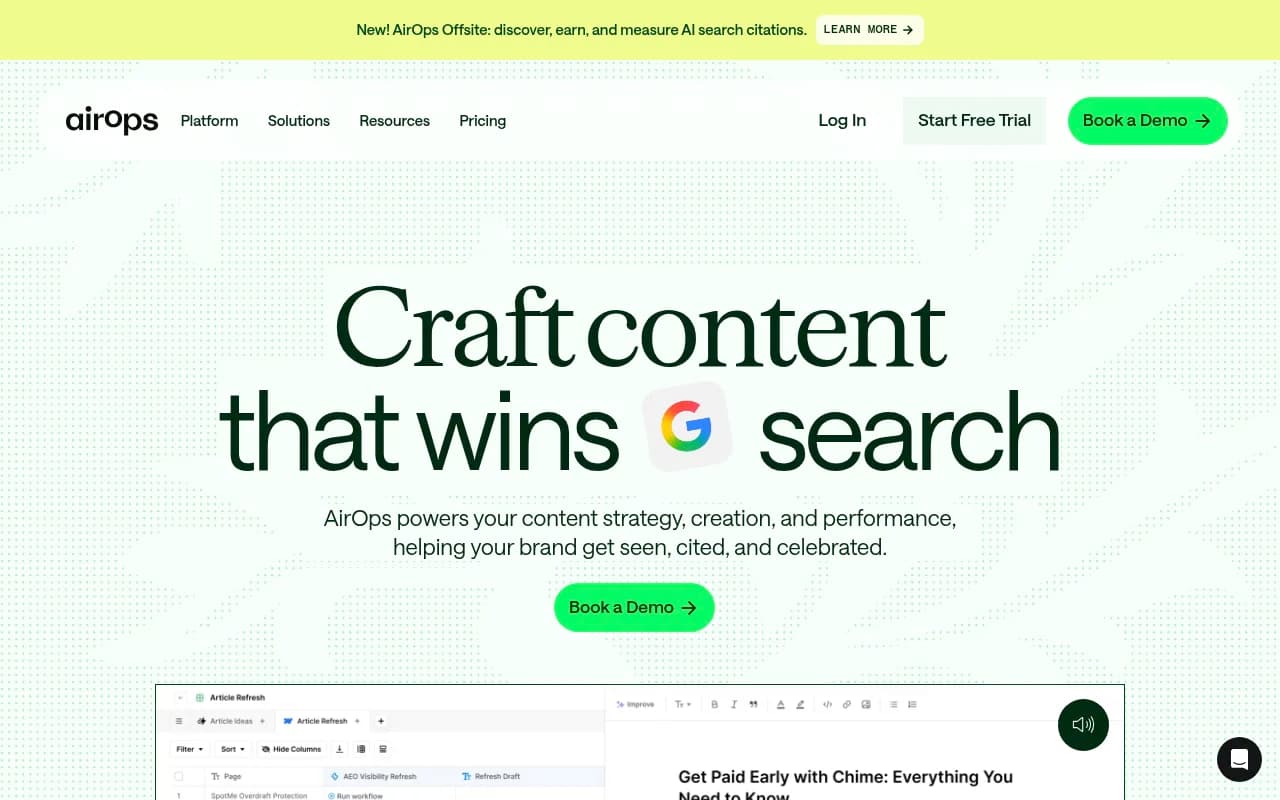
AirOps is best described as a content engineering platform. It's built for teams that need to run AI-powered content workflows at scale -- think keyword clustering, brief generation, bulk content drafting, and connecting those outputs to CMS platforms or internal tools via integrations.
The core value proposition is workflow automation. You can build custom pipelines that chain together research, drafting, optimization, and publishing steps. For a content team producing hundreds of pages a month, that kind of automation is genuinely useful. AirOps also has solid SEO research capabilities -- keyword discovery, SERP analysis, and on-page optimization guidance.
Where it shines:
- Custom AI workflow builder for complex, multi-step content pipelines
- Bulk content operations (generate 50 briefs at once, draft 100 product descriptions, etc.)
- Strong integrations with CMSes and data sources
- Useful for programmatic SEO at scale
Where it's weaker:
- The interface has a steeper learning curve -- it's more of a platform than a tool
- Less opinionated about content quality; you're building the guardrails yourself
- GEO-specific features are limited compared to dedicated optimization tools
What Frase actually does
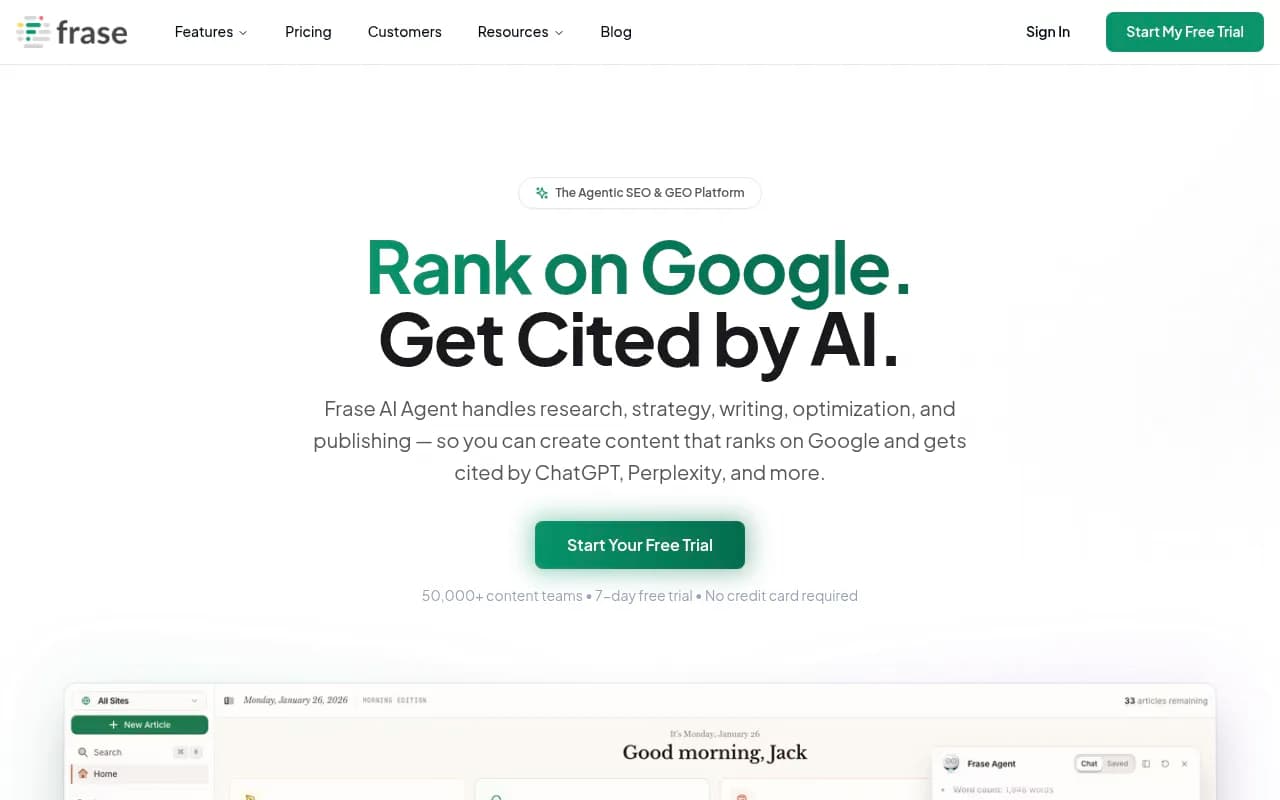
Frase takes a more opinionated approach. It's designed around the research-to-draft workflow: you enter a keyword, Frase pulls the top-ranking pages, analyzes what topics they cover, and gives you a content brief and optimization score. The writing assistant is built on top of that research layer, so you're always writing with competitive context in front of you.
According to Frase's own 2026 benchmark, it covers 6 out of 6 stages in the SEO content pipeline (research, strategy, write, audit, monitor, fix) -- a claim worth scrutinizing, but one that reflects how much Frase has expanded beyond its original brief-builder roots.
The GEO angle is interesting. Frase has added scoring that optimizes content for both traditional Google rankings and AI search engines simultaneously. That's not a trivial addition -- most content tools still treat SEO and GEO as separate concerns.
Where it shines:
- Fast, intuitive research-to-brief workflow
- Content scoring that accounts for both SEO and GEO signals
- Easier onboarding than AirOps -- most writers can use it within an hour
- Good for individual writers and small teams
Where it's weaker:
- Less flexible for custom workflows compared to AirOps
- Bulk/programmatic content generation is more limited
- The "6/6 pipeline stages" claim is generous -- monitoring and fixing are lighter features

Head-to-head comparison
| Feature | AirOps | Frase |
|---|---|---|
| Core focus | Workflow automation at scale | Research-to-draft pipeline |
| Content brief generation | Yes | Yes (stronger SERP integration) |
| AI writing assistant | Yes | Yes |
| SEO content scoring | Yes | Yes |
| GEO/AI search optimization | Limited | Yes (dual SEO+GEO scoring) |
| Bulk content operations | Strong | Limited |
| Custom workflow builder | Yes (core feature) | No |
| CMS integrations | Strong | Moderate |
| Learning curve | Steeper | Gentle |
| Best for | High-volume teams, agencies | Individual writers, small teams |
| AI search monitoring | No | No |
| Pricing | Higher (team/enterprise focus) | More accessible ($14.99/mo starter) |
The table makes the positioning clear: AirOps is a platform for teams that need to engineer content workflows, while Frase is a tool for writers who need better research and optimization in their existing workflow.
SEO capabilities: closer than you'd think
On pure SEO functionality, both tools are genuinely competitive. Both pull SERP data, both generate content briefs, and both give you optimization scores based on competitor analysis. The difference is in the experience.
Frase feels more like a writing environment. The research panel sits alongside your draft, and you can see your content score update in real time as you write. That tight feedback loop is valuable for writers who want to stay in flow.
AirOps feels more like a content operations system. You're setting up pipelines, defining inputs and outputs, and running processes. It's more powerful for teams that have standardized their content production, but it requires more setup investment upfront.
For a solo SEO consultant or a small in-house team, Frase's approach is probably more practical. For a content agency running dozens of client sites, AirOps' workflow automation starts to justify the complexity.
GEO capabilities: Frase has the edge
This is where the comparison gets more interesting in 2026. GEO -- optimizing content to appear in AI-generated answers from ChatGPT, Perplexity, Google AI Overviews, and similar engines -- has become a real priority for SEO teams.
Frase has explicitly built GEO scoring into its optimization layer. When you score a piece of content, you're getting signals about how well it's structured to be cited by AI models, not just how well it covers topics for Google. That's a meaningful differentiator.
AirOps hasn't made the same move. Its optimization guidance is still primarily Google-focused. You can use it to create content that might perform well in AI search, but there's no specific GEO scoring or AI citation analysis built in.
That said, both tools have a fundamental limitation here: they help you create content that could rank in AI search, but neither one tells you whether your content is actually being cited by AI engines. For that, you need a monitoring layer on top -- something like Promptwatch, which tracks citations across ChatGPT, Perplexity, Google AI Overviews, and 7+ other AI models.

Workflow and team fit
Use AirOps if:
- You're running a content operation at scale (50+ pieces/month)
- You need custom AI workflows that connect to your CMS, data sources, or internal tools
- Your team has technical capacity to build and maintain pipelines
- You're doing programmatic SEO with templated content at volume
Use Frase if:
- You're a writer or small team who wants better research without changing your workflow
- You want GEO scoring baked into your content optimization
- You need to get up and running quickly without a setup investment
- Budget is a consideration (Frase's entry pricing is significantly lower)
What neither tool does
Both AirOps and Frase are content creation and optimization tools. Neither one answers the question: "Is my content actually being cited by AI search engines?"
That's a separate problem. You can write a perfectly optimized article using either tool and still have zero visibility in ChatGPT or Perplexity. Understanding why -- which pages are being cited, which competitors are winning, what topics AI models want answers to that your site doesn't cover -- requires a dedicated AI visibility platform.
A few tools worth knowing about in this space:
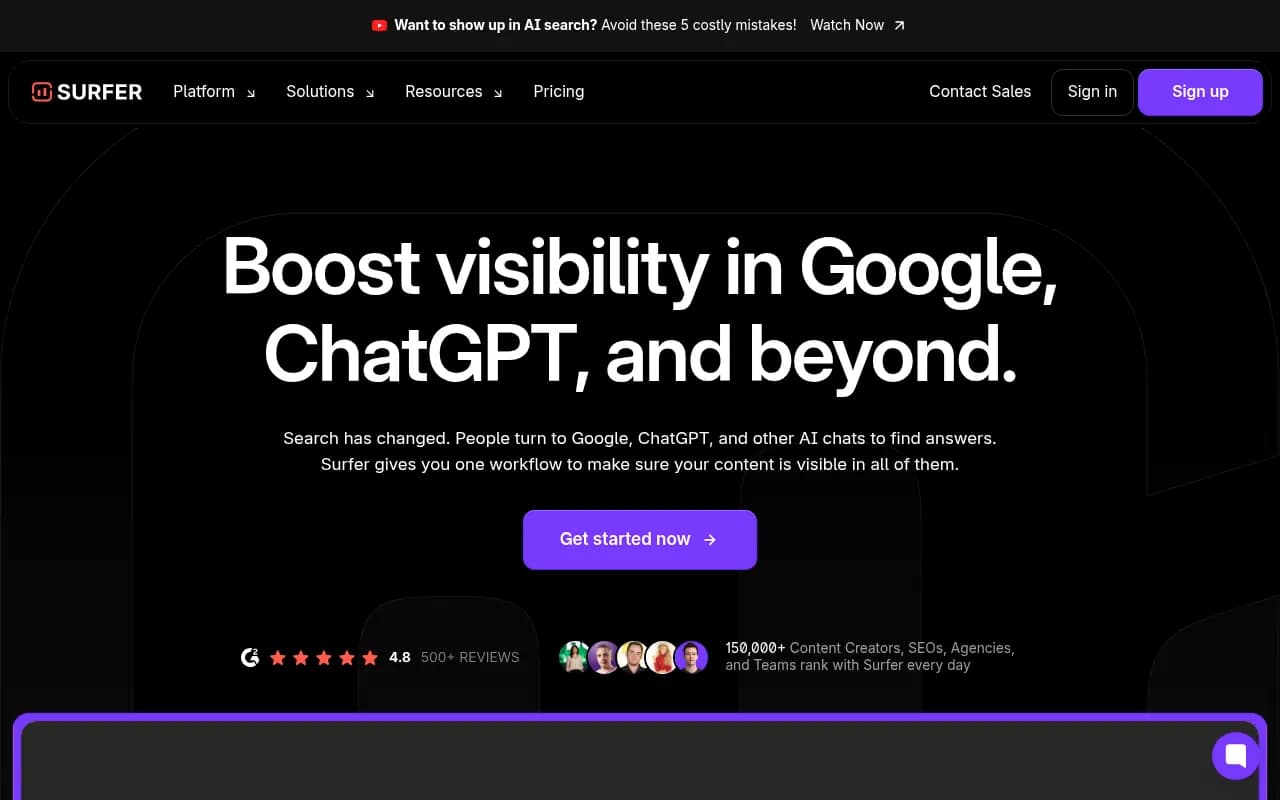
Surfer SEO sits in a similar category to Frase -- content optimization with SERP analysis -- and is worth comparing if you're evaluating the broader market.

Clearscope is the premium option in the content optimization space, with stronger topic modeling but a higher price point.
MarketMuse takes a content strategy angle, helping you map out topical authority rather than just optimizing individual pieces.
For AI search monitoring specifically -- tracking whether your content is being cited in ChatGPT, Perplexity, Google AI Mode, and similar engines -- Promptwatch is the most complete option available, with crawler logs, citation tracking, and content gap analysis that shows exactly which prompts your competitors are winning that you're not.
Pricing reality check
Frase's pricing starts at $14.99/month for solo users, with team plans around $44.99/month. That's accessible for freelancers and small teams.
AirOps doesn't publish transparent pricing at the entry level -- it's more of a "talk to sales" situation for serious team plans, though there are starter options. Expect to pay significantly more than Frase for comparable usage, with the premium justified by workflow automation depth.
If you're evaluating purely on price-to-value for a single writer or small SEO team, Frase wins. If you're evaluating on the basis of what it would cost to replace a manual content operations workflow, AirOps' pricing starts to look reasonable.
The honest verdict
Frase is the better choice for most SEO teams in 2026. The GEO scoring, the intuitive research workflow, and the accessible pricing make it the practical option for teams that want to write better content faster without building a content engineering system.
AirOps is the better choice if you're running content at real scale and need workflow automation that goes beyond what any single writing tool can offer. It's a platform investment, not a writing tool purchase.
Neither replaces the need to actually monitor your AI search visibility. Creating content is step one. Knowing whether AI engines are citing it -- and fixing the gaps when they're not -- is a different discipline that requires different tools.
For teams serious about GEO, the right stack in 2026 looks something like: Frase or AirOps for content creation, plus a dedicated AI visibility platform to track what's actually working in AI search.