Key takeaways
- ChatGPT does not search for the user's prompt. It generates its own sub-queries (fan-outs), and a page only needs to match one of them to get retrieved.
- Fan-out behavior changes fast. Promptwatch Data measured 2.15 fan-outs per response in early December 2025, about 1.84 by early March 2026, and exactly 1.0 when they returned in April. Date-stamp everything you learn.
- On August 8, 2026, ChatGPT started using the site: operator at scale, jumping from 0.37% to 16.8% of fan-outs in one day. Keyword maps built before that date are stale.
- The workflow: collect fan-outs for your target prompts, cluster them, map each cluster to a page, score the gaps, then re-check after every ChatGPT change.
- Fan-out analysis predicts retrieval, not citation. Being fetched is necessary but not sufficient, so you still have to verify what actually gets cited.
What a fan-out query actually is
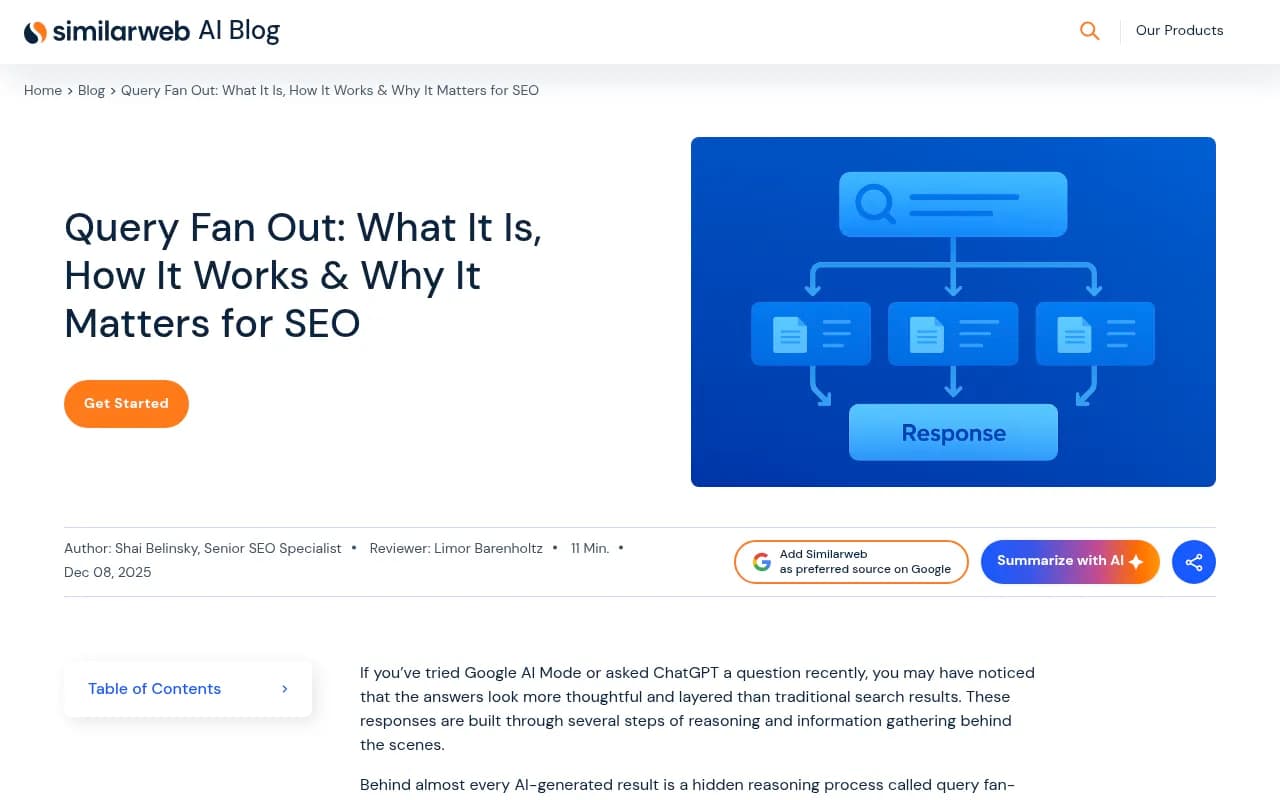
When you ask ChatGPT something that needs fresh information, it does not simply send your question to a search engine. It rewrites the question into one or more shorter searches, runs them, reads what comes back, and writes an answer from that. Those hidden searches are fan-out queries.
Similarweb's explainer describes the mechanism as AI rewriting a user's question into multiple sub-queries, running many searches in parallel, and merging the results into one answer. The practical consequence is the part that matters for SEO: you are no longer competing for one query. You are competing across every sub-query the system generates.
One distinction from Lily Ray's write-up is worth keeping in mind. Pages that are considered, pages that are retrieved, and pages that are cited are three different groups, and each is smaller than the last. More pages get looked at than ever get linked in the visible answer. Fan-out analysis helps you with the first two stages. It cannot promise the third.
Why fan-outs predict citations (and where they stop)
The logic is simple. If ChatGPT never searches for the thing your page is about, your page never enters the candidate pool. If it does search for it, you have a shot. So the fan-out list is a rough preview of the pool of pages that could be cited for a given prompt.
Promptwatch's data report makes the key point plainly: your content only needs to match one of the generated queries, not the user's original prompt. That is liberating for small sites. You do not need to outrank everyone for "best CRM." You might only need to be the best result for "CRM for small agencies pricing."
There are limits, though.
- Ranking helps but does not decide it. AirOps found, as cited by Cyrus Shepard at Zyppy, that ChatGPT cited the page ranking #1 in Google 43.2% of the time. That is high, and it also means more than half the time the cited page was not #1.
- Fan-outs are unstable. See the numbers in the next section.
- Retrieval is not citation. A page can be fetched and still not appear in the answer.
So treat fan-out analysis as a way to find the gaps where you cannot possibly be cited, not as a crystal ball for guaranteed wins.
What the numbers say (and why you should distrust old ones)
Promptwatch has been measuring ChatGPT fan-outs daily. The headline is volatility.
| Period | Avg fan-outs per response | Avg query length | Source |
|---|---|---|---|
| Early Dec 2025 | 2.15 | ~117 characters | Promptwatch Data |
| Feb to early Mar 2026 | ~1.84 | high 80s characters | same report |
| April 2026 (after a data gap) | 1.0 | ~53 characters (6 to 8 words) | same report |
| Just before Aug 8, 2026 | ~1.08 | n/a | Promptwatch Data |
| After Aug 8, 2026 | ~1.83 | n/a | same report |
A few things stand out. The "3-8+ searches per prompt" figure you see in plenty of articles is a ceiling, not an average. Measured averages are much lower. And length dropped sharply, from long conversational strings to short keyword-style searches.
You may have seen Peec AI's claim that ChatGPT fan-outs doubled in length over four months. That runs opposite to Promptwatch's measurements. The datasets cover different periods and use different methods, so both can be internally true, but I would weight the first-party daily data more heavily for anything you plan to act on. The takeaway is the same either way: whatever you measured last quarter may not hold today.
The site: operator shift
On August 8, 2026, Promptwatch Data recorded the share of fan-outs containing site: jump from 0.37% to 16.8%. That is roughly 1 in 6 fan-outs, versus about 1 in 280 before, and it happened in a single day. Average fan-outs per response rose from about 1.08 to 1.83 and stayed there.
That pattern suggests site: searches were layered on top of generic searches rather than replacing them. If they had replaced them, the average would have stayed flat. The one-day timing also points to a change on OpenAI's side, not anything publishers did.
Lily Ray's read, published August 17, 2026, is that scoping fan-outs with site: and words like "official" is a way to curate trusted sources and cut spam. That is her interpretation, not something OpenAI has confirmed. I find it plausible, but treat it as a hypothesis.
What it means in practice: ChatGPT may now run something like site:yourdomain.com pricing against your own site. Your domain has become a retrieval surface. If your key pages are not indexed, or your internal structure is thin, that query returns nothing and you lose the slot.
Step-by-step: predicting citations with fan-outs
Step 1: pick prompts that matter commercially
Start with 20 to 50 prompts your buyers would actually type. Mix three types: organic category questions ("best project management software for agencies"), brand-specific questions, and competitor comparisons. Fan-out behavior differs across them, so do not lump them together.
Pull ideas from Google Search Console queries, People Also Ask, and sales call transcripts. Google Search Console is free and gives you the actual wording people use.
Step 2: collect the fan-outs
There are three ways to do this, from cheapest to most scalable.
- Manual inspection. Run the prompt in ChatGPT with search enabled and read the searches it shows. Slow, but good for building intuition.
- Browser extensions. Promptwatch offers a free GEO Inspector Chrome extension for ChatGPT that shows fan-outs and fetched versus cited sources, and runs 100% locally.
- Platform tracking. Track prompts daily so you see how fan-outs shift over time, not just a single snapshot. This is where most teams end up, because one-off captures go stale.
Capture each prompt several times. Fan-outs vary between runs, so one sample is an anecdote.
Step 3: cluster the sub-queries
Dump everything into a spreadsheet and group by intent. You will usually see recurring patterns:
- Comparison sub-queries ("X vs Y")
- Pricing and cost
- Alternatives
- How-to or setup
- Official source checks (queries with "official" or a site: scope)
- Year or freshness modifiers ("2026")
Count frequency. A sub-query that shows up in 8 of 10 runs matters more than one that appeared once.
Step 4: map clusters to pages
For each cluster, write down the single URL on your site that should win it. Be strict. If the honest answer is "nothing" or "a page that only mentions it in passing," that is a gap.
| Cluster | Example fan-out | Your page | Verdict |
|---|---|---|---|
| Pricing | "acme crm pricing 2026" | /pricing | Covered |
| Comparison | "acme vs rival crm" | none | Gap |
| Alternatives | "rival crm alternatives small agency" | blog post, thin | Weak |
| Official check | "site:acme.com integrations" | /integrations (not indexed) | Broken |
The last row is the new one. Since the site: shift, an unindexed or thin page on your own domain is a direct loss, because the scoped search cannot find it.
Step 5: score and prioritize
Rank gaps by three things: how often the sub-query appears, how commercial the prompt is, and how weak your current page is. Fix high-frequency, high-intent, no-page gaps first. Cheap wins usually come from missing comparison and pricing pages.
Step 6: write for the query, not the prompt
Promptwatch's recommendations from its fan-out report are practical and worth following:
- Cover sub-questions such as X vs Y, pricing, alternatives, and how-tos, since each fan-out is a separate retrieval a page can win.
- Build focused page clusters rather than one mega-page.
- Write headings that look like keyword queries ("Best CRM for small agencies 2026") rather than chatty questions.
- Front-load the entity and category in titles and H2s.
The shorter fan-out strings Promptwatch measured, around 53 characters or six to eight words in April, explain why keyword-style headings tend to match better than long conversational ones. I would still keep the writing human. Matching a query does not mean stuffing it.
Step 7: confirm retrieval, then citation
After publishing, check three things in order.
- Is the page indexed? A site: query can only surface what the search engine has indexed. Bing Webmaster Tools matters here because ChatGPT search leans on Bing-style retrieval.
- Is the page being crawled by AI bots? Server or CDN logs show GPTBot, OAI-SearchBot, and ChatGPT-User hits. Our network's AI crawler traffic report shows what weekly verified bot requests look like from June to September 2026, which gives you a baseline.
- Is the page actually cited? Check the cited source list for your tracked prompts.
If you are fetched but not cited, the problem is usually content: thin answers, buried facts, or a better competing page. If you are not fetched, the problem is access, indexing, or a missing page.

Which content types tend to get cited
Fan-outs tell you what to cover. Content type tells you how. Promptwatch's content type citation data shows product pages as the most cited type in ChatGPT, at 22.4% of citations from Sep 28 to Oct 4, 2026, followed by landing pages and listicles.
Longevity differs too. In the content half-life study, landing pages and docs stayed cited longest among pages ChatGPT cited on July 6, 2026, while news lost half its pages within 36 days. So if a fan-out cluster is evergreen (pricing, comparisons, docs), invest in durable pages. If it is news-driven, expect churn and plan for refreshes.
Breadth matters as well. Promptwatch Data found almost half of ChatGPT responses cite 10 or more unique domains (Sep 28 to Oct 4, 2026). That is a lot of room, which is good news if you are not a household name. Another report found sites with domain rank 46 to 75 earned almost half of ChatGPT citations in August 2026, while DR 91 to 100 sites fell to about 3%.
Tools for the job
You can run this whole process in spreadsheets, and I would recommend doing a small batch by hand first so you understand the data. Past about a few dozen prompts, tooling pays for itself.
| Need | Options | Notes |
|---|---|---|
| Fan-out capture and daily prompt tracking | Promptwatch, Peec AI, Otterly.AI | Differ in depth; check whether they use real ChatGPT UI data |
| AI crawler visibility | Promptwatch, Siteline AI | Log-level data shows what bots actually read |
| Indexing and search data | Google Search Console, Bing Webmaster Tools | Free, essential |
| Technical crawl of your own site | Screaming Frog, Sitebulb | Finds orphaned and thin pages that hurt site: retrieval |
| Content briefs and drafts | Frase, Clearscope, MarketMuse | Useful once you know which gaps to fill |
Promptwatch is the one I would point to first for this specific workflow, since it tracks prompts against the real ChatGPT interface and exposes fan-outs, citations, and IP-verified crawler logs in one place, then feeds gaps into an action list. It also publishes its own fan-out research daily, which is how I got the numbers above.

Other trackers cover parts of this. Peec AI and Otterly.AI are mostly prompt monitors.

Otterly.AI

For the technical side, a crawler helps find thin category pages and orphaned content.
If you want a wider list of options, the GEO software directory at bestgeosoftware.com compares them side by side.
A repeatable cadence
Because fan-out behavior moves, a one-time audit decays quickly. The August 8 change is the proof: anyone who built a keyword map in July was working from outdated assumptions overnight.
A workable rhythm:
- Weekly: check whether average fan-outs per response and query length changed for your tracked prompts.
- Monthly: re-cluster sub-queries and update the page map.
- After any visible ChatGPT model or search change: re-run the full audit.
- Quarterly: prune. Merge thin pages, redirect dead ones, and refresh anything whose citations are decaying.
Watch the broader context too. Promptwatch's data shows average citations per response dropped around the GPT-5.3 rollout on March 4, 2026 (report). Behavior shifts like that change how many slots exist, not just who fills them.
Common mistakes
- Treating the "3-8 searches" claim as typical. Measured averages have been far lower.
- Optimizing for the prompt instead of the sub-queries. The user's words are not what hits the search engine.
- One mega-page for everything. Separate retrievals favor focused pages.
- Ignoring your own site structure. With site: scoping on the rise, broken internal search, thin category pages, and unindexed URLs cost you answers directly.
- Assuming retrieval equals citation. Check the cited list, not just the fetched list.
- Building the plan from a single capture. Sample repeatedly.
Where this leaves you
Fan-outs are the closest thing you have to a view into what ChatGPT is actually looking for, and the view changes every few months. Collect them for your real prompts, cluster them, map each cluster to one URL, and fix the gaps where you have no page or a page the search engine cannot find. Then re-measure, because the August site: shift will not be the last overnight change. If you only do one thing this week, run your ten most valuable prompts, list the sub-queries, and check whether each one has a page on your site that is indexed.